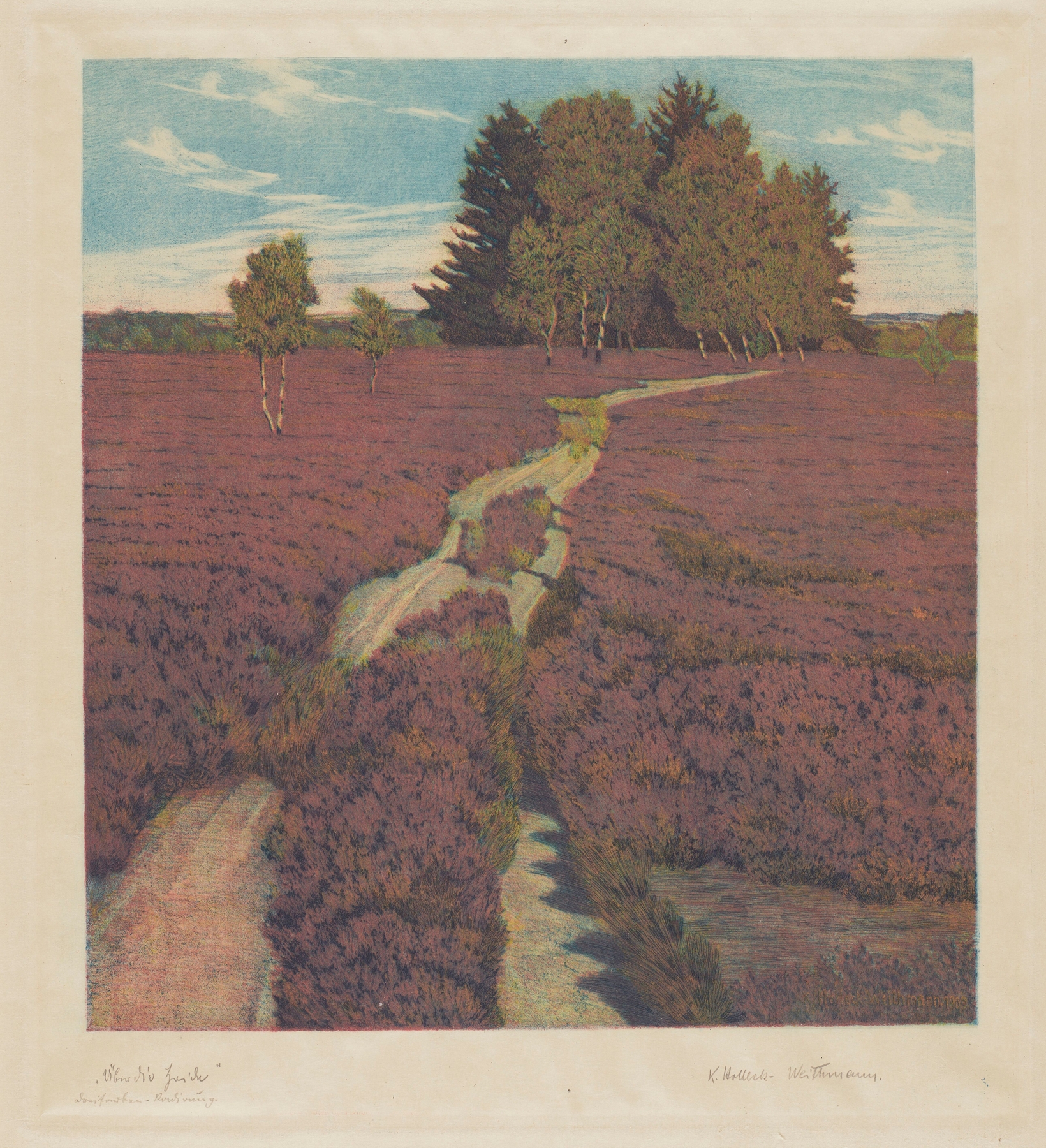
At a Moor — History & Analysis
Can paint confess what words never could? In the silent depths of At a Moor, the essence of loneliness resonates like a distant echo, inviting the viewer into a world where solitude speaks louder than company. Look to the left at the muted hues of the moorland, where soft browns and greens blend seamlessly together. The horizon stretches infinitely, a canvas of soft twilight that bathes the scene in melancholy. Notice how the wispy clouds skim across the sky, their fleeting shapes echoing the transience of connection.
Each stroke reveals the artist's delicate hand, capturing the essence of an expansive yet isolating landscape, inviting a meditative stillness. As you venture deeper into the painting, consider the contrast between the vastness of the moor and the solitary figure standing within it. This figure, almost swallowed by the environment, embodies the tension between existence and oblivion. The muted colors emphasize an air of desolation, yet there’s an underlying beauty that hints at introspection and acceptance.
Here, the isolation isn’t solely a void, but rather a space of self-discovery, reflecting the complexity of human emotion. In 1909, Karl Holleck-Weithman created At a Moor during a time when the art world was captivated by the transition from Impressionism to Modernism. Living in Germany, he was influenced by the shifting movements around him, exploring themes of isolation and the human experience. The socio-political climate of the time, marked by uncertainty, may have further shaped his contemplative approach to portraying the depth of loneliness inherent in the human spirit.