
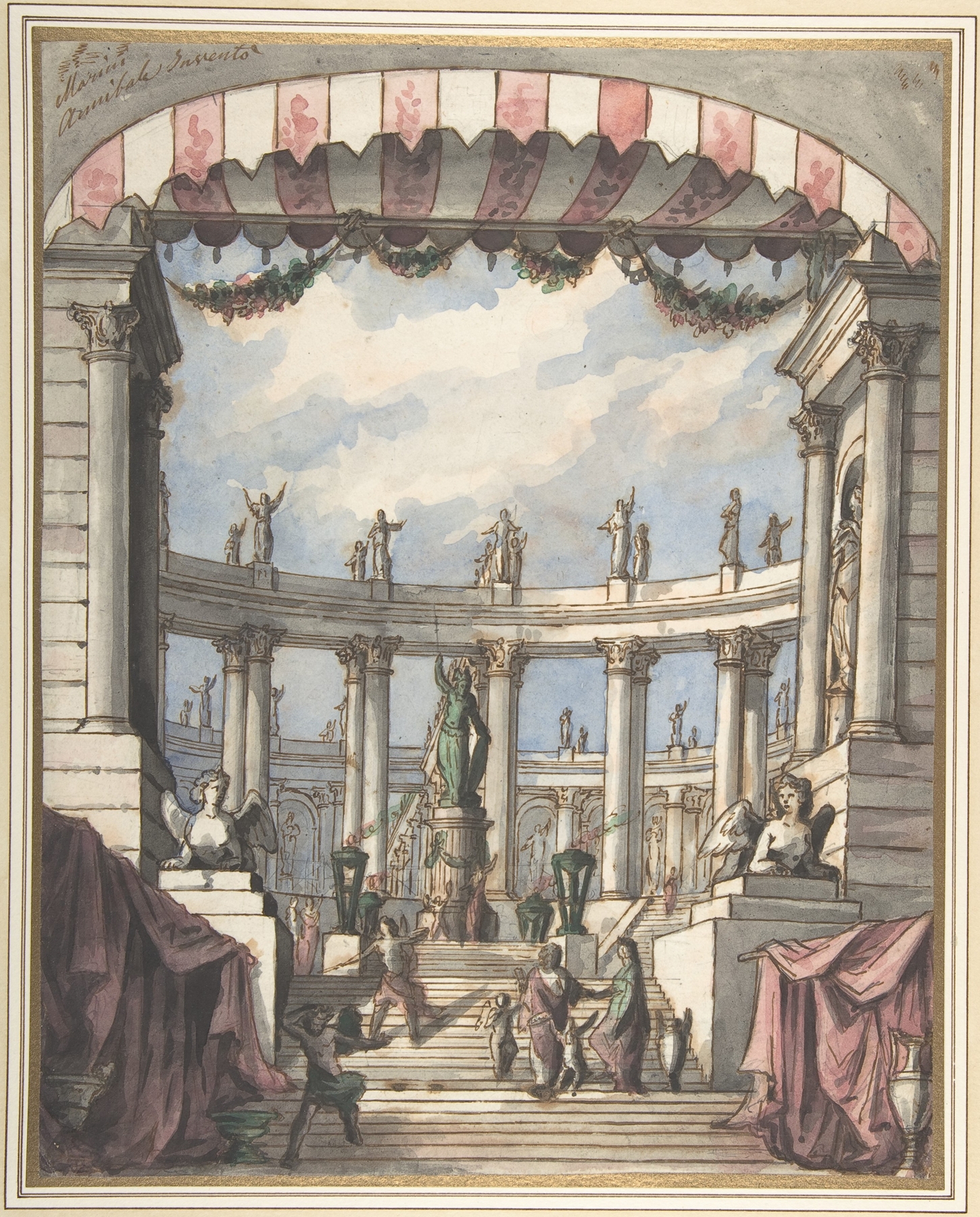
Design for a Stage Set; A Classical Courtyard and Colonnade with a Statue of Minerva — History & Analysis
“Art reveals the soul when the world turns away.” In the tranquility of a classical courtyard, serenity reigns, inviting contemplation in a fast-paced world. Here, the gentle interplay between architecture and nature reminds us of the beauty woven into the fabric of life. Look closely at the stately colonnade that frames the scene; its elegant arches draw your gaze inward toward the statue of Minerva. Notice the meticulous detailing in the columns, where light caresses the stone, creating soft shadows that whisper of time passing.
The delicate balance of warm earth tones against the cool blue sky provides a harmonious backdrop, evoking a sense of peacefulness and an idealized past that feels both timeless and distant. Within this serene setting, consider the contrast between the rigid lines of the architecture and the soft, flowing form of the statue. Minerva, embodying wisdom and strength, stands poised yet unyielding, a guardian of the tranquility around her. The careful arrangement of space invites reflections on the dualities of strength and softness, permanence and transience, suggesting that wisdom often flourishes in quietude.
Created between 1780 and 1790, this work reflects Leonardo Marini’s engagement with neoclassicism, a movement that sought to revive the ideals of ancient Greece and Rome. At that time, he was living in Italy, immersed in a cultural landscape that valued classical beauty and reason amidst the complexities of Enlightenment thought. His vision captures not only the aesthetics of his era but also a philosophical embrace of serenity in an increasingly tumultuous world.