Landscape with Fisherman and Waterfall — History & Analysis
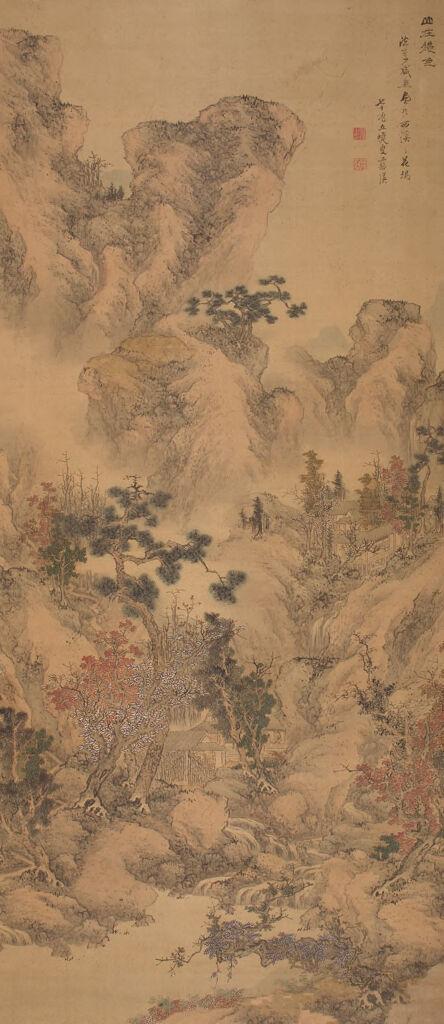
What if beauty was never meant to be finished? In Lan Ying's Landscape with Fisherman and Waterfall, we are invited to witness an eternal dance between man and nature, where divinity whispers through every brushstroke. Look to the left, where the fisherman stands against the mesmerizing cascade of a waterfall, his figure dwarfed by the grandeur of the natural world. The delicate strokes create an illusion of flowing water that seems to leap off the canvas, while the rich greens and blues blend harmoniously, evoking tranquility. Notice how the mist rising from the waterfall softens the edges, lending an ethereal quality that blurs the boundary between reality and reverie.
Beneath the serene surface, a subtle tension emerges. The solitary fisherman, engrossed in his task, symbolizes humanity's humble place within the vastness of the earth. The waterfall, in contrast, embodies the relentless force of nature, a divine reminder of its power and beauty. This juxtaposition echoes the interplay of serenity and chaos, underscoring the fragile relationship between mankind and the sublime.
Each detail, from the intricate leaves to the distant mountains, reflects a moment suspended in time, inviting contemplation of the divine presence within the mundane. In the mid-17th century, the artist worked in a period marked by a flourishing of landscape painting in China, particularly within the literati tradition. Lan Ying was deeply influenced by both the Song and Yuan dynasties' aesthetics, emphasizing spontaneity and the expressive potential of nature. As he painted Landscape with Fisherman and Waterfall, he was navigating his own artistic identity, amidst a society increasingly captivated by the portrayal of the natural world, yet yearning for a deeper spiritual connection.