
Venus and Mars — History & Facts
A woman in a white gown trimmed with gold props herself on a pink cushion at the left, gazing calmly into the distance, while a naked man sprawls asleep beside her, his head thrown back and his mouth open. Four little satyrs, half child and half goat, play with his armor: three tiptoe behind the couple with his long lance, one with the helmet pulled over his face and one blowing a conch shell near his ear, and a fourth sits grinning inside his breastplate. The National Gallery says Botticelli painted the picture about 1485, probably to celebrate a marriage; its long, low shape suggests a spalliera, a panel set into the wall of a bedchamber. The goddess of love is alert while the god of war is lost in sleep, so love has conquered war.
The wasps buzzing around Mars's head might be a pun on the Florentine Vespucci family, a possible clue to the patron. A myrtle bush behind Venus, a traditional symbol of marriage, supports the idea of a wedding commission. The picture was bought in Florence by Alexander Barker not later than 1869, and the National Gallery purchased it at the Barker sale in 1874. It is in the National Gallery in London.
Sources: National Gallery, record NG915 · Wikidata Q2293953 · Wikipedia: Venus and Mars (Botticelli) · Image source (Wikimedia Commons)
More Artworks by Sandro Botticelli

Virgin and Child
Sandro Botticelli

Madonna and Child and the Young St John the Baptist
Sandro Botticelli

Madonna and Child with six angels and Saint John the Baptist as Child
Sandro Botticelli

Adoration of the Magi
Sandro Botticelli

Virgin and Child with the Young Saint John the Baptist
Sandro Botticelli
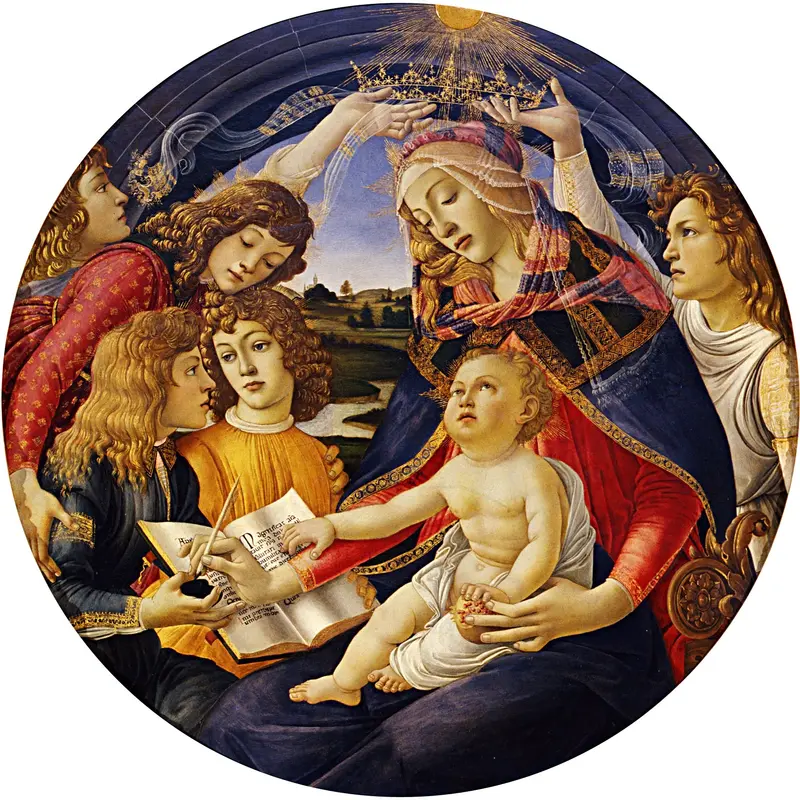
Madonna of the Magnificat
Sandro Botticelli
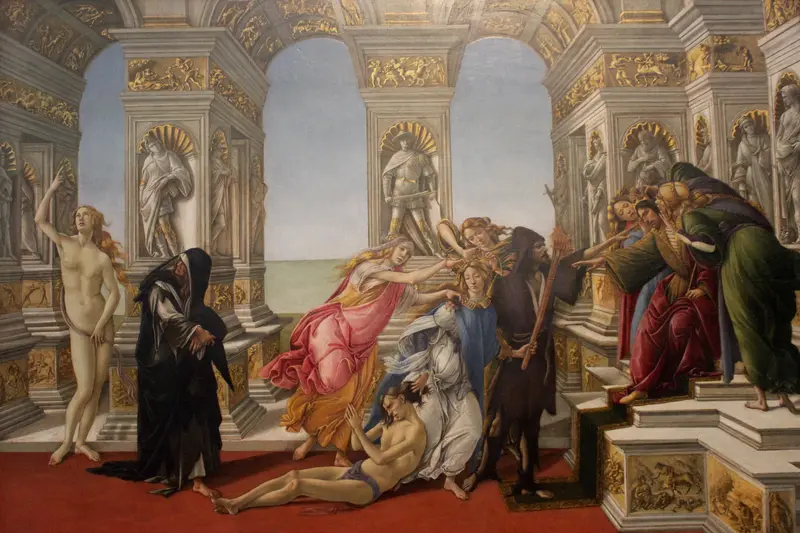
Calumny of Apelles
Sandro Botticelli

Portrait of a young man holding a roundel
Sandro Botticelli

The Trinity with Saint Mary Magdalene and Saint John the Baptist, the Archangel Raphael and Tobias
Sandro Botticelli

Idealized Portrait of a Lady (Portrait of Simonetta Vespucci as Nymph)
Sandro Botticelli





