Public domain · Free to download
Famous City Paintings
From Vermeer's View of Delft to Van Gogh's Café Terrace at Night, these are the most famous paintings of cities: streets, squares, bridges and skylines, from Bruegel's Tower of Babel to the new boulevards of Impressionist Paris. We added sections of famous paintings of New York and of Venice.
For each one you get the place it shows, who painted it and when, one detail to look for, and where it hangs today. Every image is a public-domain reproduction of the real painting, free to download and free to use.
Selected and written by Pavel MazuelasUpdated October 30, 2026
Part of The Most Famous Paintings in the WorldRelated: Famous Landscape Paintings, Famous Historical Paintings
The 25 most famous city paintings
Ranked from 1 to 25 by worldwide fame. Click any painting to see it up close and download it free.

No. 1Dutch Golden Age
View of Delft by Johannes Vermeer
City: Delft, from the south
c. 1660–1661 · Oil on canvas · 96.5 × 115.7 cm
Mauritshuis, The Hague
Delft lies across the water on a still day, with part of the city wall on the left and the Schiedam and Rotterdam gates on the right. Johannes Vermeer tidied the real townscape, which had a far more jagged skyline, and made the bridge between the two gates straighter and longer than it was. On the hull of the boat near the Rotterdam Gate he dabbed tiny dots of paint that read as light sparkling on water. Marcel Proust later wrote that he had seen the most beautiful painting in the world. It is in the Mauritshuis in The Hague.
Sources: Mauritshuis
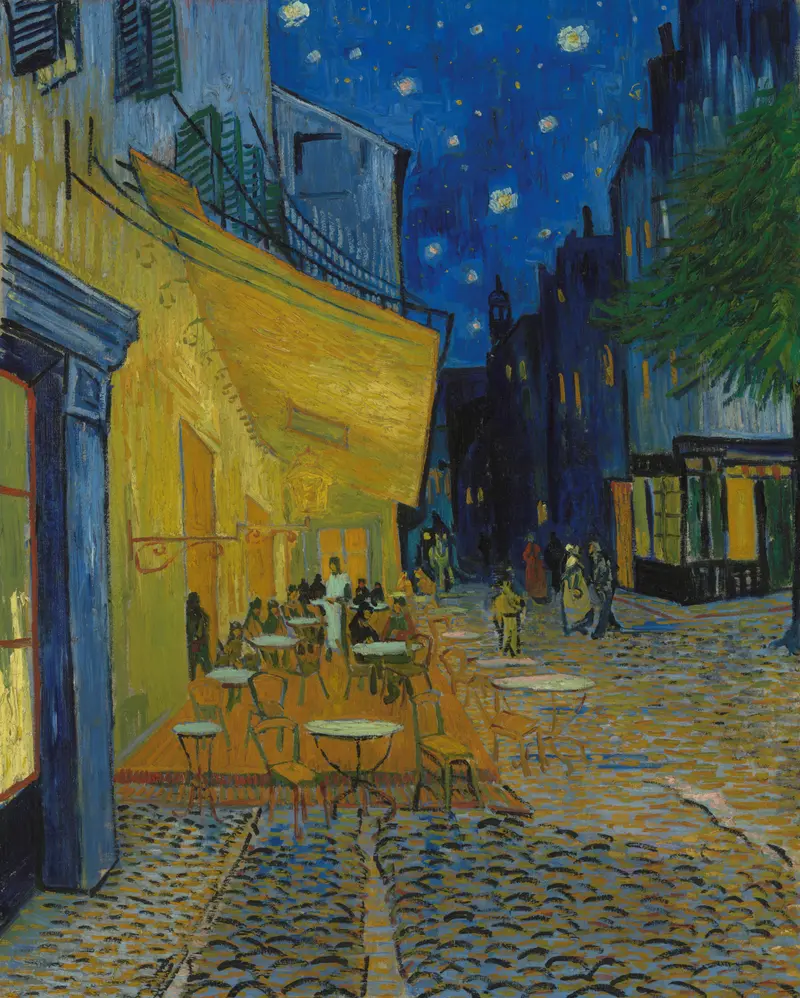
No. 2Post-Impressionism
Café Terrace at Night by Vincent van Gogh
City: Place du Forum, Arles
1888 · Oil on canvas · 80.7 × 65.3 cm
Kröller-Müller Museum, Otterlo
A gas-lit café terrace glows yellow and orange under a deep-blue, starry sky on the Place du Forum in Arles. Vincent van Gogh painted it on the spot, in the dark, in September 1888, avoiding the usual black-and-gray night scene: he wrote that gaslight, being yellow and orange, makes blue more intense. Later astronomical research showed that the stars are placed just as they appeared over Arles on the night of September 16 or 17, 1888. It is in the Kröller-Müller Museum in Otterlo.
Sources: Kröller-Müller Museum

No. 3Northern Renaissance
The Tower of Babel by Pieter Bruegel the Elder
City: Babel, an imagined port city
1563 · Oil on oak panel · 114.4 × 155.5 cm
Kunsthistorisches Museum, Vienna
At the lower left, King Nimrod visits the stonemasons building his tower; the Bible names Nimrod, but his link to the tower comes from a legend told by the historian Flavius Josephus. Pieter Bruegel the Elder set the tower on rock yet tilted it so that it seems to sink on the left, a sign that it can never be finished, and gave its shell a mix of classical and Romanesque arches with workers' homes built into it. It later belonged to Emperor Rudolf II. It is in the Kunsthistorisches Museum in Vienna.
Sources: Kunsthistorisches Museum
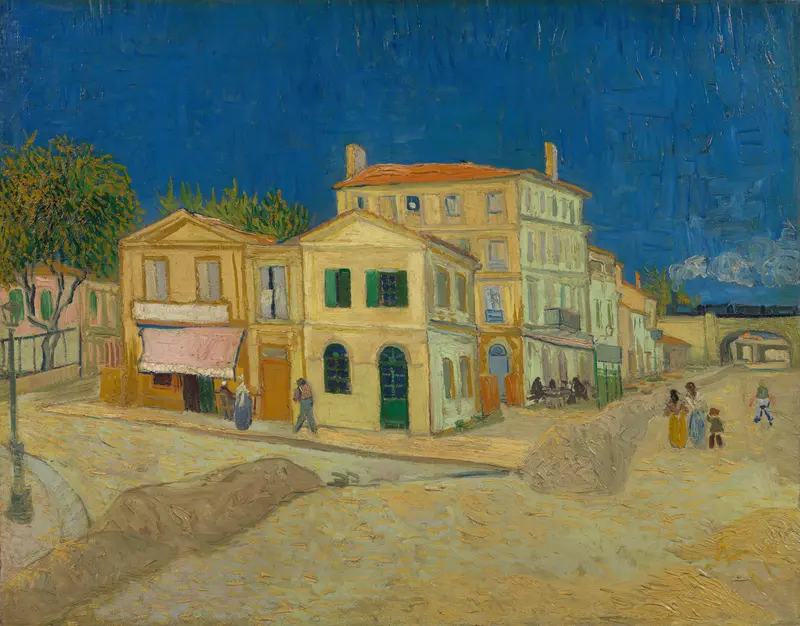
No. 4Post-Impressionism
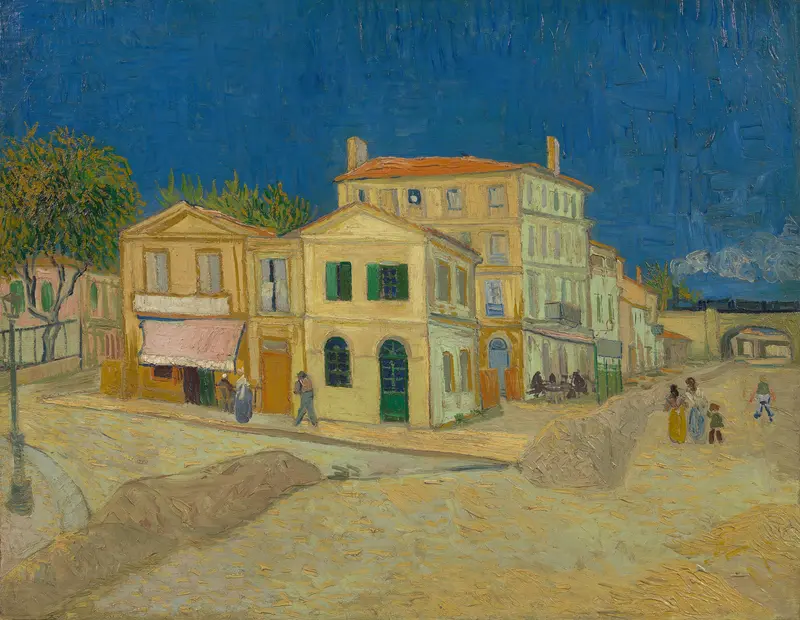
The Yellow House (The Street) by Vincent van Gogh
City: Place Lamartine, Arles
1888 · Oil on canvas · 72 × 91.5 cm
Van Gogh Museum, Amsterdam
Vincent van Gogh's yellow corner house on the Place Lamartine in Arles stands in hard sunlight under a deep-blue sky. In May 1888 he rented four rooms there, marked by the green shutters, and he called the picture The Street: he ate at the restaurant on the left, and his friend the postman Joseph Roulin lived beyond the second railway bridge. Paul Gauguin was the first and last artist to join him in his planned Studio of the South. A bomb leveled the house in June 1944. It is in the Van Gogh Museum in Amsterdam.
Sources: Van Gogh Museum
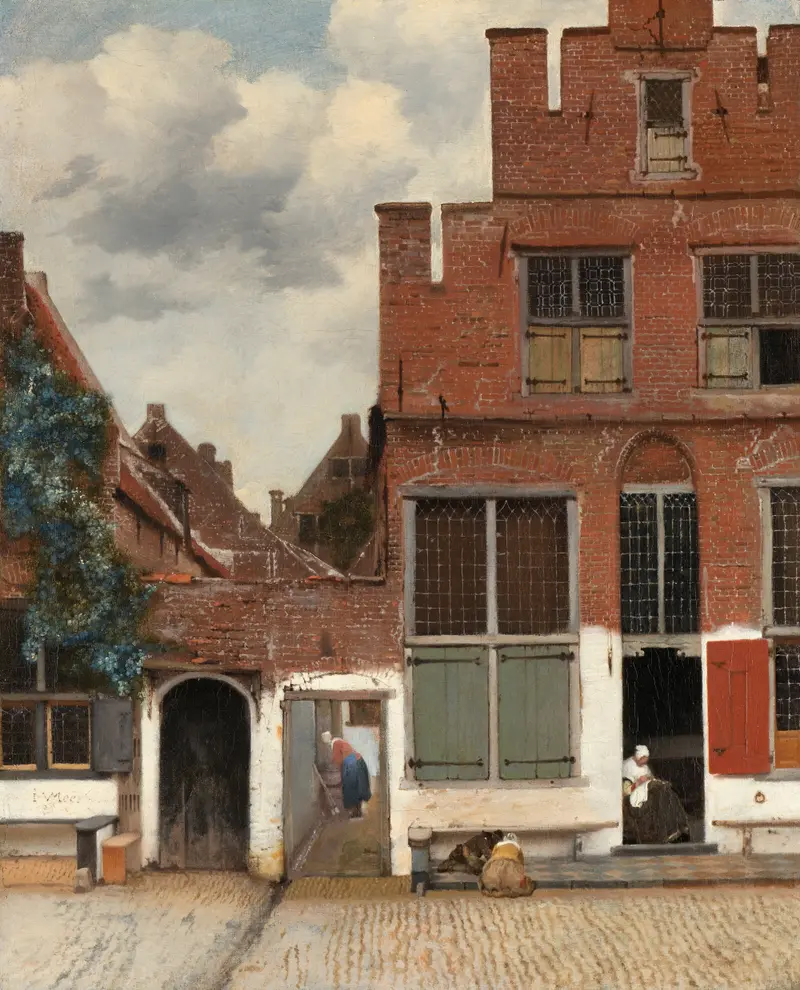
No. 5Dutch Golden Age
The Little Street by Johannes Vermeer
City: Vlamingstraat, Delft
c. 1658 · Oil on canvas · 54.3 × 44 cm
Rijksmuseum, Amsterdam
A woman bends over a washtub in an alley, another sews in a doorway and two children play on the bench outside a plain brick house in Delft. In 2015 a researcher used the town's 1667 register of quay dues, which records the widths of canal-side houses to within 15 centimeters, to pin down the exact spot. Johannes Vermeer first painted the door at the left closed, then opened its shutters to give a glimpse inside. The painting failed to sell at auction in 1921; Henry Deterding then bought it and gave it to the Rijksmuseum in Amsterdam, where it is today.
Sources: Rijksmuseum
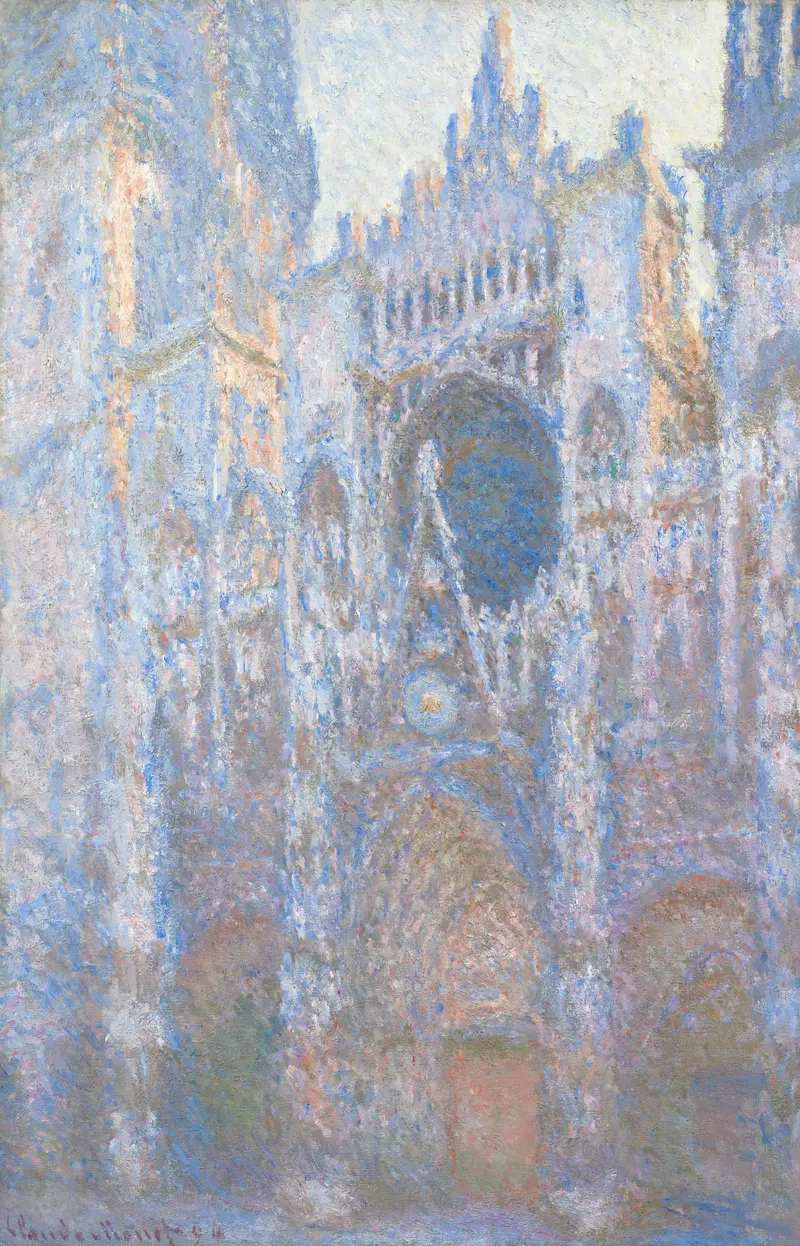
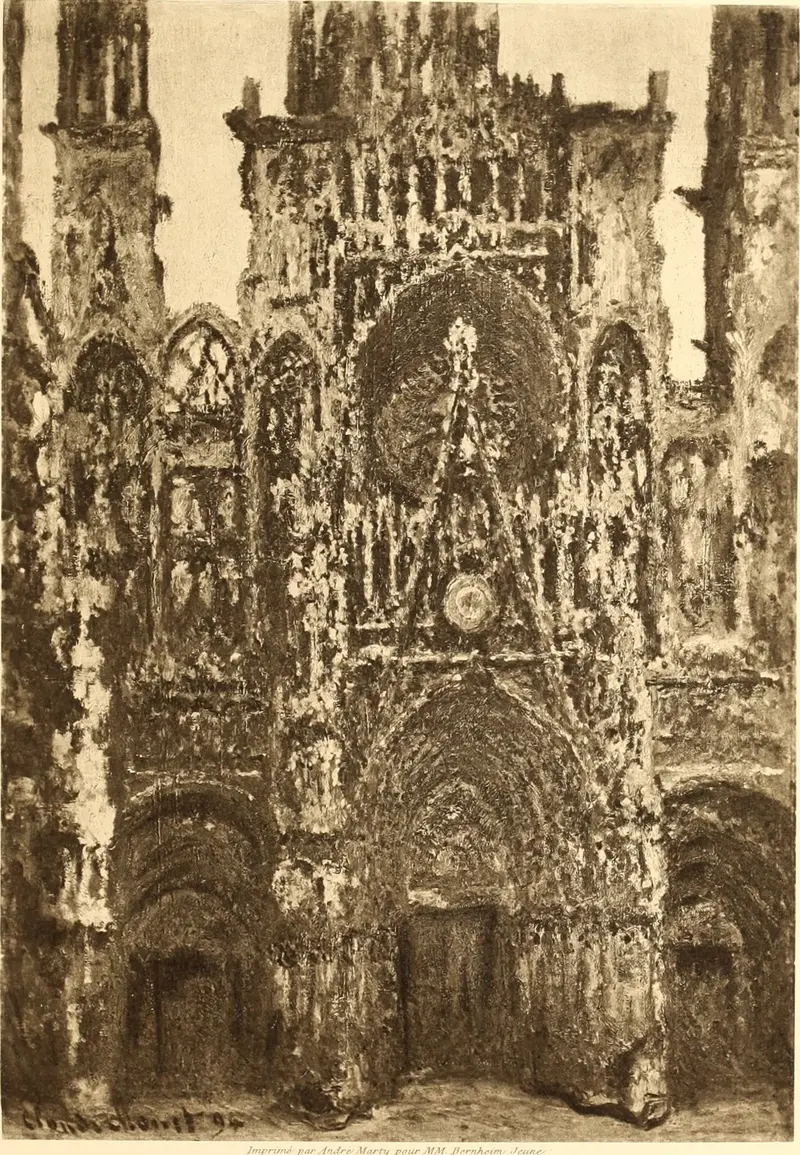
No. 6Impressionism
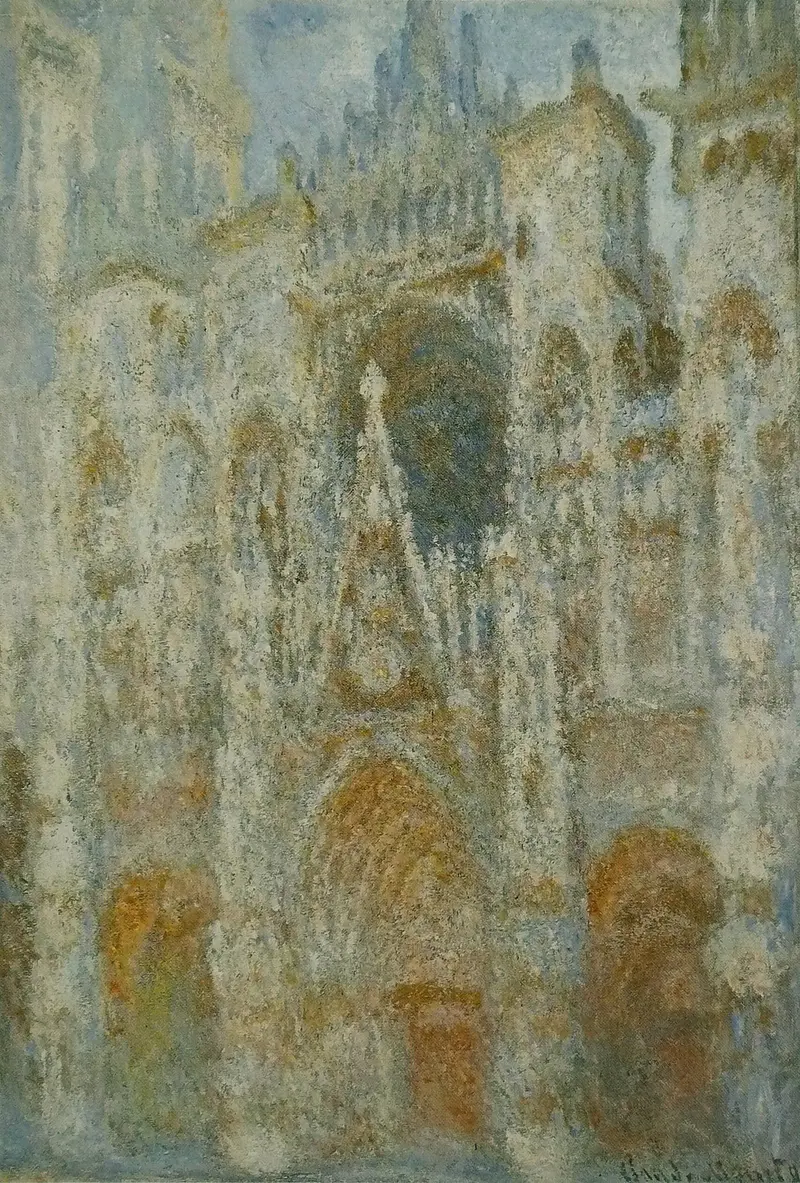
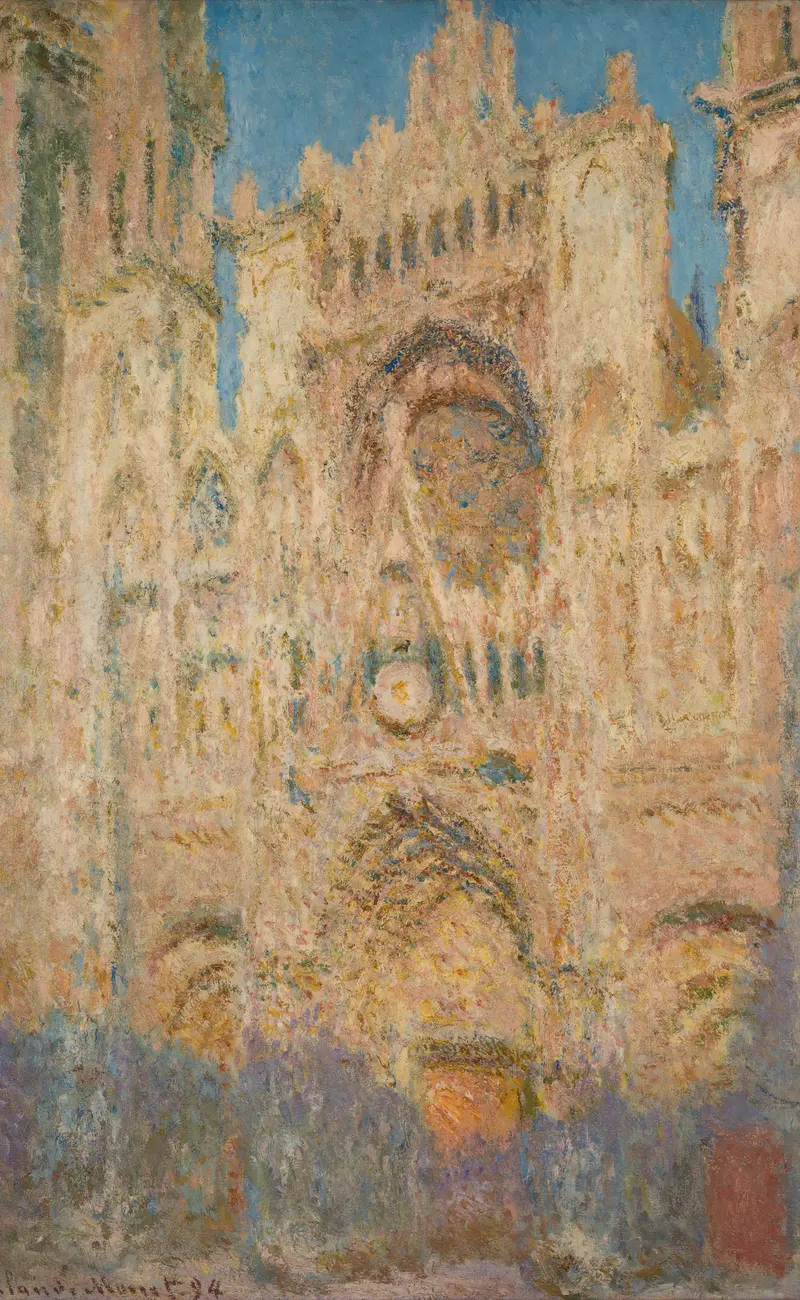
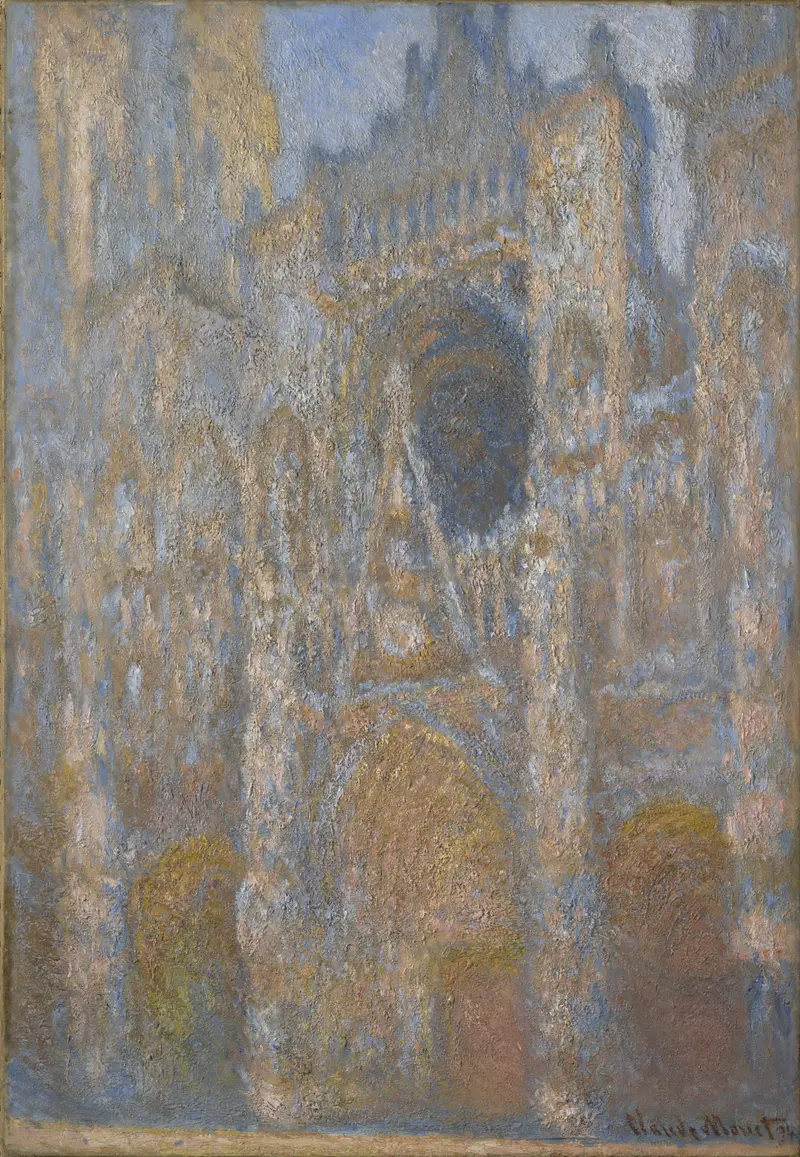
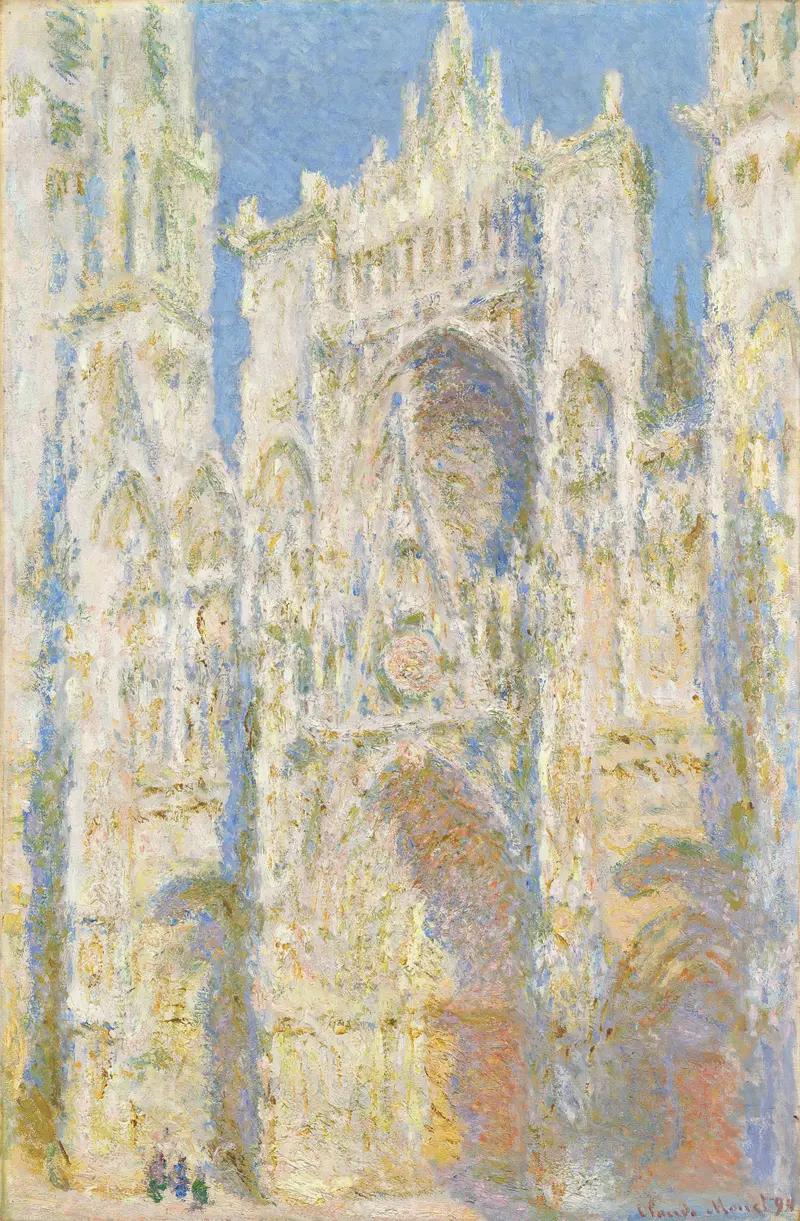
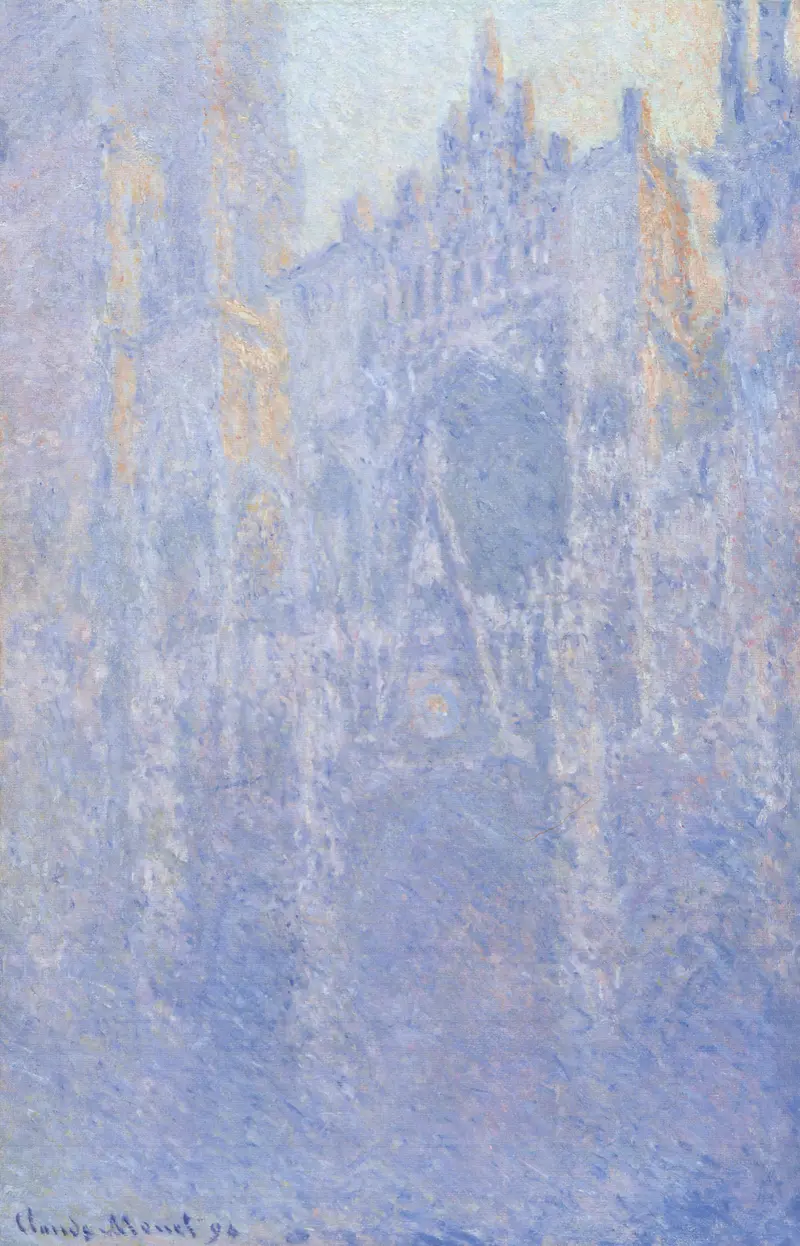
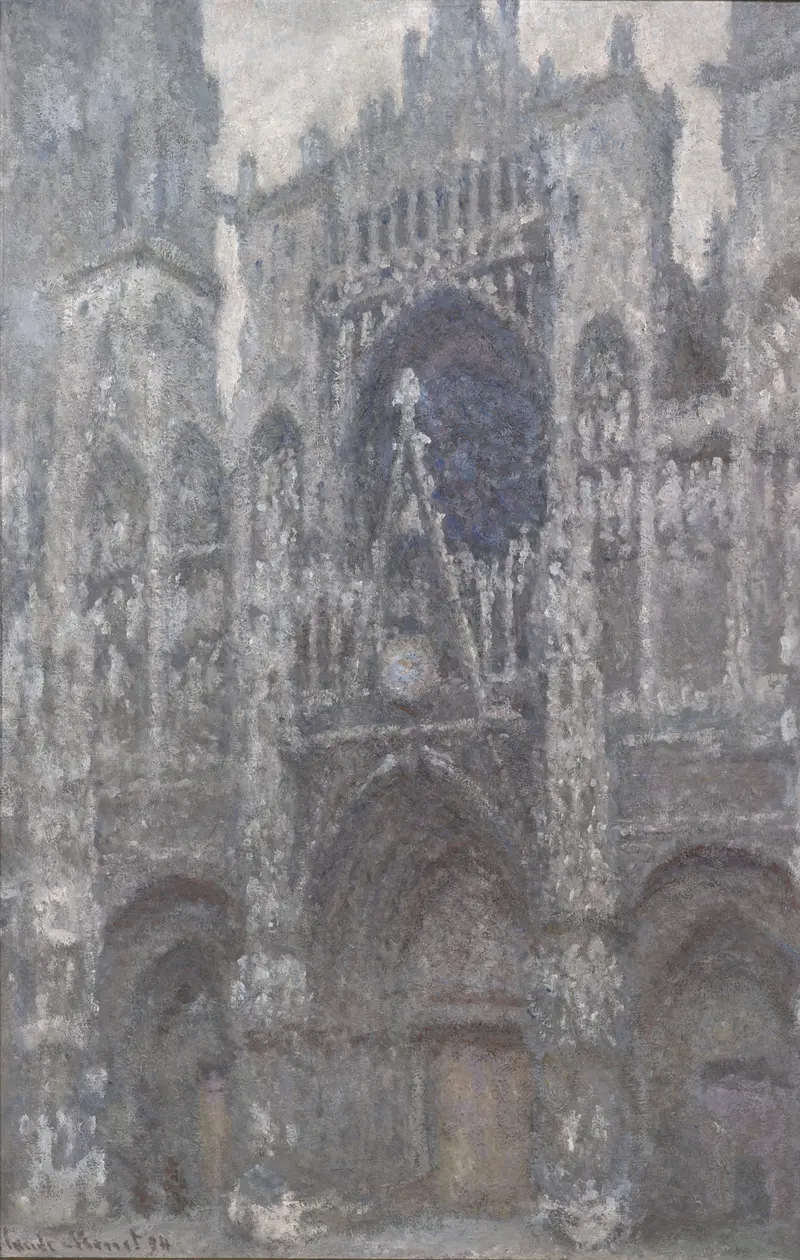
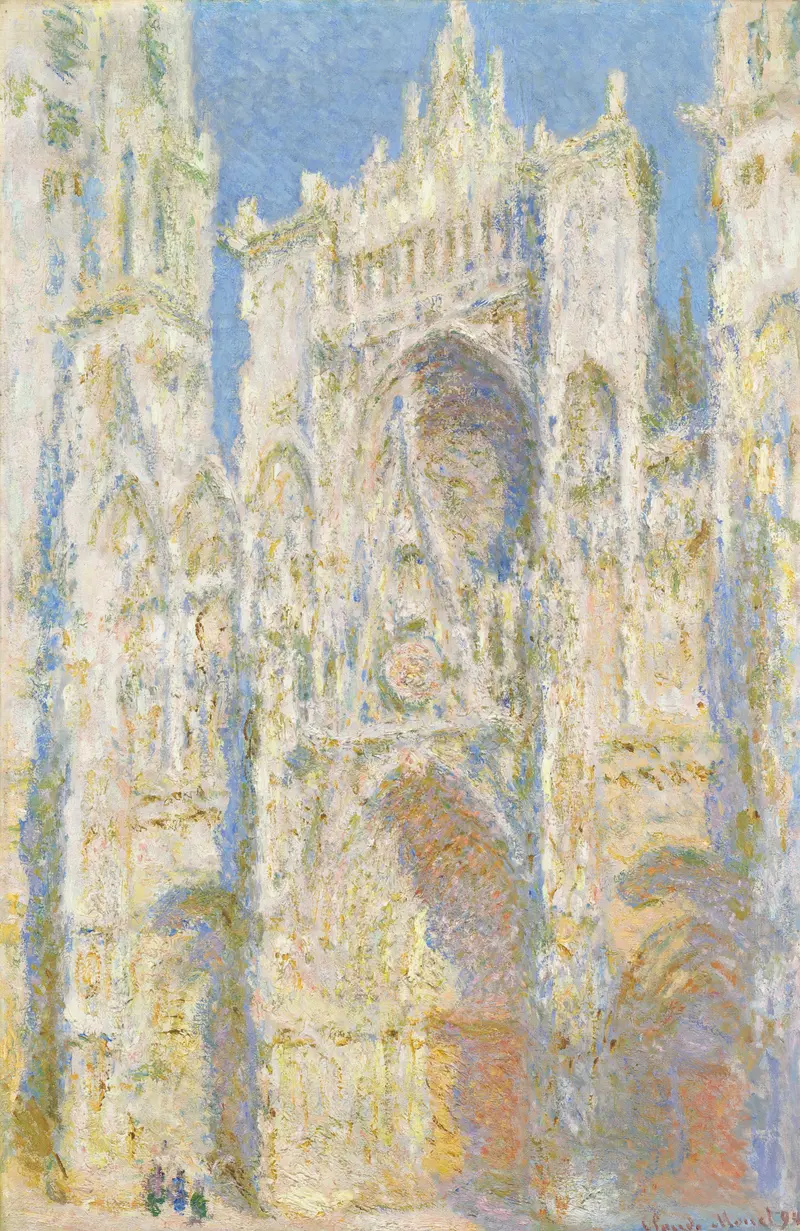
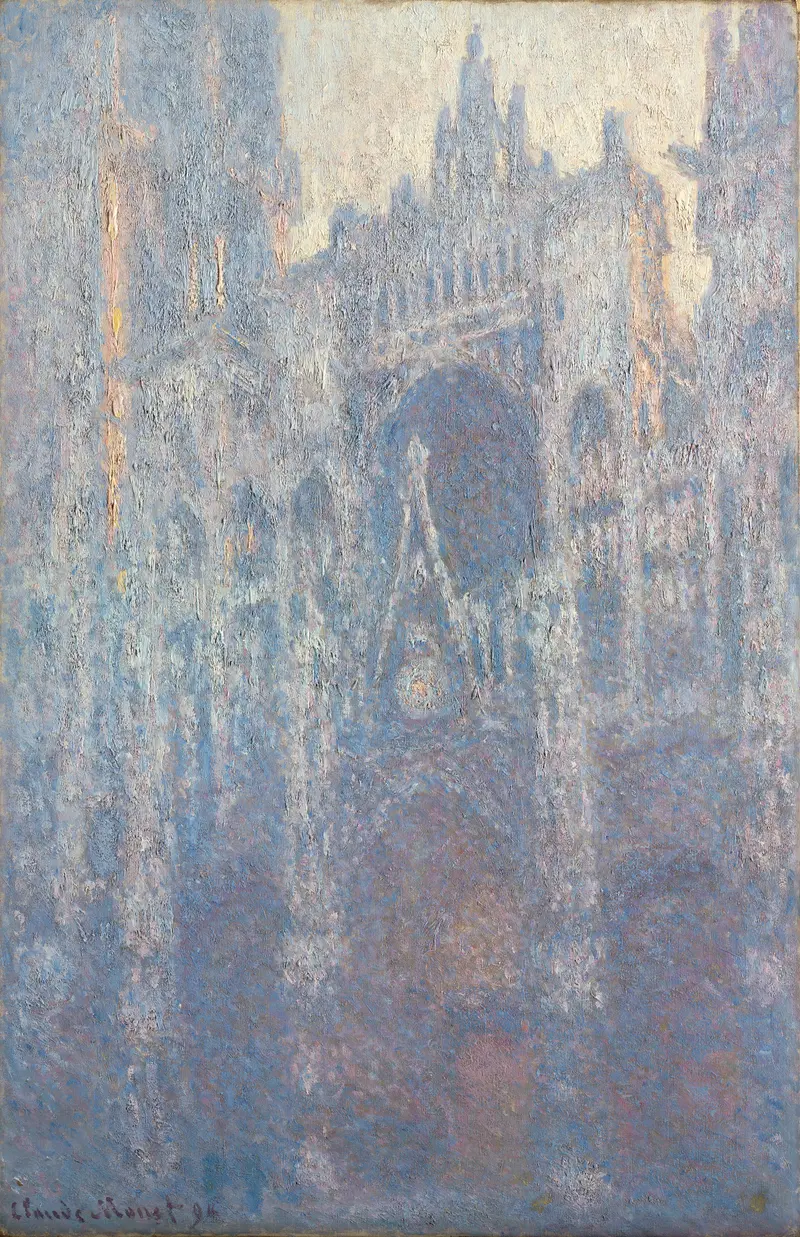
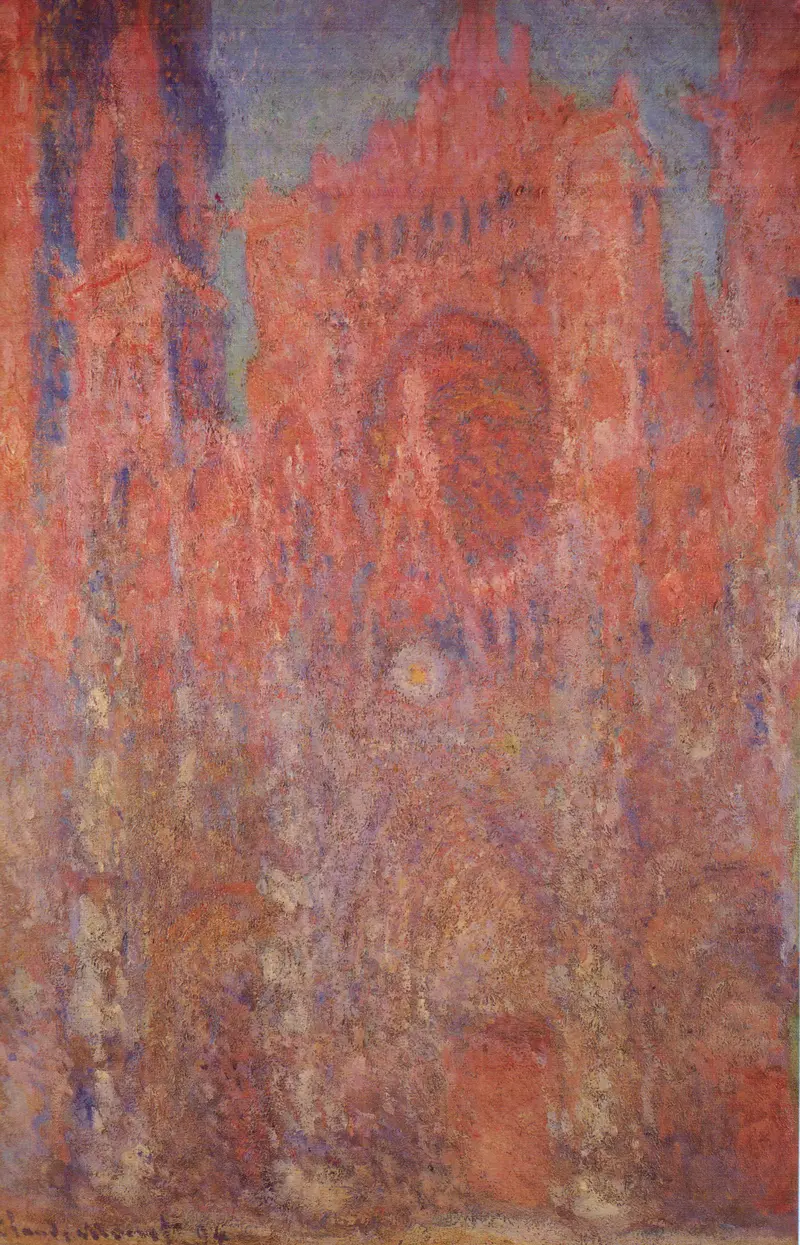
Rouen Cathedral, West Façade by Claude Monet
City: Rouen Cathedral, west facade
1894 · Oil on canvas · 100.1 × 65.9 cm
National Gallery of Art, Washington, DC
The Gothic west facade of Rouen Cathedral fills the canvas, cropped at the sides and dissolved into pale blue and lavender light. Claude Monet rented rooms across from the cathedral in early 1892 and came back the next winter, painting the front again and again in changing light; what he wanted to paint, he said, was "what exists between the motif and me." He reworked the canvases in his studio, signed this one in 1894, and showed it among 20 cathedral views in Paris in 1895. It is in the National Gallery of Art in Washington, DC.
Sources: National Gallery of Art
No. 7Impressionism
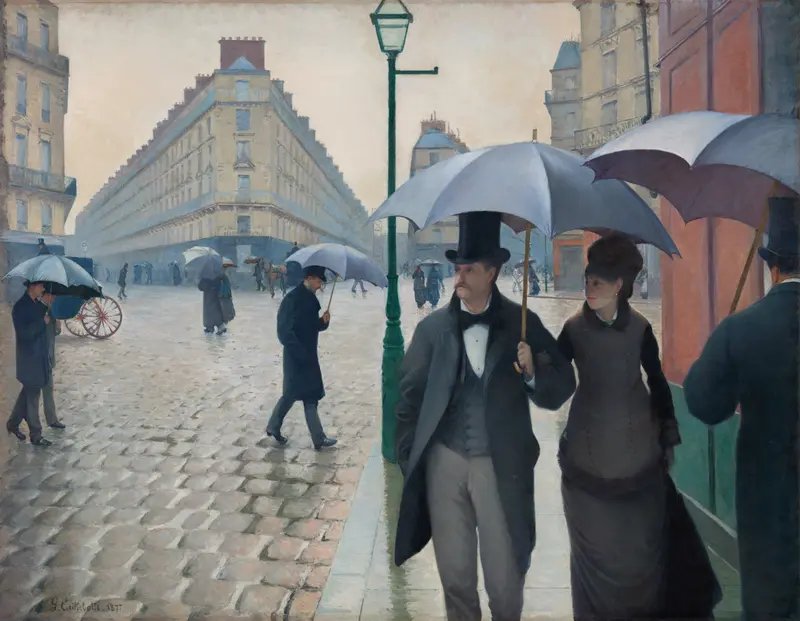
Paris Street; Rainy Day by Gustave Caillebotte
City: Rue de Turin and rue de Moscou, Paris
1877 · Oil on canvas · 212.2 × 276.2 cm
Art Institute of Chicago, Chicago
Fashionable Parisians with umbrellas cross a wide, wet intersection in the new quarter around the Gare Saint-Lazare. Critics in 1877 recognized the corner of the rue de Turin and the rue de Moscou, though Gustave Caillebotte left it unnamed; the crossing only became the place de Dublin in 1987. Shown at the third Impressionist exhibition, it drew complaints that the rain was missing. Caillebotte lengthened and straightened the green lamppost as he worked, and a year later the real one was replaced. It is in the Art Institute of Chicago.
Sources: Art Institute of Chicago
No. 8Romanticism
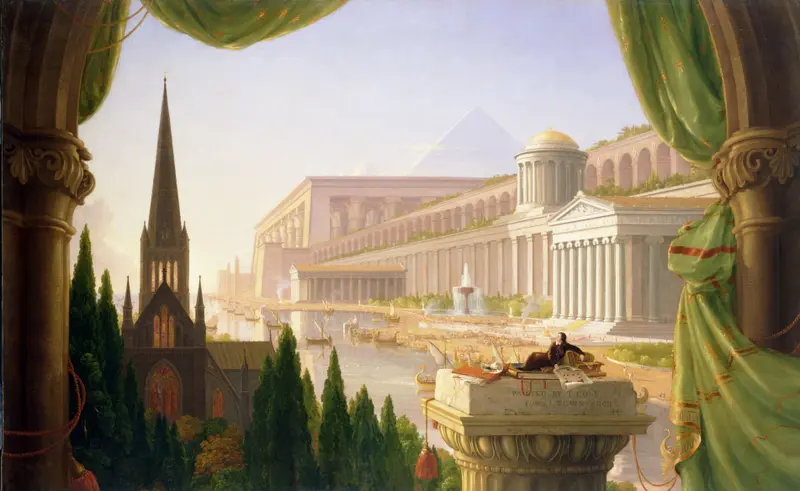
The Architect's Dream by Thomas Cole
City: An imagined city of building styles
1840 · Oil on canvas · 134.7 × 213.6 cm
Toledo Museum of Art, Toledo, Ohio
An architect reclines on giant books of designs atop a huge column, dreaming a panorama of building history: an Egyptian pyramid and temple in the haze, Greek temples, a Roman aqueduct and a Gothic church rising from the forest. The architect Ithiel Town commissioned it from Thomas Cole in 1839, asking for a view of Athens. Town liked the mix of styles but had wanted more landscape and less architecture, so he rejected it, to Cole's indignation. It stayed with Cole's family until 1949 and is in the Toledo Museum of Art in Toledo, Ohio.
Sources: Toledo Museum of Art
No. 9
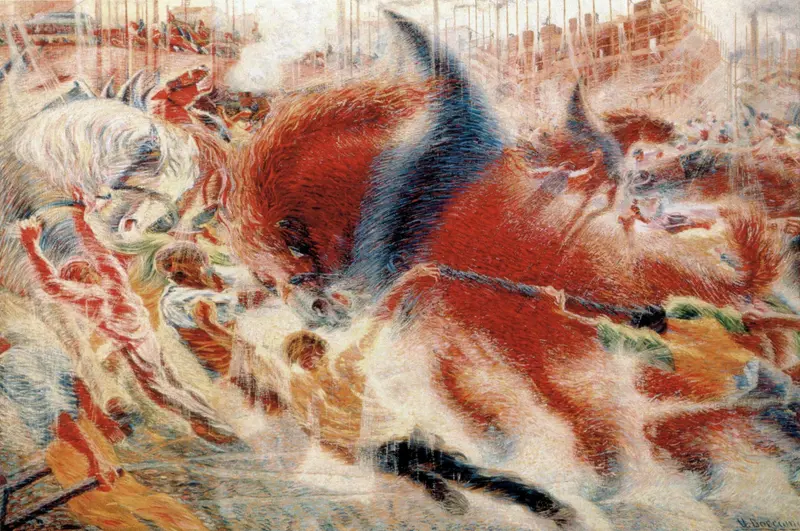
The City Rises by Umberto Boccioni
City: Milan
1910 · Oil on canvas · 199.3 × 301 cm
Museum of Modern Art, New York
A huge horse surges through a building site as workers strain to hold it, with new buildings going up behind them. Umberto Boccioni moved to Milan in 1908 and made a series of studies of the city and its industry; first called Labor, the picture became his first major Futurist painting, which he described as "a great synthesis of labor, light, and movement." The composer Ferruccio Busoni bought it in London in 1912, and the Museum of Modern Art acquired it from his son in 1951. It is in the Museum of Modern Art in New York.
Sources: Museum of Modern Art
No. 10Impressionism
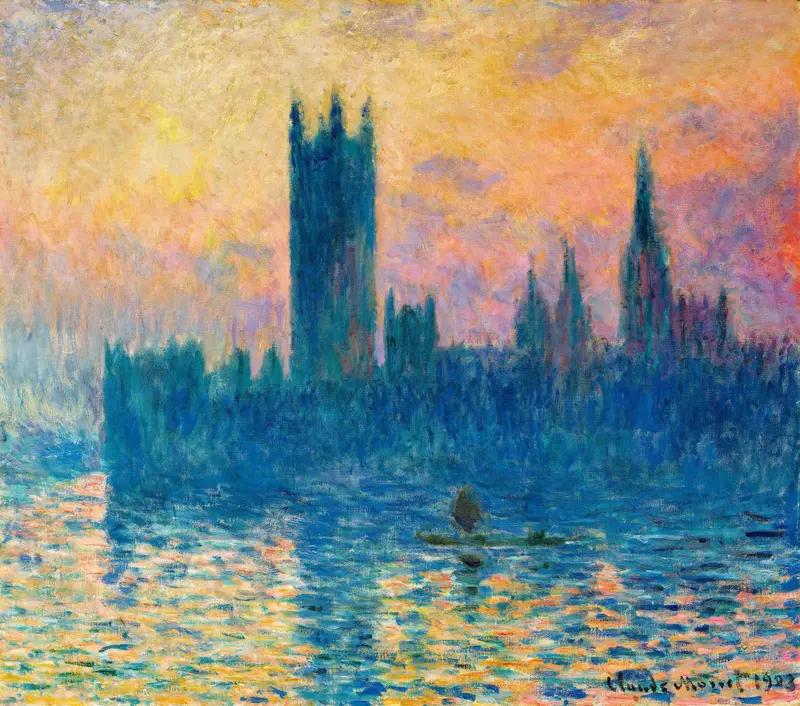
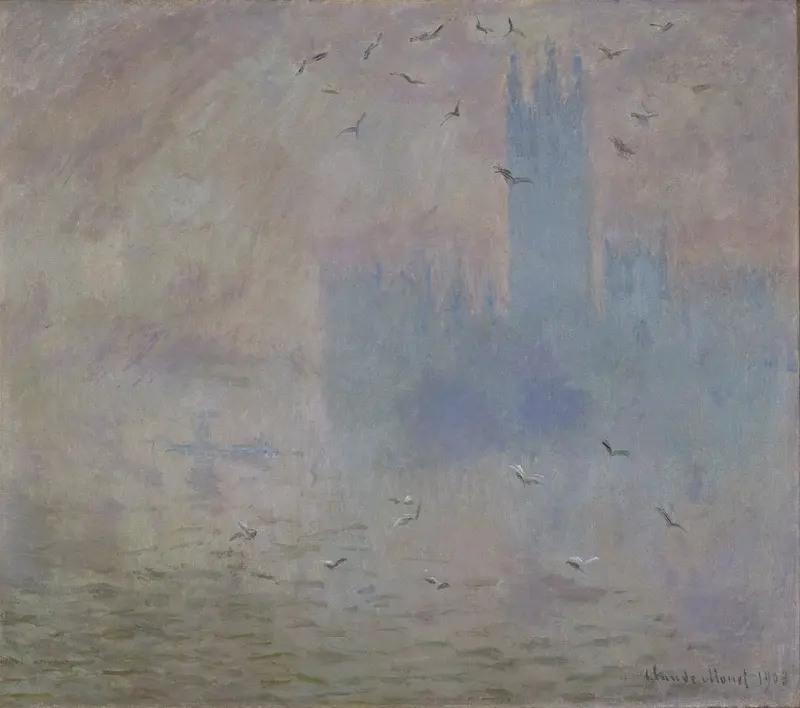
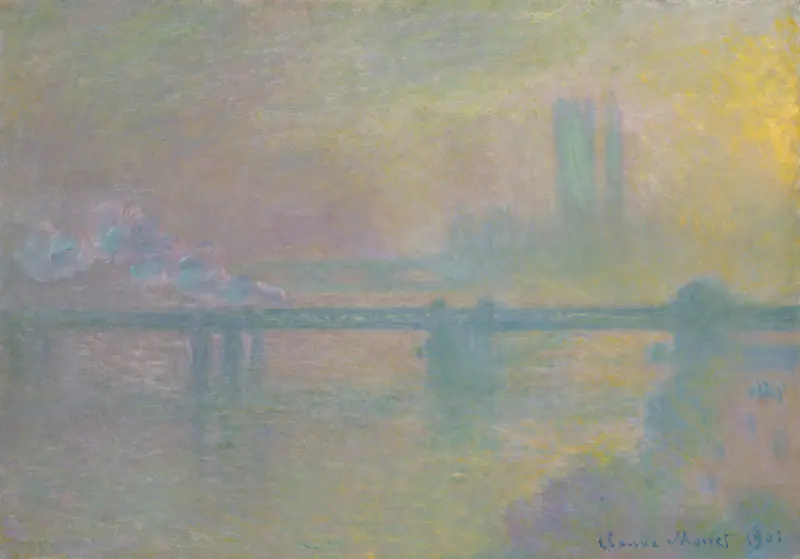
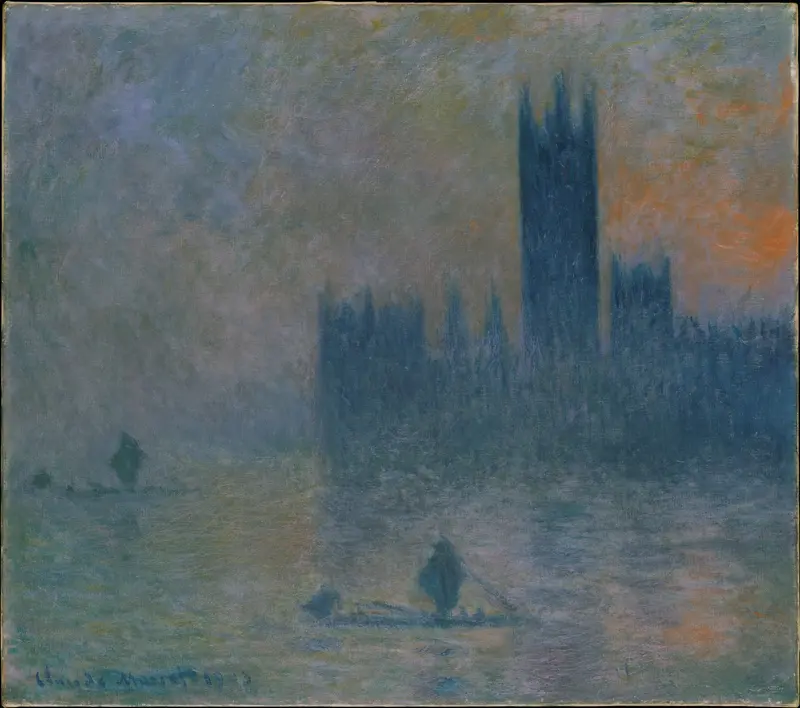
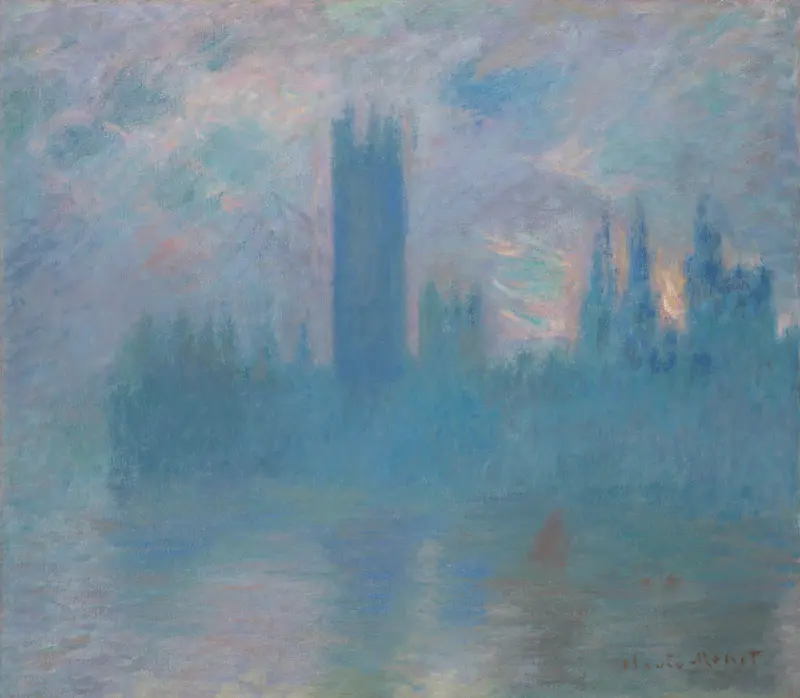
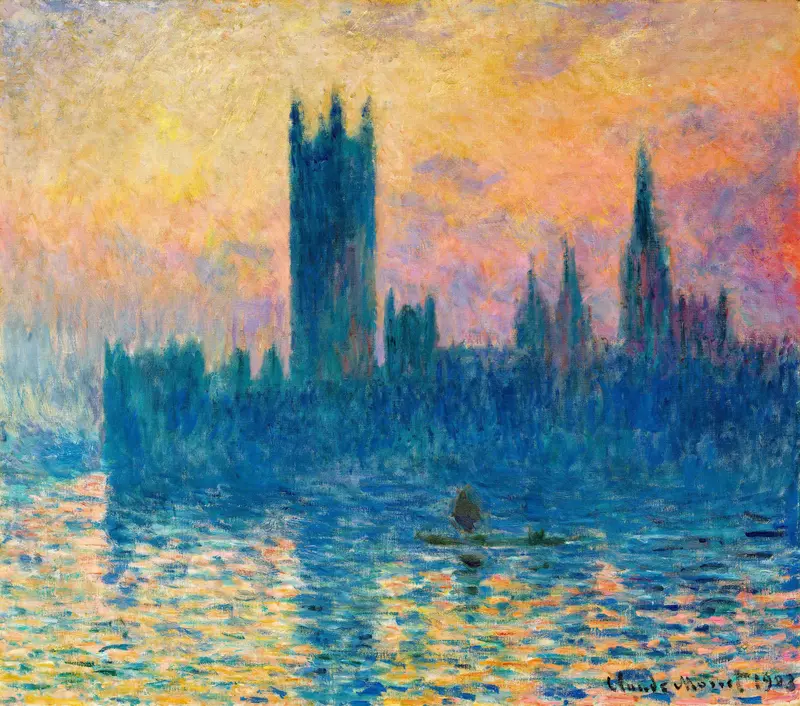
The Houses of Parliament, Sunset by Claude Monet
City: Houses of Parliament, London
1903 · Oil on canvas · 81.3 × 92.5 cm
National Gallery of Art, Washington, DC
The towers of the Houses of Parliament stand in deep blue against a sunset of pink, orange and violet, mirrored in the Thames. Claude Monet painted his London views from a balcony of St Thomas' Hospital across the river, switching canvases as the light changed, on three visits between 1899 and 1901, then reworked them at Giverny. He signed this one in 1903 and showed it in Paris in 1904 among 37 Thames views, an enormously successful show. It is in the National Gallery of Art in Washington, DC.
Sources: National Gallery of Art
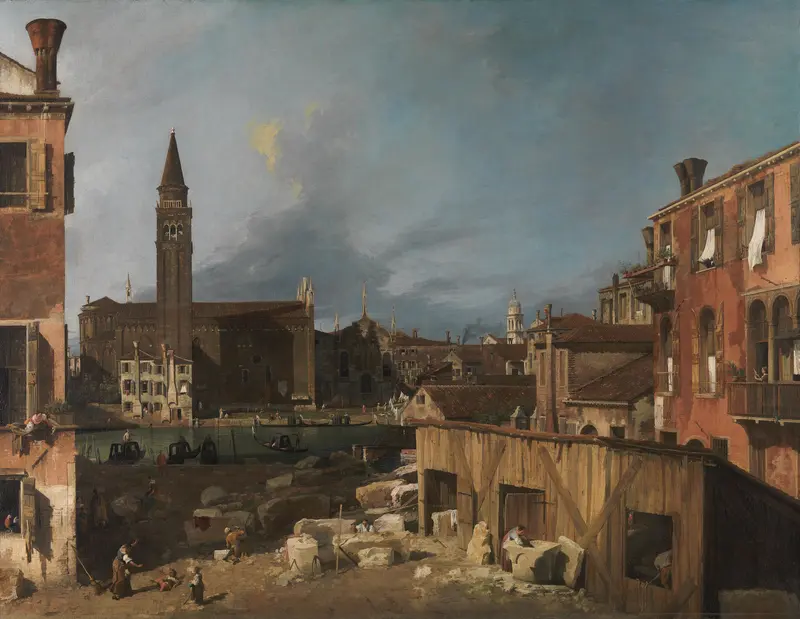
No. 11Rococo
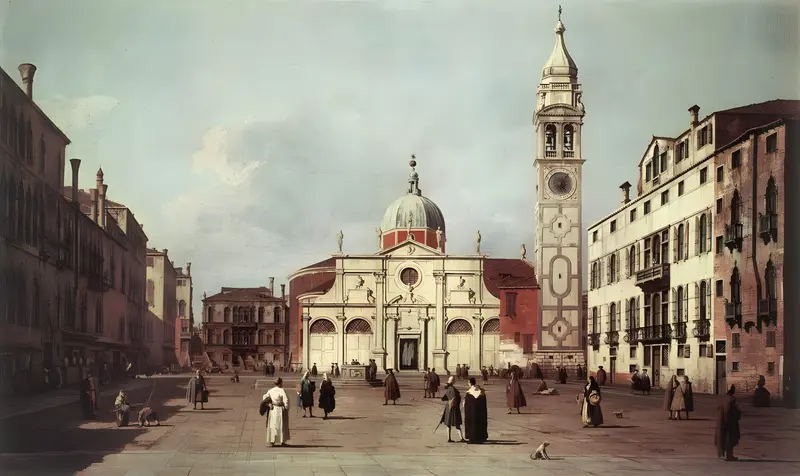
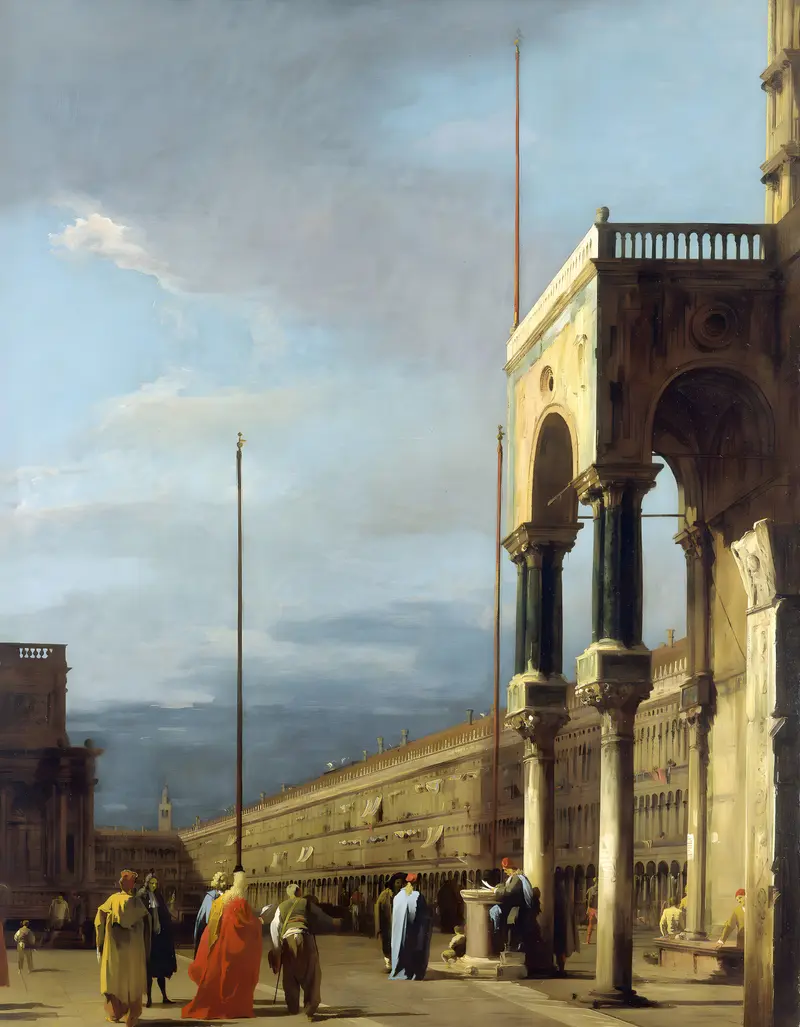
The Stonemason's Yard by Canaletto
City: Campo San Vidal, Venice
c. 1725 · Oil on canvas · 123.8 × 162.9 cm
National Gallery, London
Masons dress blocks of stone in a Venetian square early in the morning, while a cockerel crows on a windowsill and a mother rushes to a toddler who has fallen over. Canaletto painted the Campo San Vidal around 1725, when it seems to have been turned into a workshop for repairs to its church, looking across the Grand Canal to Santa Maria della Carità. That church's bell tower collapsed in 1744, and its buildings now house the Accademia gallery. It was the first Canaletto in the National Gallery in London, where it hangs today.
Sources: National Gallery
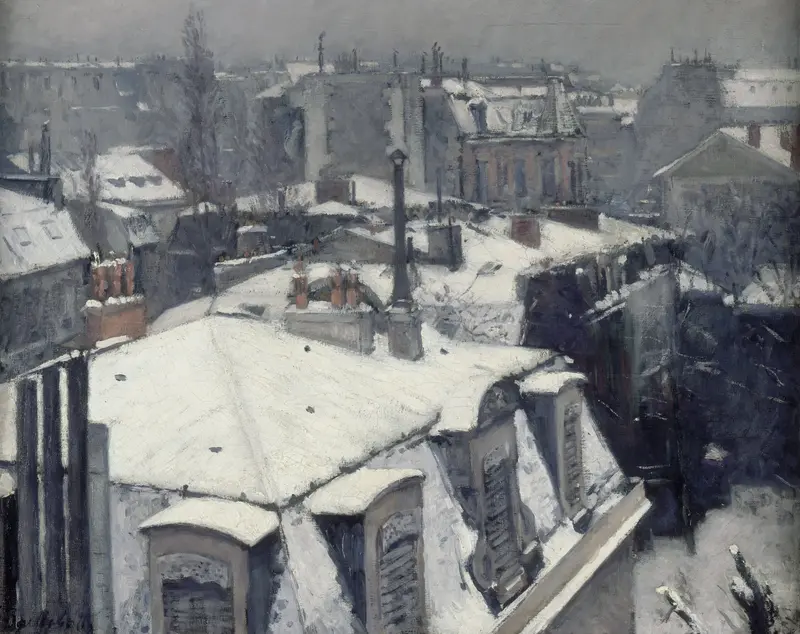
No. 12Impressionism
Rooftops in the Snow by Gustave Caillebotte
City: Paris rooftops
1878 · Oil on canvas · 64.5 × 81 cm
Musée d'Orsay, Paris
Snow-covered roofs and chimneys stretch across Paris under a heavy gray sky lit by a few notes of soft pink. Gustave Caillebotte painted the view in 1878 and showed it the next year at the fourth Impressionist exhibition, one of more than 25 works he sent; his two roofscapes drew little comment, and the museum notes the subject had few precedents outside photography. His brother Martial gave it to the national museums in 1894 together with The Floor Scrapers. It is in the Musée d'Orsay in Paris.
Sources: Musée d'Orsay
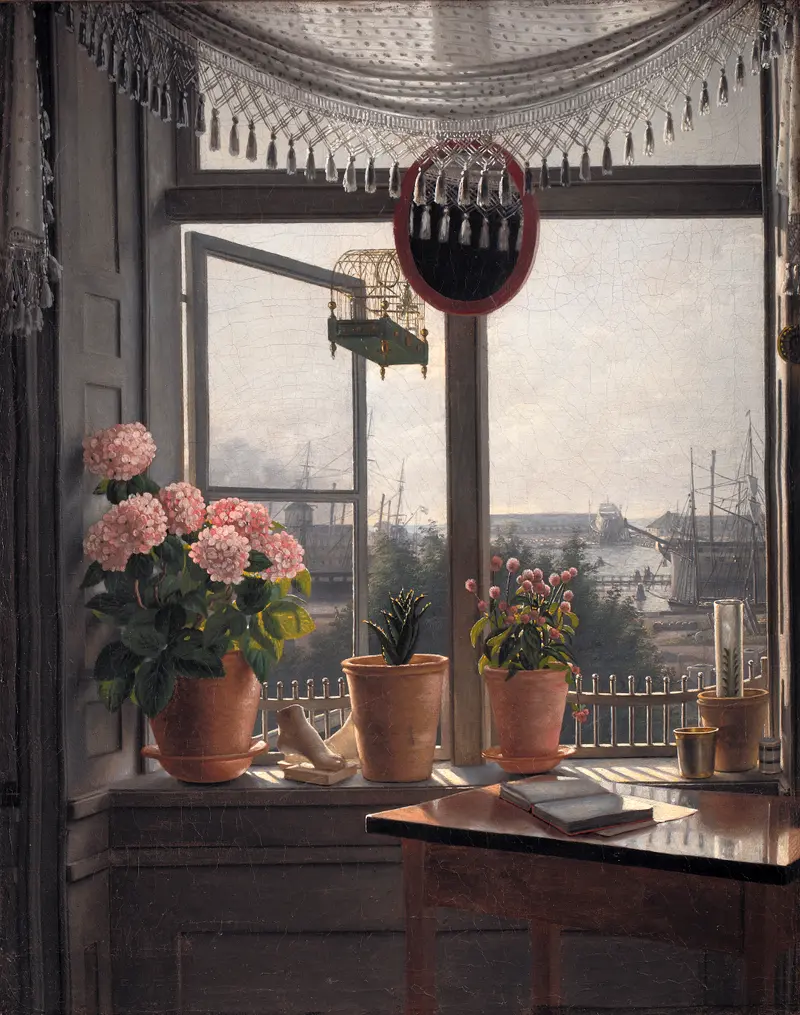
No. 13Romanticism
View from the Artist's Window by Martinus Rørbye
City: Copenhagen harbor, from Amaliegade
c. 1825 · Oil on canvas · 38 × 29.8 cm
SMK – National Gallery of Denmark, Copenhagen
Potted plants and a birdcage fill a sunlit windowsill above Copenhagen's naval harbor. Martinus Rørbye painted the view from the drawing room of his parents' house on Amaliegade around 1825, just before he left home, and every detail carries meaning: the caged bird hangs between indoors and out, the plants show stages of life, and of the three warships only the one at left is ready to sail. When an owner tried to sell it at auction in London in 1987, Denmark's Cultural Assets Committee stopped the sale and bought it. It is in the SMK in Copenhagen.
Sources: SMK – National Gallery of Denmark
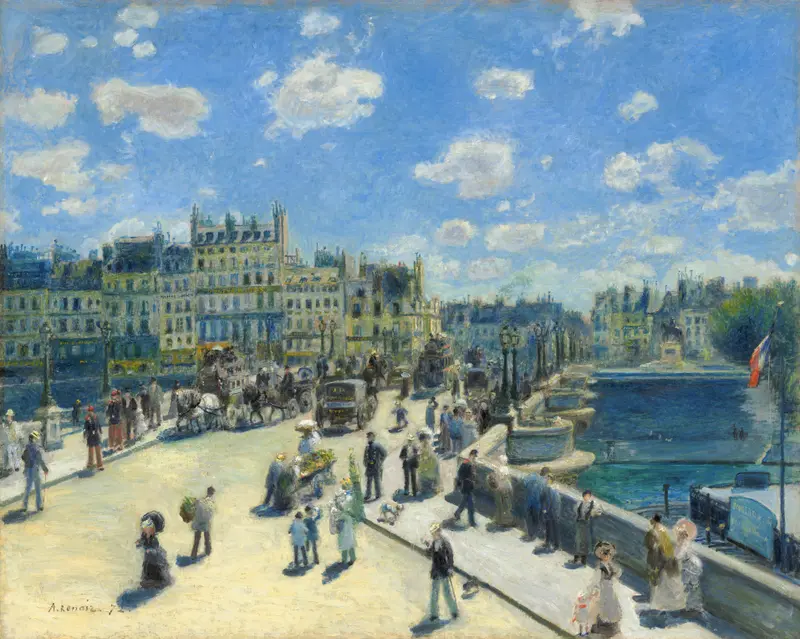
No. 14Impressionism
Pont Neuf, Paris by Pierre-Auguste Renoir
City: Pont Neuf, Paris
1872 · Oil on canvas · 75.3 × 93.7 cm
National Gallery of Art, Washington, DC
Crowds, carriages and a flag-decked quay fill the sunlit Pont Neuf, the oldest bridge in Paris. According to his brother Edmond, Pierre-Auguste Renoir borrowed an upper floor of a café for the day while Edmond stopped passersby long enough to be sketched, though the National Gallery of Art thinks careful preparation lay behind it. Painted in 1872, after the Franco-Prussian War and the Commune, it shows the city whole and busy again. Renoir sold it at his own auction in 1875; it is in the National Gallery of Art in Washington, DC.
Sources: National Gallery of Art
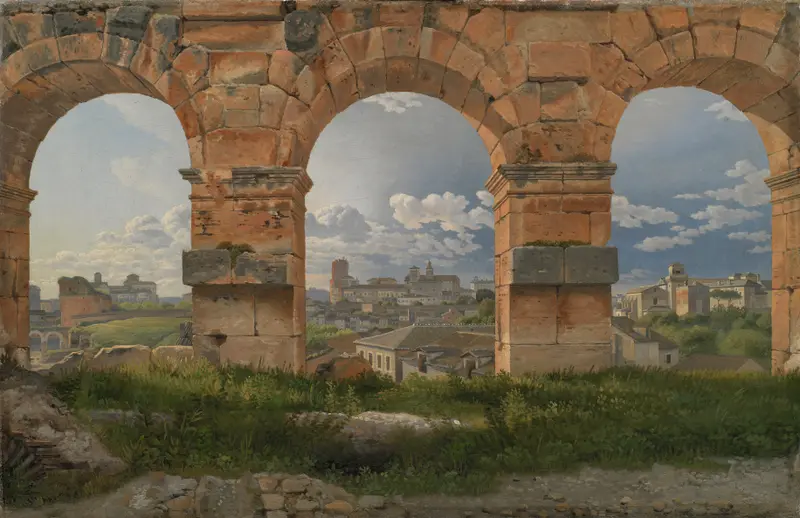
No. 15Romanticism
A View through Three Arches of the Colosseum by Christoffer Wilhelm Eckersberg
City: Rome, from the Colosseum
1815 · Oil on canvas · 32 × 49.5 cm
SMK – National Gallery of Denmark, Copenhagen
Rome opens up through three arches of the Colosseum's third story, with a storm gathering over the city. Christoffer Wilhelm Eckersberg painted it in the open air in 1815, something new in Danish art, and probably used binoculars for the distant details. The view is a construct: from the central arch he could see only the middle scene, and had to take two steps to the left or five to the right for the others. The museum calls it his most famous painting. It is in the SMK in Copenhagen.
Sources: SMK – National Gallery of Denmark
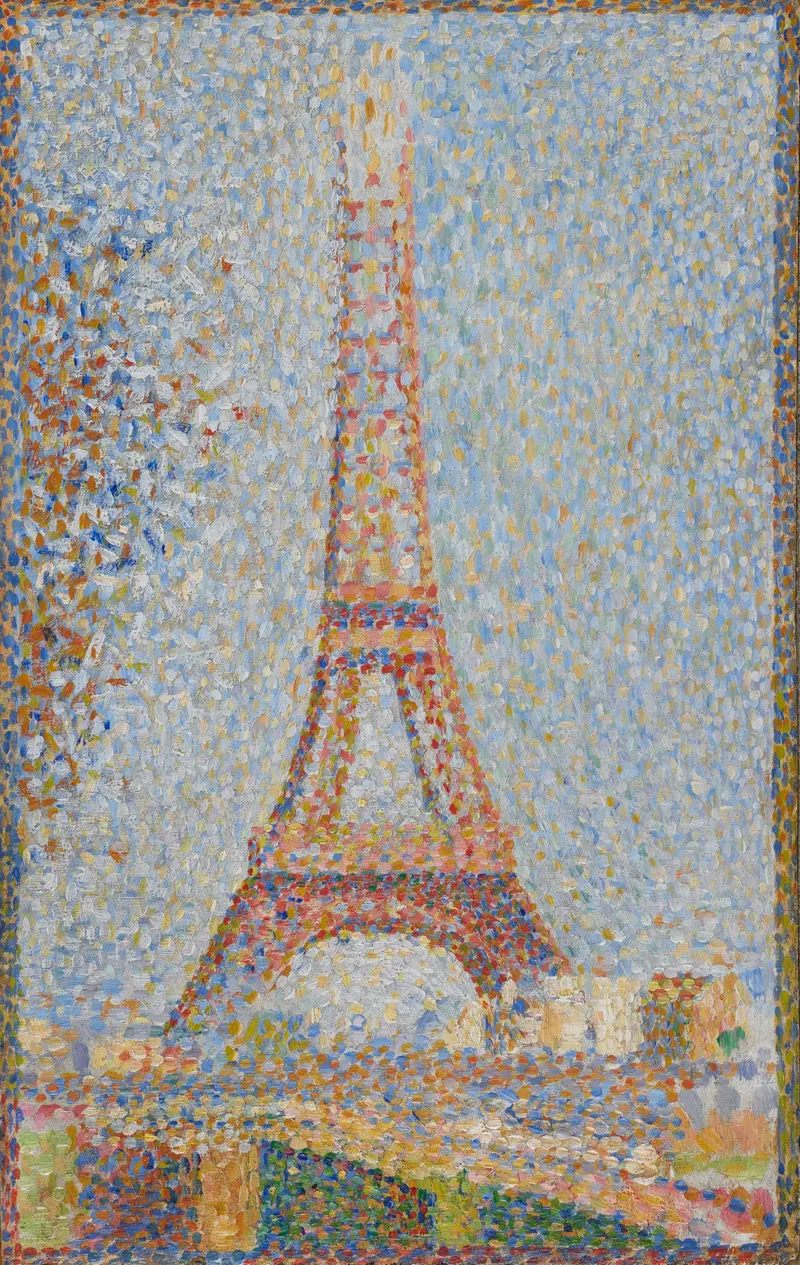
No. 16Post-Impressionism
The Eiffel Tower by Georges Seurat
City: Eiffel Tower, Paris
c. 1889 · Oil on wood panel · 24.1 × 15.2 cm
Legion of Honor, San Francisco
The Eiffel Tower rises in tiny dots of color on a wooden panel only about 24 by 15 centimeters. Georges Seurat painted it around 1889, the year Gustave Eiffel's tower was finished for the Paris Universal Exposition after just over two years of building; it opened to visitors on May 15, nine days after the fair opened. The Fine Arts Museums of San Francisco bought the little panel in 1979, and it is in the Legion of Honor in San Francisco.
Sources: Legion of Honor
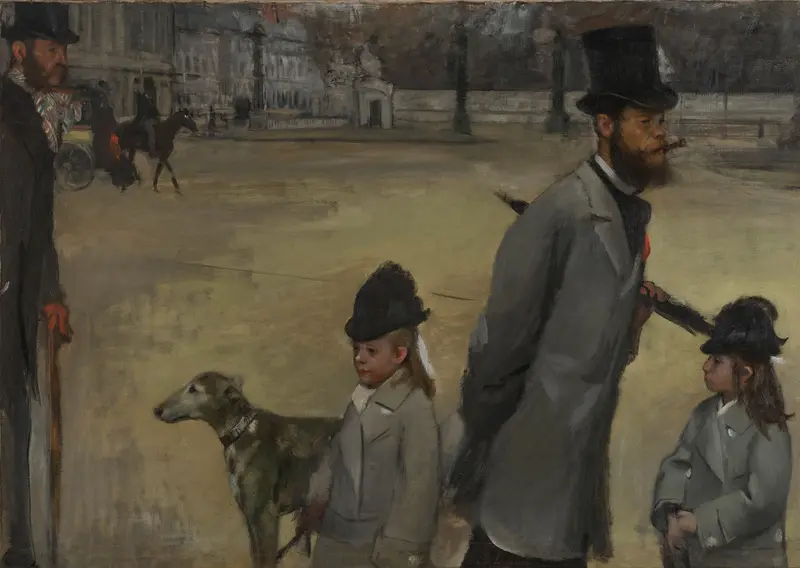
No. 17Impressionism
Place de la Concorde by Edgar Degas
City: Place de la Concorde, Paris
1875 · Oil on canvas · 78.4 × 117.5 cm
Hermitage Museum, St. Petersburg
The artist Ludovic-Napoléon Lepic crosses the Place de la Concorde with his two daughters and their dog, while a passer-by is cut off at the left edge. Edgar Degas painted his friends in this casual moment in 1875 and, short of money, sold the canvas to Lepic; it was never exhibited and stayed almost unknown. It later belonged to the Berlin collector Otto Gerstenberg, was taken to the Soviet Union in 1945 and was believed lost until the Hermitage showed it in 1995. It is in the Hermitage Museum in St. Petersburg.
Sources: Hermitage Museum
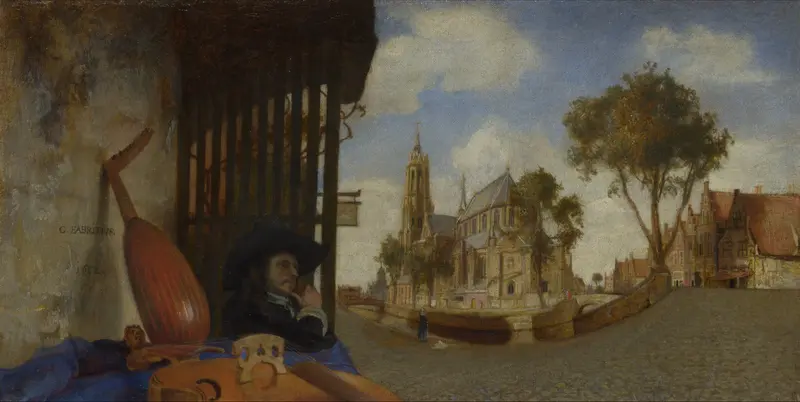
No. 18Dutch Golden Age
A View of Delft by Carel Fabritius
City: Delft, toward the Nieuwe Kerk
1652 · Oil on canvas · 15.5 × 31.7 cm
National Gallery, London
A musical-instrument seller's stall on a Delft street corner, with the Nieuwe Kerk and the town hall bent as if seen through a wide-angle lens. Carel Fabritius painted this tiny canvas in 1652, and its stretched perspective has led many historians to think it was made for a perspective box, viewed through a peephole, though how it was mounted is unproven. He scratched his signature into the wall beside the lute like graffiti. Two years later he was killed in the Delft gunpowder explosion. It is in the National Gallery in London.
Sources: National Gallery
No. 19Expressionism
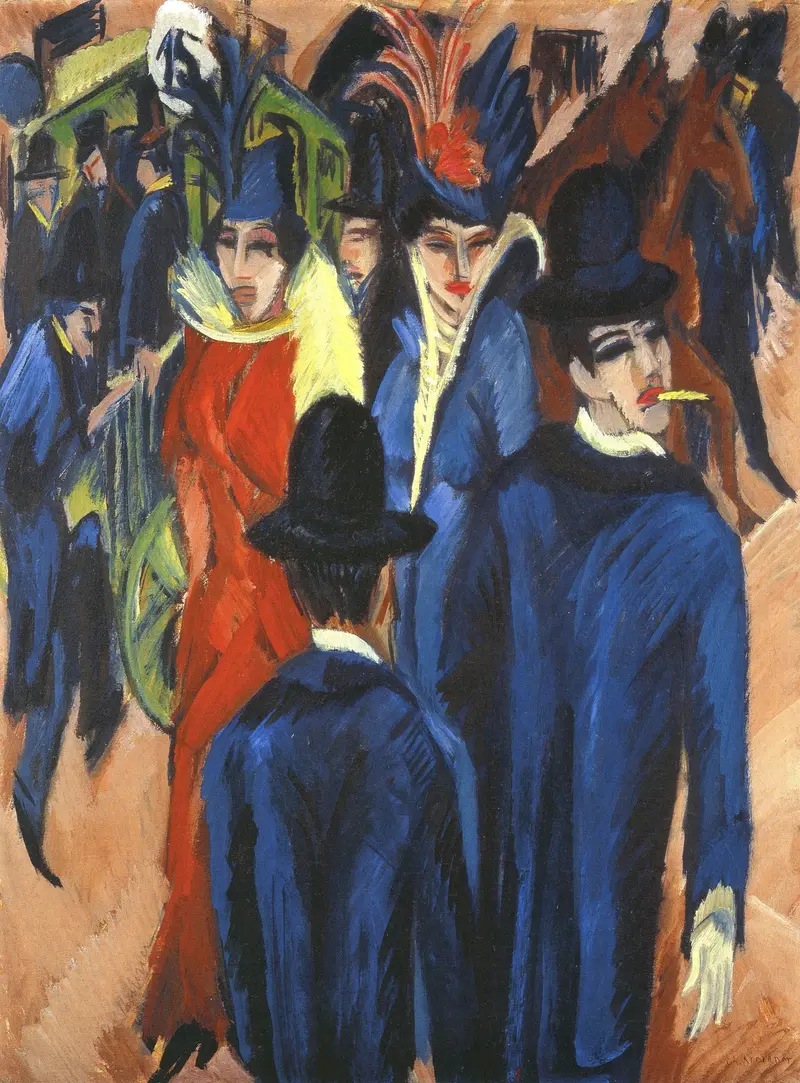
Berlin Street Scene by Ernst Ludwig Kirchner
City: Berlin
1913–1914 · Oil on canvas · 121 × 95 cm
Neue Galerie, New York
Two towering women in tight gowns and feathered hats stride down a crowded Berlin avenue. Ernst Ludwig Kirchner moved to Berlin in 1911, eager to capture what he called "the symphony of the great city," and the Neue Galerie says the figures are modeled on the sisters Erna and Gerda Schilling. Bought for Berlin's Brücke Museum in 1980, the painting was returned in 2006 to the heirs of the Jewish collectors Alfred and Tekla Hess. It now hangs in the Neue Galerie in New York.
Sources: Neue Galerie
No. 20Expressionism
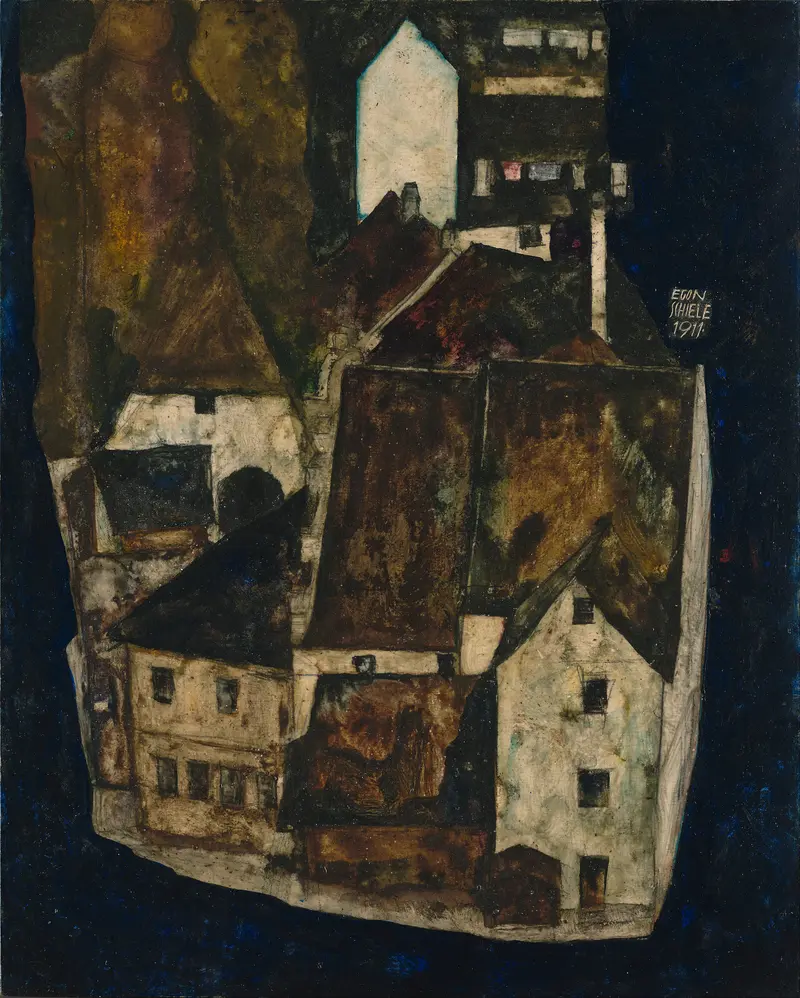
Dead City III by Egon Schiele
City: Krumau (Český Krumlov), Bohemia
1911 · Oil and opaque color on wood · 37.3 × 29.8 cm
Leopold Museum, Vienna
Dark roofs swallow the pale walls like moss, and the only sign of life is a line of washing above a blackish-blue river. Egon Schiele painted Krumau (Český Krumlov), his mother's birthplace in Bohemia, looking down from the castle plateau onto the houses in the bend of the Vltava. He called this small panel the one with the "most serious colors," and the museum reads his Dead City pictures as images of loneliness. It is in the Leopold Museum in Vienna.
Sources: Leopold Museum
No. 21Symbolism
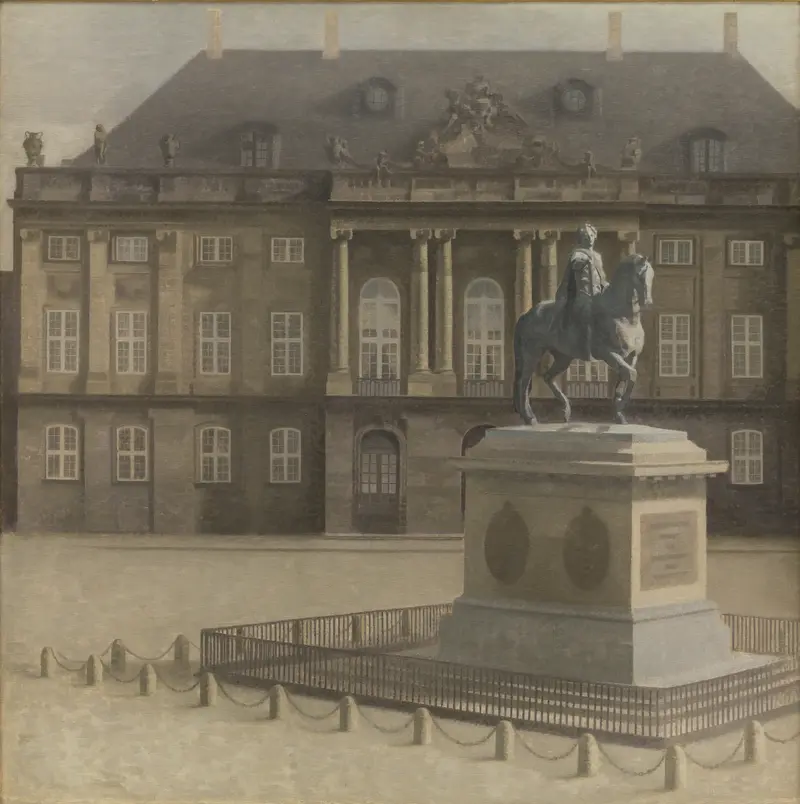
Amalienborg Square, Copenhagen by Vilhelm Hammershøi
City: Amalienborg Square, Copenhagen
1896 · Oil on canvas · 136.5 × 136.5 cm
SMK – National Gallery of Denmark, Copenhagen
Copenhagen's Amalienborg Square stands completely empty around the equestrian statue of King Frederik V. Vilhelm Hammershøi studied the site and got permission to paint it from the second floor of Levetzau's Palace, one of the four Amalienborg palaces, keeping to a tight, neutral palette with no trace of modern life. At 136.5 cm square it is one of his largest pictures. The national gallery bought it in 1896, the year he painted it, and it is in the SMK in Copenhagen.
Sources: SMK – National Gallery of Denmark
No. 22Baroque
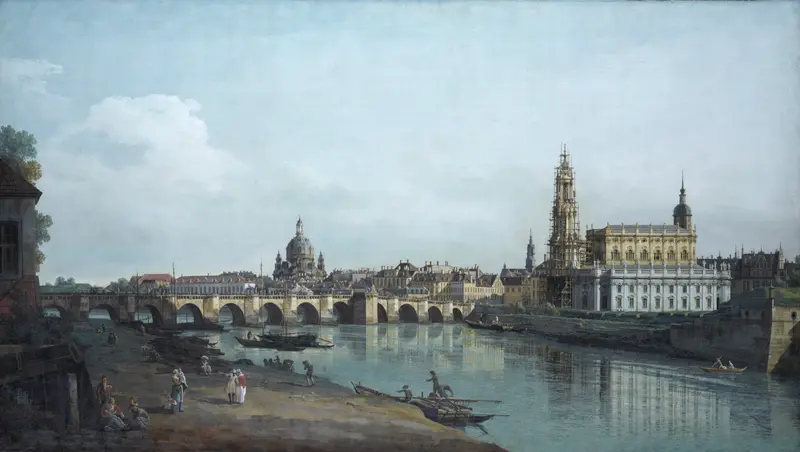
Dresden from the Right Bank of the Elbe below the Augustus Bridge by Bernardo Bellotto
City: Dresden, across the Elbe
1748 · Oil on canvas · 133 × 237 cm
Gemäldegalerie Alte Meister, Dresden
Dresden's Old Town rises across the Elbe beyond the long Augustus Bridge, with the Catholic Court Church on the right. Bernardo Bellotto, Canaletto's nephew and pupil, painted it in 1748 as his second picture in the city, and drew the church tower from the architect's plans because it had not yet been built. No other view has shaped the image of the city as strongly, and Dresden still calls it the "Canaletto view." It is in the Gemäldegalerie Alte Meister in Dresden.
Sources: Gemäldegalerie Alte Meister
No. 23Impressionism
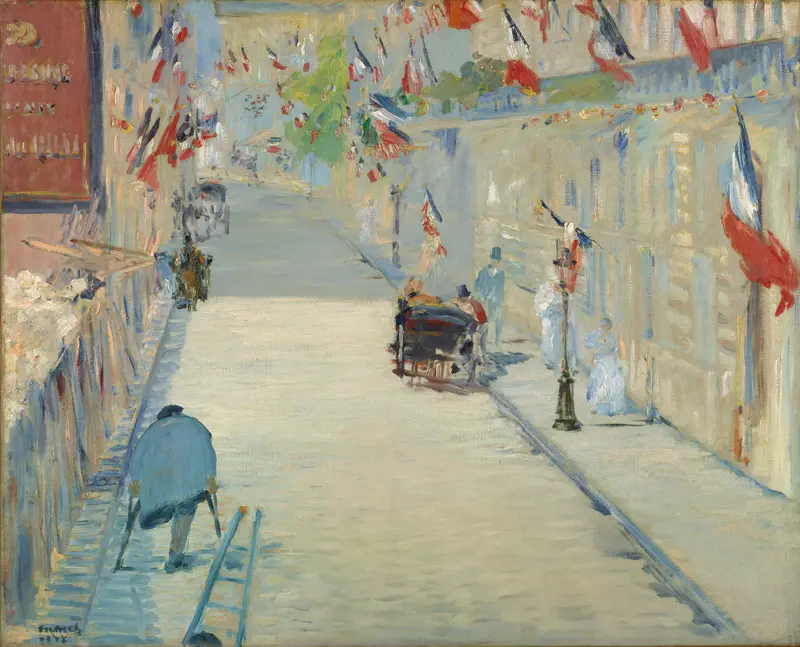
The Rue Mosnier with Flags by Édouard Manet
City: Rue Mosnier (now Rue de Berne), Paris
1878 · Oil on canvas · 65.4 × 80 cm
J. Paul Getty Museum, Los Angeles
French flags hang from the new buildings of the Rue Mosnier on June 30, 1878, a national holiday declared during the Paris world's fair. Édouard Manet painted the street from his studio window above it, in the reds, whites and blues of the flags. In the foreground a hunched man on crutches, perhaps a war veteran, passes the fenced-off works for a new railway line, tempering the festive mood. The street is now the Rue de Berne; the painting is in the J. Paul Getty Museum in Los Angeles.
Sources: J. Paul Getty Museum

No. 24Renaissance
The Ideal City by Unknown artist of central Italy
City: An imagined ideal city
c. 1480–1490 · Oil on panel · 67.7 × 239.4 cm
Galleria Nazionale delle Marche, Urbino
An empty, perfectly symmetrical square opens onto a large round building, perhaps a baptistery or a mausoleum, framed by Renaissance palaces in colored marble. Nobody walks here: the only living things are two doves on a cornice. Once credited to the architect Luciano Laurana among others, the panel is now given to an anonymous painter of central Italy, about 1480–1490, and with related panels in Baltimore and Berlin it was apparently made for the court of Federico da Montefeltro. It is in the Galleria Nazionale delle Marche in Urbino.
Sources: Galleria Nazionale delle Marche
No. 25Impressionism
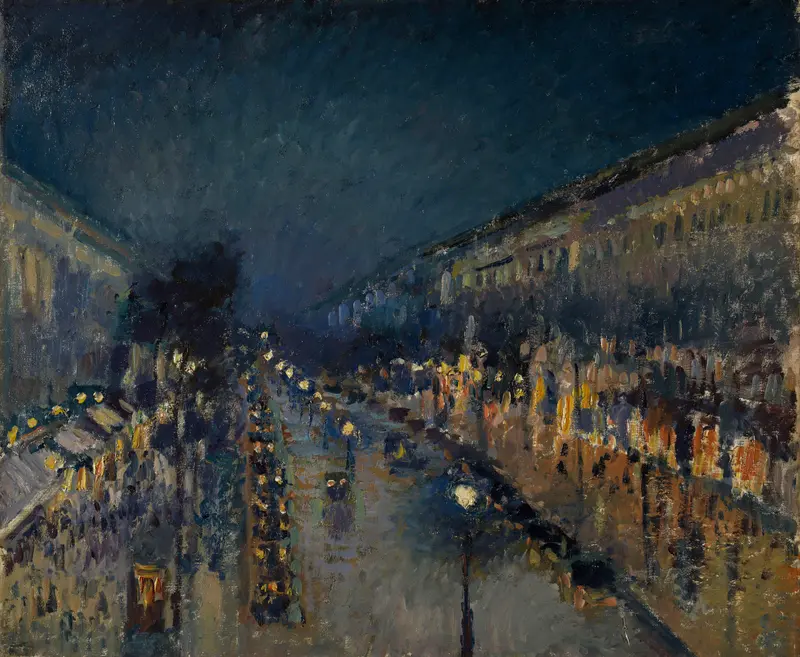
The Boulevard Montmartre at Night by Camille Pissarro
City: Boulevard Montmartre, Paris
1897 · Oil on canvas · 53.3 × 64.8 cm
National Gallery, London
Rain-wet pavement doubles the lights of a Paris boulevard: the cool white of new electric arc lamps, the warm yellow of gaslit shop windows and the red and yellow dots of waiting cabs. Camille Pissarro, then in his late sixties, painted it in 1897 from a hotel room above the street, and it is the only night scene he ever made. It came from his son Lucien's collection and was bought for the nation through the Courtauld Fund in 1925. It is in the National Gallery in London.
Sources: National Gallery
Want to see more? Browse every city painting in the collection.
Browse all 6,731 city paintingsFamous paintings of New York
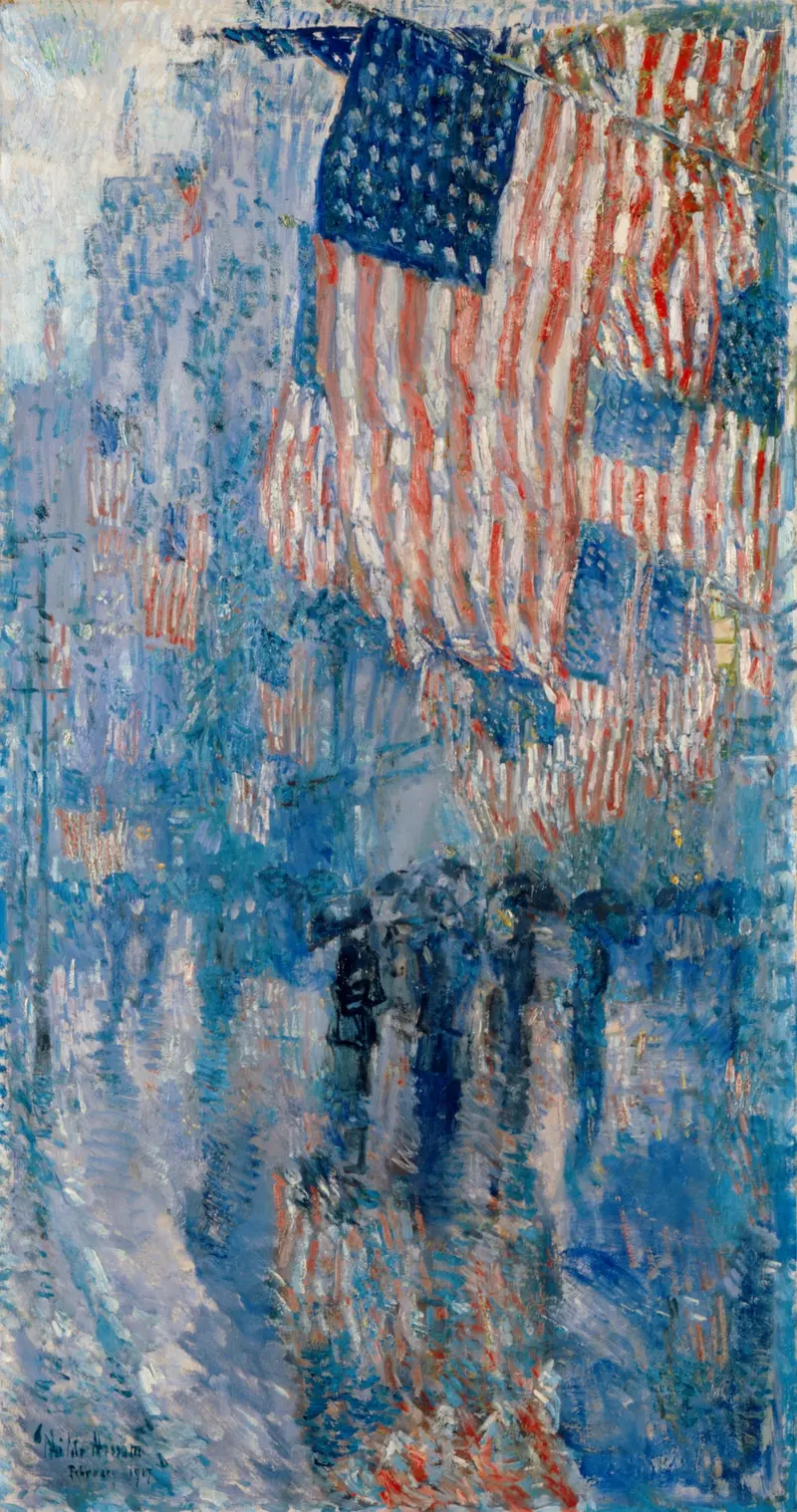
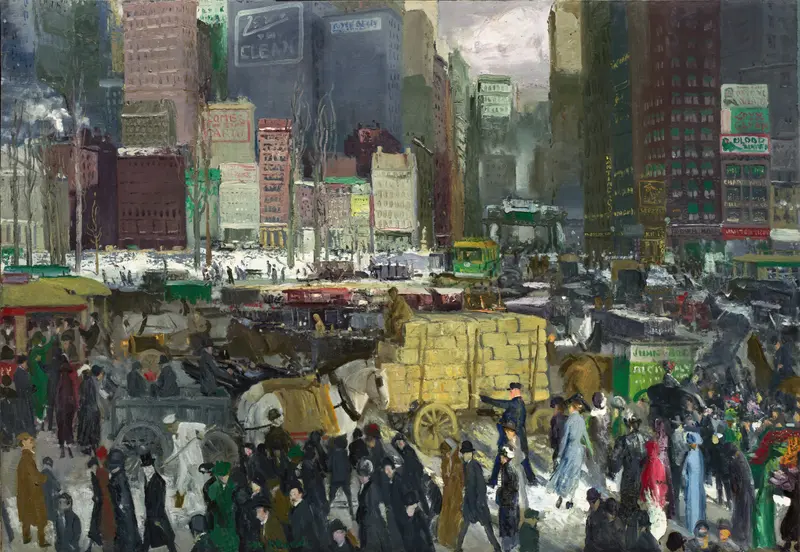
Six famous paintings of New York, from Childe Hassam's flag-hung Fifth Avenue to Joseph Stella's Brooklyn Bridge.
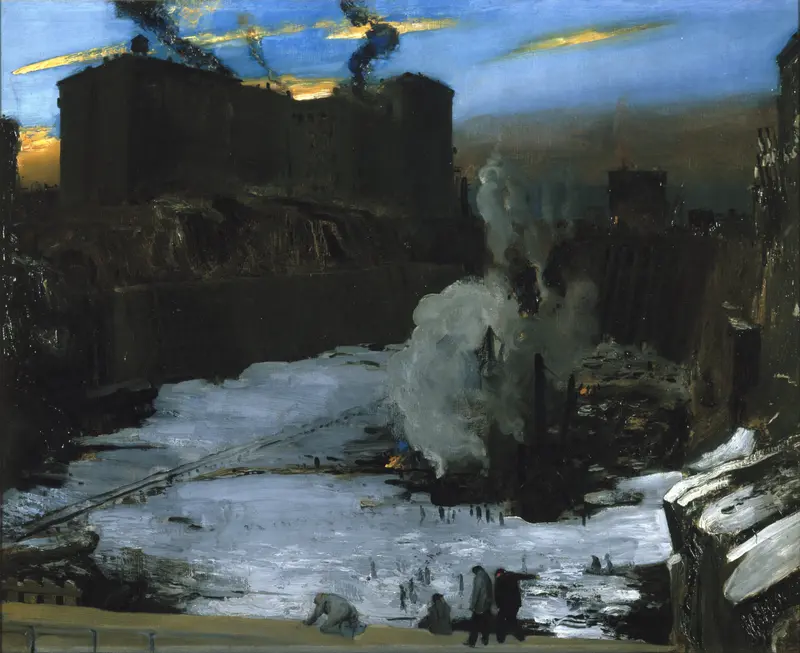

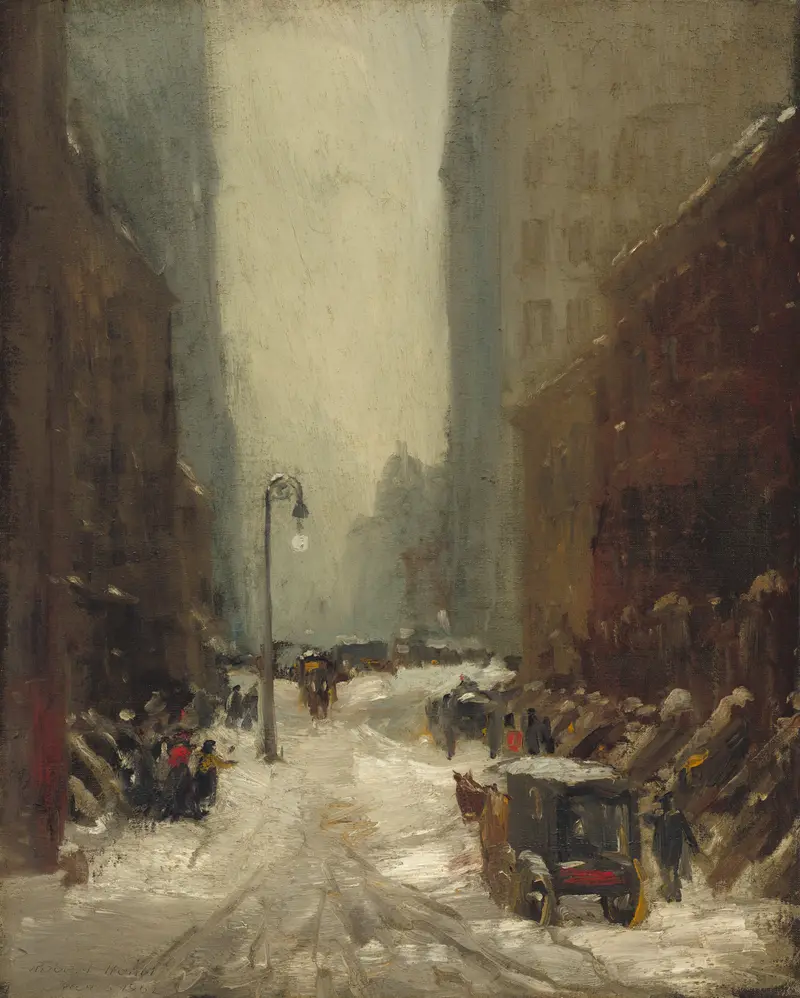
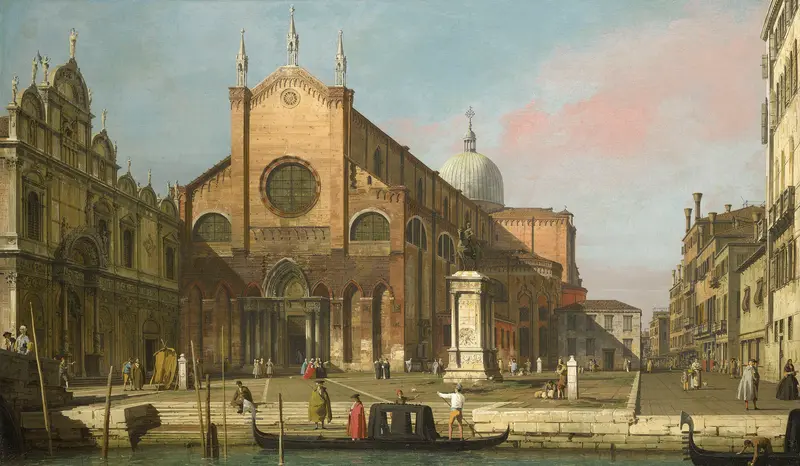
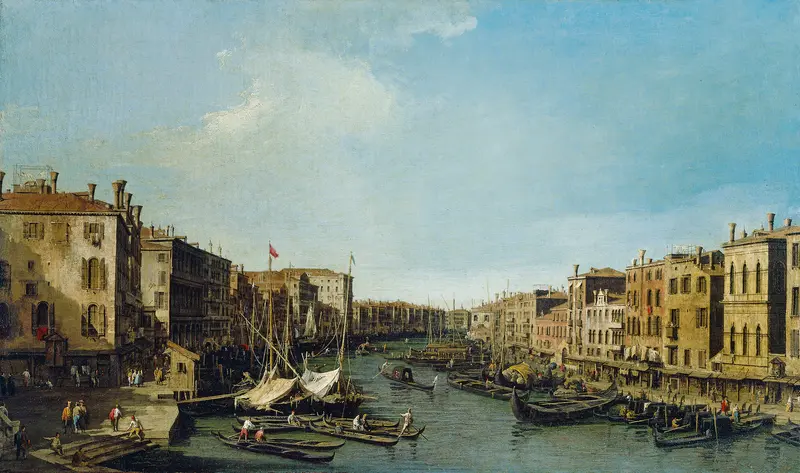
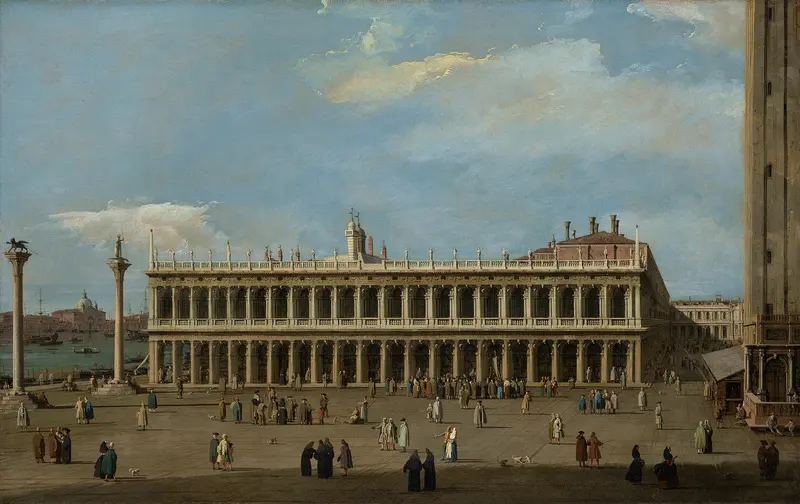
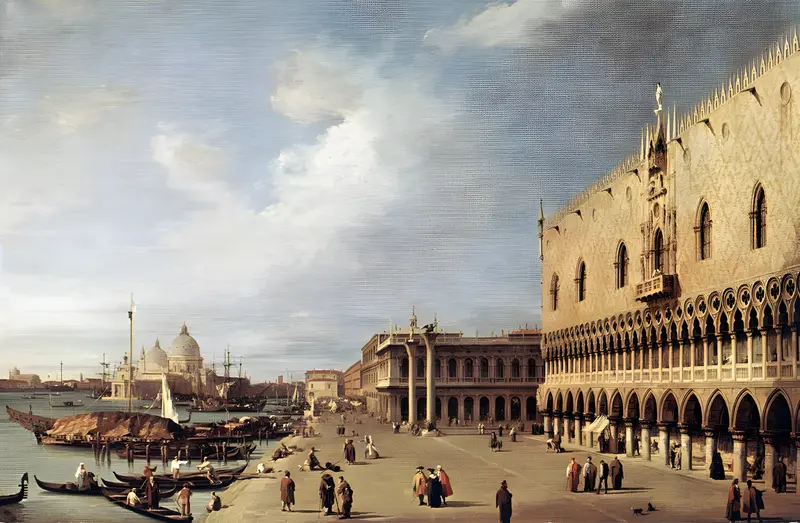
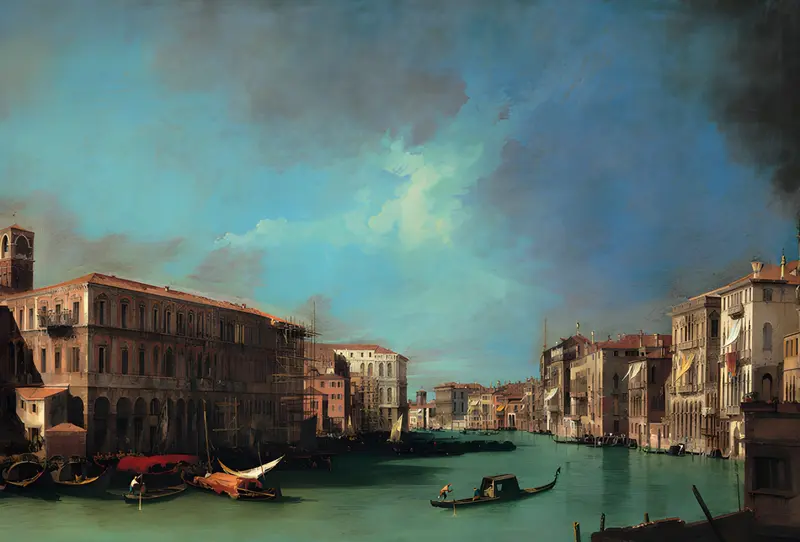
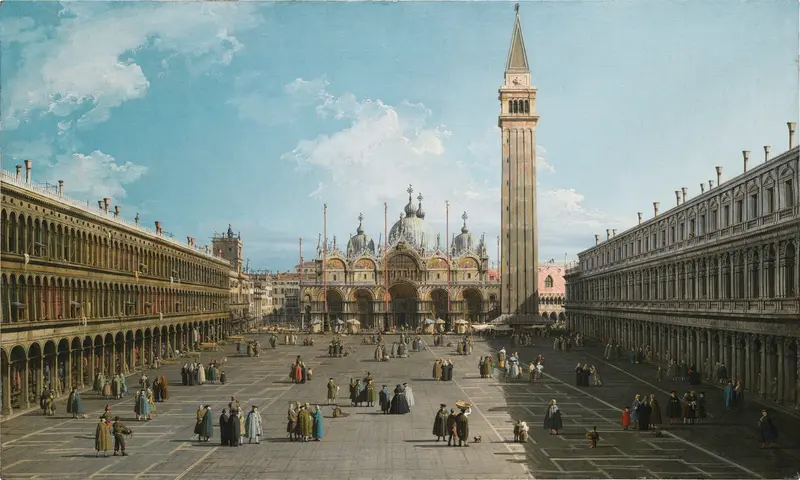
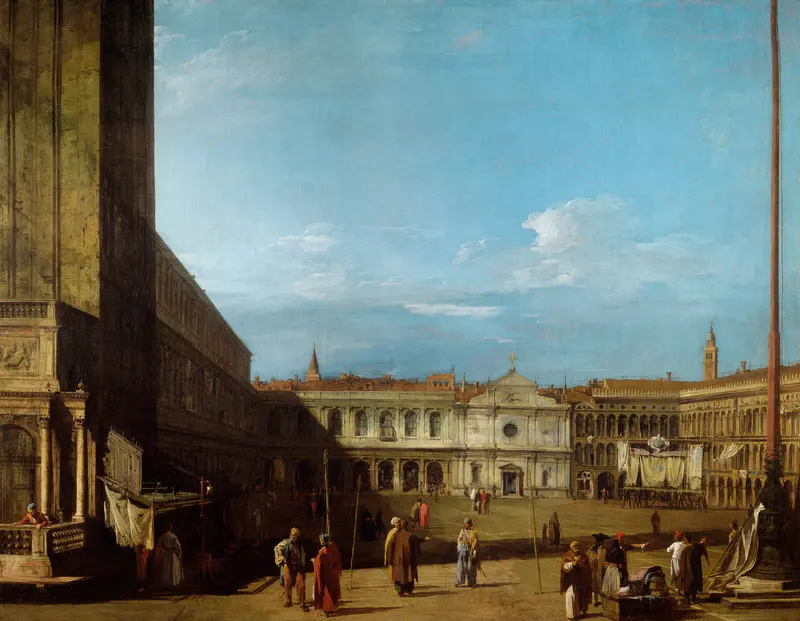
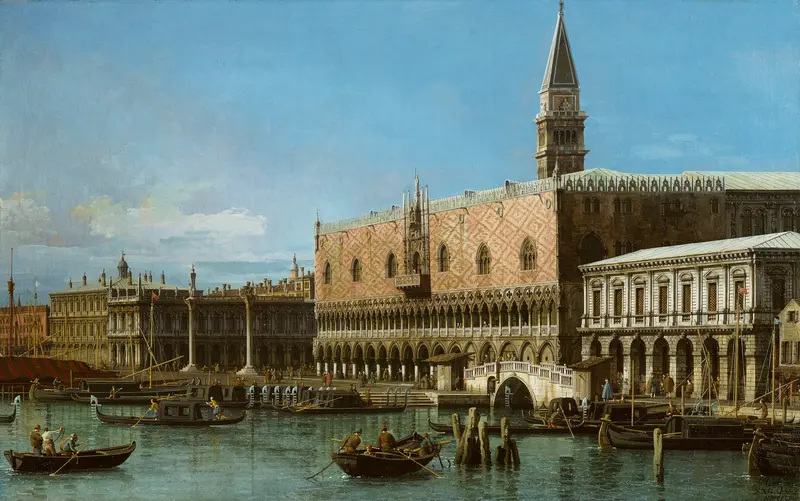
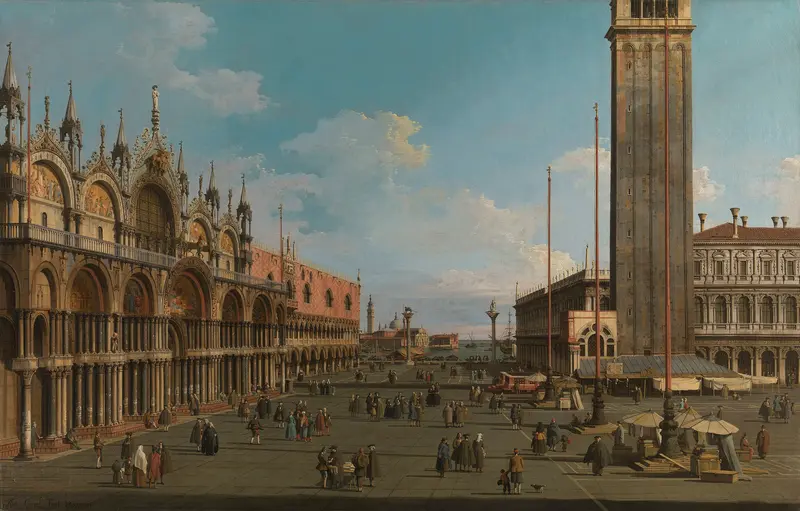
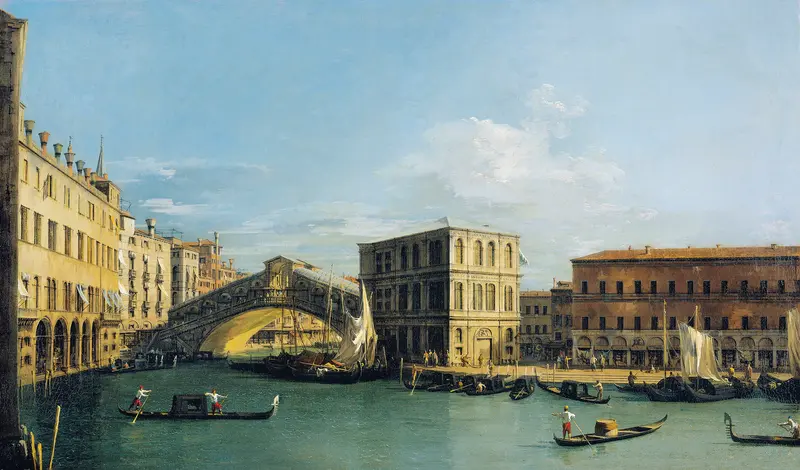
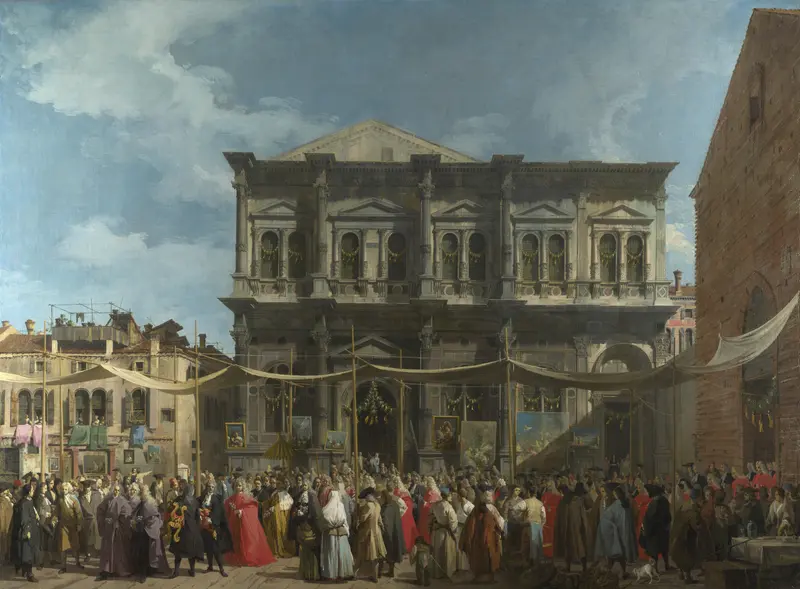
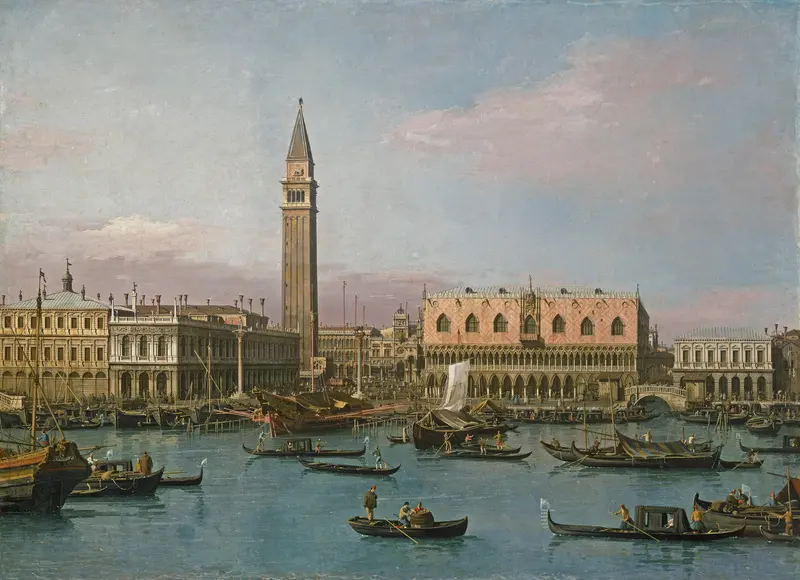
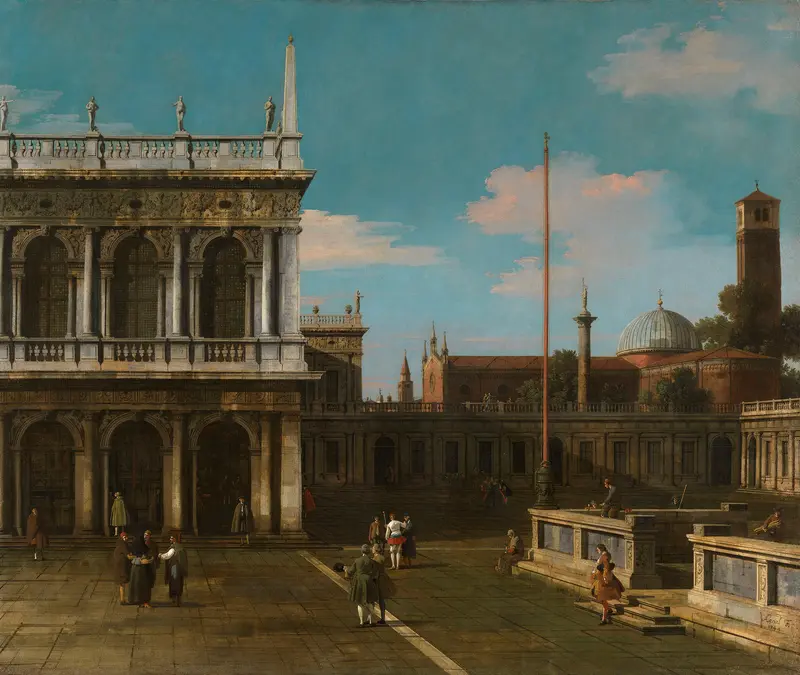
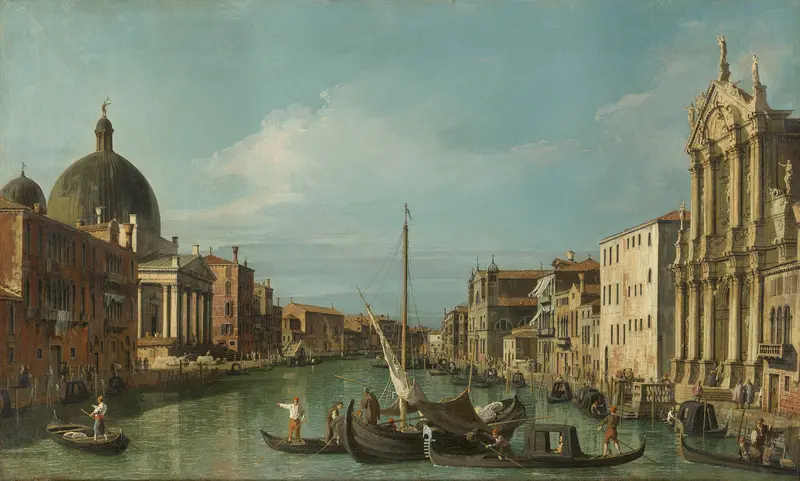
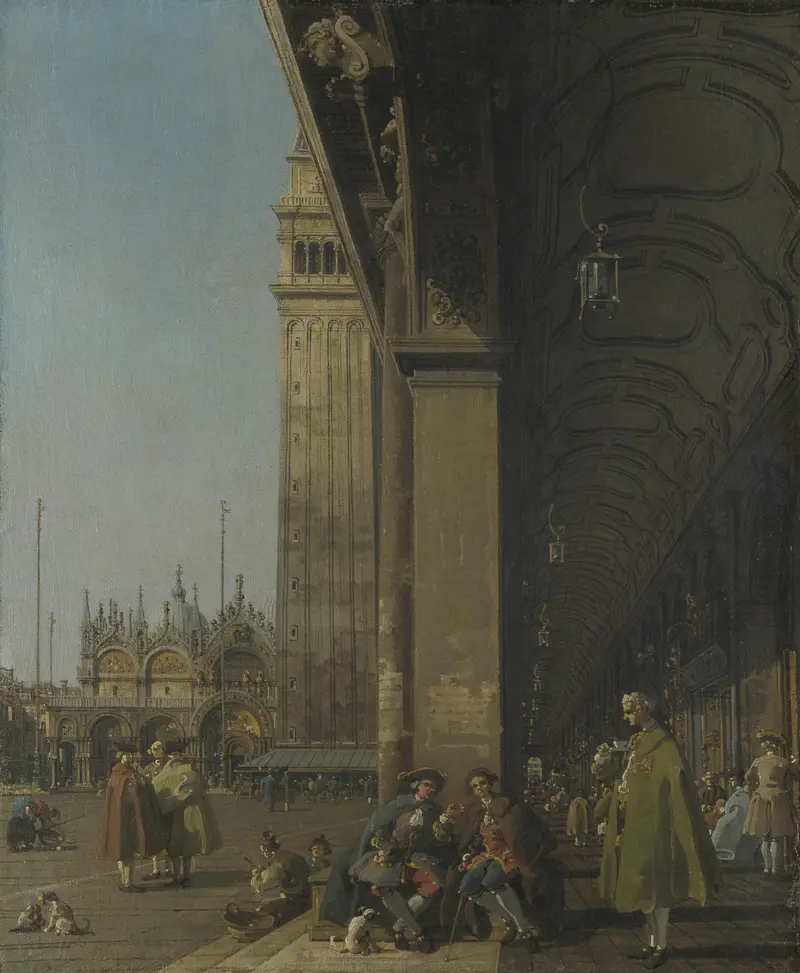
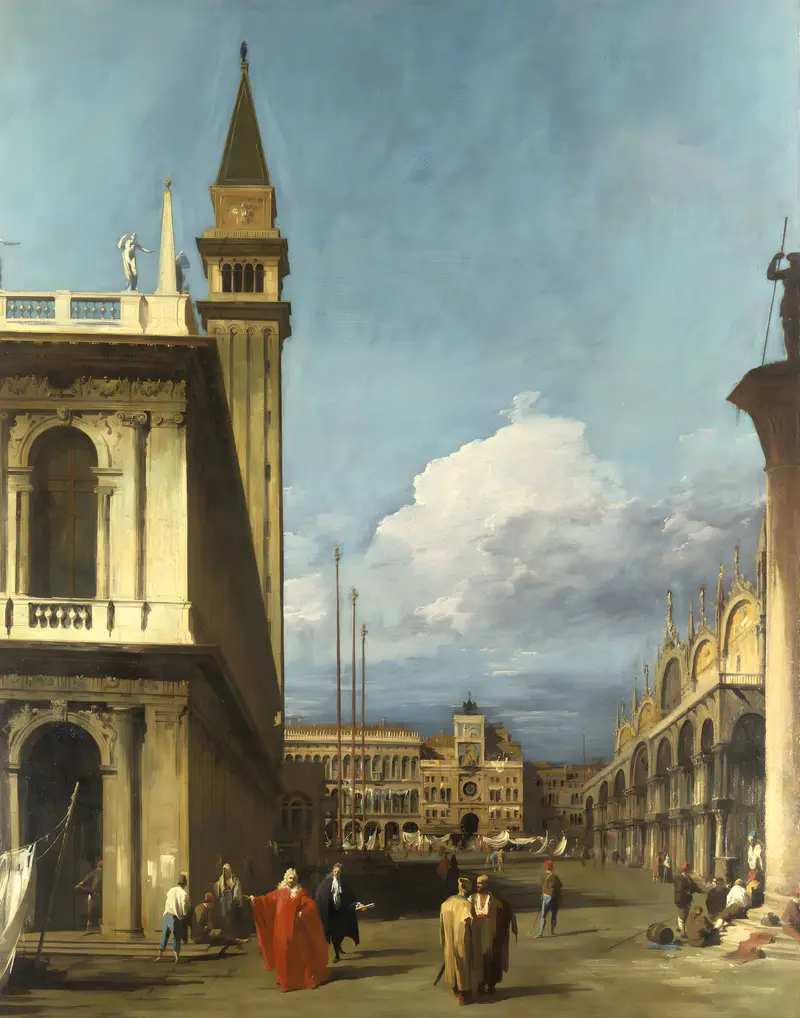
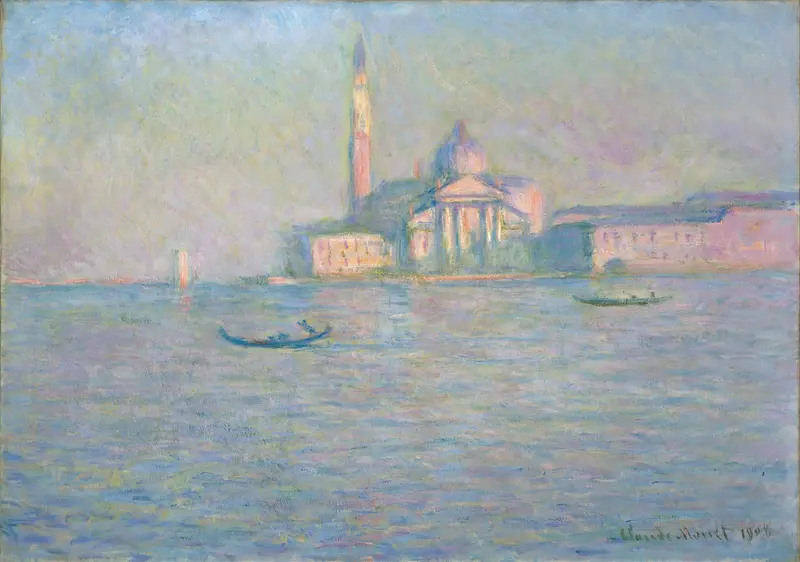
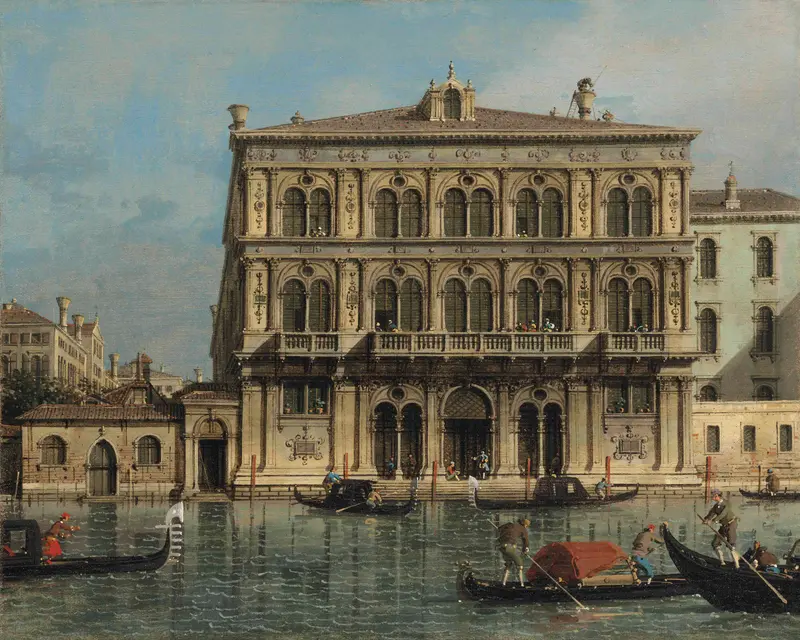
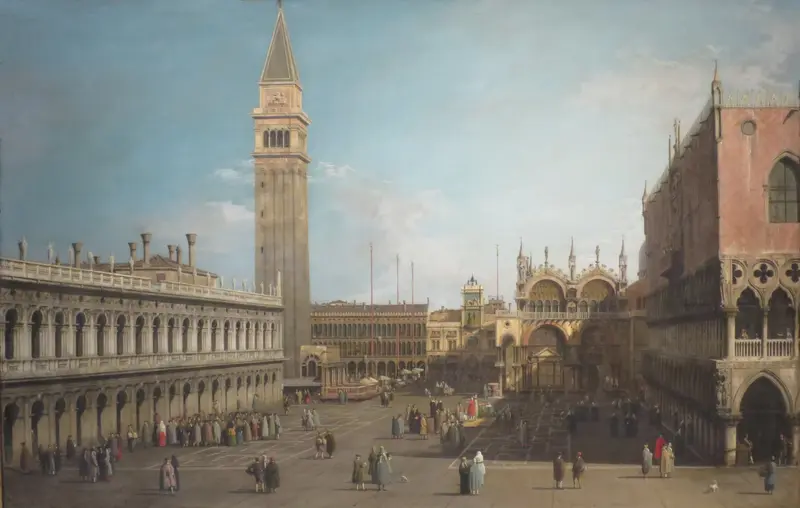
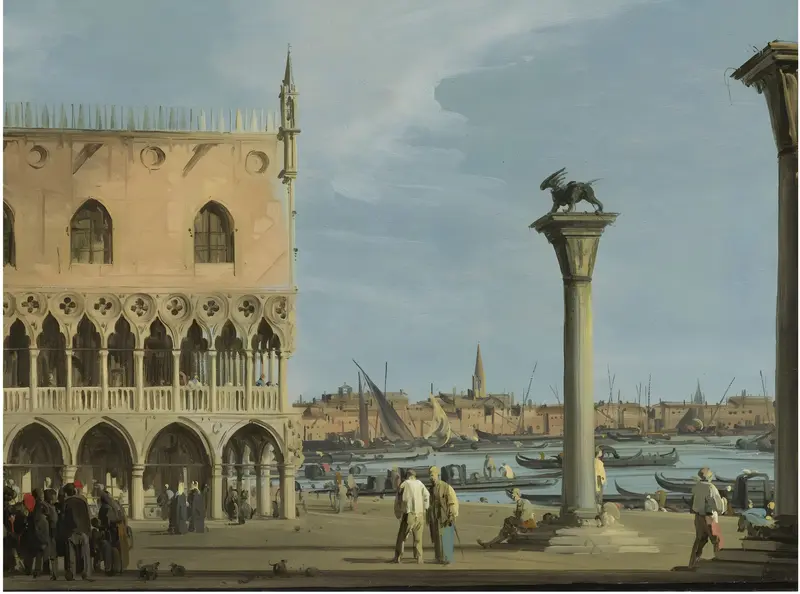
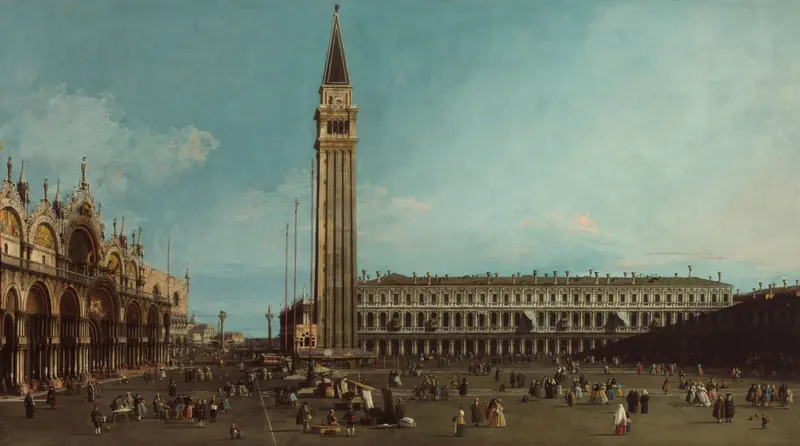
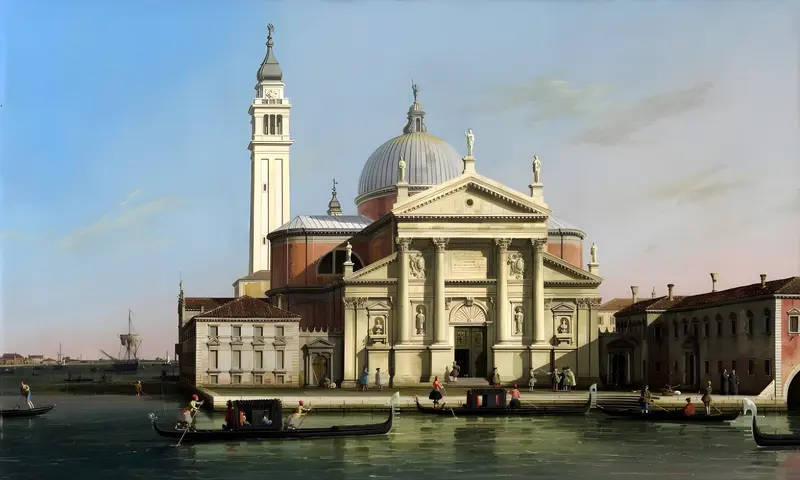
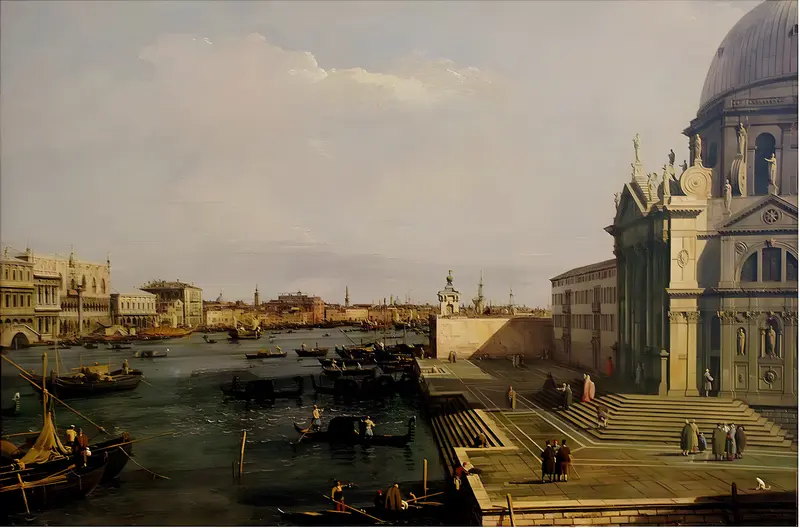
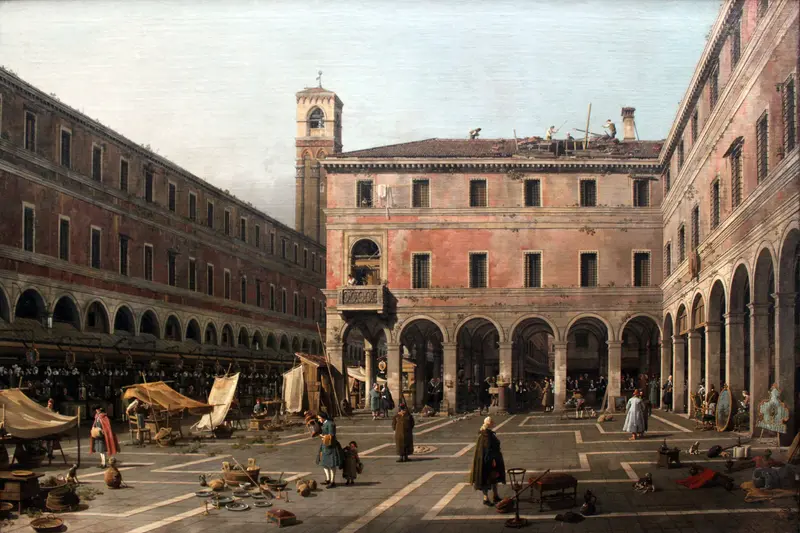
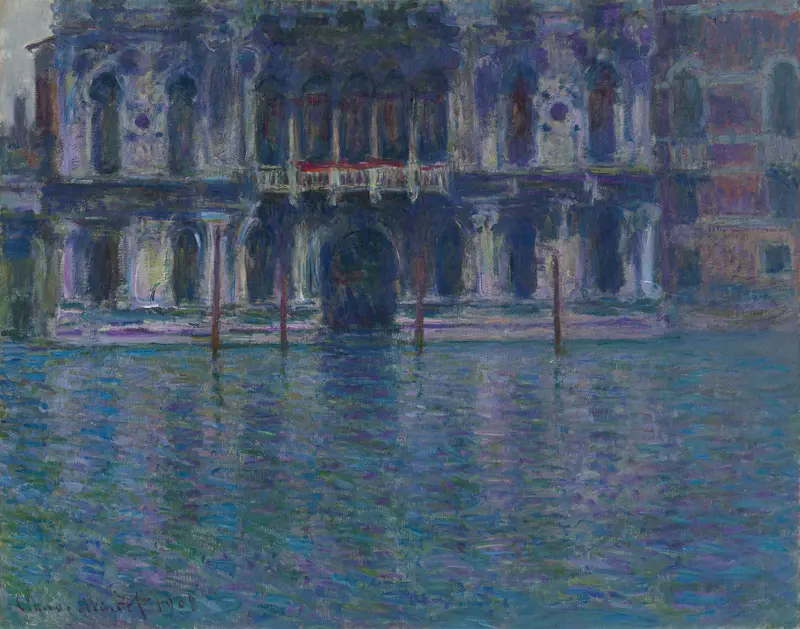
Famous paintings of Venice
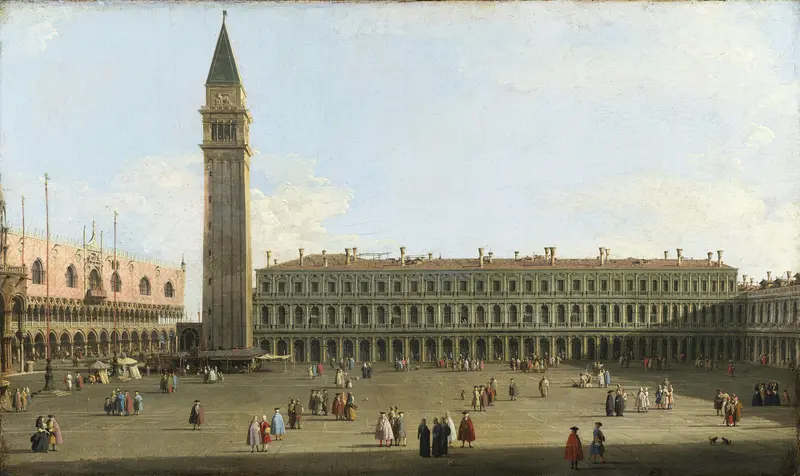
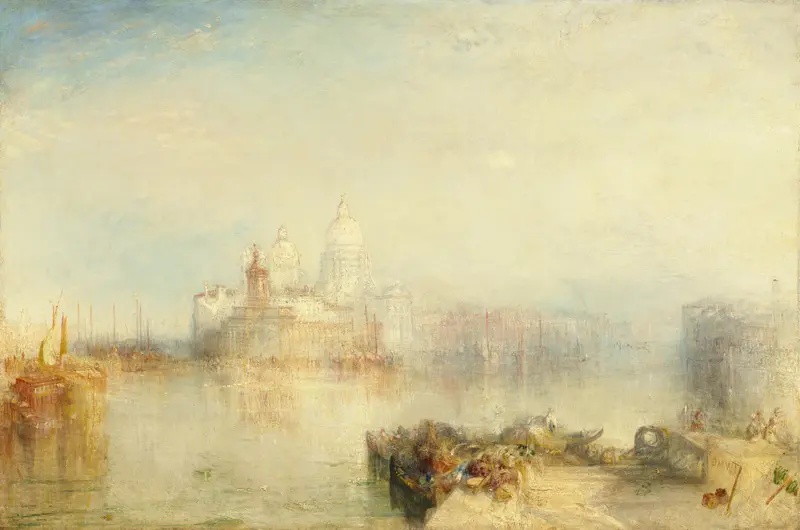
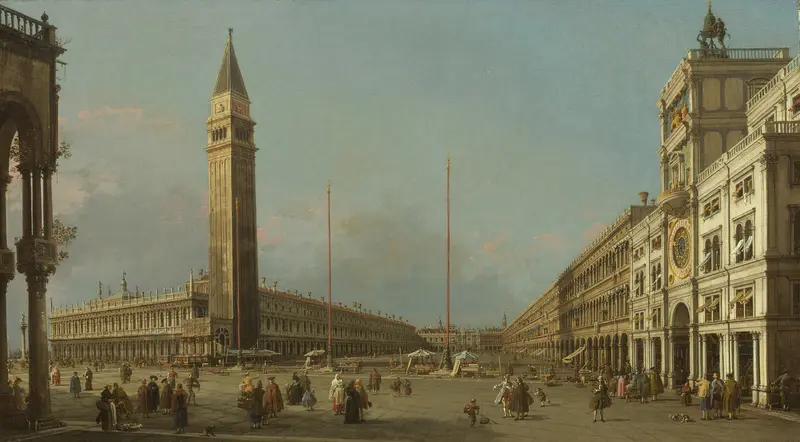
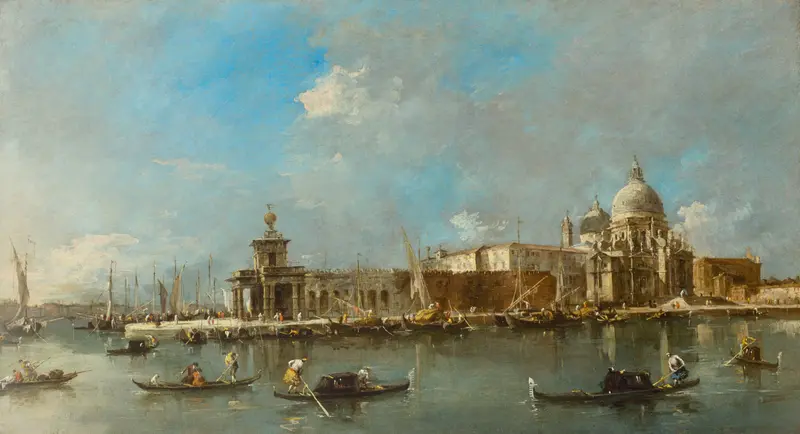
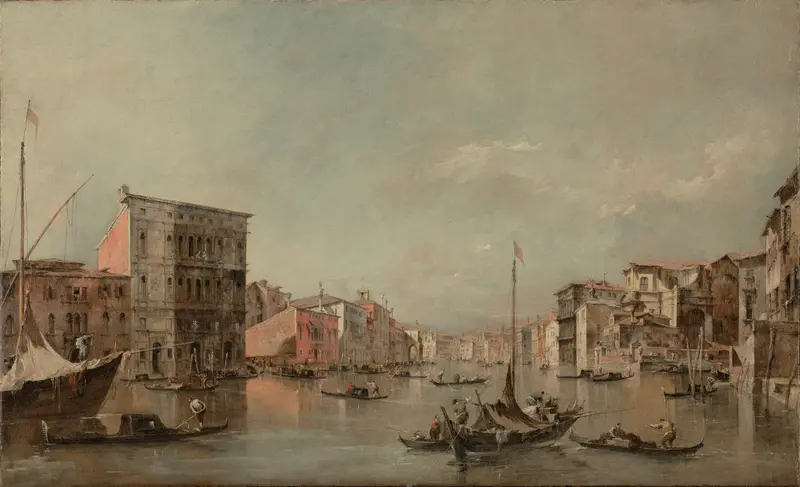
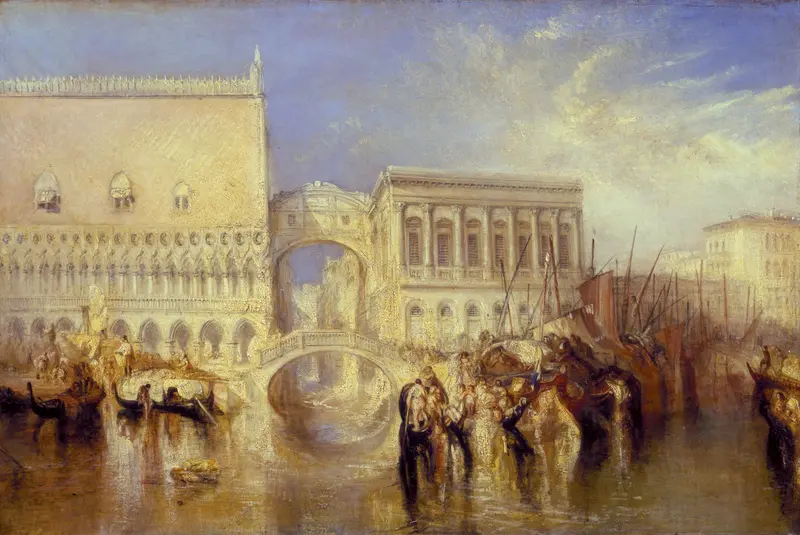
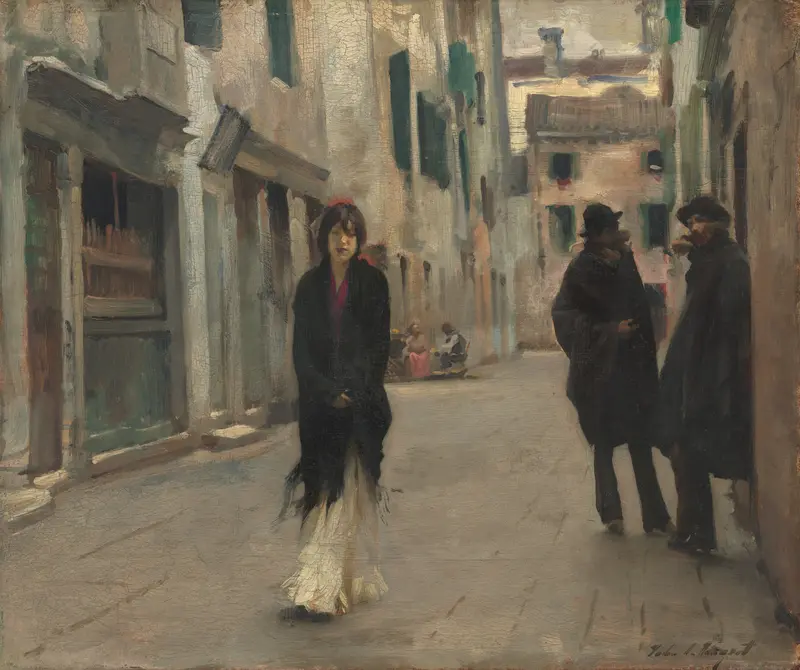
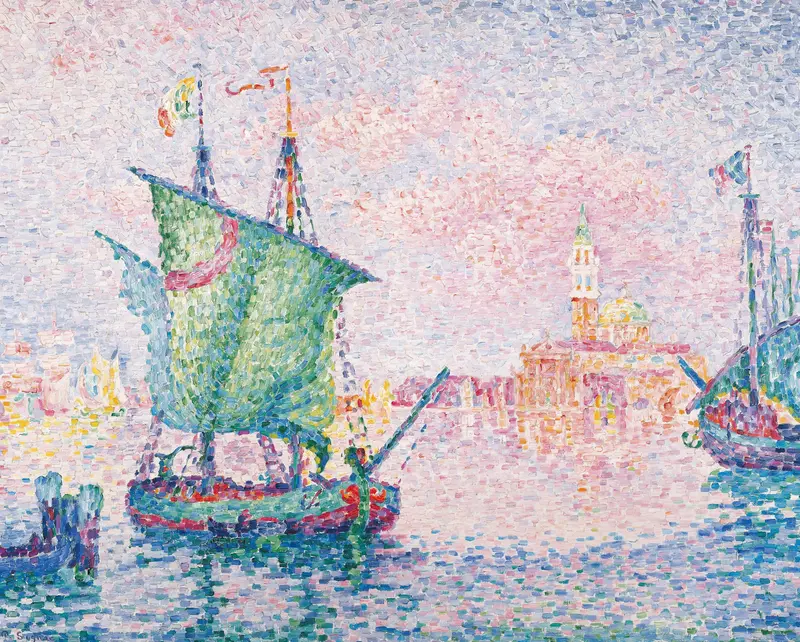
Six famous views of Venice, from Canaletto's Grand Canal to Monet's San Giorgio Maggiore at dusk and Signac's pink cloud.
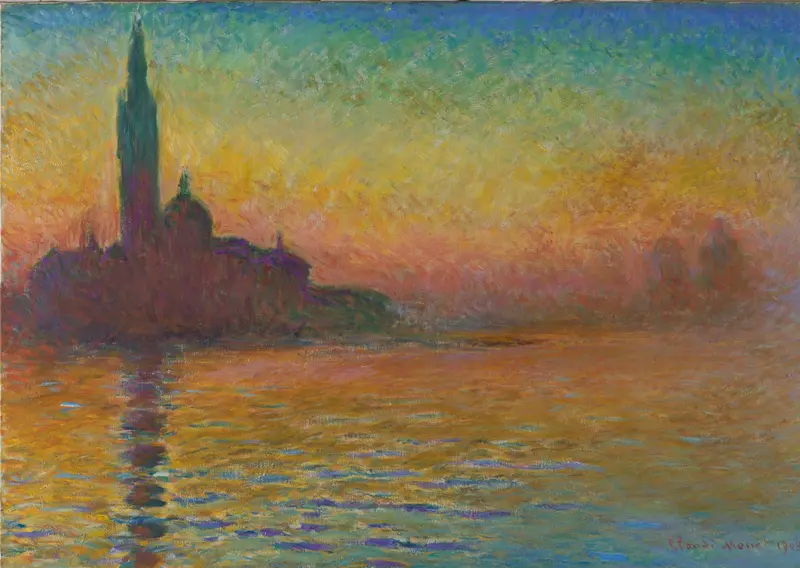
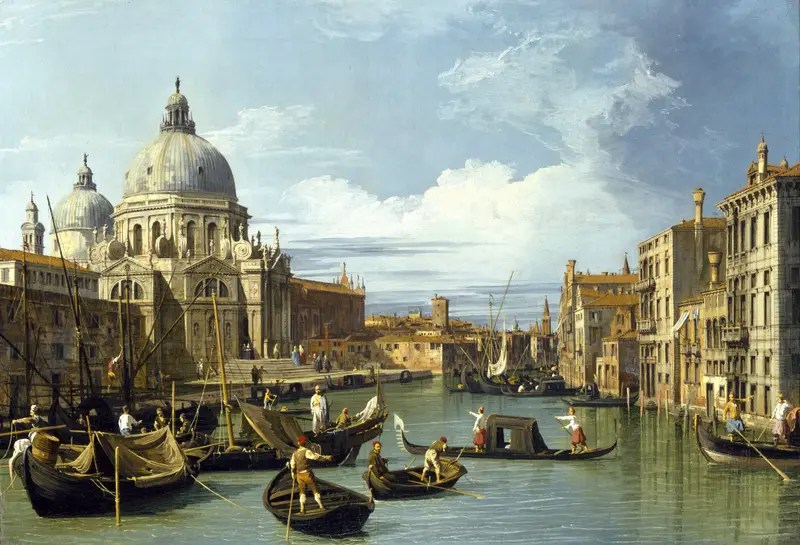
Famous painters of cities
The painters who made the city their subject, from Canaletto's Venice to Pissarro's boulevards. Each link opens all their paintings.
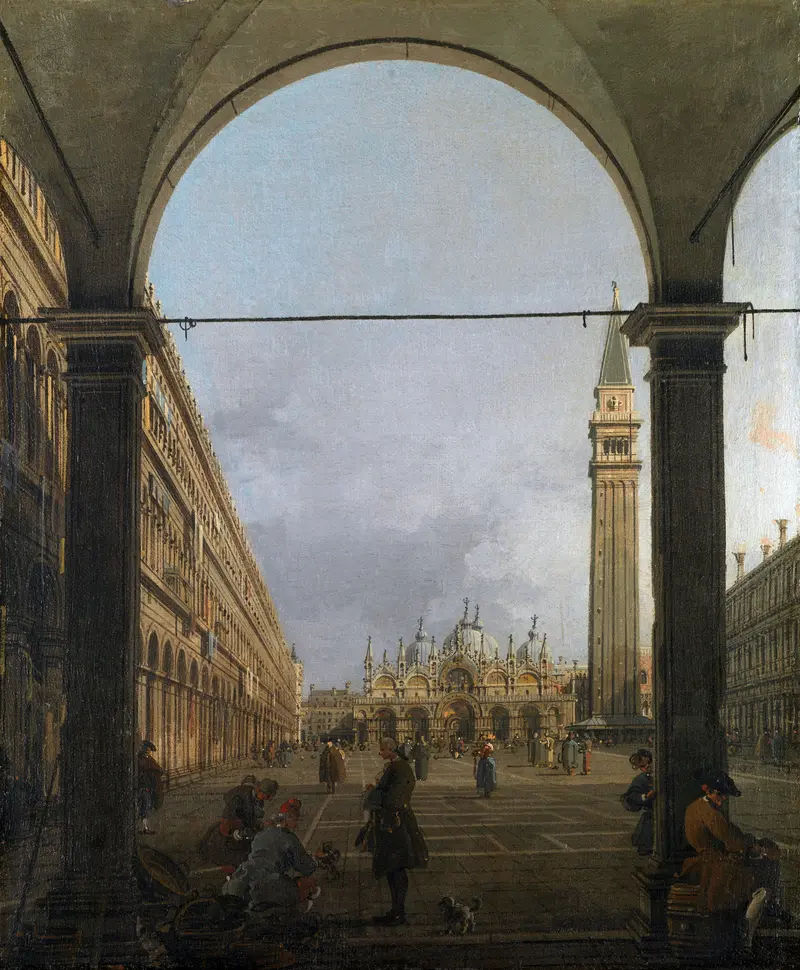
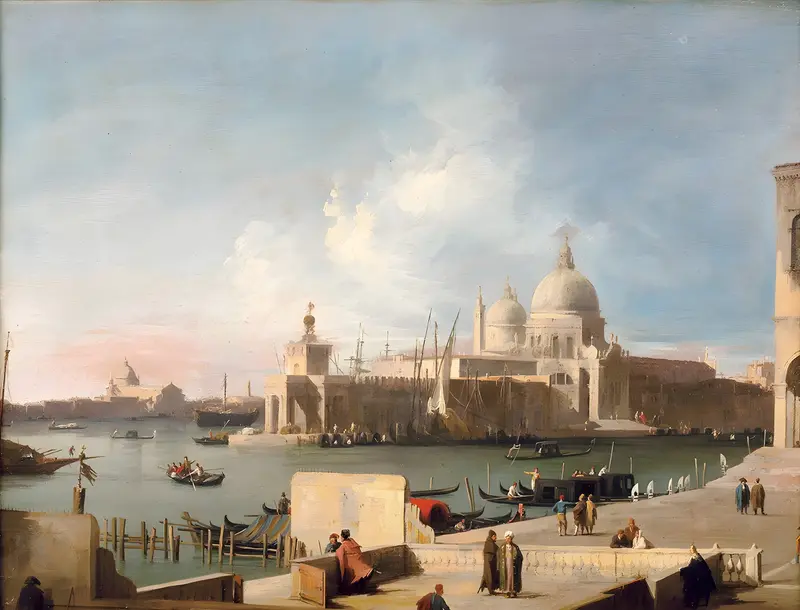
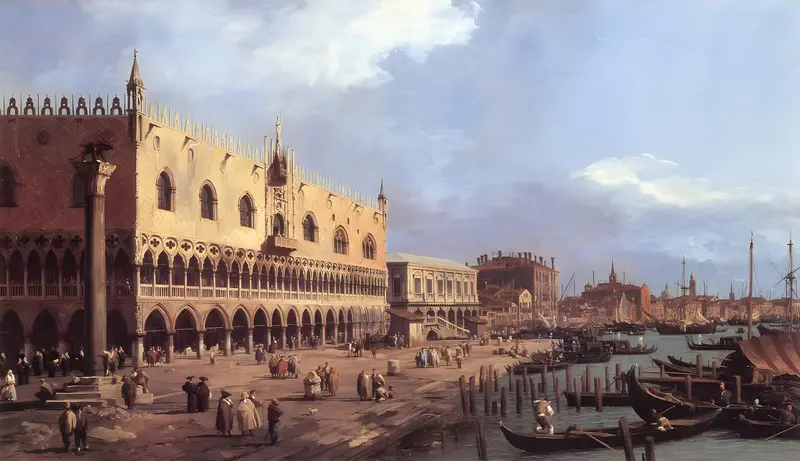
- CanalettoBorn in Venice to a theatrical scene painter, Canaletto was famed for precise city views and may have used a camera obscura for some designs.
- Johannes VermeerVermeer's The Little Street shows Vlamingstraat 40–42 in Delft; his aunt Ariaentgen Claes lived in the house on the right.
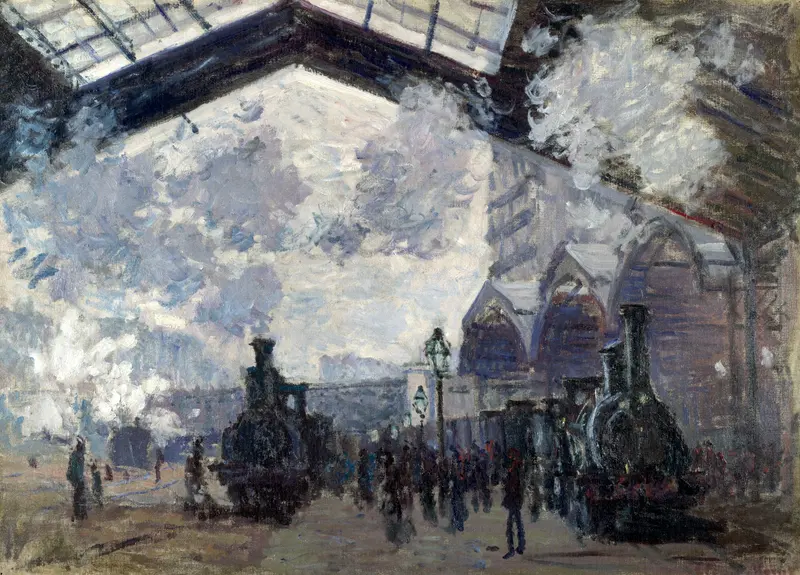
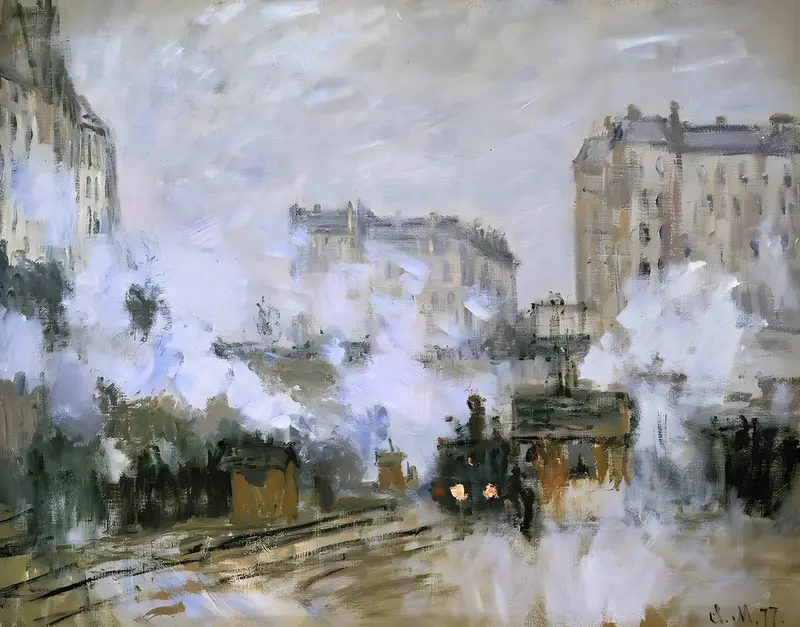
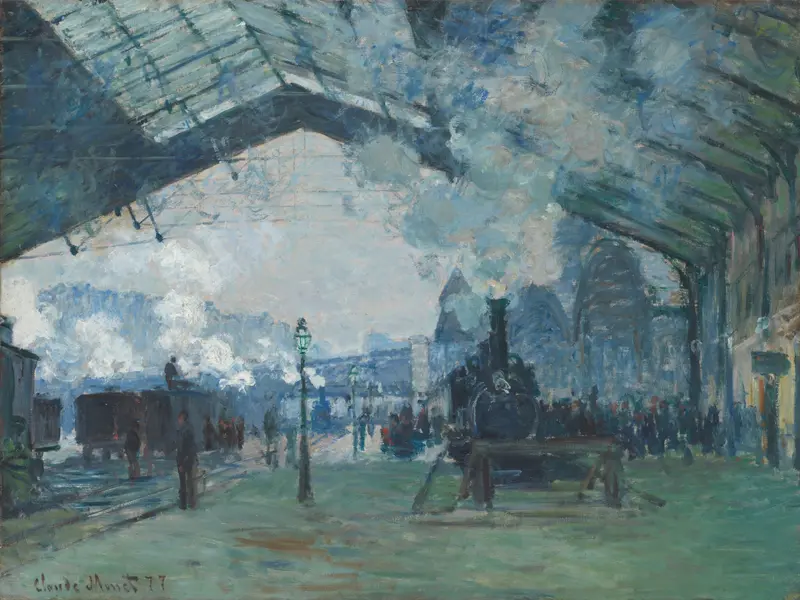
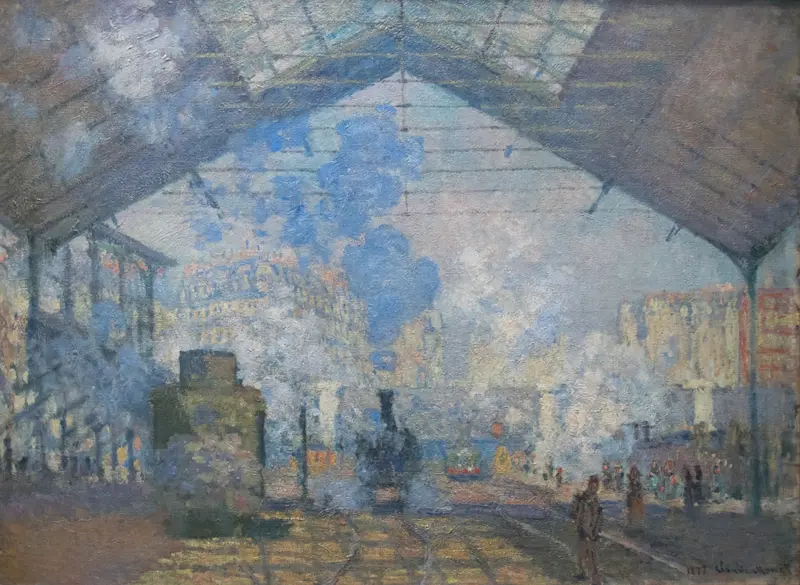
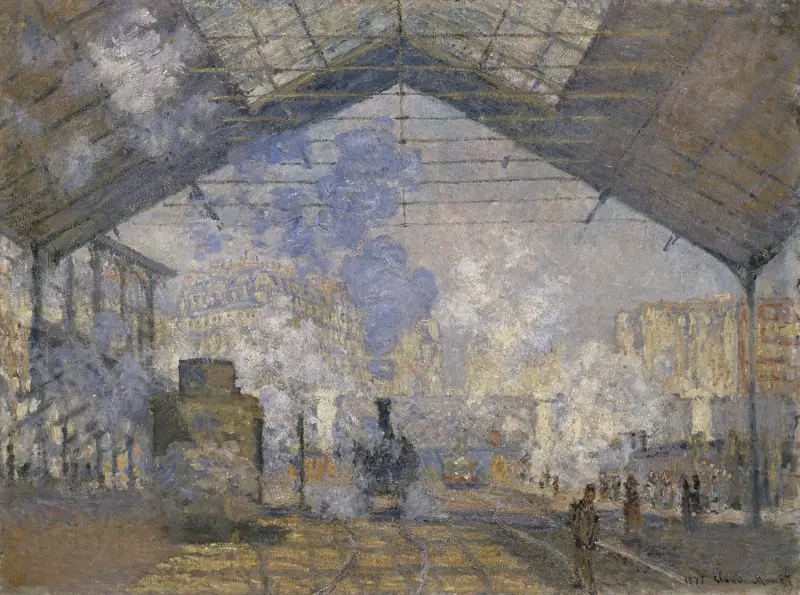
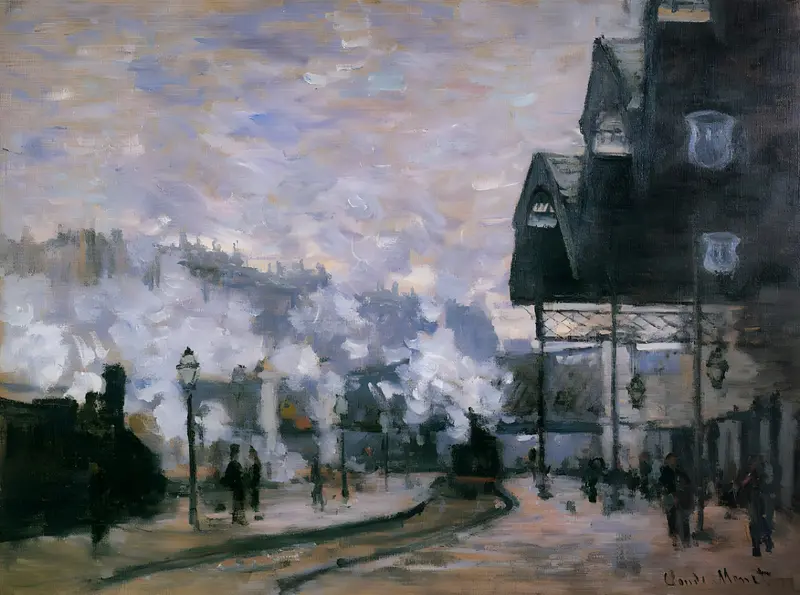
- Claude MonetMonet painted a dozen views of the Gare Saint-Lazare in early 1877, after being granted permission that January to paint the station and its approaches.
- Camille PissarroPissarro, best known for rural scenes, turned in his late sixties to Paris boulevards painted from hotel windows, a change the National Gallery links partly to an eye condition.
- Gustave CaillebotteCaillebotte's Paris pictures rarely go beyond his familiar neighborhoods; Paris Street; Rainy Day shows a busy intersection a short walk from his home.
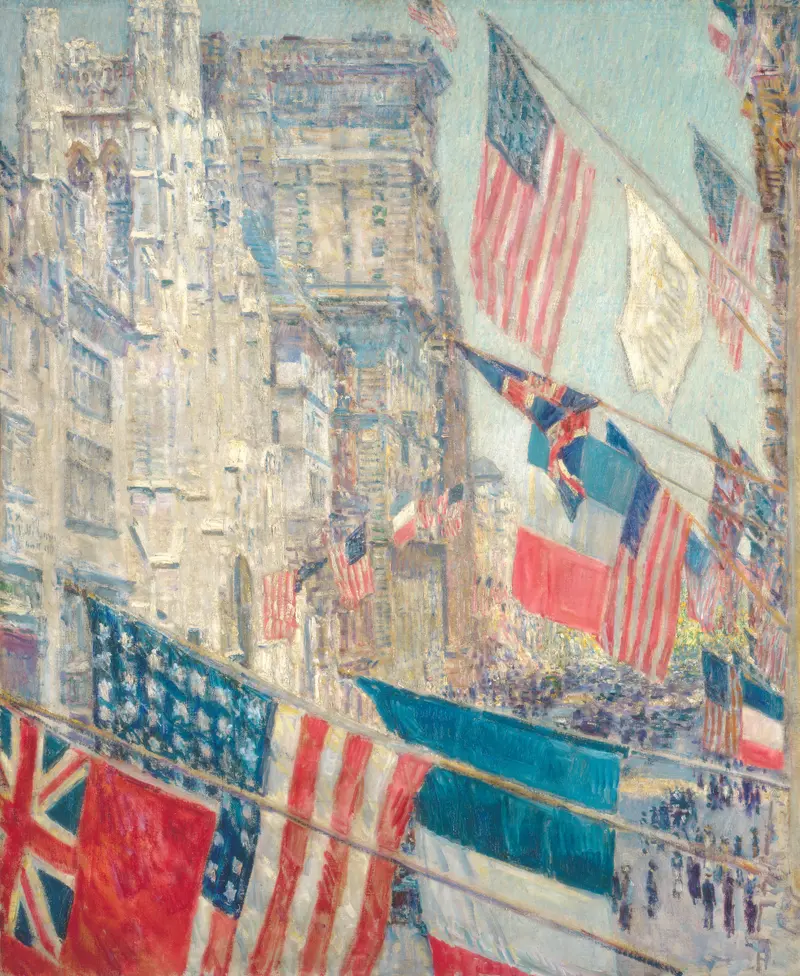 Childe HassamHassam painted some 30 flag-decorated street scenes between 1916 and 1919, works the White House Historical Association calls the climax of his career.
List of famous city paintings and their artists
The 25 most famous city paintings: who painted them, the place they show, when, and where each one is today.
Show the list of 25 city paintingsHide the list
| # | Painting | City | Painted by | Year | Medium | Size | Located in | Museum city |
|---|---|---|---|---|---|---|---|---|
| 1 | View of Delft | Delft, from the south | Johannes Vermeer | c. 1660–1661 | Oil on canvas | 96.5 × 115.7 cm (38 × 45.6 in) | Mauritshuis | The Hague |
| 2 | Café Terrace at Night | Place du Forum, Arles | Vincent van Gogh | 1888 | Oil on canvas | 80.7 × 65.3 cm (31.8 × 25.7 in) | Kröller-Müller Museum | Otterlo |
| 3 | The Tower of Babel | Babel, an imagined port city | Pieter Bruegel the Elder | 1563 | Oil on oak panel | 114.4 × 155.5 cm (45 × 61.2 in) | Kunsthistorisches Museum | Vienna |
| 4 | The Yellow House (The Street) | Place Lamartine, Arles | Vincent van Gogh | 1888 | Oil on canvas | 72 × 91.5 cm (28.3 × 36 in) | Van Gogh Museum | Amsterdam |
| 5 | The Little Street | Vlamingstraat, Delft | Johannes Vermeer | c. 1658 | Oil on canvas | 54.3 × 44 cm (21.4 × 17.3 in) | Rijksmuseum | Amsterdam |
| 6 | Rouen Cathedral, West Façade | Rouen Cathedral, west facade | Claude Monet | 1894 | Oil on canvas | 100.1 × 65.9 cm (39.4 × 25.9 in) | National Gallery of Art | Washington, DC |
| 7 | Paris Street; Rainy Day | Rue de Turin and rue de Moscou, Paris | Gustave Caillebotte | 1877 | Oil on canvas | 212.2 × 276.2 cm (83.5 × 108.7 in) | Art Institute of Chicago | Chicago |
| 8 | The Architect's Dream | An imagined city of building styles | Thomas Cole | 1840 | Oil on canvas | 134.7 × 213.6 cm (53 × 84.1 in) | Toledo Museum of Art | Toledo, Ohio |
| 9 | The City Rises | Milan | Umberto Boccioni | 1910 | Oil on canvas | 199.3 × 301 cm (78.5 × 118.5 in) | Museum of Modern Art | New York |
| 10 | The Houses of Parliament, Sunset | Houses of Parliament, London | Claude Monet | 1903 | Oil on canvas | 81.3 × 92.5 cm (32 × 36.4 in) | National Gallery of Art | Washington, DC |
| 11 | The Stonemason's Yard | Campo San Vidal, Venice | Canaletto | c. 1725 | Oil on canvas | 123.8 × 162.9 cm (48.7 × 64.1 in) | National Gallery | London |
| 12 | Rooftops in the Snow | Paris rooftops | Gustave Caillebotte | 1878 | Oil on canvas | 64.5 × 81 cm (25.4 × 31.9 in) | Musée d'Orsay | Paris |
| 13 | View from the Artist's Window | Copenhagen harbor, from Amaliegade | Martinus Rørbye | c. 1825 | Oil on canvas | 38 × 29.8 cm (15 × 11.7 in) | SMK – National Gallery of Denmark | Copenhagen |
| 14 | Pont Neuf, Paris | Pont Neuf, Paris | Pierre-Auguste Renoir | 1872 | Oil on canvas | 75.3 × 93.7 cm (29.6 × 36.9 in) | National Gallery of Art | Washington, DC |
| 15 | A View through Three Arches of the Colosseum | Rome, from the Colosseum | Christoffer Wilhelm Eckersberg | 1815 | Oil on canvas | 32 × 49.5 cm (12.6 × 19.5 in) | SMK – National Gallery of Denmark | Copenhagen |
| 16 | The Eiffel Tower | Eiffel Tower, Paris | Georges Seurat | c. 1889 | Oil on wood panel | 24.1 × 15.2 cm (9.5 × 6 in) | Legion of Honor | San Francisco |
| 17 | Place de la Concorde | Place de la Concorde, Paris | Edgar Degas | 1875 | Oil on canvas | 78.4 × 117.5 cm (30.9 × 46.3 in) | Hermitage Museum | St. Petersburg |
| 18 | A View of Delft | Delft, toward the Nieuwe Kerk | Carel Fabritius | 1652 | Oil on canvas | 15.5 × 31.7 cm (6.1 × 12.5 in) | National Gallery | London |
| 19 | Berlin Street Scene | Berlin | Ernst Ludwig Kirchner | 1913–1914 | Oil on canvas | 121 × 95 cm (47.6 × 37.4 in) | Neue Galerie | New York |
| 20 | Dead City III | Krumau (Český Krumlov), Bohemia | Egon Schiele | 1911 | Oil and opaque color on wood | 37.3 × 29.8 cm (14.7 × 11.7 in) | Leopold Museum | Vienna |
| 21 | Amalienborg Square, Copenhagen | Amalienborg Square, Copenhagen | Vilhelm Hammershøi | 1896 | Oil on canvas | 136.5 × 136.5 cm (53.7 × 53.7 in) | SMK – National Gallery of Denmark | Copenhagen |
| 22 | Dresden from the Right Bank of the Elbe below the Augustus Bridge | Dresden, across the Elbe | Bernardo Bellotto | 1748 | Oil on canvas | 133 × 237 cm (52.4 × 93.3 in) | Gemäldegalerie Alte Meister | Dresden |
| 23 | The Rue Mosnier with Flags | Rue Mosnier (now Rue de Berne), Paris | Édouard Manet | 1878 | Oil on canvas | 65.4 × 80 cm (25.7 × 31.5 in) | J. Paul Getty Museum | Los Angeles |
| 24 | The Ideal City | An imagined ideal city | Unknown artist of central Italy | c. 1480–1490 | Oil on panel | 67.7 × 239.4 cm (26.7 × 94.3 in) | Galleria Nazionale delle Marche | Urbino |
| 25 | The Boulevard Montmartre at Night | Boulevard Montmartre, Paris | Camille Pissarro | 1897 | Oil on canvas | 53.3 × 64.8 cm (21 × 25.5 in) | National Gallery | London |
Famous city paintings: questions and answers
What is the most famous painting of a city?
There is no official answer, but two pictures are named most often. The Mauritshuis calls Johannes Vermeer's View of Delft (c. 1660–1661) "the most famous cityscape of the Dutch Golden Age," praising its light and shade, cloudy sky and reflections. The other is Vincent van Gogh's Café Terrace at Night (1888): the Kröller-Müller Museum notes he painted the gas-lit café in Arles on the spot and in the dark, with bright colors instead of the usual black and gray.
Sources: Mauritshuis via Google Arts & Culture · Kröller-Müller Museum
What is a cityscape painting called?
A painting of a city is usually called a cityscape, or a townscape when it shows a smaller town; the Getty's Art & Architecture Thesaurus lists both terms. The Italian word is veduta (plural vedute), which the National Gallery in London defines as a topographical view, especially one with architectural elements. Painters who specialized in them, such as Canaletto, Bellotto and Guardi, are called vedutisti. When real buildings are rearranged into an imaginary scene, the picture is a capriccio.
Sources: National Gallery, London: Glossary, Vedute · National Gallery, London: Glossary, Capriccios · Getty Art & Architecture Thesaurus: vedutisti · Getty Art & Architecture Thesaurus: cityscapes
Why did the Impressionists paint Paris streets?
Because Paris was being rebuilt around them. Baron Haussmann, Prefect of the Seine under the Second Empire (1852–1870), tore down cramped medieval quarters for wide boulevards and parks, and the National Gallery says these new spaces fascinated Manet, Monet and Renoir. Caillebotte painted the grand new boulevards meeting at a busy intersection in Paris Street; Rainy Day, Monet painted the new Gare Saint-Lazare, and Pissarro painted the Boulevard Montmartre from a hotel window.
Sources: National Gallery, London: The Boulevard Montmartre at Night · Art Institute of Chicago: Paris Street; Rainy Day · National Gallery, London: The Gare St-Lazare
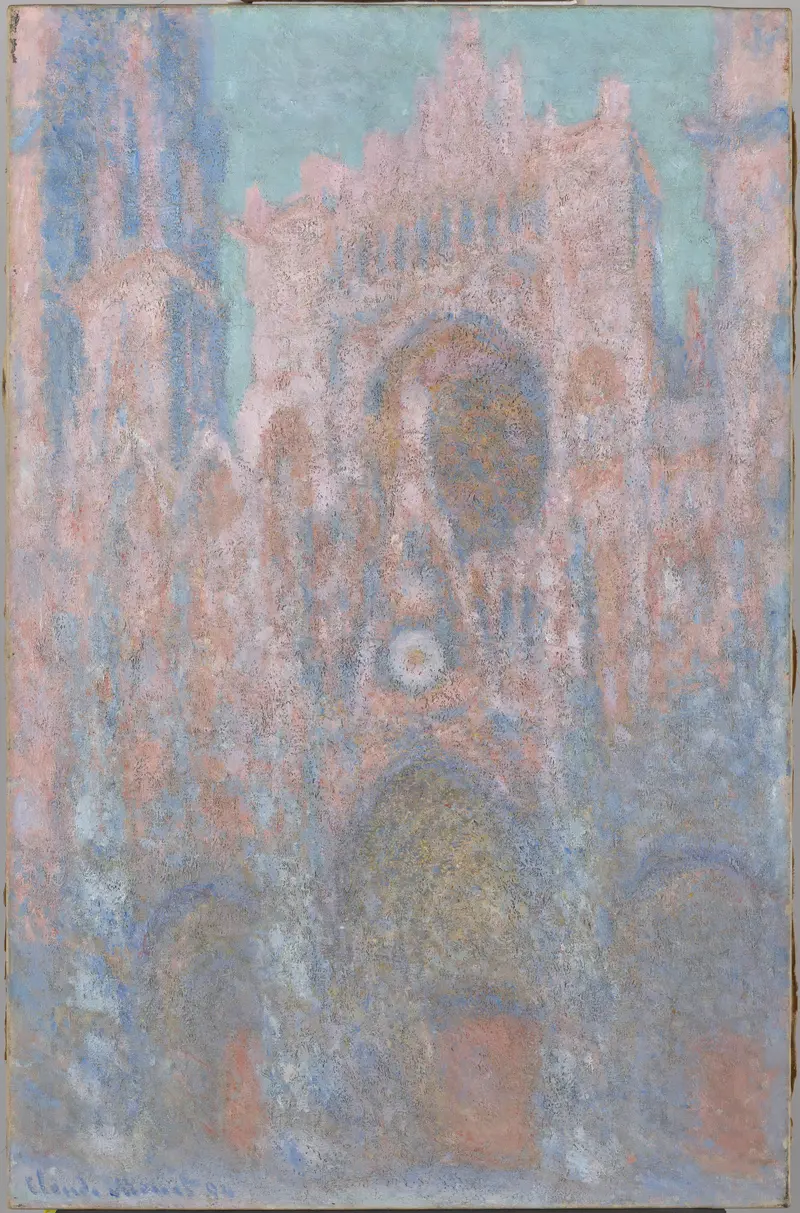
Why did Monet paint Rouen Cathedral so many times?
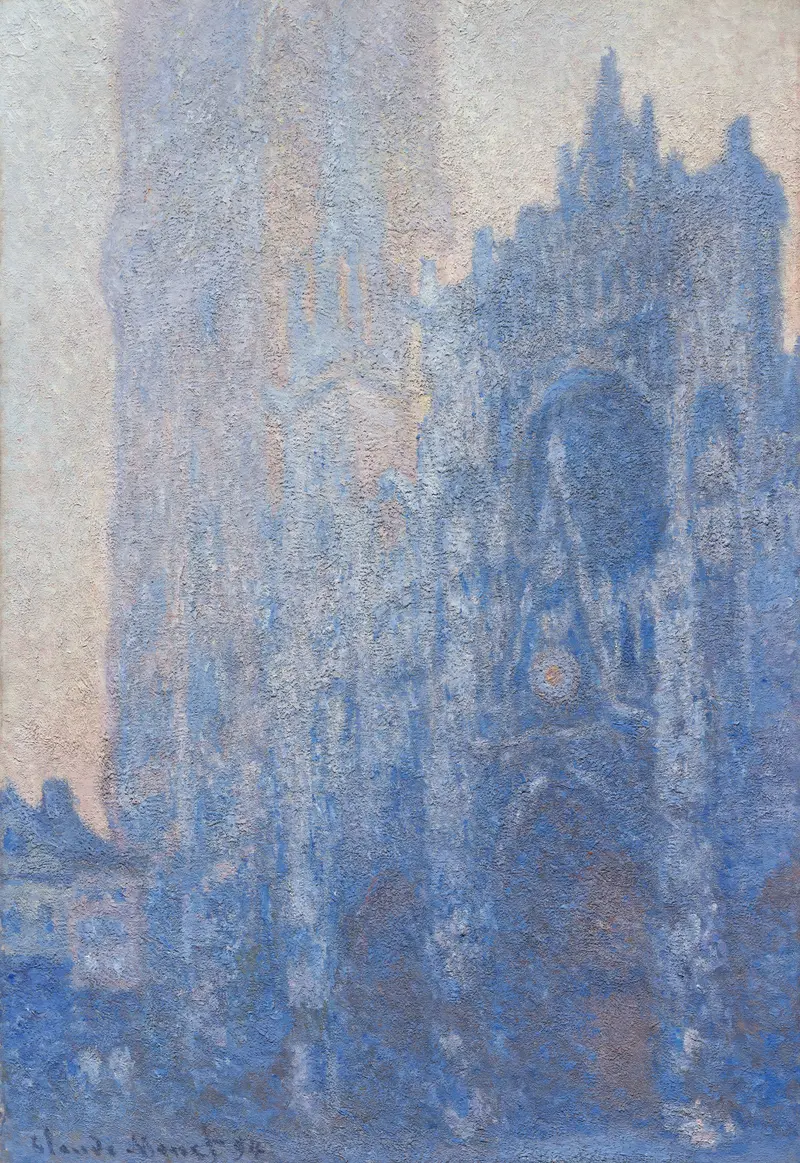
To study how changing light and weather transformed a single subject. Monet painted the cathedral's facade in late winter in both 1892 and 1893, working at times from an improvised studio in a dressmaker's shop across from it, then reworked his thirty canvases from memory through 1894. The National Gallery of Art notes that the motif itself was secondary to effects of light and weather. In May 1895 he showed twenty of them at the Durand-Ruel gallery in Paris.
Sources: J. Paul Getty Museum: The Portal of Rouen Cathedral in Morning Light · National Gallery of Art, Washington: Rouen Cathedral, West Façade
What are the most famous paintings of New York?
Among public-domain works, the best known are Childe Hassam's flag paintings, such as The Avenue in the Rain on Fifth Avenue; George Bellows's New York and his four canvases of the Pennsylvania Station excavation; and Joseph Stella's Brooklyn Bridge (1919–20). Later icons such as Edward Hopper's Nighthawks (1942) are not here: Hopper died in 1967, and the Art Institute of Chicago does not list the painting as public domain.
Sources: White House Historical Association: Avenue in the Rain · Brooklyn Museum: Pennsylvania Station Excavation · Yale University Art Gallery: Brooklyn Bridge · Art Institute of Chicago: Nighthawks (collection API record)
Can I download these paintings for free?
Yes. Every painting on this page is in the public domain where we checked it: each artist died by 1955 and each work was made by 1930. A faithful photograph does not create a new copyright either. The U.S. Copyright Office will not register a "slavish copy" of a painting, and Article 14 of EU Directive 2019/790 says reproductions of public-domain visual art are not protected unless they are themselves original. Click any painting: its standard download is free for any use, including commercial.
Sources: U.S. Copyright Office, Compendium of U.S. Copyright Office Practices (Third Edition), §909.3(A) · Directive (EU) 2019/790, Article 14 (EUR-Lex)
How we chose the most famous city paintings
We ranked the paintings by how widely each one is known around the world: the number of languages that have an encyclopedia entry about it, checked in October 2026. For Monet's Rouen Cathedral and Houses of Parliament, Bruegel's Tower of Babel and the Ideal City, we counted the entry on the series or group of paintings, since that is where they are written about.
A few rules keep the list useful. Every painting is in the public domain: it was made by 1930, by an artist who died by 1955, so you can download and use it freely. No painter has more than two places. A painting qualifies when a city, its streets or its buildings are the subject, real or imagined. Where the image we could find shows a frame, is too small or is a different version, the work is left out.
Dates, sizes and locations come from the museums' own records, and each entry links to its sources.
Spotted a mistake? Tell us and we will correct it.
Browse all 6,731 city paintings
Every one is public domain and free to download, most famous first: paintings of cities, streets and buildings by famous artists.