
Church and Street, Camprodon — História e Análise
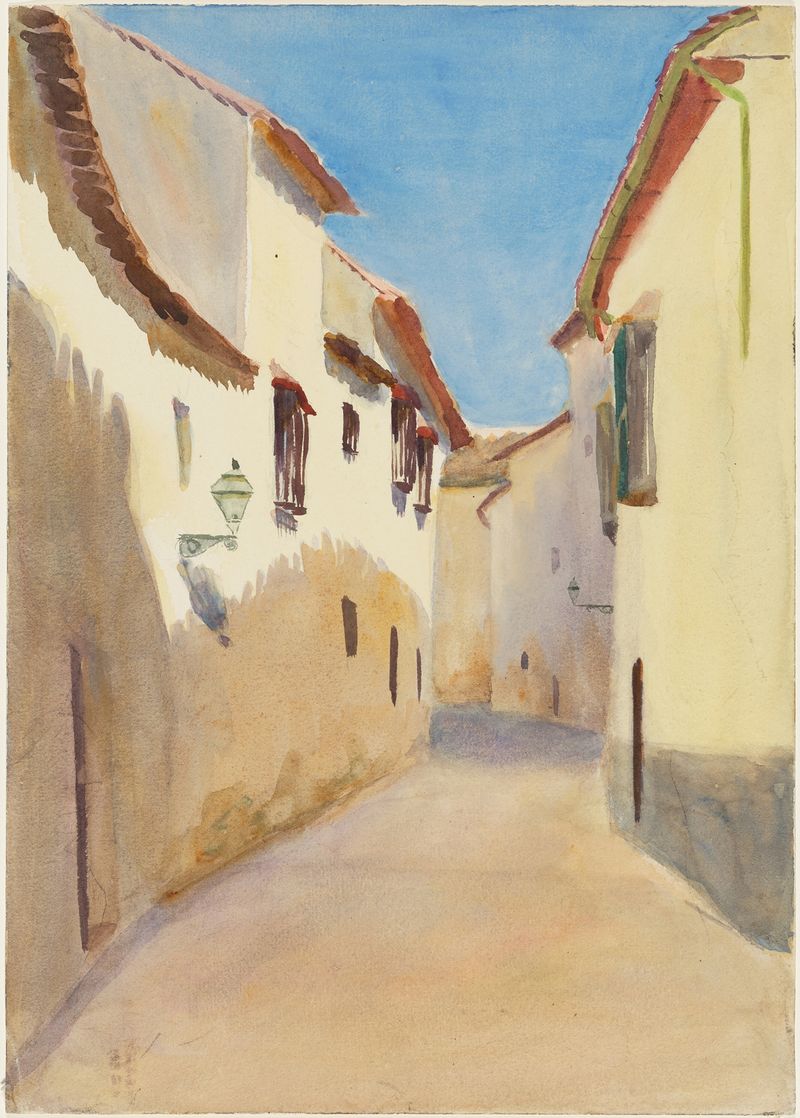
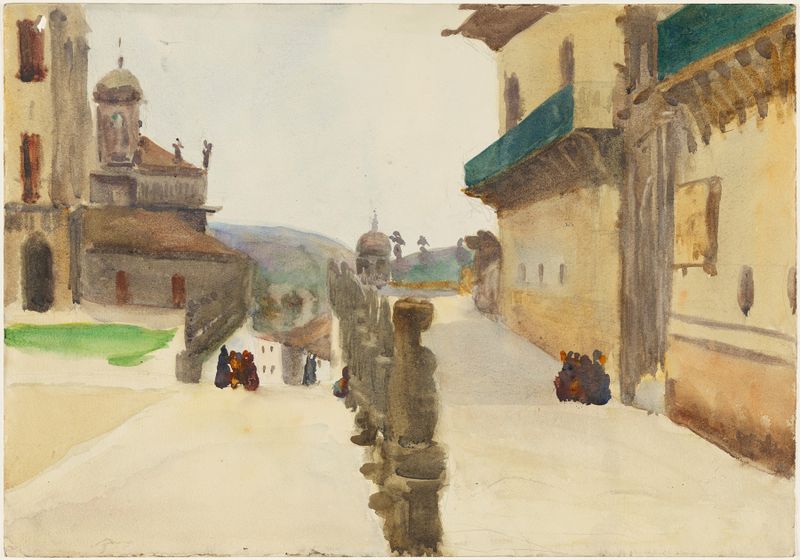
In Church and Street, Camprodon, the artist captures the very essence of movement, breathing life into a still moment. Look to the left at the sturdy stone façade of the church, its weathered textures revealing centuries of history. Notice how the artist employs a soft, muted palette, allowing warm earth tones to dominate, contrasting with the cool blues of the sky. The play of light subtly dances across the textured surface, illuminating details where the sun caresses the stones, while shadows gather in delicate corners, hinting at unseen stories waiting to unfold.
The composition guides the eye along the angled street, inviting exploration into the bustling life beyond the church's stoic presence. Beneath the tranquil appearance lies a tension between the sacred and the mundane. The church stands as a symbol of enduring faith, yet the lively street hints at the vibrant chaos of daily life. Curiously, the figures in the foreground, whether strolling or engaged in conversation, are captured in fluid gestures, suggesting an energetic rhythm that contrasts with the stillness of the architecture.
Each brushstroke conveys a sense of fleeting moments, where every movement is imbued with significance — a reminder of life's transience in the embrace of permanence. In 1902, Emily Sargent painted this piece during a period of burgeoning interest in Impressionism, as her brother, John Singer Sargent, was achieving acclaim in the art world. Living in Europe, she would have been influenced by the dynamic shifts in artistic expression and the vibrant culture of her surroundings. This context informs her approach, blending traditional subjects with a fresh, lively interpretation that invites viewers to find beauty in the everyday.
Mais obras de Emily Sargent
Ver tudo →


Mais arte de Arquitetura
Ver tudo →
The statue of Liberty
Frédéric Auguste Bartholdi

View of Houses in Delft, Known as ‘The Little Street’
Johannes Vermeer

View of Houses in Delft, Known as ‘The Little Street’
Johannes Vermeer

The Cathedral in Rouen. The portal, Grey Weather
Claude Monet

The yellow house
Vincent van Gogh

The Church in Auvers-sur-Oise, View from the Chevet
Vincent van Gogh