Die Kampenwand bei Prien — História e Análise
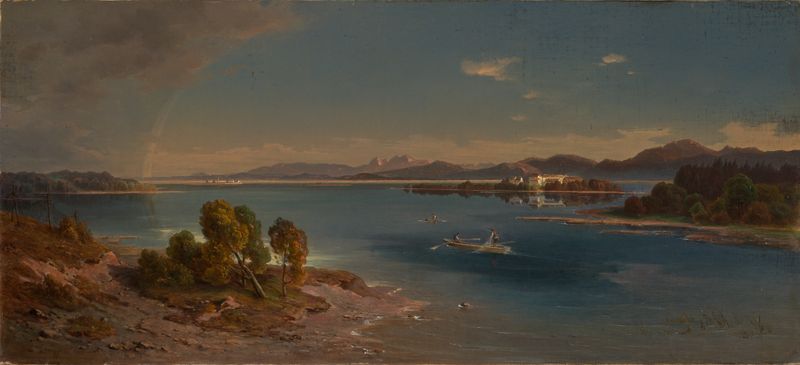
What if beauty was never meant to be finished? In the work Die Kampenwand bei Prien, the artist encapsulates a fleeting moment, revealing the delicate balance between permanence and transience in nature. Look to the foreground where the gentle undulations of lush green meadows invite the viewer’s gaze, leading us toward the majestic Kampenwand mountain. Notice how the cool hues of blue and gray in the mountain’s rugged silhouette contrast with the warm, golden tones of the sun-drenched fields below. The meticulous brushstrokes convey both the solidity of the earth and the ephemeral quality of light, capturing a moment that feels both serene and alive. The painting breathes a subtle tension through its carefully rendered details.
The interplay of shadow and light suggests the fragility of nature; the radiant sunlight clings to the landscape, yet it is ever on the brink of fading. The wisps of clouds swirling above add an element of motion, hinting at the inevitable passage of time. This duality—the permanence of the mountains juxtaposed with the transient beauty of the surrounding meadow—speaks to the heart of existence itself. In the early 1830s, while working in Bavaria, the artist was deeply influenced by the Romantic movement, which emphasized emotion and the sublime in nature.
Amidst a Europe grappling with change, Fohr sought to transcend the immediate world around him, capturing the spiritual essence of landscapes. Die Kampenwand bei Prien stands as a testament to his quest, marrying technical precision with an evocative exploration of beauty and fragility.