
Fatehpur Sikri, Birbal’S Palace, India — História e Análise
In the serene embrace of Fatehpur Sikri, the artist captures a moment suspended in an eternal calm, where history whispers through every stone and shadow. Look to the vibrant ochres and deep reds that envelop the walls of Birbal’s Palace; the interplay of light and shadow creates a dance of warmth and nostalgia. Notice how the intricate latticework frames the scene, guiding your eye toward the tranquil courtyard that beckons with promises of peace. Each brushstroke reveals the meticulous detail of Mughal architecture, rendering the palace not just a structure but a testament to an era brimming with cultural richness. Amid this beauty lies a contrast between the grandeur of the architecture and the stillness of the moment.
The ornate carvings speak of power and artistry, yet the silence invites introspection. It is a visual diary of a bygone era, where every element in the composition underscores the notion of impermanence, suggesting that even the most magnificent creations are mere whispers in the passage of time. Lockwood de Forest painted this work in 1881 during his travels throughout India, a period marked by a fascination with Indian culture among Western artists. His engagement with the Mughal aesthetic mirrored a broader artistic movement that sought to capture the exoticism and tranquility of the East, as well as a personal exploration of identity far removed from his American roots.
Mais obras de Lockwood de Forest
Ver tudo →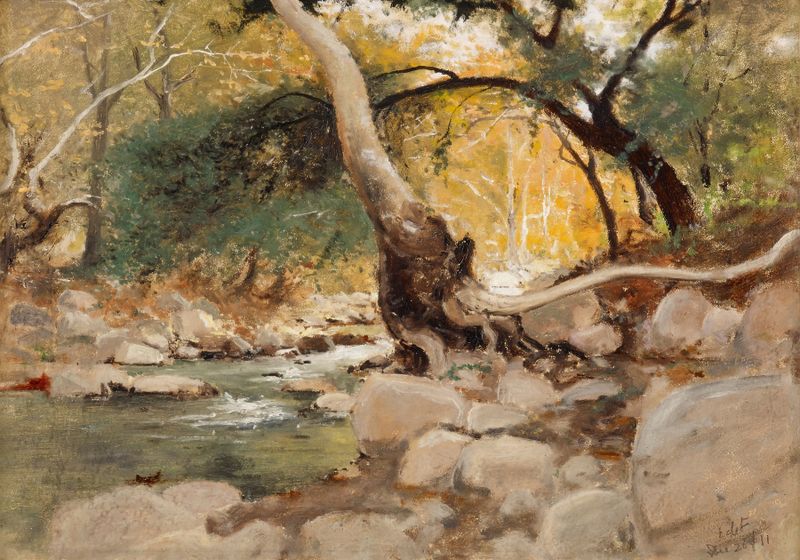
Mais arte de Arquitetura
Ver tudo →
The statue of Liberty
Frédéric Auguste Bartholdi

View of Houses in Delft, Known as ‘The Little Street’
Johannes Vermeer

View of Houses in Delft, Known as ‘The Little Street’
Johannes Vermeer

The Cathedral in Rouen. The portal, Grey Weather
Claude Monet

The yellow house
Vincent van Gogh

The Church in Auvers-sur-Oise, View from the Chevet
Vincent van Gogh