
Murnau, Burggrabenstrasse 1, 1908 — História e Análise
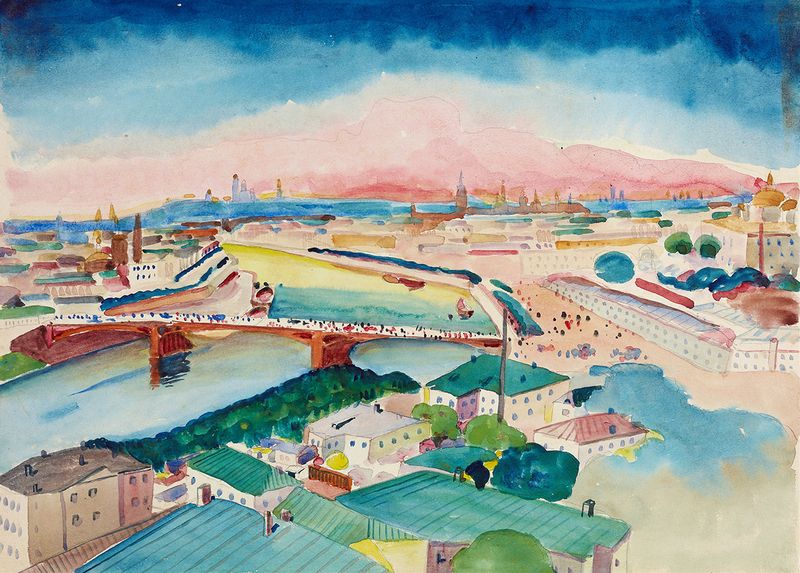
In the heart of chaos, vibrant hues collide, revealing a world fraught with emotion. It is amid this vivid turmoil that the essence of violence weaves silently through the strokes, echoing the internal struggles of humanity. Focus on the swirling colors that dominate the canvas, where bold reds and blues clash with softer yellows and greens. Look to the center, where the gestural lines seem to pulse with tension, suggesting both movement and stillness simultaneously.
Notice how the geometry of the buildings emerges from the abstraction, creating a disorienting yet familiar space, a testament to the artist's innovative approach to perspective and form. Beneath the surface, Kandinsky invites us to contemplate the duality of beauty and brutality. The frenetic energy in the brushwork speaks of unseen battles, perhaps mirroring his own psychological landscape at the time. Each stroke carries an emotional weight, hinting at the violence of thoughts and feelings that struggle to break free from the confines of color and form. In 1908, Kandinsky was deeply entrenched in his exploration of spiritual and emotional expression through abstraction.
Living in Munich, he was influenced by the burgeoning avant-garde movement, which sought to transcend traditional artistic boundaries. This period marked a turning point for him, as he began to distance himself from representational art, seeking instead to evoke profound emotional truths through the interplay of color and form.
Mais obras de Wassily Kandinsky
Ver tudo →
Jocular Sounds
Wassily Kandinsky
Green Lane in Murnau
Wassily Kandinsky

Murnau
Wassily Kandinsky

Murnau – View from the window of the Griesbräu
Wassily Kandinsky

Landscape with a yellow field
Wassily Kandinsky
Zubovsky Platz
Wassily Kandinsky

Murnau – Castle and Church
Wassily Kandinsky
Park Von St. Cloud – Herbst I
Wassily Kandinsky

Cemetery and rectory in Kochel
Wassily Kandinsky
Blick auf Moskau
Wassily Kandinsky





