Road to a Breton Village — História e Análise
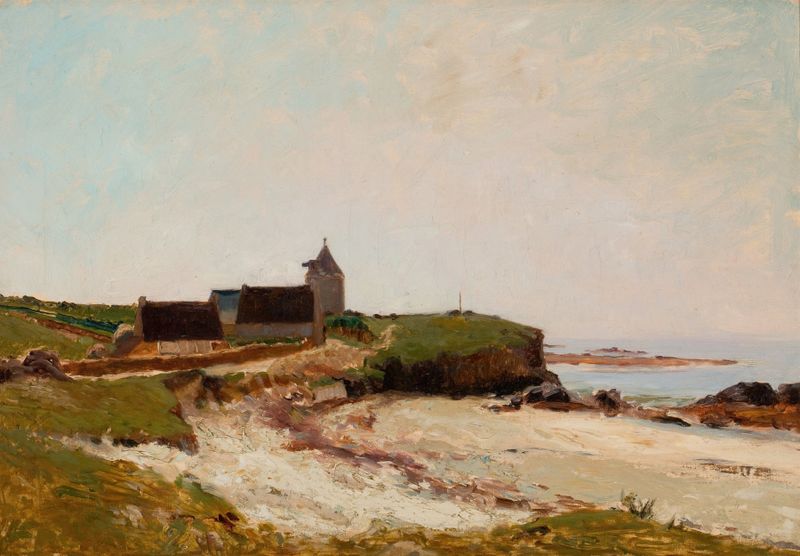
Who listens when art speaks of silence? In Road to a Breton Village, the passage of time is captured in brushstrokes that evoke both journey and stillness, inviting contemplation on the echoes of memory. Look to the left at the winding path, where the muted tones of earth and sky create a seamless blend, guiding the viewer’s eye toward the horizon. The figures, small and almost ghostlike, traverse the road, shrouded in the soft glow of twilight. Notice how the golden hues of the setting sun delicately illuminate their forms, creating an ethereal quality that contrasts with the heavy, textured foliage surrounding them, suggesting the weight of both journey and destination. Amidst this serene landscape lies an emotional tension; the journey may symbolize hope or perhaps a longing for something lost.
The figures, though united in their passage, appear solitary in the vastness of the scene, hinting at personal stories interwoven with the rural tranquility. The contrasting light and shadow evoke the duality of time itself—its ability to both heal and haunt, to connect and isolate. Painted in 1889, Ryder was in the throes of his artistic exploration in Brittany, immersed in its rich culture and landscape. This period marked a significant evolution in his style, shifting from tightly rendered realism to a more impressionistic approach, reflecting broader movements in art.
As Europe shifted into modernity, his work captures an essence of stillness amid change, a moment frozen on the road to a village that speaks volumes in silence.