
Stowe House, Buckingham — História e Análise
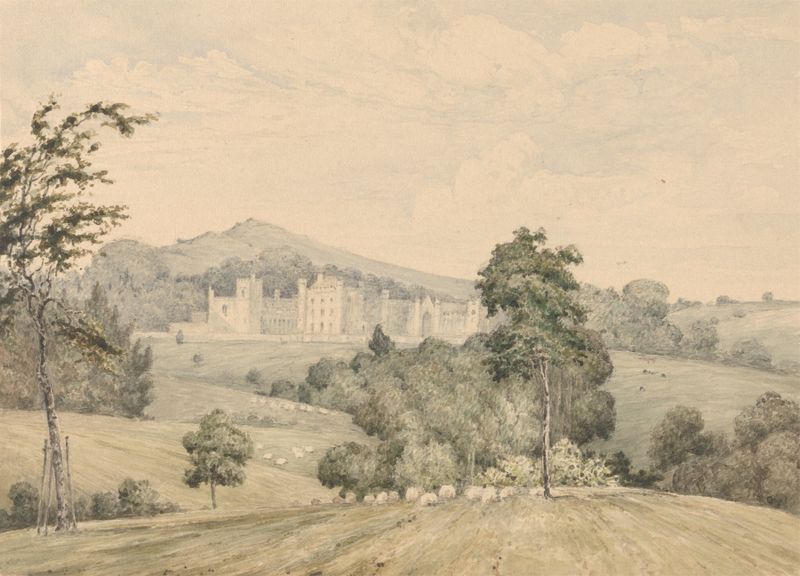
In the stillness of Stowe House, Buckingham, Robert Streatfeild captures the haunting echo of loss nestled within the grandeur of architecture. The very walls seem to breathe stories of sorrow, each brushstroke reverberating with unspoken grief. Look to the left at the grand façade, where the light softly illuminates the stone, revealing subtle textures that speak of time and neglect. Notice how the artist employs a muted palette, dominated by soft greys and tender greens, evoking an atmosphere of quiet reflection.
The careful composition draws the eye towards the central entrance, inviting yet foreboding, suggesting a passage into memories both cherished and mourned. As you explore the painting further, consider the contrast between the majestic structure and the stillness surrounding it. The vibrant life of the gardens, rendered with delicate foliage, stands in stark juxtaposition to the somber façade. This tension reflects not only the physical space but also the emotional burden carried by those who once roamed its halls.
It whispers of families gathered in joy, now separated by the weight of absence, their laughter replaced by the rustle of leaves in the wind. In 1797, Streatfeild painted this work amidst a shifting artistic landscape, where neoclassicism was giving way to romanticism. At this time, he was deeply influenced by the interplay of nature and architecture, reflecting societal changes and the burgeoning appreciation for landscapes infused with emotion. The painting stands as a testament to his ability to convey profound feelings through the still imagery of a once-bustling home, now draped in the veil of memory.
Mais obras de Robert Streatfeild
Ver tudo →
Mais arte de Arquitetura
Ver tudo →
The statue of Liberty
Frédéric Auguste Bartholdi

View of Houses in Delft, Known as ‘The Little Street’
Johannes Vermeer

View of Houses in Delft, Known as ‘The Little Street’
Johannes Vermeer

The Cathedral in Rouen. The portal, Grey Weather
Claude Monet

The yellow house
Vincent van Gogh

The Church in Auvers-sur-Oise, View from the Chevet
Vincent van Gogh