Swiss Valley Landscape — História e Análise
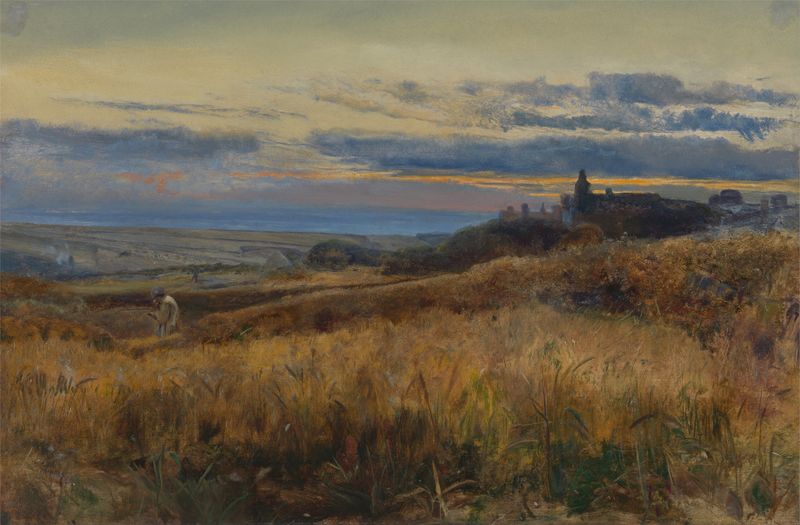
Can beauty exist without sorrow? In John William Inchbold's Swiss Valley Landscape, the answer unfolds through the gentle interplay of mountains, valleys, and a wistful sky. Focus on the serene expanse of the valley, where soft greens meet the earthy browns of the mountains, bridged by a delicate ribbon of a river that dances through the scene. Notice how the light bathes the peaks in a golden glow, illuminating their grandeur while casting shadows that whisper stories of solitude. Each brushstroke conveys a sense of tranquility, yet hints at the lingering presence of something deeper, perhaps a sense of longing that echoes through the vastness. The contrast between the vibrant landscape and the muted hues of the sky draws attention to the emotional landscape of the viewer.
Tiny details, like the distant figures of shepherds, evoke a quiet existence, suggesting that human life is both an integral part of this beauty and a testament to its fragility. The juxtaposition of the lush foreground against the stark mountain silhouettes invokes a tension, hinting that serenity often coexists with underlying melancholy. Inchbold painted Swiss Valley Landscape in 1885, during a period when he was exploring the themes of nature and emotion. At this time, he was living in England but frequently traveled to the Alps, seeking to capture the sublime beauty of the Swiss landscape.
This work reflects his fascination with the interplay of light and space, characteristic of the romantic landscape movement, as well as the personal journey toward understanding the relationship between beauty and human experience.