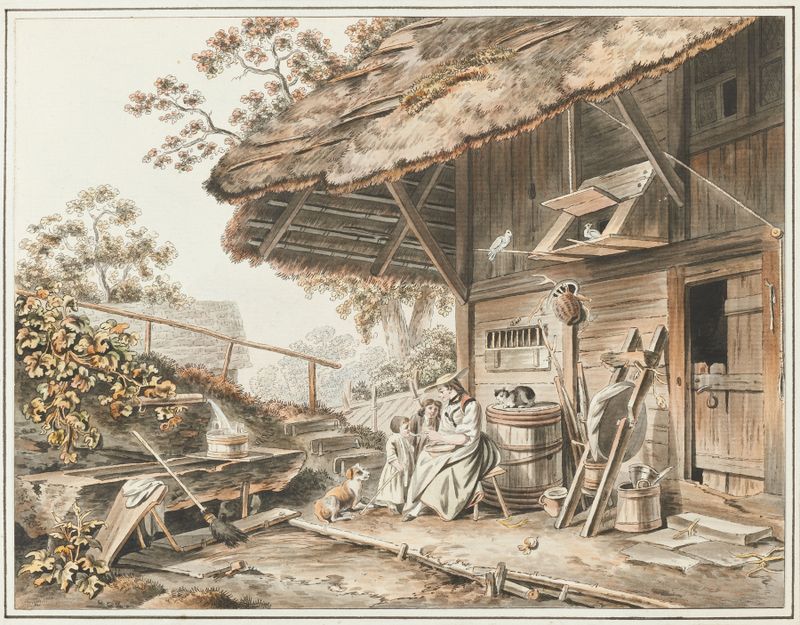
Szene vor einem Bauernhaus — História e Análise
In a world filled with noise, the void left behind often speaks louder than words. What do we find within that silence, where emptiness becomes a canvas for our unspoken truths? Look to the center, where the humble farmhouse stands resilient against an expansive backdrop of muted earth tones. The sturdy, weathered roof and simple structure draw the eye, evoking a sense of nostalgia and history.
Notice how the light gently caresses the building’s edges, illuminating imperfections that tell stories of labor and endurance. The surrounding landscape, painted with soft strokes, seems to recede into the distance, inviting contemplation of life’s unassuming yet profound moments. Delve deeper into the details, where the interplay of shadow and light reveals emotional layers. The starkness of the foreground contrasts with the softness of the sky, suggesting an internal conflict between presence and absence.
The sparse vegetation surrounding the farmhouse hints at a once-thriving life, now overshadowed by the weight of solitude. Each element speaks to a collective memory, a shared longing for connection even amidst desolation. Sigmund Freudenberger painted this work during a period marked by personal and societal upheaval, although the exact date remains unknown. Active in the late 19th to early 20th century, he was influenced by the changing tides of artistic movements and a growing focus on realism.
This piece encapsulates his fascination with rural life, reflecting both an intimate understanding of the resilience found in simplicity and the broader existential questions of his time.