
Army Advancing among Roman Ruins — História e Análise
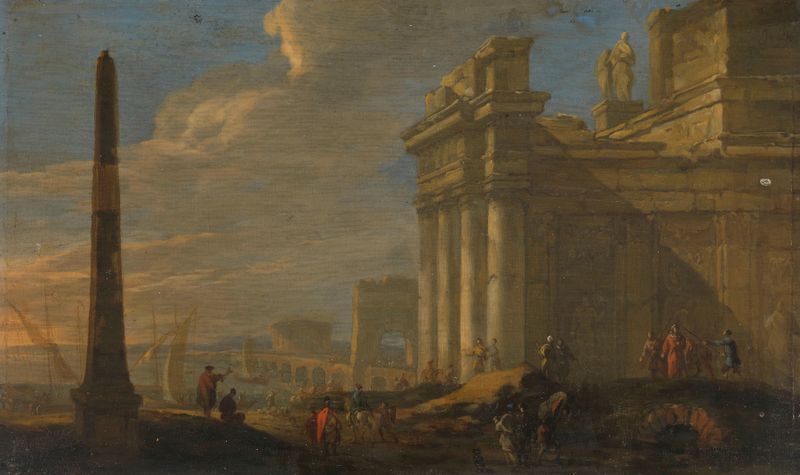
Is this a mirror — or a memory? As time marches forward, the weight of history echoes in the spaces we traverse, revealing destinies intertwined with the past. Look to the center of the composition, where a regiment of soldiers advances through the crumbling remnants of ancient Roman architecture. Their figures, clad in armor and vivid hues of blue and red, stand stark against the muted earth tones of the ruins that surround them. Notice how the light dances off their polished weapons and glimmers in the dust of the ground, creating a sort of halo effect that underscores their movement.
The contrast between the soldiers’ vibrant presence and the desolate backdrop is striking, forcing the viewer to confront the fragility of human endeavors against the immortal whispers of history. Beneath the surface, there lies a poignant commentary on the cyclical nature of civilization. The advancing army symbolizes ambition and conquest, yet the ruins serve as a somber reminder of the impermanence of power. Each soldier's determination juxtaposes the stoic silence of the past, suggesting a tense relationship between hope and inevitability.
The weathered stone suggests that every new generation inherits the legacies—both glorious and ruinous—of those who came before. In 1671, Jacob van der Ulft, a Dutch painter known for his landscapes and historical scenes, crafted this work during a period of great political turmoil and artistic evolution in Europe. Living in the Netherlands, a nation emerging from conflict, he captured this moment with a keen awareness of the interplay between history and the present, reflecting not only the spirit of his time but also the persistent question of what legacies we choose to uphold or abandon.
Mais obras de Jacob van der Ulft
Ver tudo →
Mais arte de Pintura Histórica
Ver tudo →
The Night Watch Militia Company of District II under the Command of Captain Frans Banninck Cocq
Rembrandt van Rijn

Lincoln Memorial
Henry Bacon

The Third of May 1808
Francisco de Goya

Isaac and Rebecca, Known as ‘The Jewish Bride’
Rembrandt van Rijn

The Charge of the Mamelukes (1814)
Francisco de Goya

De vier ruiters van de apocalyps
Albrecht Dürer