Two hares in a landscape, — História e Análise
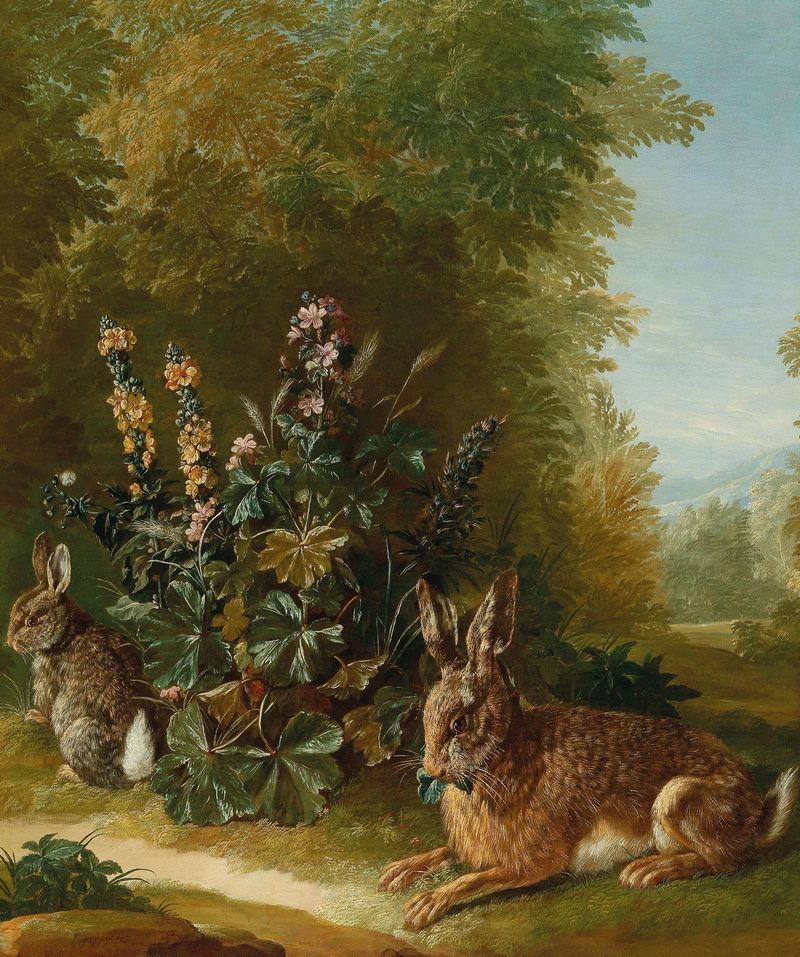
Can beauty exist without sorrow? In the delicate interplay of light and shadow, the two hares in this artwork embody a fleeting moment of grace amid the inevitability of life’s transience. Look to the left, where the hares are positioned against a verdant landscape, the vibrant greens contrasting with the soft browns of their fur. Notice how the artist skillfully employs dappled light, illuminating the hares’ forms while casting gentle shadows that hint at the depth of the world beyond. The composition is balanced yet dynamic, drawing the viewer's eye from the foreground to the horizon, creating a sense of both intimacy and distance. Beneath the surface, the hares represent more than mere creatures of nature; they embody a tension between innocence and mortality.
Their alert postures suggest a moment suspended between action and stillness, an acknowledgment of the ever-looming presence of danger. The lush backdrop may symbolize the beauty of life, yet it is also a reminder of the fragility that accompanies it, a delicate balance of joy and melancholy. The painting emerged during a period of quiet introspection for Jean Jacques Spoede, whose work flourished amidst a growing emphasis on realism in the late 19th century. Living in a time when artists began to explore deeper emotional narratives within nature, Spoede sought to capture these dualities.
Although the exact date of creation remains unknown, it reflects a moment in an artist’s journey to probe the complexities of existence through the lens of the natural world.