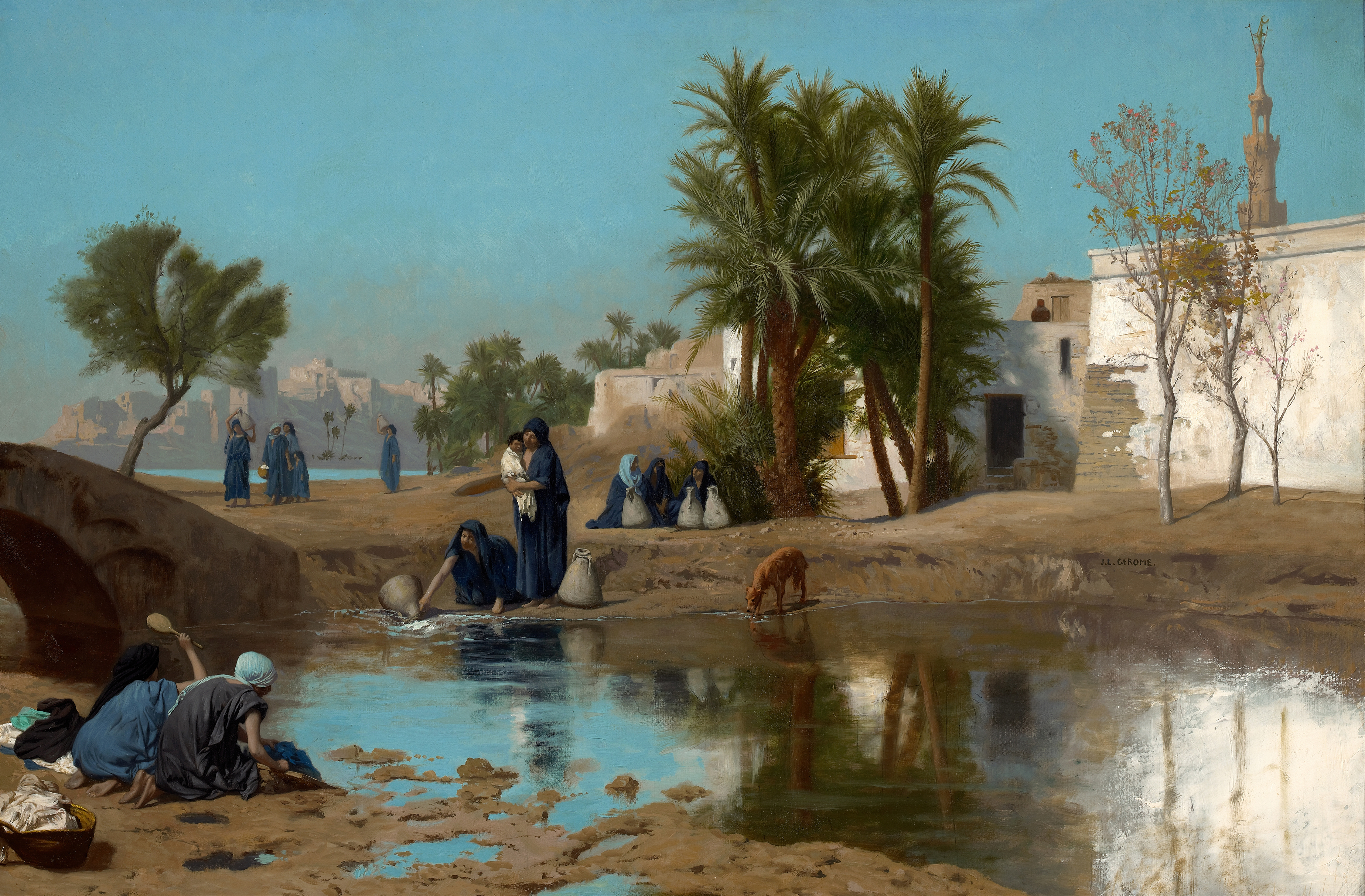
Can paint confess what words never could? In *Fellah Women Drawing Water*, the essence of creation unfolds through the delicate gestures and the silent strength of its subjects. Look to the left at the women, their figures elegantly poised as they balance heavy clay vessels upon their heads. The light filters gently, illuminating the smooth curves of the pottery while casting soft shadows that highlight the contours of their faces. Notice how the earthy palette of ochres and deep greens conveys both the harshness of their labor and the beauty of their surroundings, bridging the gap between task and tranquility. In this work, a profound emotional tension emerges from the juxtaposition of the women’s toil against their serene expressions. The act of drawing water, traditionally viewed as a mundane chore, transforms into a ritual of connection with nature. Each droplet symbolizes not just sustenance but the very essence of life and community, suggesting an unbroken lineage of resilience through generations. The playful interaction between light and shadow serves as a poignant reminder of the struggle and grace inherent in daily life. Created between 1873 and 1875, this piece reflects Gérôme’s fascination with the East, a theme central to his work during this period. Living in Paris amidst an era rife with Orientalism and academic realism, he meticulously studied the cultures of the Mediterranean and North Africa. The painting embodies his desire to capture the authentic experience of the people within these regions, marking a significant moment in the evolution of landscape and genre painting.