Kanaya — History & Analysis
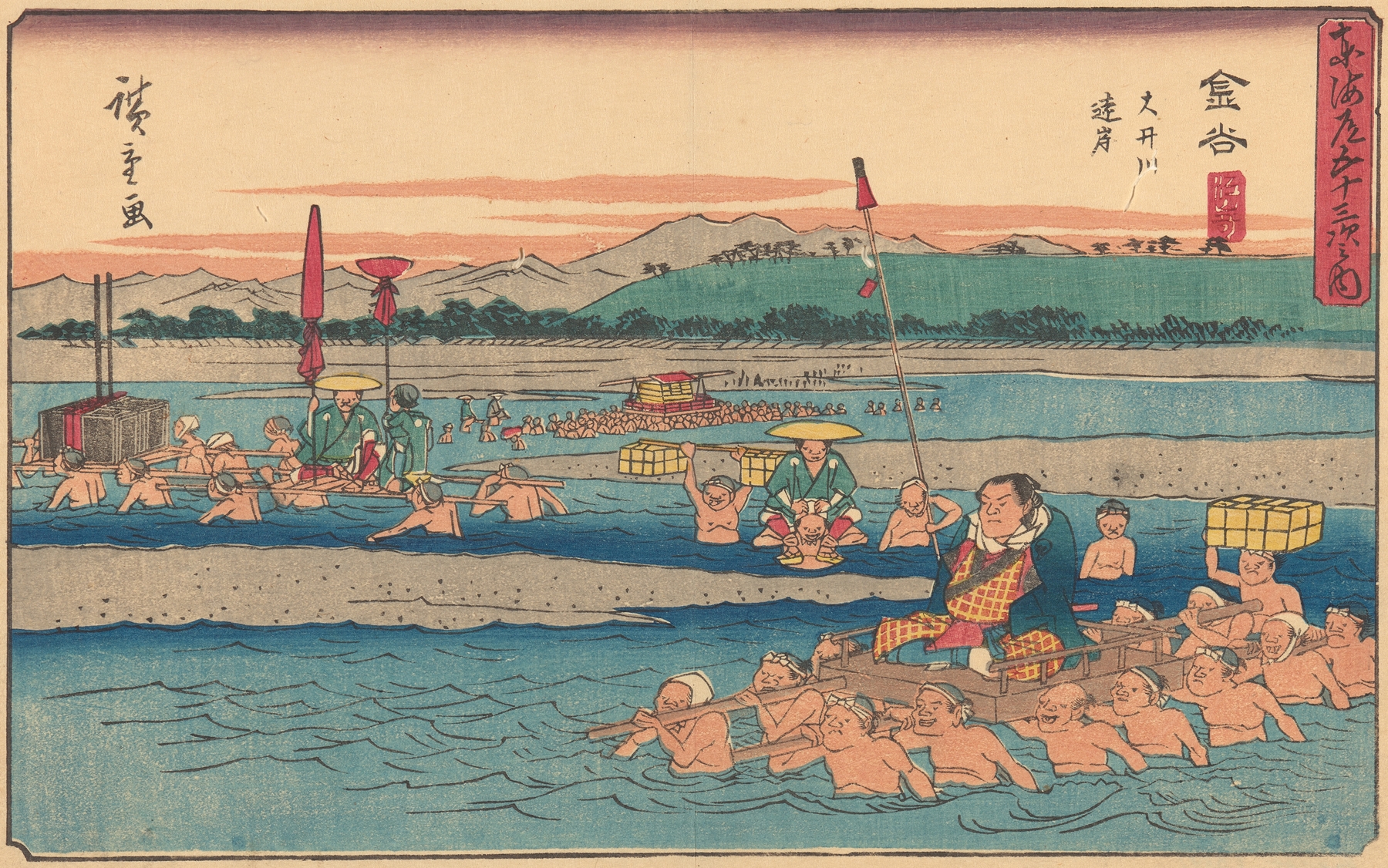
Could beauty survive in a century of chaos? In Kanaya, Utagawa Hiroshige offers a poignant reflection on nature’s resilience amidst the encroaching turmoil of the Edo period. The artwork's delicate lines and vibrant hues serve as a testament to an era grappling with rapid change and an obsession with capturing fleeting moments of tranquility. Look to the foreground, where the curling waves gently embrace the rocky shore, their rhythmic motion drawing the eye. Notice how the rich indigo contrasts with the soft greens and earthy browns of the landscape, creating a sense of harmony and balance.
The subtle gradation of colors in the sky, transitioning from warm oranges to cooler blues, evokes the fading light of dusk, inviting contemplation on the passage of time and the beauty found in impermanence. Yet, beneath this serene surface lies a deeper tension. The starkness of the jagged rocks against the gentle waves suggests a struggle between nature and humanity, reflecting the societal upheaval of Hiroshige's time. The obsession with capturing beauty is palpable, not just in the landscape, but in the fleeting moment it represents—reminding us of how easily tranquility can be disrupted.
Each brushstroke encapsulates a desire to hold onto beauty, even as the world around it shifts. During the years 1841–1842, Hiroshige created this work while residing in Edo, a time when the country was on the cusp of modernization. The artist was deeply immersed in developing his unique style, which combined traditional ukiyo-e techniques with a fresh perspective on nature and everyday life. This painting emerged against a backdrop of both artistic innovation and social change, a reflection of a society wrestling with the future while striving to preserve its rich cultural heritage.