The Rape of a Sabine Woman — History & Facts
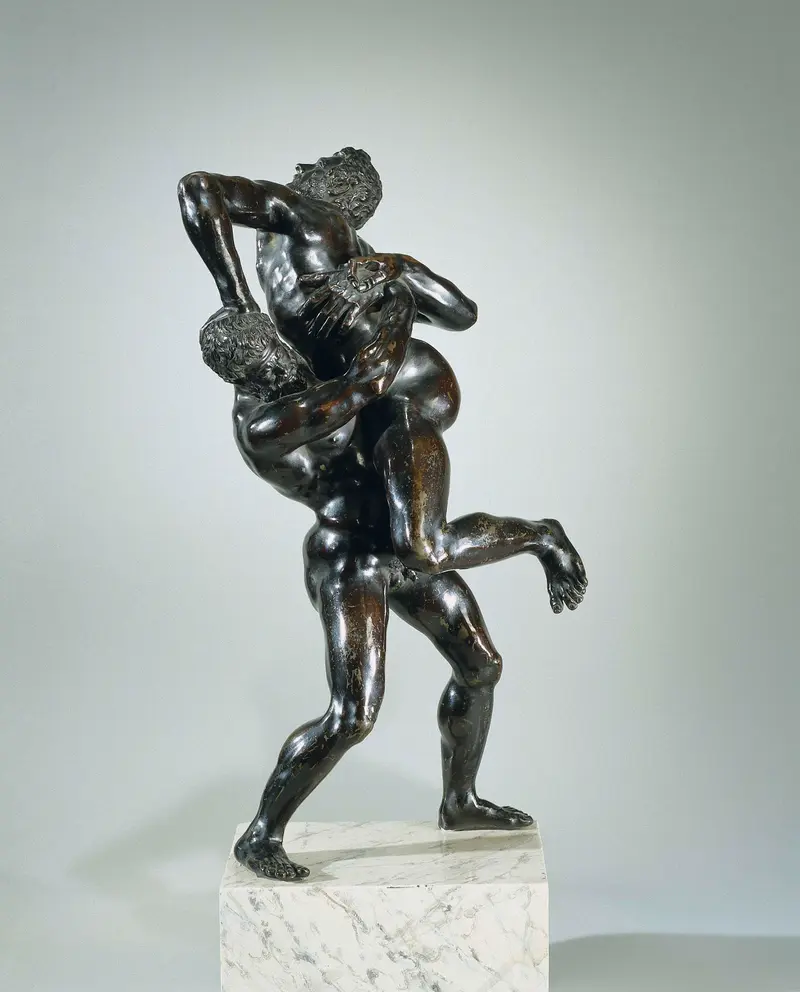
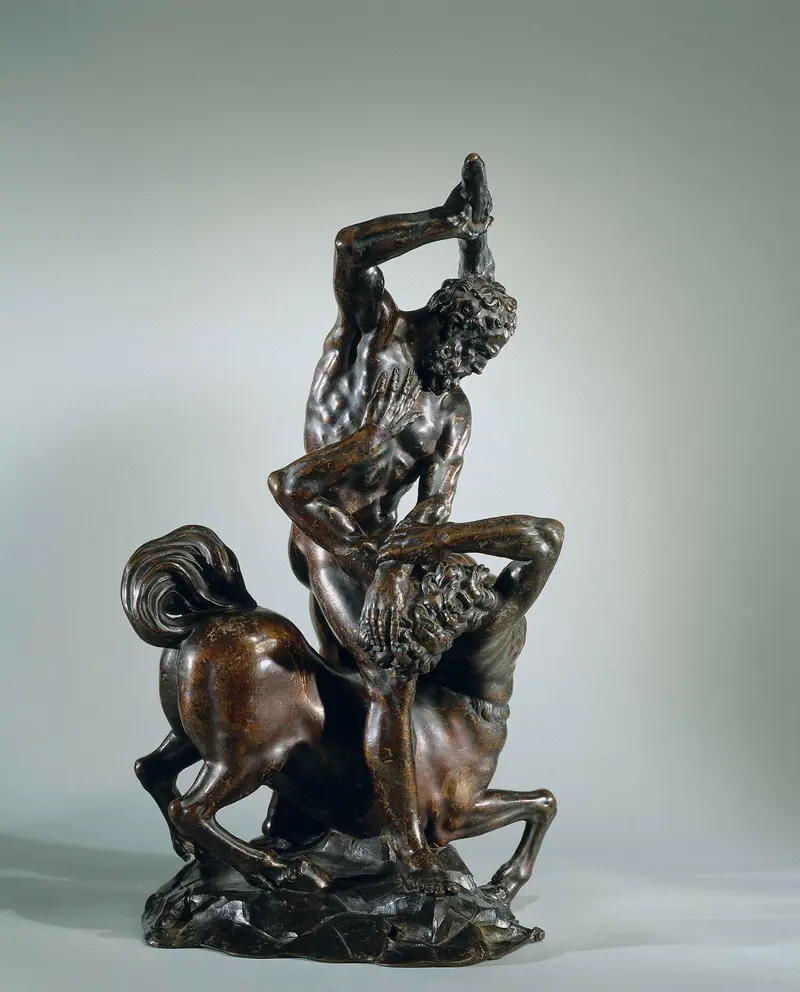
A twisting group of three nude figures rises in a dramatic spiral from a narrow base, each body contorted in struggle or flight. At the top, a woman is lifted high, her right arm flung upward and her head thrown back, her face turned away in distress. Her left hand pushes against the shoulder of the man who seizes her, his muscular form straining as he hoists her above his head.
Below him, another man crouches low, his back arched and his face twisted upward, one arm raised defensively as he tries to fend off the abductor. The composition is tightly coiled, with limbs interlocking and torsos overlapping, creating a sense of movement that spirals upward through the group. Light glances across the dark bronze surface, highlighting the smooth modeling of flesh and the tense musculature of each figure.
The surface is highly polished, giving the sculpture a reflective sheen that emphasizes the anatomical detail and the play of light and shadow. Each figure's hair is carefully rendered in tight curls, contrasting with the broad, sweeping planes of their bodies. The base is irregular and textured, suggesting rocky ground and anchoring the figures as they rise in a vertical column.
The figures are arranged so that the viewer can trace a continuous line from the crouching man at the bottom, through the abductor’s twisting torso, to the outstretched arm of the woman at the top. This sculpture, titled The Rape of a Sabine Woman, was created by Giambologna between about 1600 and 1625. The Rijksmuseum’s record notes that it once belonged to Dr Fritz Mannheimer, who kept it in usufruct as security for a loan in 1934. In 1940, it was acquired by the Dienststelle Mühlmann in The Hague for Adolf Hitler's planned Führermuseum in Linz.
After the war, the sculpture was recuperated by the SNK in 1945 and later loaned, along with many other objects, to the museum in 1952. It was formally transferred to the museum in 1960.
Sources: Rijksmuseum, record BK-16938