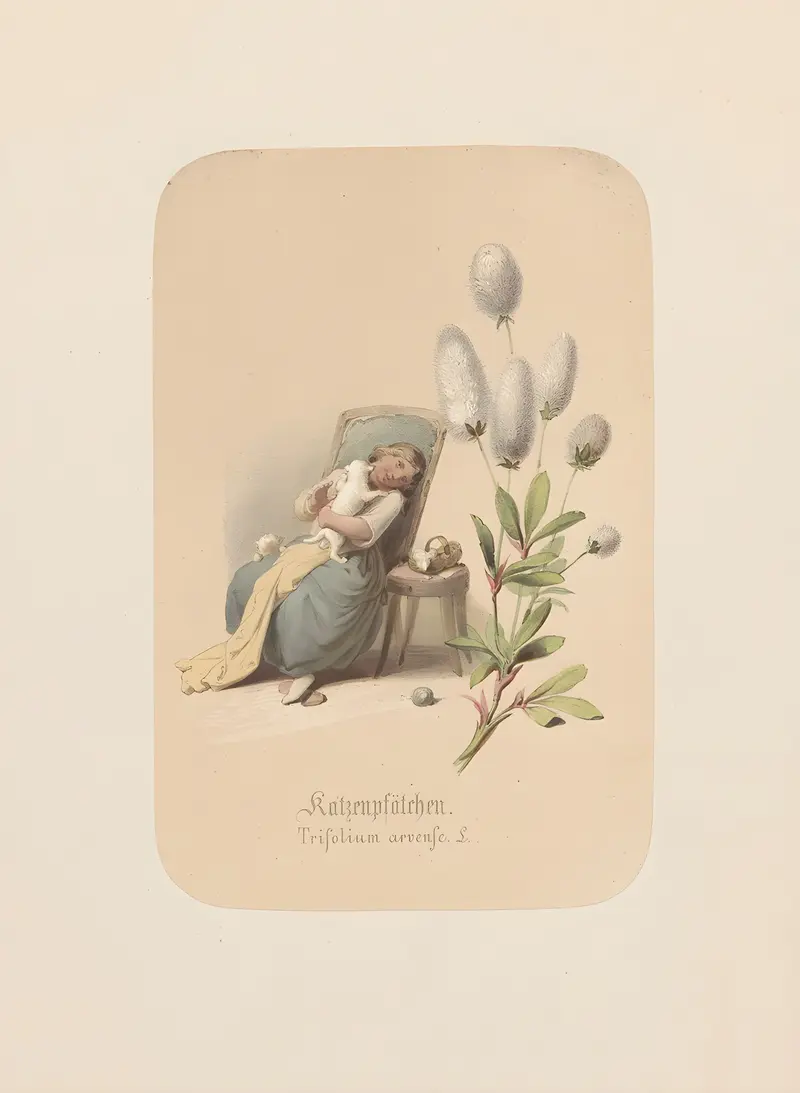
Public domain · Free to download
Botanical Art: Vintage Botanical Prints
From Albrecht Dürer's Great Piece of Turf to Pierre-Joseph Redouté's roses and Maria Sibylla Merian's pineapple, this is the most famous botanical art: pictures made to show plants exactly as they are, for science as much as for beauty. We added sections of Redouté's roses and of Merian's plates from Suriname.
For each one you get the plant it shows, the book or collection it comes from, how it was made, one detail to look for, and, where known, where the copy we show is kept. Every image is a public-domain scan, free to download and free to use.
Selected and written by Pavel MazuelasUpdated October 30, 2026
Part of The Most Famous Paintings in the WorldRelated: Famous Still Life Paintings, Famous Illustrations, Famous Landscape Paintings
The 16 most famous works of botanical art
Ranked by the fame of their artists. Click any picture to see it up close and download it free.
No. 1
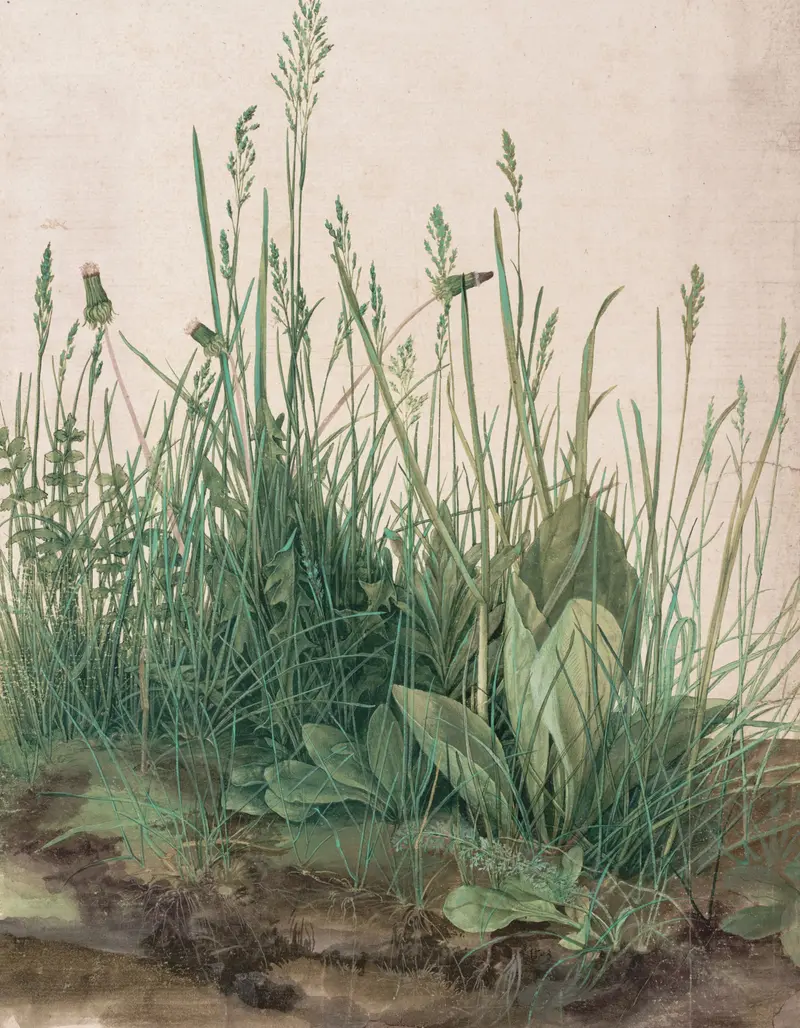
The Great Piece of Turf by Albrecht Dürer
Plant: Dandelion, greater plantain and grasses
1503 · Watercolor and bodycolor on paper · 40.8 × 31.5 cm
Albertina, Vienna
A clump of meadow grasses, dandelion and greater plantain rises from dark soil, painted leaf by leaf at natural size. Albrecht Dürer used the largest sheet of paper then available, and the Albertina says he surely painted it in the workshop rather than outdoors, probably from plants he studied one by one and then arranged. The date 1503 hides in the dark ground at lower right. It is in the Albertina in Vienna.
Sources: Albertina
No. 2
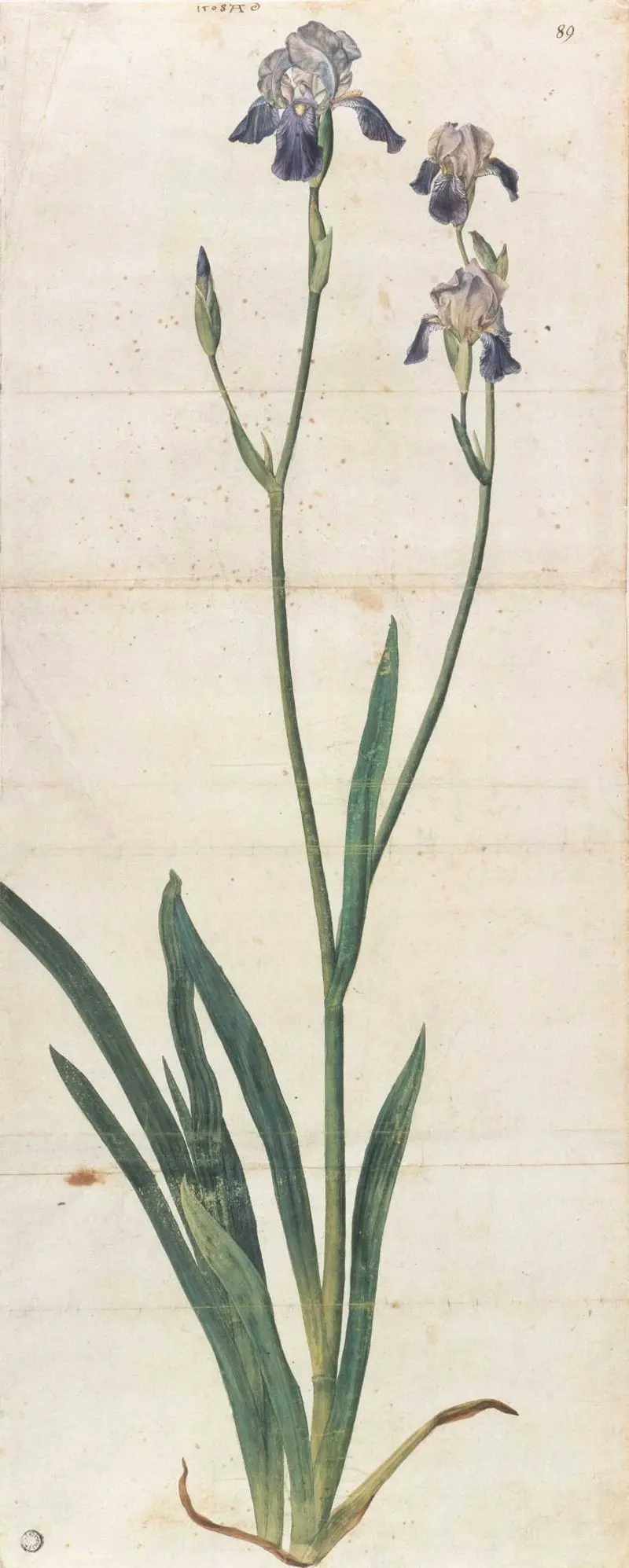
Iris by Albrecht Dürer
Plant: Blue-flowering iris
c. 1503 · Watercolor and bodycolor on paper · 77.5 × 31.3 cm
Kunsthalle Bremen, Bremen
A blue-flowering iris stands on a tall sheet, its petals and sword-like leaves worked in extremely delicate gradations of color. Albrecht Dürer painted it around 1503, and the same iris reappears almost identically in The Madonna with the Iris, a painting from his workshop now in the National Gallery, London. The Albertina counts it, with The Great Piece of Turf, as his only securely attributed pure plant studies. It is in the Kunsthalle Bremen.
Sources: Kunsthalle Bremen
No. 3Naturalism
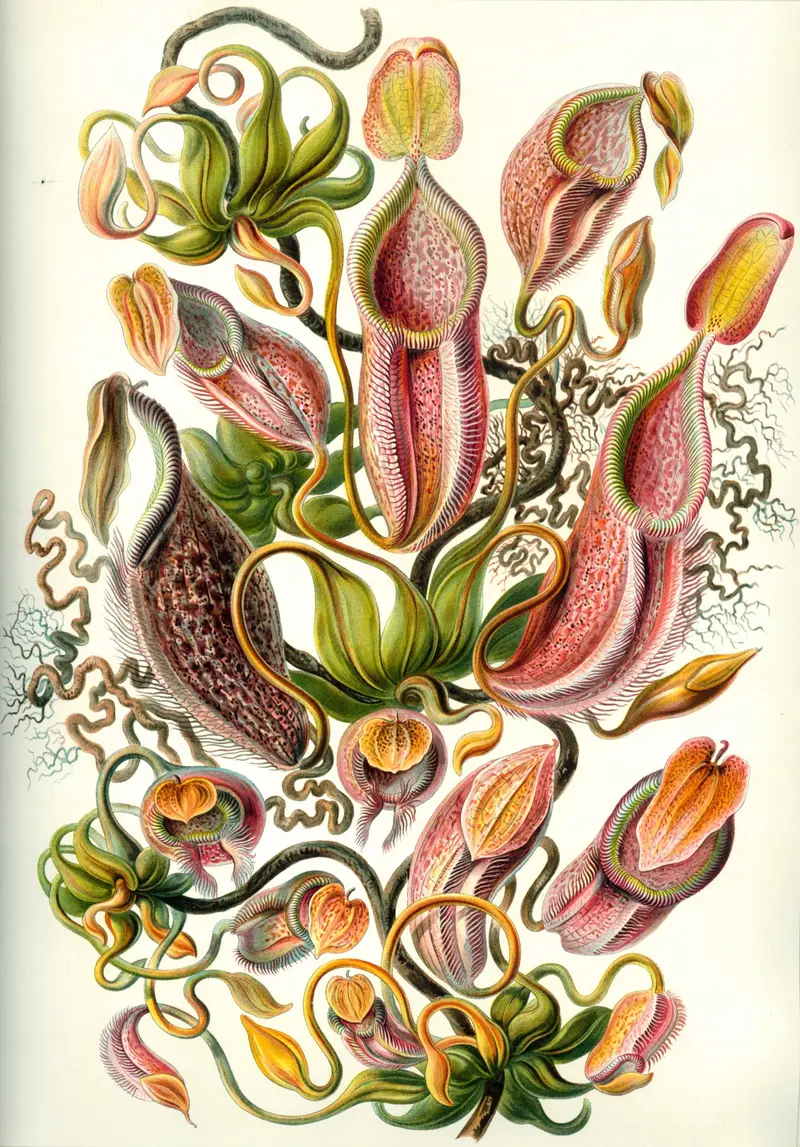
Nepenthaceae (Pitcher Plants) by Ernst Haeckel
Plant: Pitcher plant (Nepenthes)
1904 · Color lithograph · 36 × 26 cm
Pitcher plants hang their colorful traps from their leaves; the pitchers are not flowers but parts of the leaf built to catch insects. Ernst Haeckel found this one at a waterfall in the rainforest of Java on January 4, 1901, and painted it from life; in its digestive fluid he saw flies, beetles, bees and spiders, some still trying to escape. Adolf Giltsch made the lithograph for plate 62 of Kunstformen der Natur (Art Forms in Nature).
No. 4Naturalism
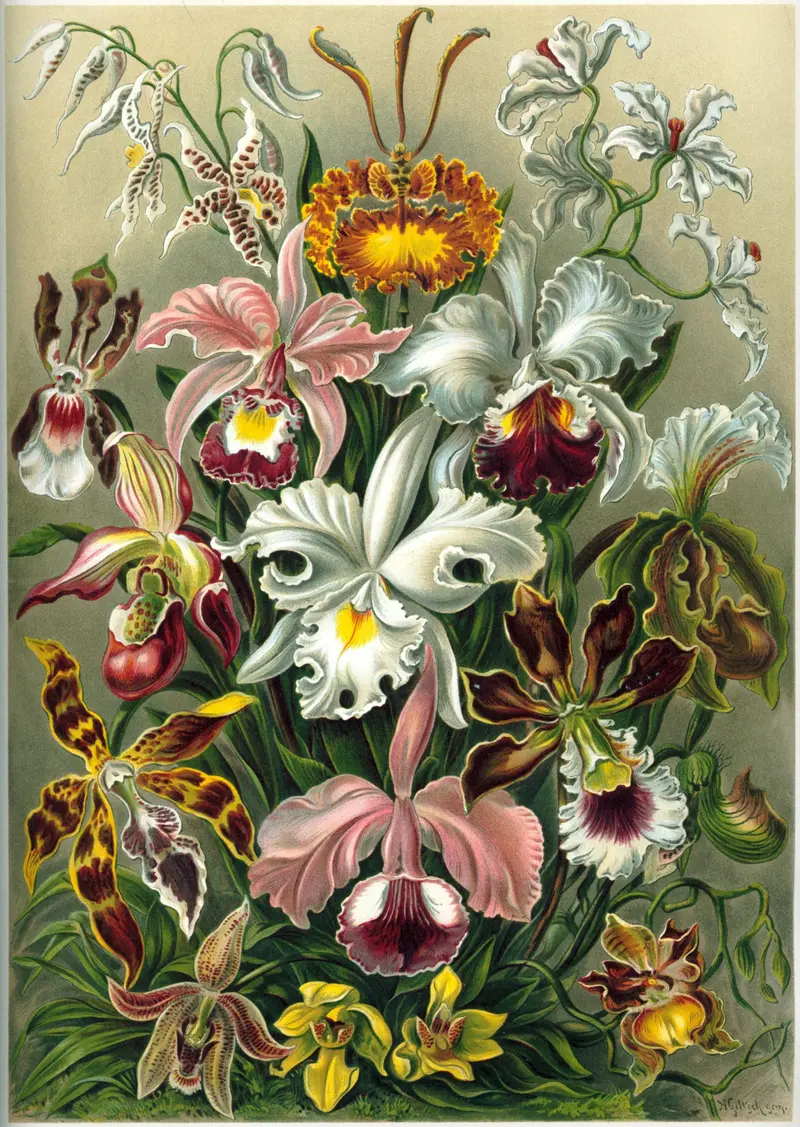
Orchideae (Orchids) by Ernst Haeckel
Plant: Sixteen tropical orchids
1904 · Color lithograph · 36 × 26 cm
Sixteen tropical orchids crowd the plate, each drawn at natural size and in natural color. Ernst Haeckel chose mostly tree-dwelling orchids of the tropics and used the plate to argue for natural selection: their two-sided flowers and their likeness to bees, flies and butterflies, he wrote, are adaptations to the insects that pollinate them. In his preface he predicted that designers would find new motifs in plates like this one.
No. 5Naturalism
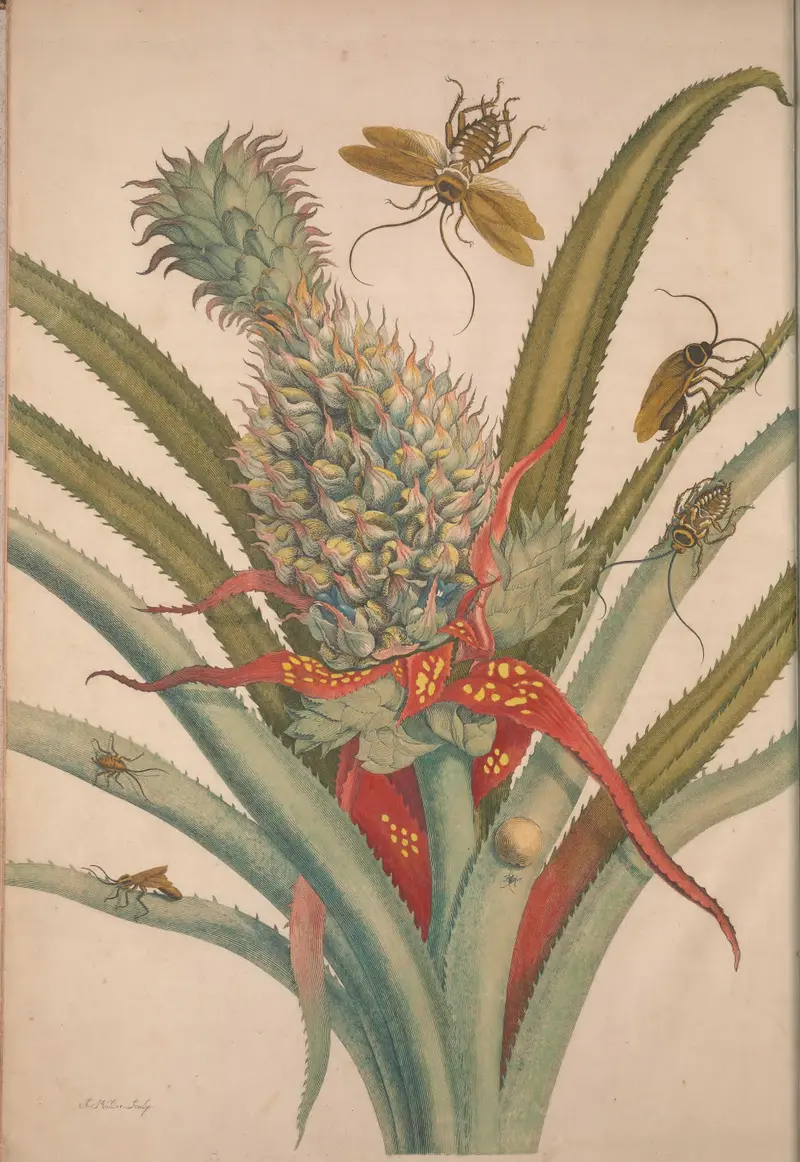
Pineapple with Cockroaches by Maria Sibylla Merian
Plant: Pineapple (Ananas comosus)
1705 · Hand-colored engraving
Smithsonian Libraries, Washington, DC
A pineapple in flower rises from its spiky leaves, with cockroaches crawling over it. Maria Sibylla Merian opened her book with it because she thought the pineapple the finest of all edible fruits, and wrote that cockroaches, the best-known insects in America, love it for its sweetness. She had sailed to Suriname in 1699 with her daughter Dorothea; Metamorphosis insectorum Surinamensium followed in 1705, with 60 hand-colored engravings. This copy belongs to the Smithsonian Libraries.
Sources: Smithsonian Libraries
No. 6Naturalism
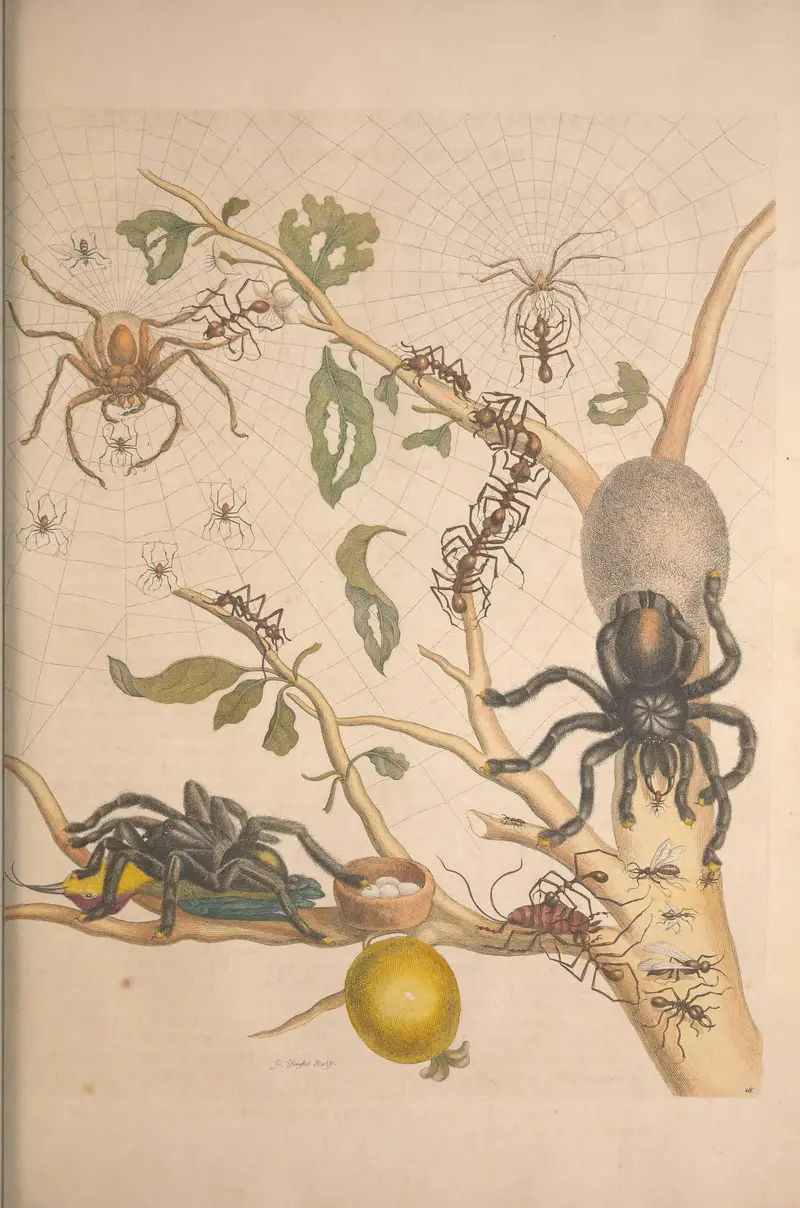
Spiders, Ants and Hummingbird on a Guava Branch by Maria Sibylla Merian
Plant: Guava (Psidium guajava)
1705 · Hand-colored engraving
Smithsonian Libraries, Washington, DC
A huge spider drags a hummingbird from its nest on a guava branch, while ants and smaller spiders swarm around. Maria Sibylla Merian wrote that she usually found the largest spiders on guava trees, and that for lack of ants they would take small birds from their nests. Linnaeus named the spider avicularia, little bird, after this plate; the idea was later ridiculed, but researchers now know she drew a real predation. This copy belongs to the Smithsonian Libraries.
Sources: Smithsonian Libraries
No. 7
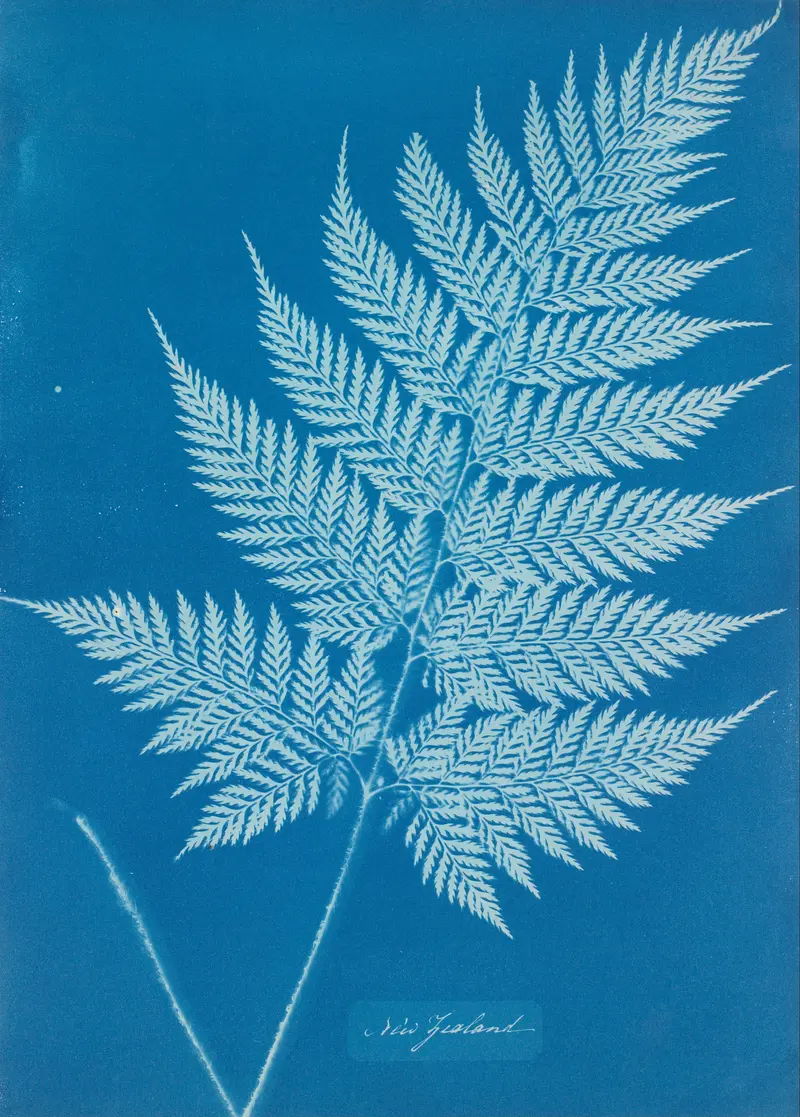
New Zealand (fern cyanotype) by Anna Atkins
Plant: A fern
c. 1853–1854 · Cyanotype · 35.2 × 25.1 cm
Minneapolis Institute of Art, Minneapolis
A fern frond appears as a white silhouette on deep blue, labeled New Zealand. No camera was used: the plant was laid on paper coated with light-sensitive iron salts, exposed to light and washed in water, a process invented by Sir John Herschel that later gave us the word blueprint. From about 1852 Anna Atkins worked with her friend Anne Dixon on albums of ferns and flowering plants, so prints like this one may be by either or both. It is in the Minneapolis Institute of Art.
Sources: Minneapolis Institute of Art

No. 8
Rosa centifolia Burgundiaca by Pierre-Joseph Redouté
Plant: Cabbage rose
1824 · Color stipple engraving with watercolor
California State Library, San Francisco
A small pink cabbage rose, Rosa centifolia Burgundiaca, opens beside its buds on a single stem. Pierre-Joseph Redouté painted it for Les Roses (1817–1824), whose text by Claude-Antoine Thory says Paris growers raised this little rose under glass frames, making it one of the first roses at the flower market each spring. The plate is a stipple engraving printed in color and finished with watercolor. This copy is in the California State Library in San Francisco.
Sources: California State Library
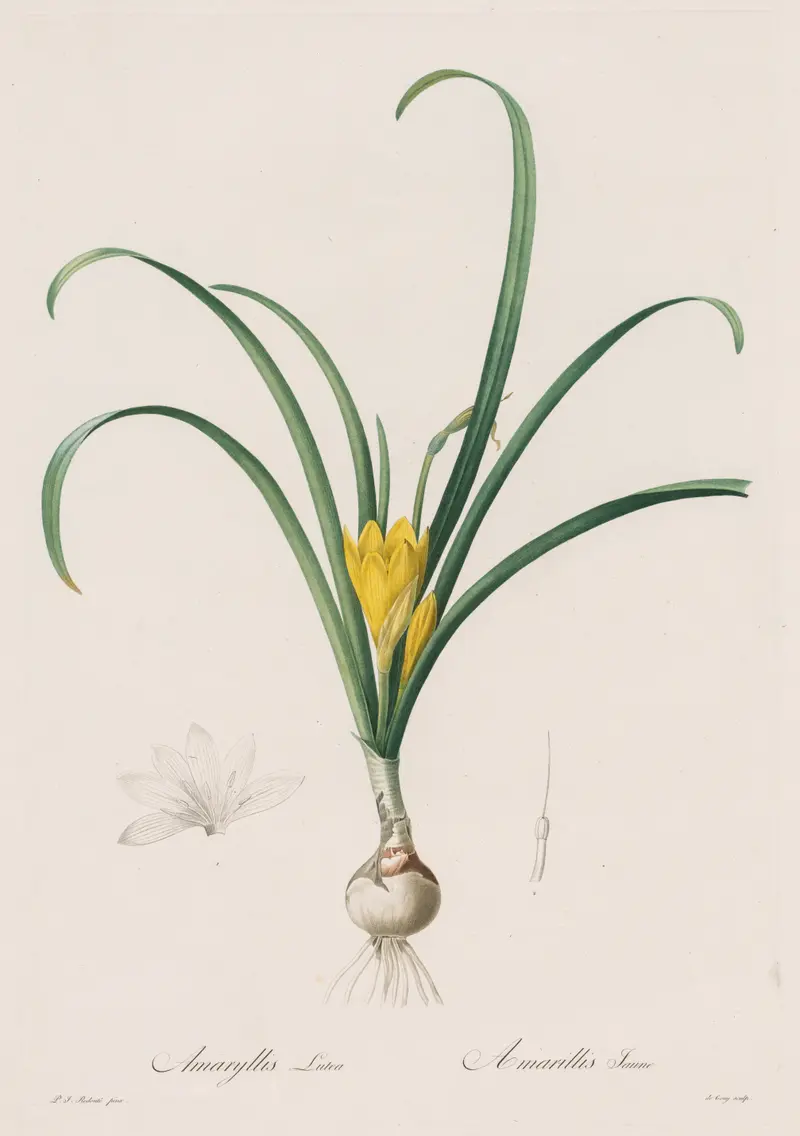
No. 9
Amaryllis lutea by Pierre-Joseph Redouté
Plant: Autumn narcissus
1802–1816 · Stipple and line engraving with hand coloring
Cleveland Museum of Art, Cleveland
A yellow autumn flower rises from its bulb among narrow leaves, with small outline drawings of its opened flower and its pistil beside it. Pierre-Joseph Redouté painted it at natural size for Les Liliacées (1802–1816), and de Gouy engraved it; the text says it flowers at the start of autumn, which earned it the French name autumn narcissus, in damp meadows of Spain and Italy. This impression is in the Cleveland Museum of Art.
Sources: Cleveland Museum of Art
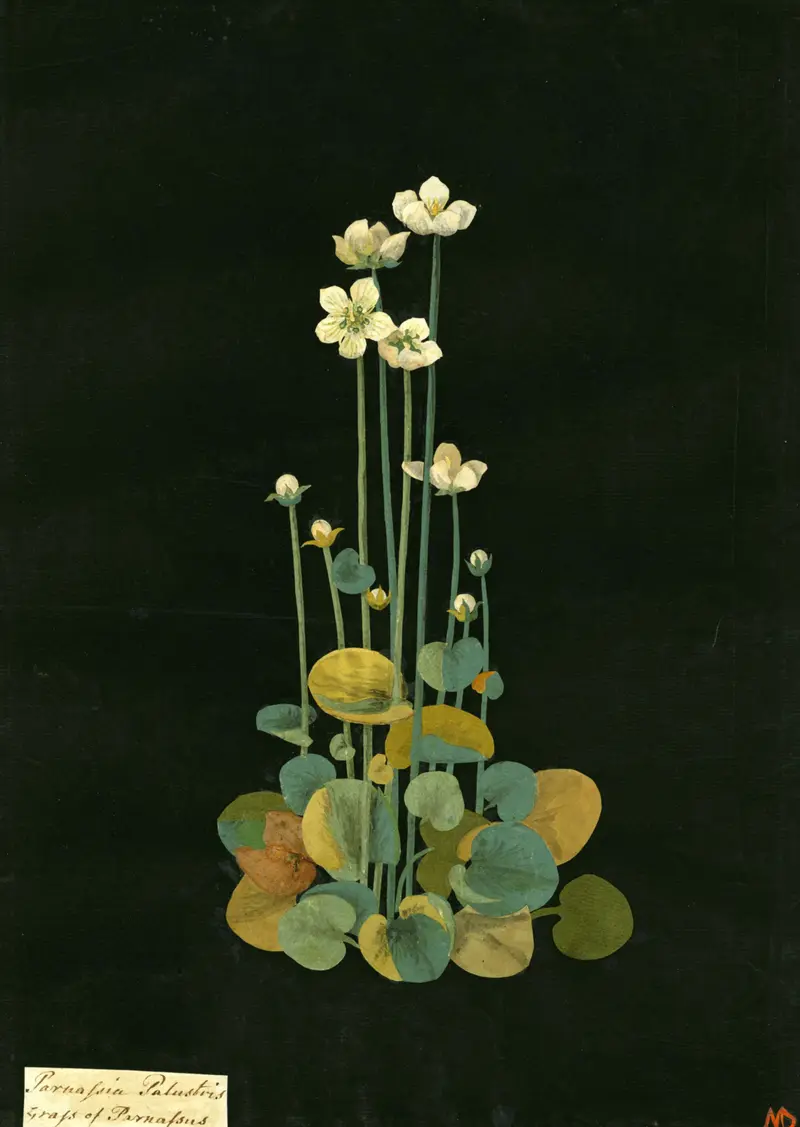
No. 10
Parnassia palustris by Mary Delany
Plant: Grass of Parnassus
1776 · Collage of colored papers
British Museum, London
A white grass of Parnassus stands out against a black ground, its petals, stems and leaves cut from layers of colored paper, touched with bodycolor and watercolor, with a real leaf sample added. Mary Delany made it in 1776, and the British Museum's record names the plant with its Linnaean class, Pentandria Tetragynia. Most of her paper mosaics came to the museum in 1897 as a gift from her great-niece, Lady Llanover, and this sheet is there today, in London.
Sources: British Museum
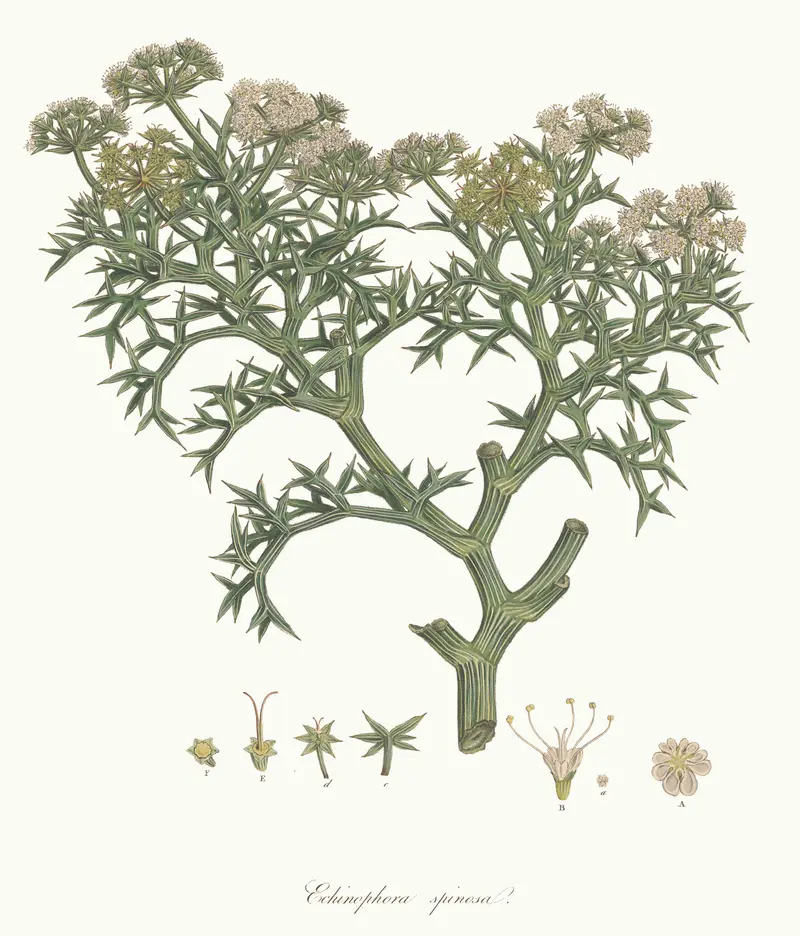
No. 11
Echinophora spinosa (Flora Graeca) by Ferdinand Bauer
Plant: Echinophora spinosa
1819 · Hand-colored engraving
Lloyd Library and Museum, Cincinnati
Echinophora spinosa, a spiny plant of Mediterranean coasts, spreads across the page with its flowers and seeds enlarged below. Ferdinand Bauer sketched it on John Sibthorp's journey through Greece and Turkey in 1786–88, writing numbers on his field sketches to stand for colors so he could paint it accurately years later in Oxford. Flora Graeca took 54 years to produce and only 25 copies were first printed; this volume of 1819 is in the Lloyd Library and Museum in Cincinnati.
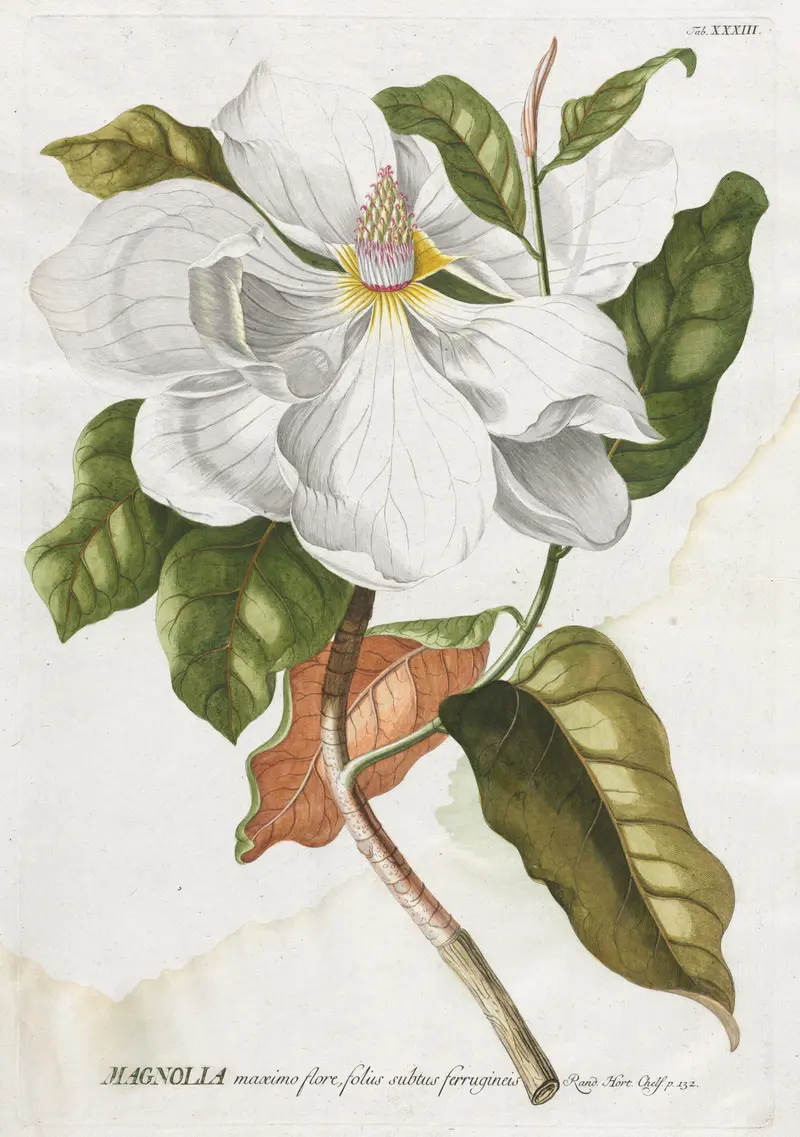
No. 12
Magnolia (Plantae Selectae) by Georg Dionysius Ehret
Plant: Southern magnolia
1750–1773 · Hand-colored engraving
Cleveland Museum of Art, Cleveland
A southern magnolia opens its great white flower among glossy leaves. Georg Dionysius Ehret drew it from a living plant in 1737, measuring the flower at eleven inches across and counting ten petals; that same year he published his own engraving of it. Johann Jacob Haid engraved and colored this plate for Christoph Jacob Trew's Plantae Selectae (1750–1773). This impression is in the Cleveland Museum of Art.
Sources: Cleveland Museum of Art
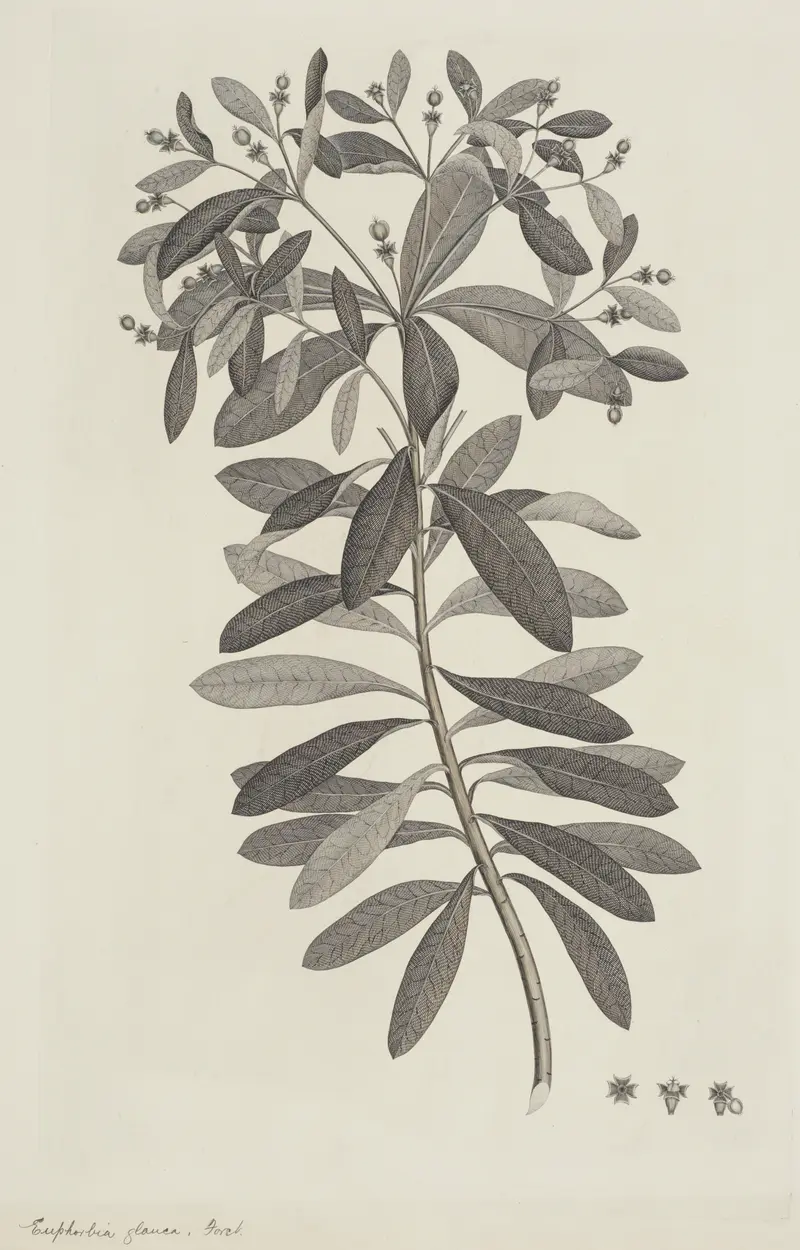
No. 13
Euphorbia glauca by Sydney Parkinson
Plant: New Zealand spurge
1895 · Line engraving · 50.4 × 37.8 cm
Museum of New Zealand Te Papa Tongarewa, Wellington
A New Zealand spurge, Euphorbia glauca, is engraved in fine black lines, with its name written in ink at lower left. Sydney Parkinson drew the plants Joseph Banks collected on Cook's first voyage (1768–1771); after he died on the way home, Banks had other artists finish the drawings and 18 engravers cut them in copper for a book that was never published. This proof was printed in 1895 for New Zealand botanists and is in Te Papa in Wellington.
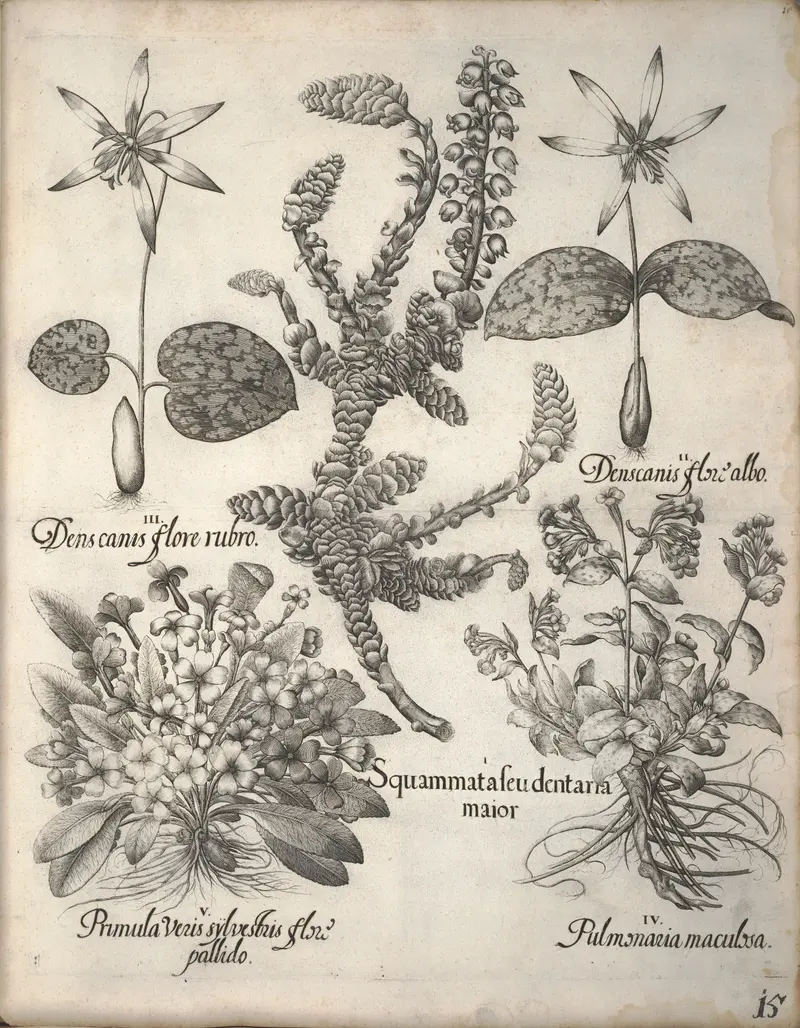
No. 14Northern Renaissance
Hortus Eystettensis, Spring, Plate 15 by Basilius Besler
Plant: Toothwort and dog's-tooth violets
1640 · Engraving
Missouri Botanical Garden, St. Louis
Toothwort, dog's-tooth violets and other spring plants fill a folio page, each numbered and named in Latin. Basilius Besler, a Nuremberg apothecary, recorded the gardens of the Prince-Bishop of Eichstätt in the Hortus Eystettensis of 1613. Besler died in 1629, and Swedish troops destroyed the gardens in 1633; this copy of the 1640 edition, which describes plants that were once to be seen there, is in the Missouri Botanical Garden library in St. Louis.
Sources: Missouri Botanical Garden
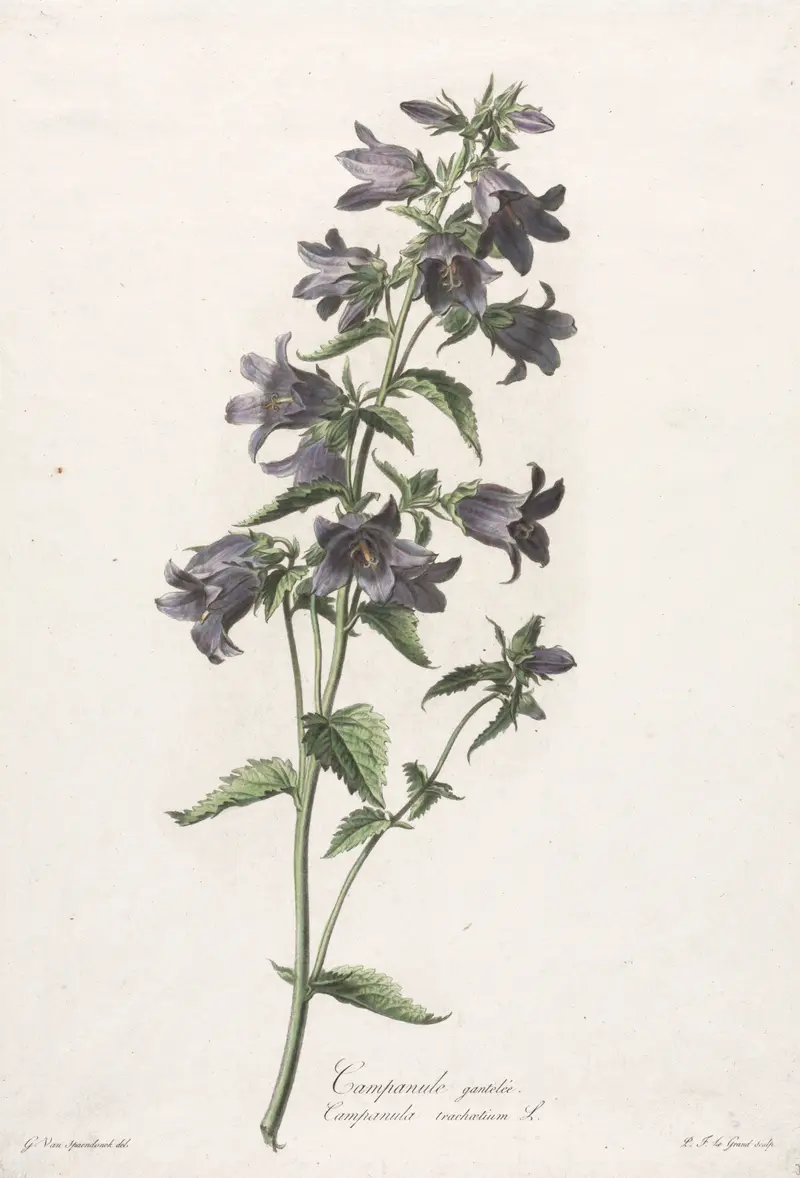
No. 15
Campanule gantelée by Gerard van Spaendonck
Plant: Nettle-leaved bellflower
c. 1800 · Hand-colored stipple engraving
Cleveland Museum of Art, Cleveland
A nettle-leaved bellflower rises in a spray of violet-blue bells, printed in fine stippled dots and finished by hand. Gerard van Spaendonck drew it for Fleurs dessinées d'après nature, a set of 24 large flower prints published in Paris in 1799–1801 and engraved by Pierre François Le Grand. Van Spaendonck held the chair of natural-history painting at the new Muséum in Paris, and Pierre-Joseph Redouté learned his craft under him. This impression is in the Cleveland Museum of Art.
Sources: Cleveland Museum of Art
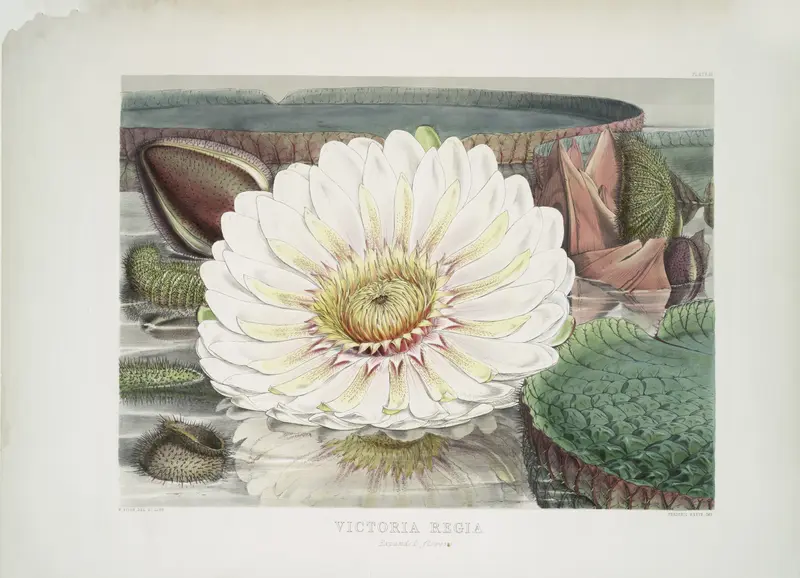
No. 16
Victoria Regia: Expanded Flower by Walter Hood Fitch
Plant: Giant water lily
1851 · Hand-colored lithograph
New York Public Library, New York
The giant water lily Victoria regia opens a huge white flower above its round, rimmed leaves. Walter Hood Fitch drew it and put it on the lithographic stone himself for William Jackson Hooker's Victoria Regia (1851), working chiefly from plants flowering at Syon and Kew. The lily had first flowered in England at Chatsworth in 1849, and Joseph Paxton drew on it for his greenhouse designs, including the Crystal Palace. This copy is in the New York Public Library.
Sources: New York Public Library
Want to see more? Browse every botanical print in the collection.
Browse all 214 botanical printsRedouté roses
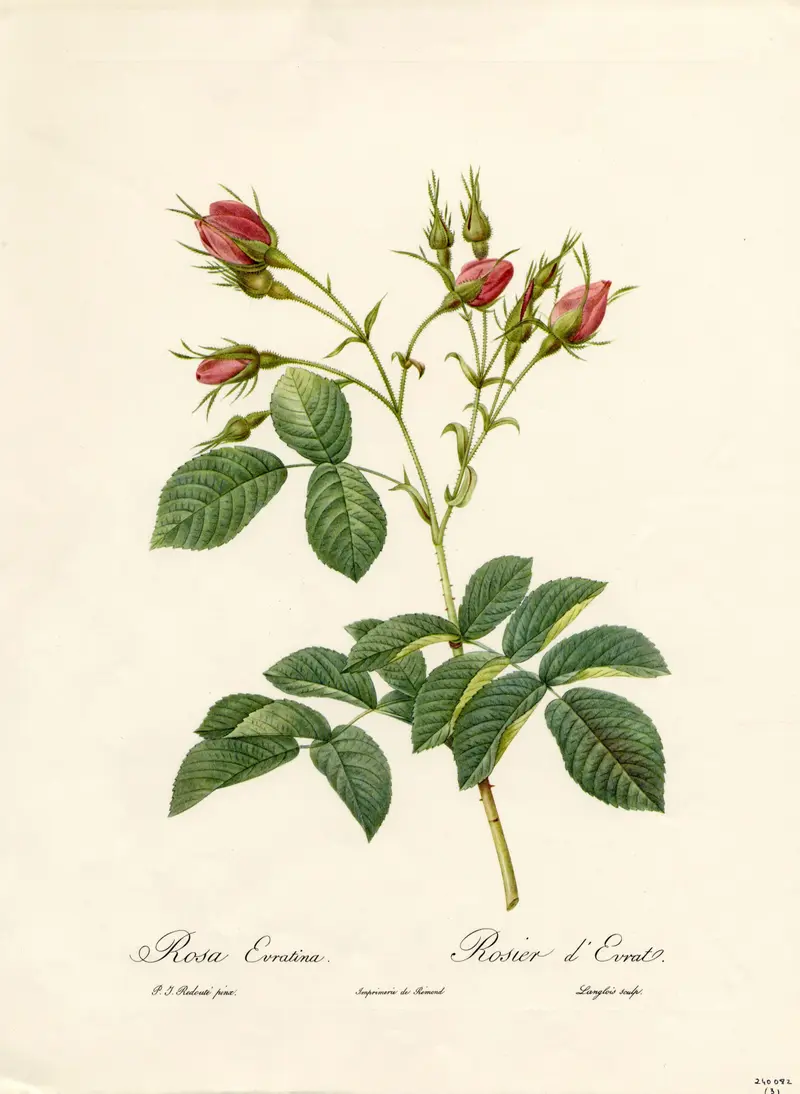
Five more plates from Pierre-Joseph Redouté's Les Roses (1817–1824), from the white moss rose to Evrat's rose.
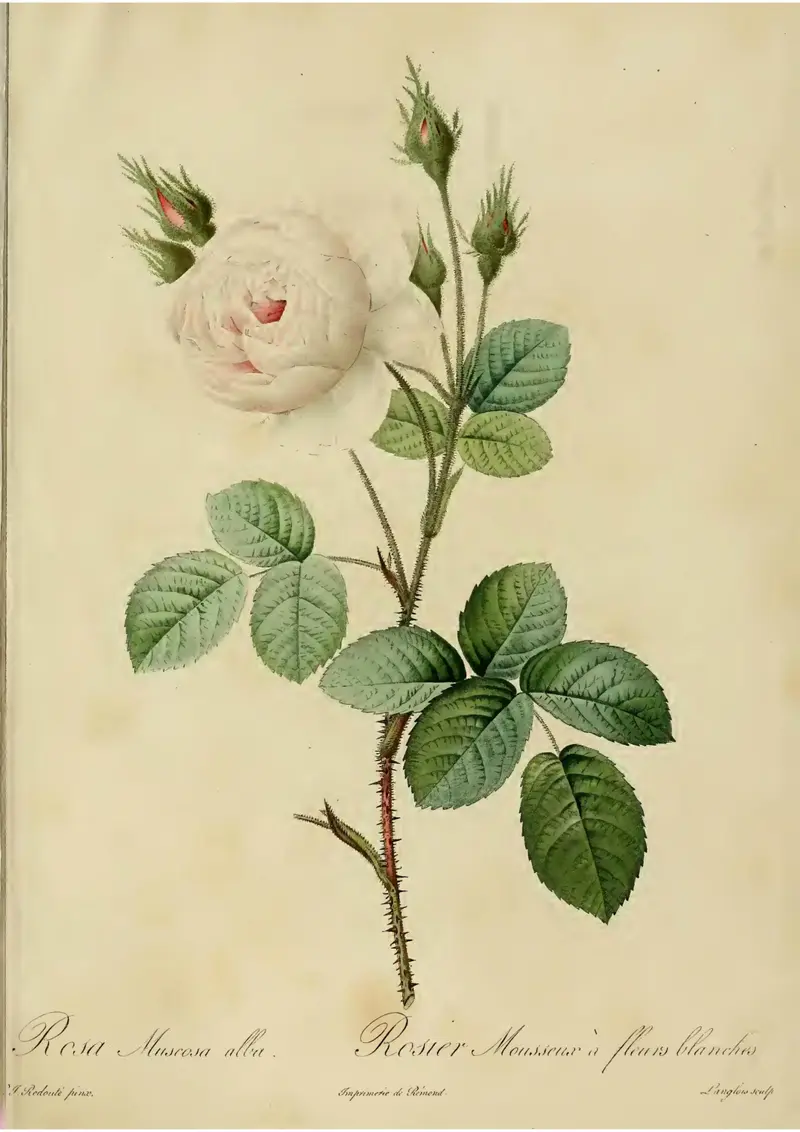
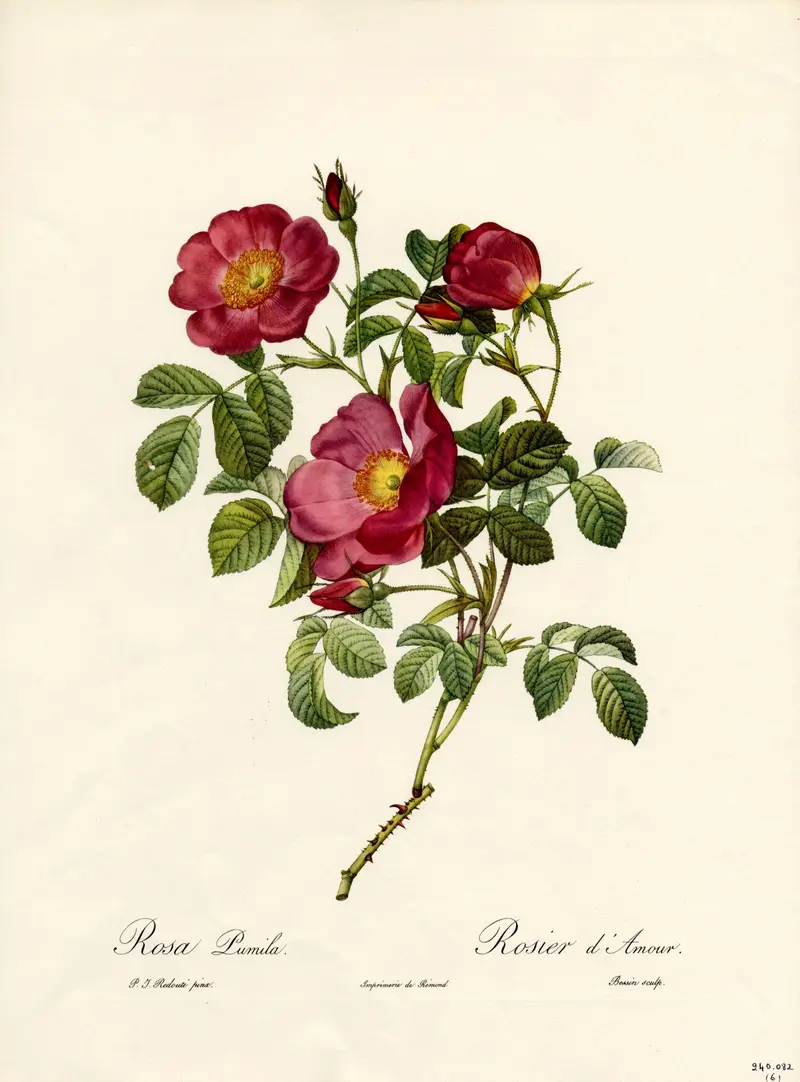
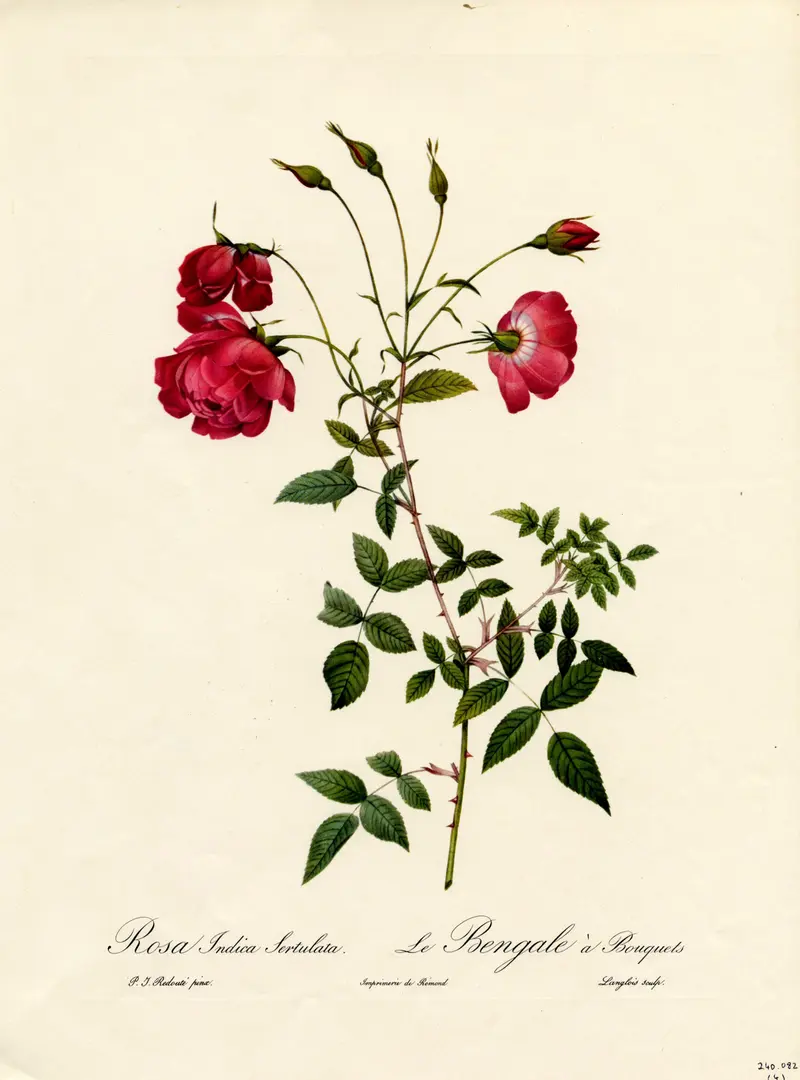
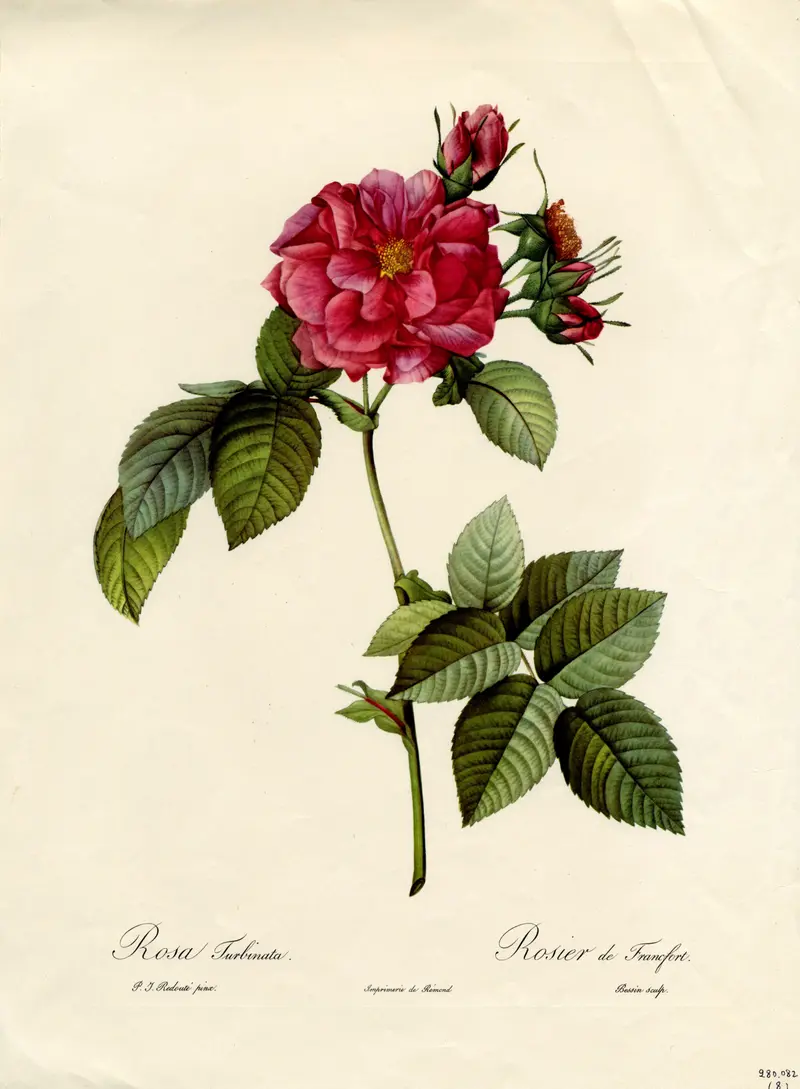
Maria Sibylla Merian
Six more plates from Merian's Metamorphosis insectorum Surinamensium (1705): Suriname's plants with the insects and animals that live on them.
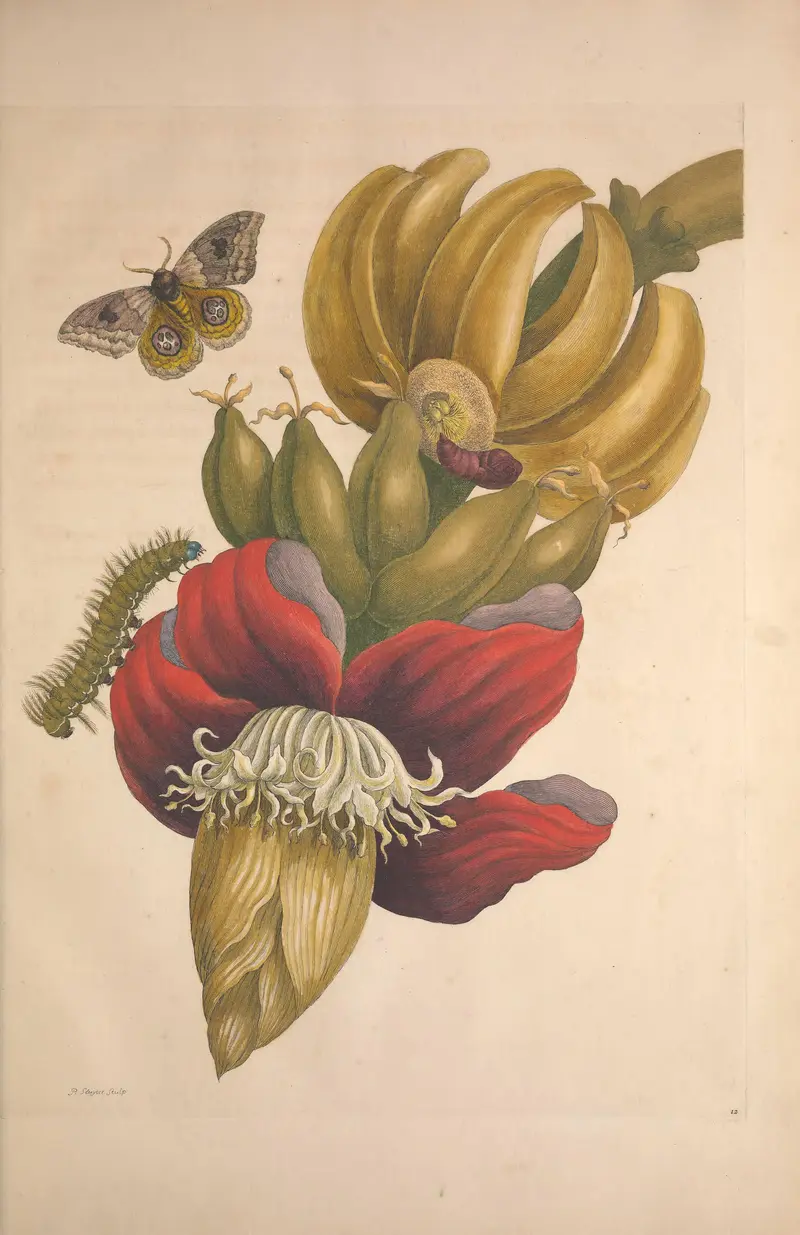 Banana with Bullseye Moth and CaterpillarMaria Sibylla Merian
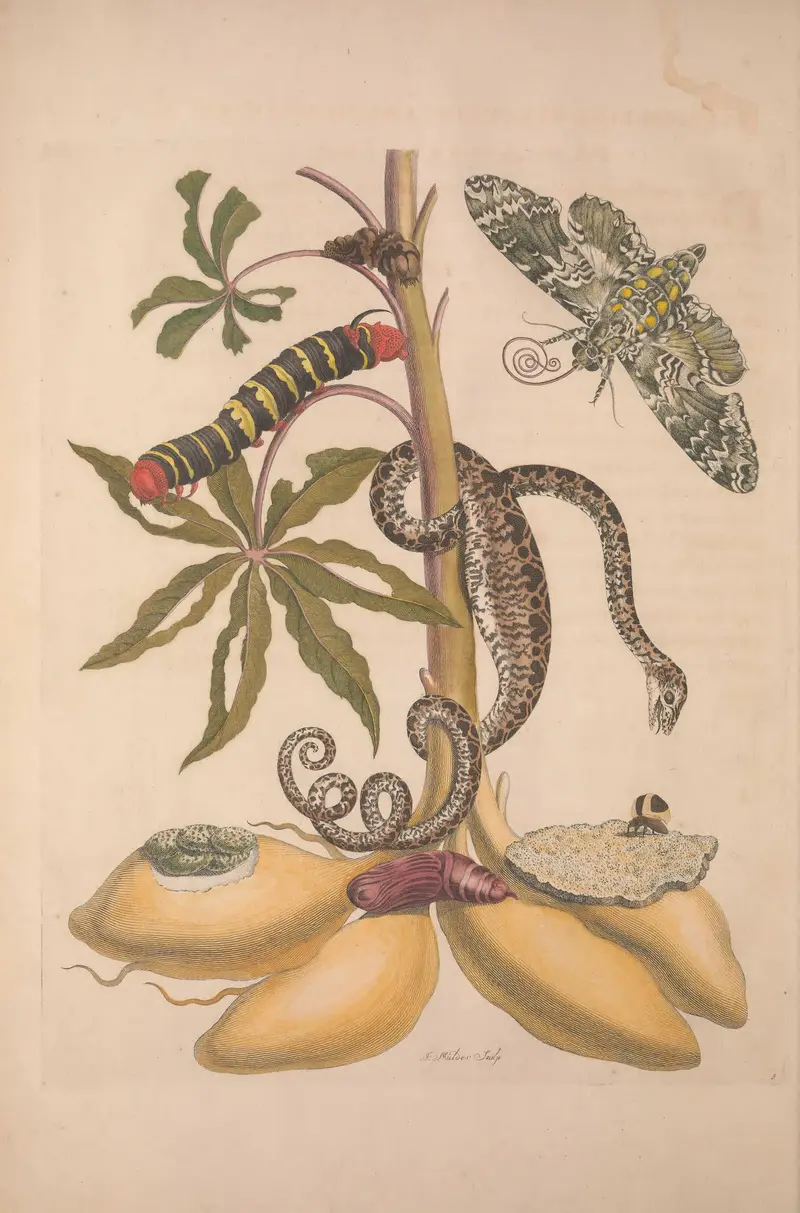 Cassava Root with Tree Boa and Sphinx MothMaria Sibylla Merian
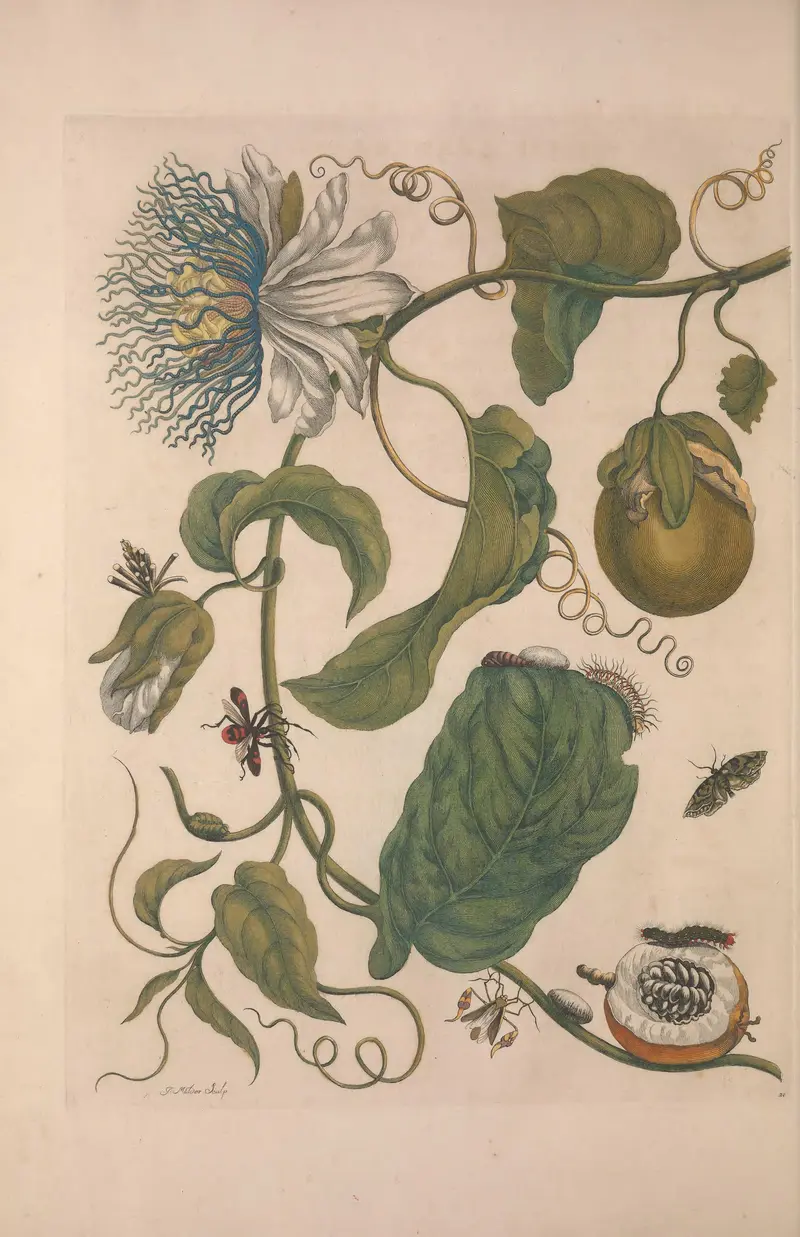 Passionflower with Caterpillars and InsectsMaria Sibylla Merian
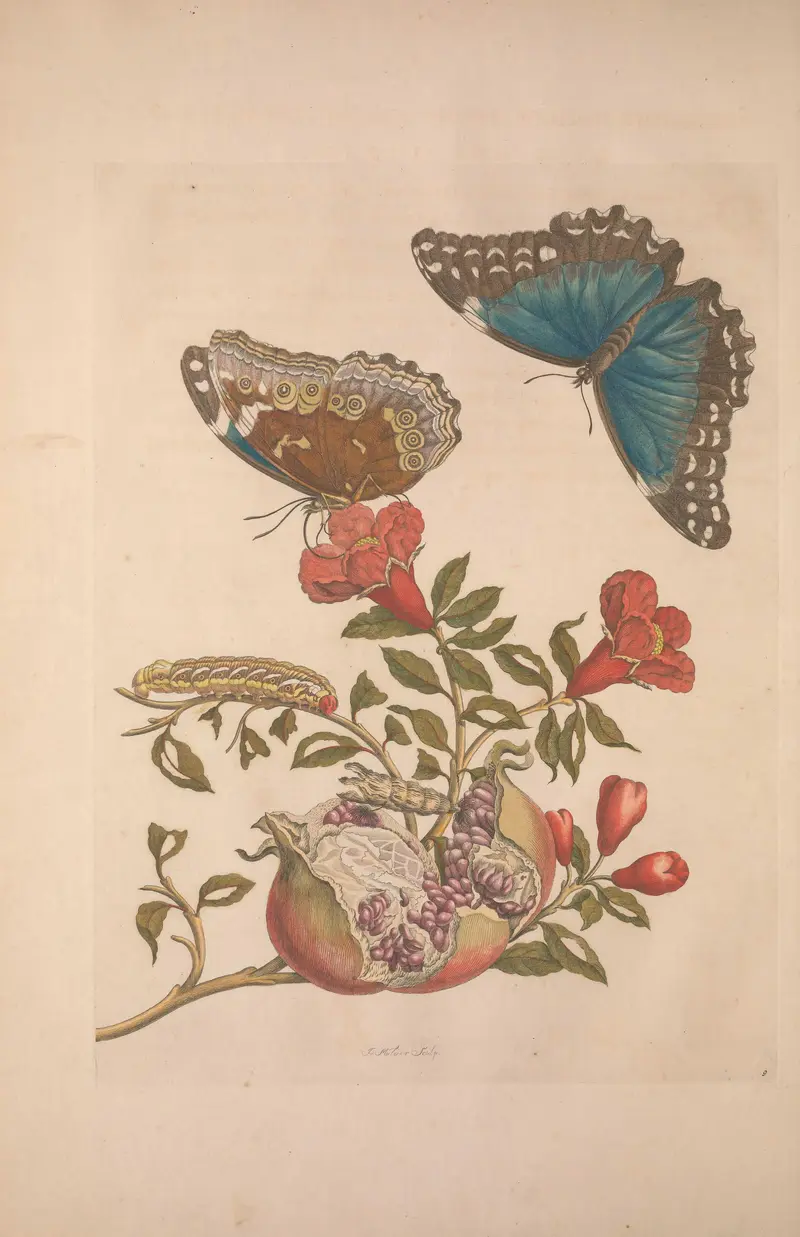 Pomegranate with Caterpillar, Pupa and Blue ButterflyMaria Sibylla Merian
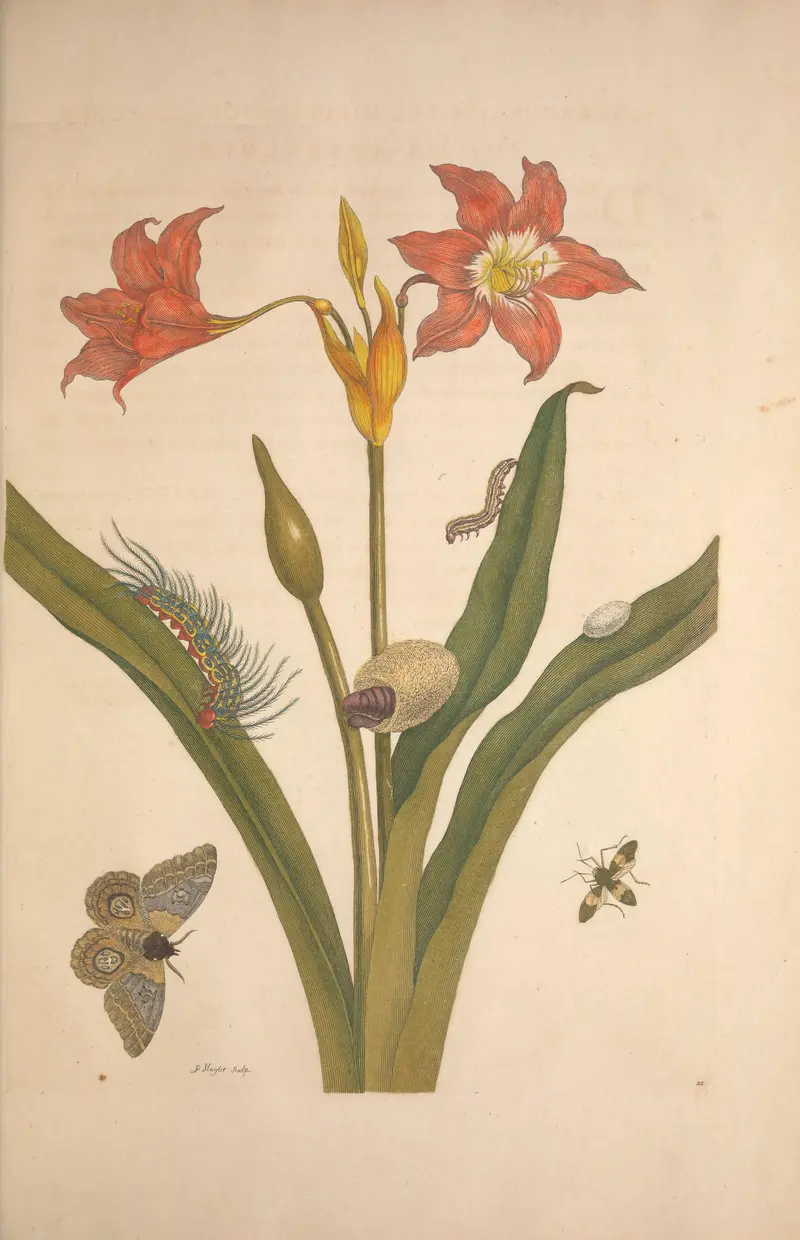 Red Amaryllis Lily with Moth and CaterpillarsMaria Sibylla Merian
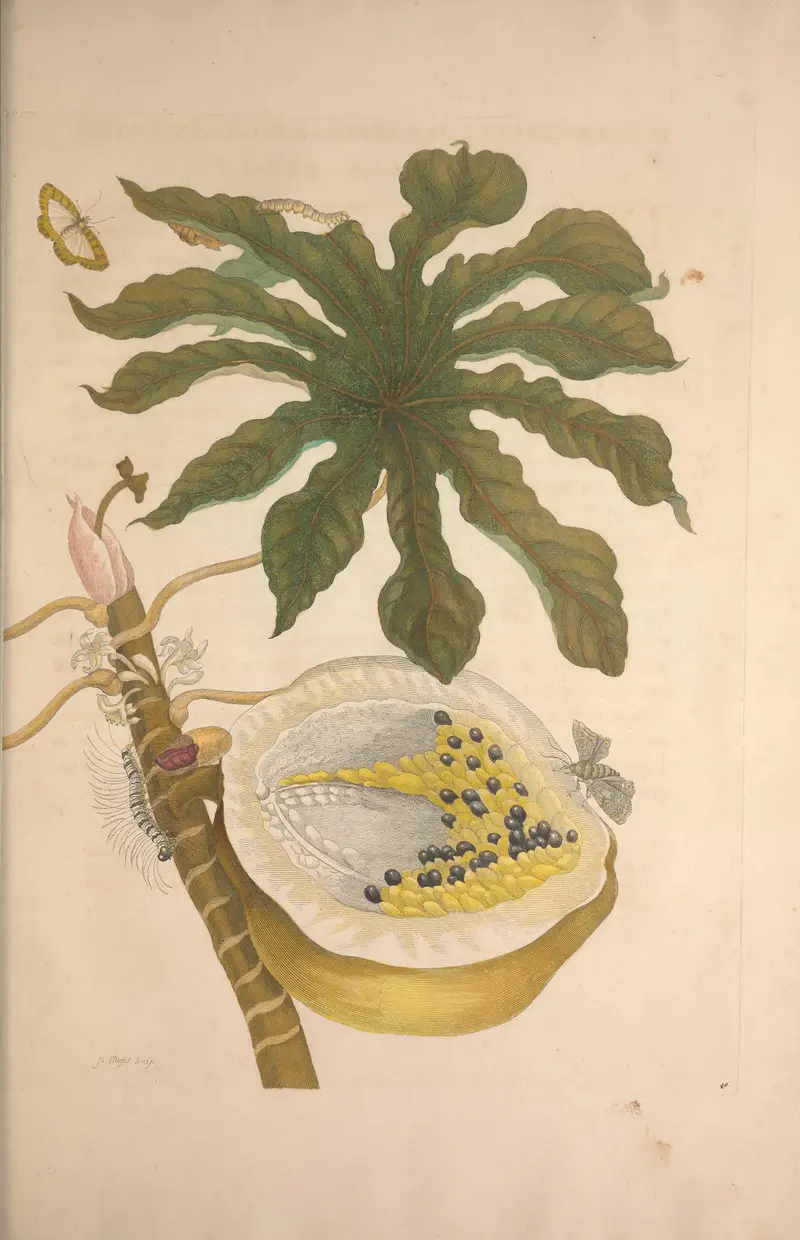 Papaya with Moth and CaterpillarMaria Sibylla Merian
Famous botanical artists
The artists who drew plants for science and for beauty, from Merian and Redouté to Haeckel and Anna Atkins. Each link opens all their work.
- Maria Sibylla MerianBy painting caterpillars on the plants they feed on, Merian brought a more ecological approach to the study of insect metamorphosis.
- Pierre-Joseph RedoutéFor the plates of Les Roses, Redouté employed a workshop of 18 printmakers; each print was inked à la poupée, then retouched with watercolor.
- Ernst HaeckelHaeckel's Kunstformen der Natur (Art Forms in Nature) came out in ten-plate installments from 1899 to 1904: 100 large lithographs in all.
- Georg Dionysius EhretWhen the Bull Bay magnolia first flowered in Europe, in a garden at Parson's Green, London, Ehret walked there daily from Chelsea to draw it.
- Anna AtkinsAtkins was the first person to print and publish a book illustrated with photographs, British Algae (1843), using John Herschel's new cyanotype process.
- Mary DelanyMary Delany began her botanical paper mosaics at age 72; almost one thousand of them are now in the British Museum.
List of famous botanical art and its artists
The 16 most famous works of botanical art: who made them, the plant they show, when, and where the copy we show is kept.
Show the list of 16 botanical printsHide the list
| # | Work | Plant | Artist | Year | Medium | Size | Located in | City |
|---|---|---|---|---|---|---|---|---|
| 1 | The Great Piece of Turf | Dandelion, greater plantain and grasses | Albrecht Dürer | 1503 | Watercolor and bodycolor on paper | 40.8 × 31.5 cm (16.1 × 12.4 in) | Albertina | Vienna |
| 2 | Iris | Blue-flowering iris | Albrecht Dürer | c. 1503 | Watercolor and bodycolor on paper | 77.5 × 31.3 cm (30.5 × 12.3 in) | Kunsthalle Bremen | Bremen |
| 3 | Nepenthaceae (Pitcher Plants) | Pitcher plant (Nepenthes) | Ernst Haeckel | 1904 | Color lithograph | 36 × 26 cm (14.2 × 10.2 in) | ||
| 4 | Orchideae (Orchids) | Sixteen tropical orchids | Ernst Haeckel | 1904 | Color lithograph | 36 × 26 cm (14.2 × 10.2 in) | ||
| 5 | Pineapple with Cockroaches | Pineapple (Ananas comosus) | Maria Sibylla Merian | 1705 | Hand-colored engraving | Smithsonian Libraries | Washington, DC | |
| 6 | Spiders, Ants and Hummingbird on a Guava Branch | Guava (Psidium guajava) | Maria Sibylla Merian | 1705 | Hand-colored engraving | Smithsonian Libraries | Washington, DC | |
| 7 | New Zealand (fern cyanotype) | A fern | Anna Atkins | c. 1853–1854 | Cyanotype | 35.2 × 25.1 cm (13.9 × 9.9 in) | Minneapolis Institute of Art | Minneapolis |
| 8 | Rosa centifolia Burgundiaca | Cabbage rose | Pierre-Joseph Redouté | 1824 | Color stipple engraving with watercolor | California State Library | San Francisco | |
| 9 | Amaryllis lutea | Autumn narcissus | Pierre-Joseph Redouté | 1802–1816 | Stipple and line engraving with hand coloring | Cleveland Museum of Art | Cleveland | |
| 10 | Parnassia palustris | Grass of Parnassus | Mary Delany | 1776 | Collage of colored papers | British Museum | London | |
| 11 | Echinophora spinosa (Flora Graeca) | Echinophora spinosa | Ferdinand Bauer | 1819 | Hand-colored engraving | Lloyd Library and Museum | Cincinnati | |
| 12 | Magnolia (Plantae Selectae) | Southern magnolia | Georg Dionysius Ehret | 1750–1773 | Hand-colored engraving | Cleveland Museum of Art | Cleveland | |
| 13 | Euphorbia glauca | New Zealand spurge | Sydney Parkinson | 1895 | Line engraving | 50.4 × 37.8 cm (19.8 × 14.9 in) | Museum of New Zealand Te Papa Tongarewa | Wellington |
| 14 | Hortus Eystettensis, Spring, Plate 15 | Toothwort and dog's-tooth violets | Basilius Besler | 1640 | Engraving | Missouri Botanical Garden | St. Louis | |
| 15 | Campanule gantelée | Nettle-leaved bellflower | Gerard van Spaendonck | c. 1800 | Hand-colored stipple engraving | Cleveland Museum of Art | Cleveland | |
| 16 | Victoria Regia: Expanded Flower | Giant water lily | Walter Hood Fitch | 1851 | Hand-colored lithograph | New York Public Library | New York |
Botanical art: questions and answers
What is botanical art?
Botanical art is the accurate picturing of plants, often drawn from life, so that a species can be recognized and told apart from other species. It calls for artistic skill and botanical knowledge together; the Royal Horticultural Society says the best botanical illustration combines scientific accuracy with visual appeal. That aim sets it apart from flower painting: the V&A notes that grouped stems and an added butterfly suggest one Ehret watercolor was probably meant as "a decorative painting rather than a scientific botanical illustration."
Sources: Royal Horticultural Society, Botanical Art & Photography Show Selection Meeting Factsheet · Getty Art & Architecture Thesaurus, botanical illustrations · Cleveland Museum of Art, Flower Power · Victoria and Albert Museum, Daphne mezereum with butterfly
Who is the most famous botanical artist?
There is no official ranking. Pierre-Joseph Redouté, hailed as the "Raphael of flowers," was the most celebrated botanical illustrator of his day. Other leading names are Maria Sibylla Merian, whose Insects of Suriname the Getty counts among the greatest illustrated natural history books of all time; Georg Dionysius Ehret, one of the greatest botanical illustrators of the 18th century; and Albrecht Dürer, a pioneer of nature studies, whose watercolor The Great Piece of Turf dates from 1503.
Sources: Cleveland Museum of Art, Lillium Pomponium (Turban Lily), plate 7 from Les Liliacées · J. Paul Getty Museum, Maria Sibylla Merian & Daughters: Women of Art and Science · Victoria and Albert Museum, American Turk's-cap lily (Lilium superbum) · Albertina Museum via Google Arts & Culture, The Large Piece of Turf, 1503
Why did Redouté paint roses?
Largely because of Empress Joséphine. At Malmaison, her estate just outside Paris, she built an immense hothouse and gathered some 250 varieties of roses, and the Cleveland Museum of Art describes Les Roses (1817–1824) as a set of lavish prints she commissioned. A workshop of 18 printmakers turned Redouté's watercolors into stipple engravings, printed in color and retouched with watercolor. With text by Claude-Antoine Thory, Les Roses is probably his best-known work.
Sources: Cleveland Museum of Art, Flower Power · Cleveland Museum of Art, The Roses: China or Bengal Rose · Linda Hall Library, Scientist of the Day: Pierre-Joseph Redouté · The Metropolitan Museum of Art, ‘Empress Josephine’ or Frankfort Rose (Rosa turbinata), from Les Roses
Who was Maria Sibylla Merian?
Maria Sibylla Merian (1647–1717) was a German-born artist and naturalist, born in Frankfurt, who studied how insects transform. In 1699, at 52, she sailed to the Dutch colony of Suriname with her younger daughter, Dorothea Maria. The result was Metamorphosis insectorum Surinamensium (1705), whose 60 plates each show a plant with at least one insect in various stages of metamorphosis. Its vivid colors, large format and exotic insects made it her breakthrough with a wider public.
Sources: J. Paul Getty Museum, Maria Sibylla Merian & Daughters: Women of Art and Science · Linda Hall Library, Scientist of the Day: Maria Merian · Rijksmuseum, Over de voortteeling en wonderbaerlijke veranderingen der Surinaamsche insecten
How were vintage botanical prints made?
Many began as watercolors that skilled craftsmen translated into prints. Early herbals used woodcuts colored by hand; later plates were engraved or etched, with stipple (tone built from tiny dots) or aquatint, and were often printed in color and finished with watercolor by hand. In the later 1800s chromolithography printed each color from a separate stone or plate. Nature printing pressed a real leaf into soft metal to make the printing surface, and cyanotypes were made by laying plants on iron-salt paper in sunlight.
Sources: Cleveland Museum of Art, Flower Power · Getty Art & Architecture Thesaurus, chromolithography · Getty Art & Architecture Thesaurus, nature printing · Victoria and Albert Museum, Papaver Orientale
Can I download these botanical prints for free?
Yes. Every work on this page is public domain where we checked it, and a faithful copy of a public-domain picture adds no new copyright. The U.S. Copyright Office will not register a photograph that is merely a "slavish copy" of a painting or drawing, and says simple scanning is not creative enough. Article 14 of EU Directive 2019/790 likewise leaves reproductions of public-domain visual art unprotected unless they are themselves original. For every picture here, its standard download is free for any use, including commercial.
Sources: U.S. Copyright Office, Compendium of U.S. Copyright Office Practices, Chapter 900: Visual Art Works · U.S. Copyright Office, Compendium of U.S. Copyright Office Practices, Chapter 300: Copyrightable Authorship · EUR-Lex, Directive (EU) 2019/790 on copyright and related rights in the Digital Single Market, Article 14
How we chose the most famous botanical art
We ranked the artists by how widely each one is known around the world: the number of languages that have an encyclopedia entry about them, checked in October 2026. For each, we chose up to two of their best-known plant pictures.
A few rules keep the list useful. Every picture is in the public domain, so you can download and use it freely. It must show plants with botanical accuracy: flower paintings in vases are on our still life page, and gardens on our landscape page. Where the only image we could find was too small, or the credit was doubtful, the work is left out, which is why Leonardo da Vinci's plant studies and Charles Rennie Mackintosh's flower watercolors are missing for now.
Dates and holders come from museum and library records, and each entry links to its sources.
Spotted a mistake? Tell us and we will correct it.
Browse all 214 botanical prints and drawings
Every one is public domain and free to download: botanical prints, plant studies and cyanotypes.