
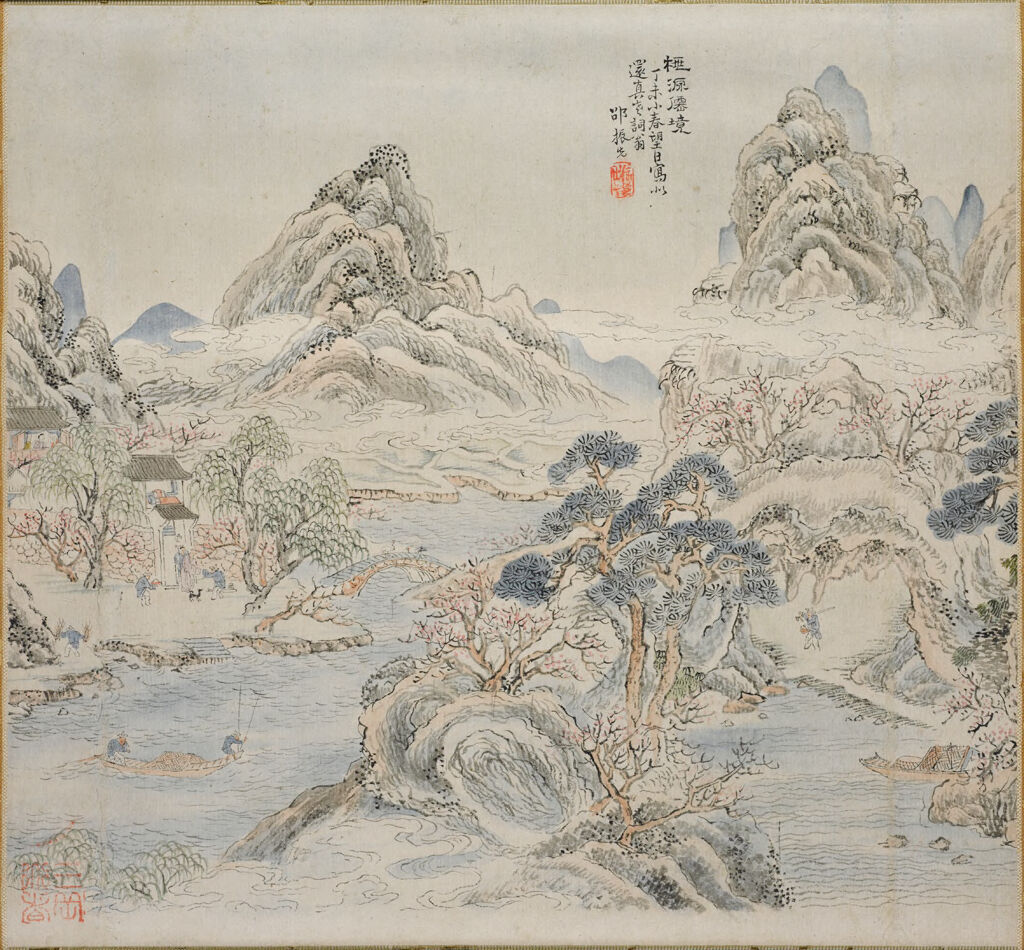
Peach Blossom Spring (after Shao Zhenxian) — History & Analysis
Art reveals the soul when the world turns away. In Peach Blossom Spring, the quiet beauty of nature transcends time and invites the viewer into a realm of revelation. Look to the left, where delicate pink blossoms burst against a soft blue sky, their gentleness contrasted by the sturdy branches that cradle them. Notice how the brushwork creates a sense of movement, as if the petals might flutter away at any moment, carried by a whisper of wind.
The composition is harmonious, guiding the eye through the tranquil landscape and inviting exploration into every nook. Beneath this serene surface lies a narrative of longing and transience. The cherry blossoms symbolize both the fleeting nature of beauty and the ephemeral nature of life, echoing the cyclical patterns inherent in the natural world. The distant mountains rise, imbued with an ethereal quality, suggesting a sanctuary where time pauses and the soul can reflect.
This juxtaposition of fragile blossoms against the steadfast landscape speaks to the artist's meditation on the passage of time and the search for a sanctuary amidst chaos. Ikeno Taiga created this work in 1757 during Japan's Mid Edo period, a time marked by artistic flourishing and a renewed interest in traditional themes. Living in Kyoto, Taiga was influenced by the cultural richness of his surroundings and took inspiration from Chinese poetry and philosophy, striving to capture the essence of beauty in nature. The painting exemplifies the era's aesthetic ideals while also reflecting Taiga's personal quest for enlightenment through art.
![Pines on Mount Tai (after Gao Qian [after Tang Yin]), by Ikeno Taiga 池大雅, public domain](https://froigstrpvutwqtqikzt.supabase.co/storage/v1/object/public/art-images/artworks/3f7616d79812ca4338c2f57a0d5a8e4f7255205fa54db08c6493100359ac297b.jpg)