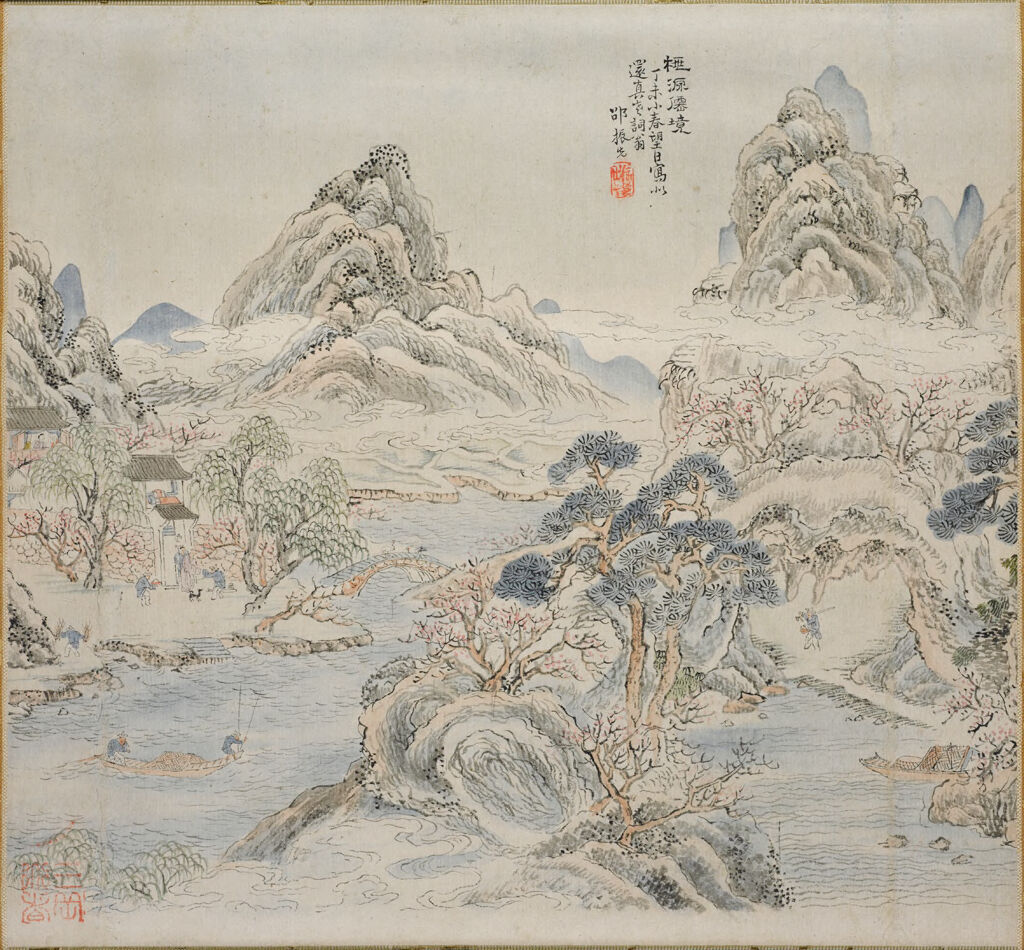
Yueyang Pavilion (after Shao Zhenxian) — History & Analysis
What if silence could speak through light? In Yueyang Pavilion, a tranquil moment unfolds, inviting the viewer to listen to the whispers of nature and the echoes of history. Focus on the delicate interplay of colors. Look closely at the lush greens and soft blues that breathe life into the landscape. The serene pavilion, perched elegantly on its foundation, draws the eye with its traditional architecture, while the misty mountains recede into the background like dreams.
Notice how the light dances across the gentle ripples of the water, creating a sparkling path that leads to the structure — a visual invitation to pause and reflect. At first glance, the scene appears peaceful, yet there lies an undercurrent of contemplation. The juxtaposition of the vibrant flora against the muted sky suggests a dialogue between life and transience. The pavilion, a symbol of cultural continuity, stands firm amid nature's fleeting moments, while the soft mist hints at the ephemeral nature of existence.
This tension encapsulates the spirit of creation, where beauty thrives alongside the inevitable passage of time. Ikeno Taiga painted Yueyang Pavilion in 1757 during the mid Edo period while residing in Japan. This era was marked by a flourishing of arts and culture, as traditional aesthetics began to blend with new influences. The artist was deeply engaged in the revival of classical themes and landscapes, seeking to capture the essence of nature in a way that resonated with the intellectual and spiritual currents of his time.
![Pines on Mount Tai (after Gao Qian [after Tang Yin]), by Ikeno Taiga 池大雅, public domain](https://froigstrpvutwqtqikzt.supabase.co/storage/v1/object/public/art-images/artworks/3f7616d79812ca4338c2f57a0d5a8e4f7255205fa54db08c6493100359ac297b.jpg)