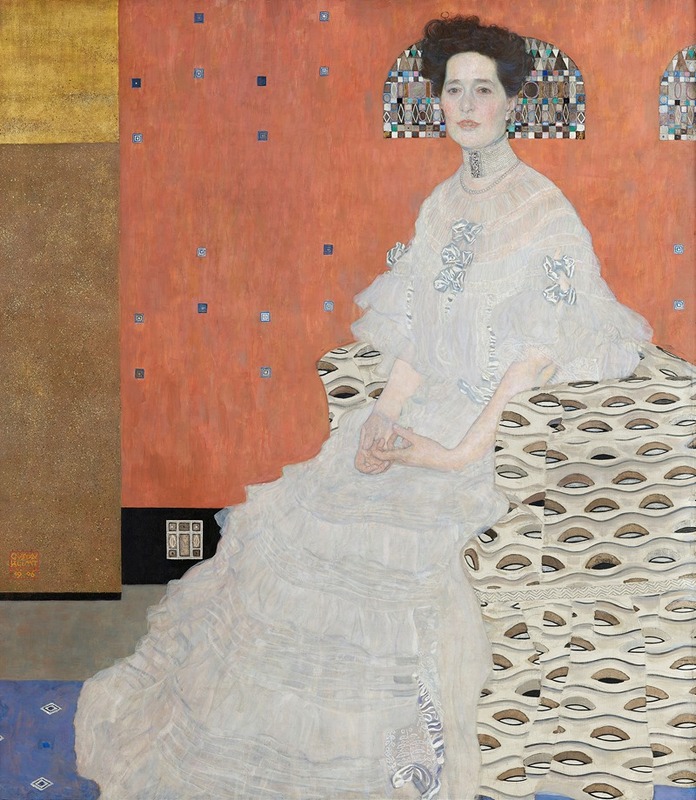

Here we have “Portrait of Fritza Riedler”, painted by Gustav Klimt in 1906. Notice how Klimt captures not just her likeness, but her presence and personality. Fritza sits elegantly, her posture poised yet relaxed, exuding a quiet confidence. The background is simplified, almost flat, allowing her figure to stand out, emphasizing the grace of her long lines and the elegance of her attire. Klimt’s brushwork here is delicate and precise, especially in the rendering of her skin and facial features. Unlike some of his more heavily ornamented works, this portrait is restrained, showing his skill in realism while still hinting at the decorative tendencies that would define his later Golden Phase. The subtle play of light and shadow gives her a three-dimensional presence, making her seem both approachable and enigmatic. Look also at the interplay of patterns and textures in her clothing: the delicate details of lace and fabric contrast with the smoothness of her skin, showcasing Klimt’s fascination with surface and material. This painting is a beautiful example of how Klimt balances realism, elegance, and decorative artistry to create portraits that feel both intimate and timeless.