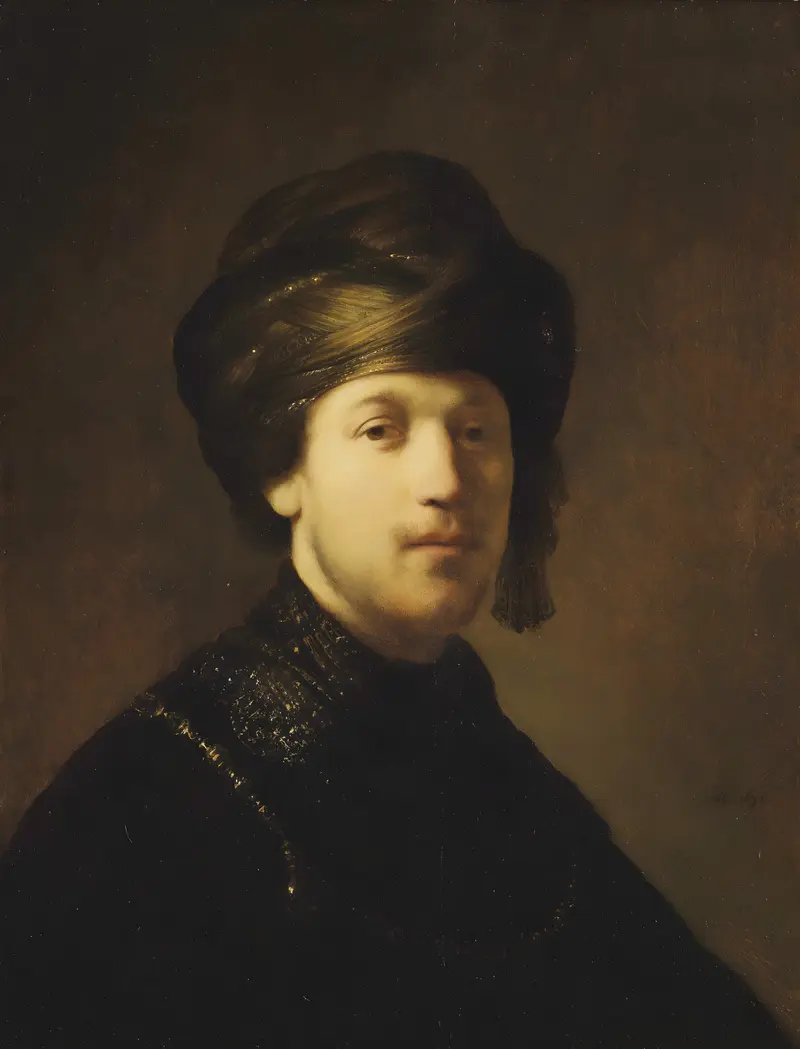
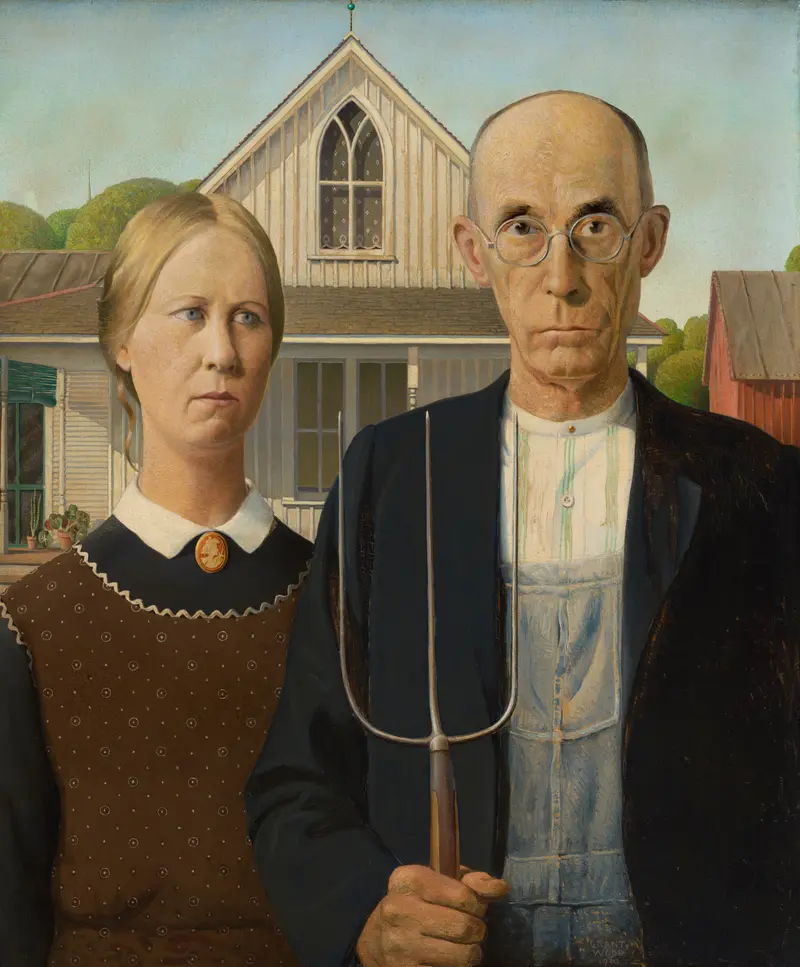
Public domain · Free to download
Famous Portrait Paintings
We curated the 25 most famous portrait paintings of all time, starting with the most famous portrait in the world, the Mona Lisa, and added the best of the rest: famous portraits of women, famous self-portraits, and portraits of kings, queens and presidents.
For each one you get the story of the sitter: who they were, why they were painted, the detail to look for and where the portrait hangs today. Every image is a public-domain reproduction of the real painting, free to download and free to use.
Before photography, a painted portrait was the only way to keep a face for the future. These are the faces that lasted, from a merchant couple in Bruges in 1434 to a Viennese salon hostess in 1907.
Selected and written by Pavel MazuelasUpdated October 29, 2026
Part of The Most Famous Paintings in the WorldRelated: Famous Paintings of People, Famous Historical Paintings
The 25 most famous portrait paintings of all time
Ranked from 1 to 25 by worldwide fame. Click any portrait to see it up close and download it free.

No. 1Renaissance
Mona Lisa by Leonardo da Vinci
Sitter: Lisa Gherardini (Lisa del Giocondo)
1503–1519 · Oil on poplar panel · 79.4 × 53.4 cm
Louvre, Paris
Who was the Mona Lisa? Lisa Gherardini, wife of the Florentine silk merchant Francesco del Giocondo: a note written in October 1503 by a Florentine official confirms Leonardo was painting her “head.” Her married name may even explain the smile, since giocondo means happy in Italian. Leonardo kept the portrait for the rest of his life, and it is in the Louvre in Paris.
Sources: Louvre

No. 2Dutch Golden Age
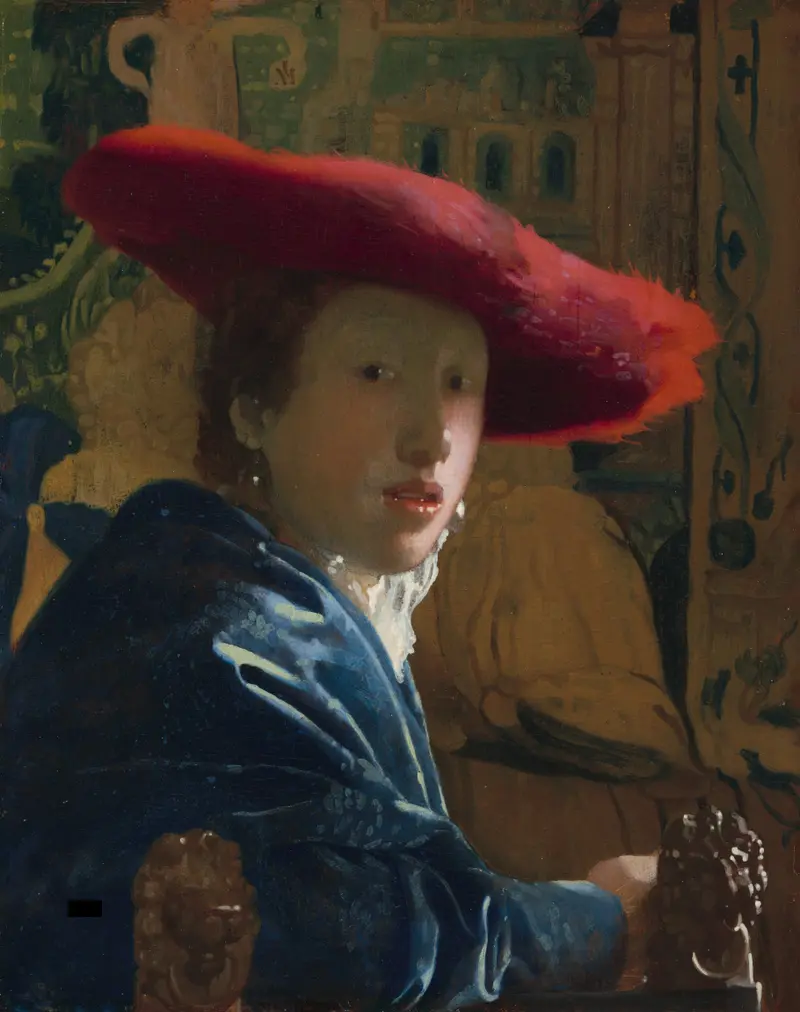
Girl with a Pearl Earring by Johannes Vermeer
Sitter: Unknown model (a tronie, not a portrait)
c. 1665 · Oil on canvas · 44.5 × 39 cm
Mauritshuis, The Hague
Strictly speaking, Girl with a Pearl Earring is not a portrait but a “tronie”: an imaginary figure in exotic dress, with an oriental turban and an improbably large pearl. Nobody knows who modeled for Vermeer. Look at the dark background: research has shown he painted her in front of a green curtain. It sold for just 2.30 guilders in 1881 and is now in the Mauritshuis in The Hague.
Sources: Mauritshuis

No. 3Baroque
Las Meninas by Diego Velázquez
Sitter: The Infanta Margarita and her court
1656 · Oil on canvas · 318 × 276 cm
Museo del Prado, Madrid
The little girl at the center is the Infanta Margarita, daughter of Philip IV of Spain, surrounded by two maids of honor (the meninas), the court dwarfs Mari Bárbola and Nicolasito Pertusato, and a sleepy mastiff. Velázquez painted himself at the easel, and the mirror on the back wall shows the king and queen, as if they were standing where you are. It is in the Prado in Madrid.
Sources: Museo del Prado
No. 4Renaissance
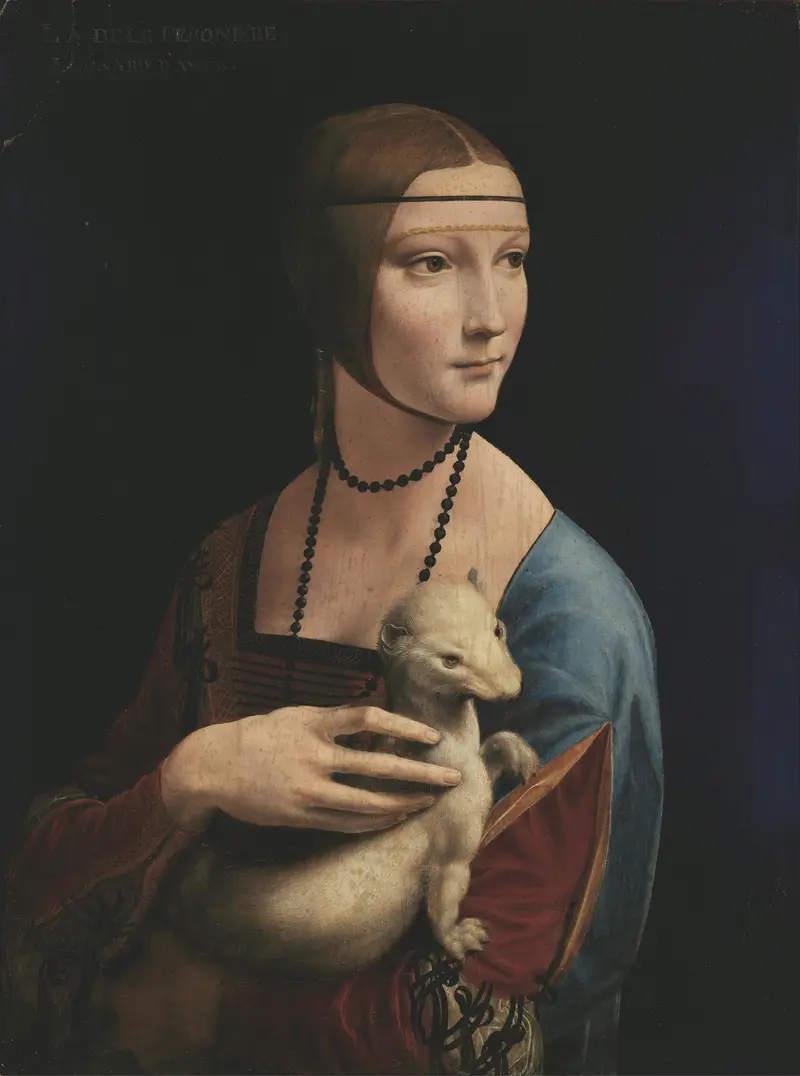
Lady with an Ermine by Leonardo da Vinci
Sitter: Cecilia Gallerani
c. 1490 · Oil and tempera on walnut panel · 53.4 × 39.3 cm
National Museum in Kraków, Kraków
Cecilia Gallerani was about 16 when Leonardo painted her at the court of Milan, where she was the mistress of Duke Ludovico Sforza and admired as a learned woman and poet. The ermine in her arms is a double pun: Ludovico was nicknamed the “white ermine,” and the Greek word for the animal echoes her surname. Looted by the Nazis and recovered in 1946, it is in the National Museum in Kraków.
Sources: National Museum in Kraków
No. 5Dutch Golden Age
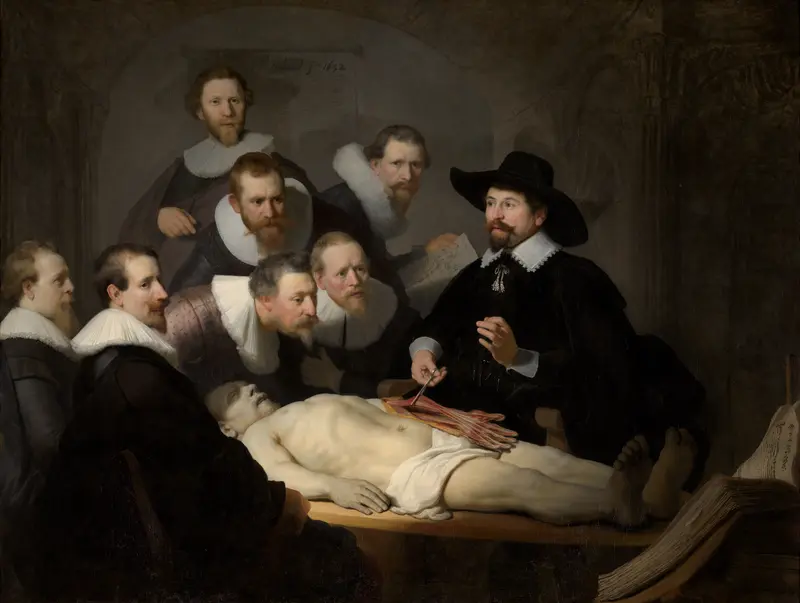
The Anatomy Lesson of Dr. Nicolaes Tulp by Rembrandt
Sitter: Dr. Nicolaes Tulp and members of the Surgeons' Guild
1632 · Oil on canvas · 169.5 × 216.5 cm
Mauritshuis, The Hague
Rembrandt was only 25 when the Amsterdam surgeons commissioned this group portrait of Dr. Nicolaes Tulp giving his anatomy lesson in January 1632. The body on the table was a hanged robber, Aris Kindt, and X-rays show that Rembrandt first painted a stump where the right hand is now. It is in the Mauritshuis in The Hague.
Sources: Mauritshuis
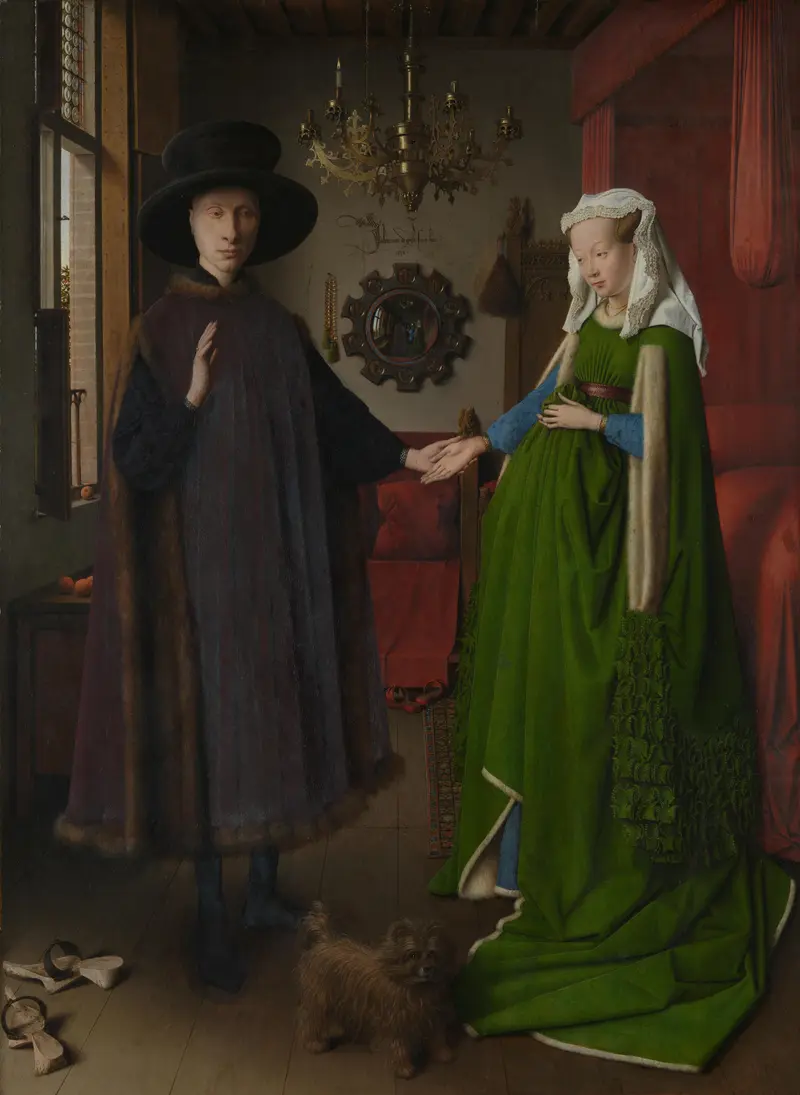
No. 6Northern Renaissance
Arnolfini Portrait by Jan van Eyck
Sitter: Probably Giovanni di Nicolao Arnolfini and his wife
1434 · Oil on oak panel · 82.2 × 60 cm
National Gallery, London
The couple is probably Giovanni di Nicolao Arnolfini, an Italian merchant in Bruges, and his wife, and despite appearances she is not pregnant: she is holding up the heavy folds of a fashionable gown. Above the mirror van Eyck wrote “Jan van Eyck was here. 1434,” and the mirror shows two visitors in the doorway. It is in the National Gallery in London.
Sources: National Gallery
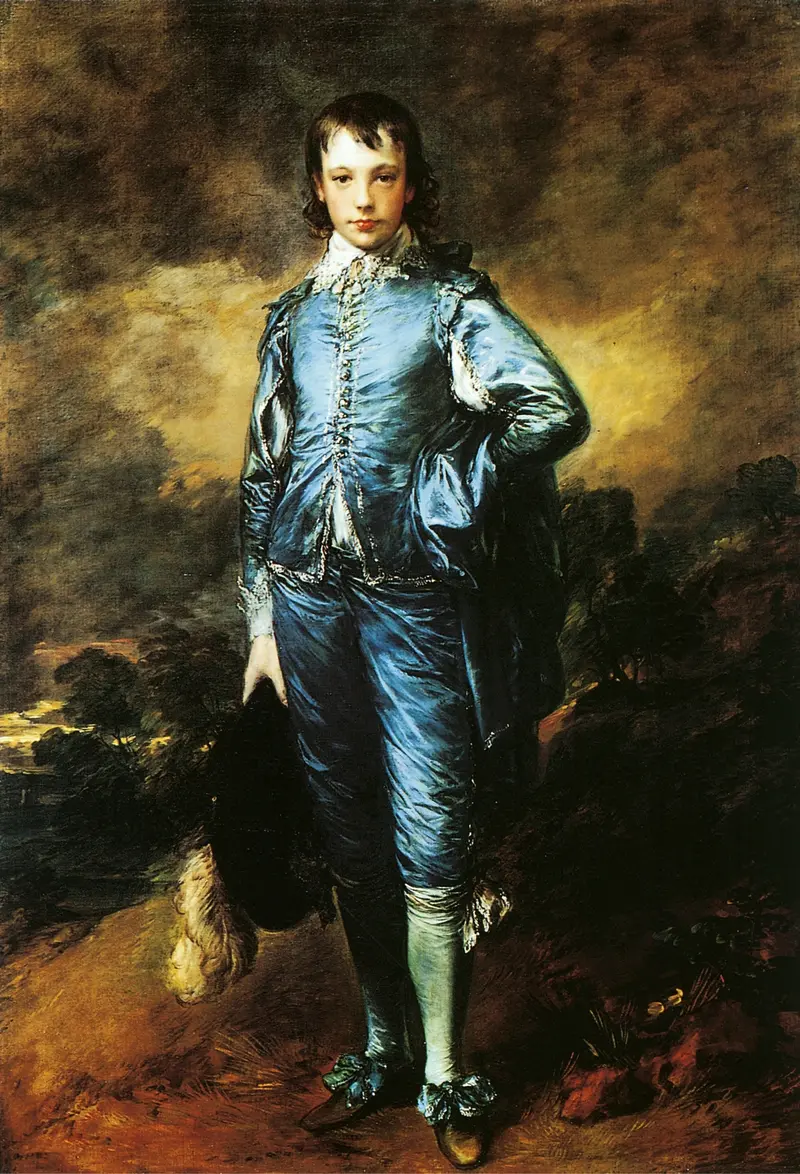
No. 7Romanticism
The Blue Boy by Thomas Gainsborough
Sitter: An unidentified boy
c. 1770 · Oil on canvas · 179.4 × 123.8 cm
The Huntington, San Marino, California
For two centuries the boy in blue satin was said to be Jonathan Buttall, the painting's first owner, but The Huntington says recent research has disproved it, so his name is unknown. Gainsborough first showed it in 1770 as “A Portrait of a Young Gentleman.” When it left London for California in 1922, 90,000 people came to say goodbye. It is at The Huntington in San Marino, California.
Sources: The Huntington

No. 8Art Nouveau
Portrait of Adele Bloch-Bauer I by Gustav Klimt
Sitter: Adele Bloch-Bauer
1907 · Oil, gold, and silver on canvas · 140 × 140 cm
Neue Galerie, New York
Adele Bloch-Bauer, a Viennese salon hostess, is the only person Klimt ever painted twice in full-length portraits. Look at her hands: she clasped them to hide a disfigured finger she was self-conscious about. Seized by the Nazis and renamed “Woman in Gold” to conceal who she was, it was returned to her niece Maria Altmann and is now in the Neue Galerie in New York.
Sources: Neue Galerie
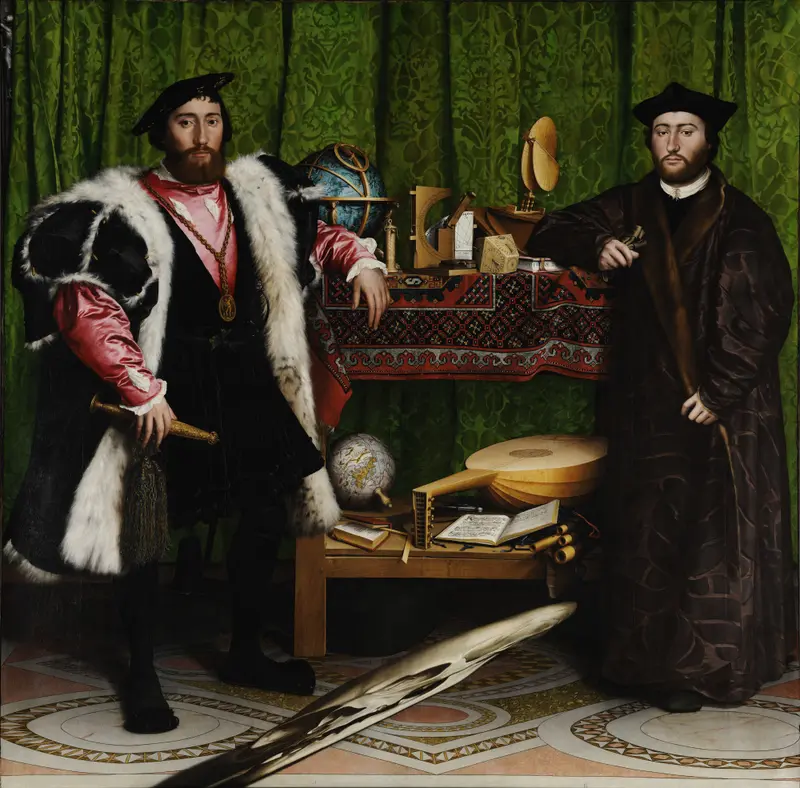
No. 9Mannerism
The Ambassadors by Hans Holbein the Younger
Sitter: Jean de Dinteville and Georges de Selve
1533 · Oil on oak panel · 207 × 209.5 cm
National Gallery, London
The two men are Jean de Dinteville, the French ambassador who attended Henry VIII's wedding to Anne Boleyn, and his friend Georges de Selve, a bishop visiting London in 1533. Dinteville called himself “the most melancholy, weary and wearisome ambassador that was ever seen.” The slanting shape at their feet is a skull that snaps into focus only from the lower right. It is in the National Gallery in London.
Sources: National Gallery
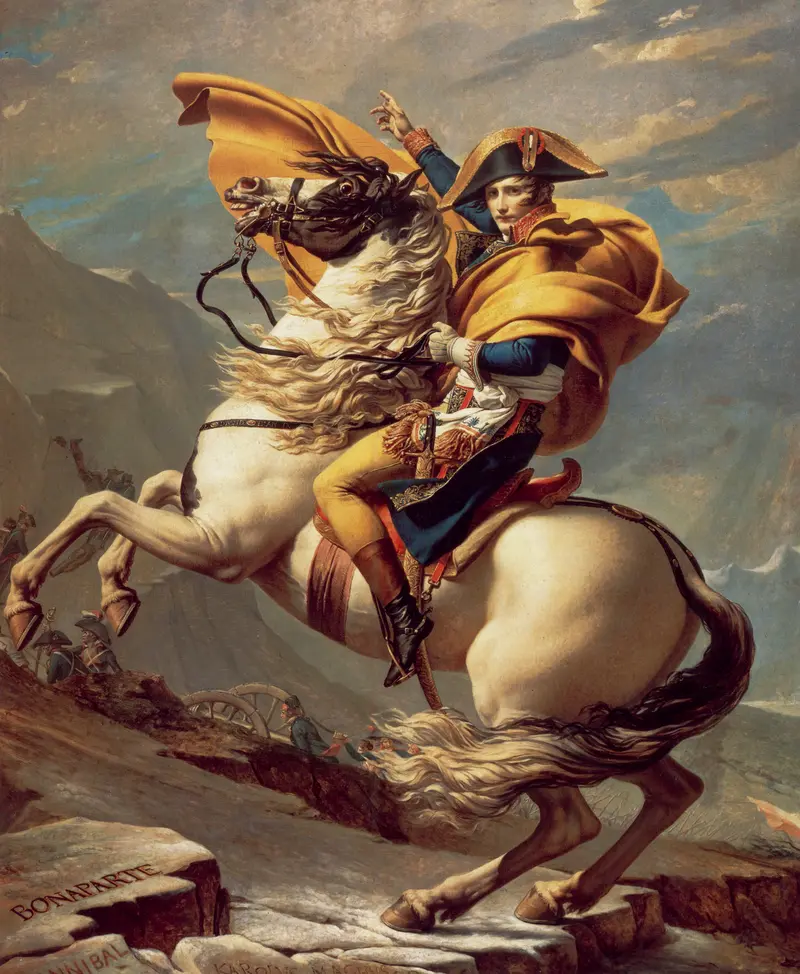
No. 10Neoclassicism
Napoleon Crossing the Alps by Jacques-Louis David
Sitter: Napoleon Bonaparte as First Consul
1800 · Oil on canvas · 259 × 221 cm
Château de Malmaison, Rueil-Malmaison
Napoleon refused to pose and asked David to show him “calm on a fiery horse.” The rearing horse is invention: in May 1800 he actually crossed the Great St Bernard Pass on a mule. King Charles IV of Spain ordered this first version, and David then painted replicas with different cloaks and horses. The original is at the Château de Malmaison, near Paris.
Sources: Château de Malmaison
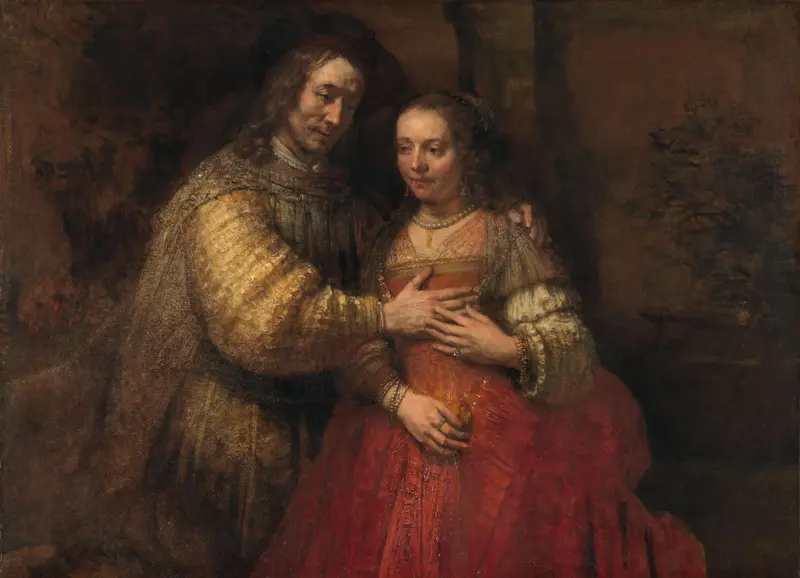
No. 11Dutch Golden Age
The Jewish Bride by Rembrandt
Sitter: An unknown couple posing as Isaac and Rebecca
c. 1665–1669 · Oil on canvas · 121.5 × 166.5 cm
Rijksmuseum, Amsterdam
Despite its nickname, the Rijksmuseum sees this as a portrait of a real couple posing as the biblical Isaac and Rebecca, though who they were is unknown. Late in life Rembrandt laid the paint on thickly and scratched into it with the end of his brush. Van Gogh said he would give ten years of his life to sit in front of it for two weeks. It is in the Rijksmuseum in Amsterdam.
Sources: Rijksmuseum
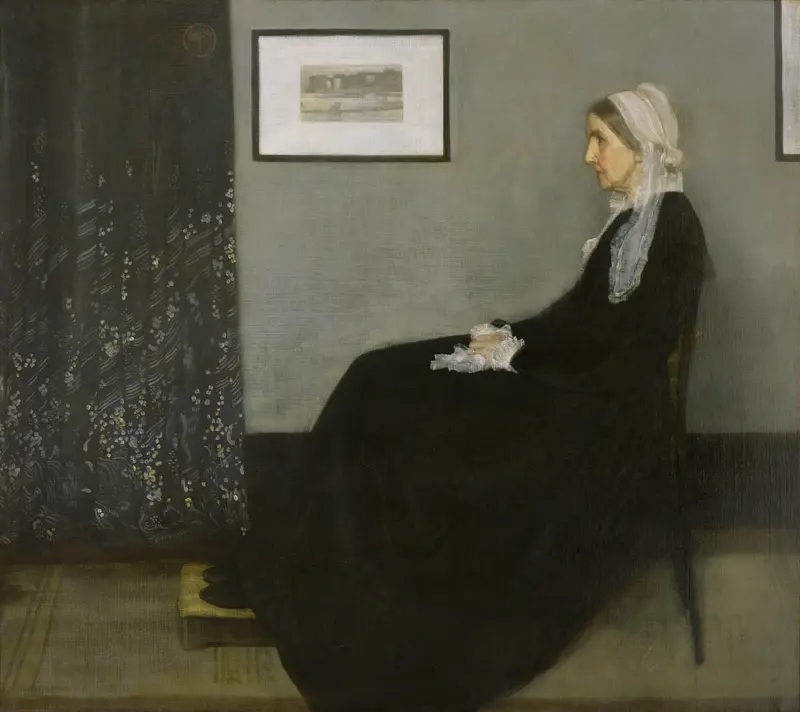
No. 12Realism
Whistler's Mother by James McNeill Whistler
Sitter: Anna McNeill Whistler, the artist's mother
1871 · Oil on canvas · 144.3 × 163 cm
Musée d'Orsay, Paris
The woman in black is Anna McNeill Whistler, the painter's mother, although Whistler titled it Arrangement in Grey and Black No. 1 to put the harmony of tones before the subject. The French State bought it from him in 1891, and in 1934 it appeared on a US 3-cent Mother's Day stamp. It is in the Musée d'Orsay in Paris.
Sources: Musée d'Orsay
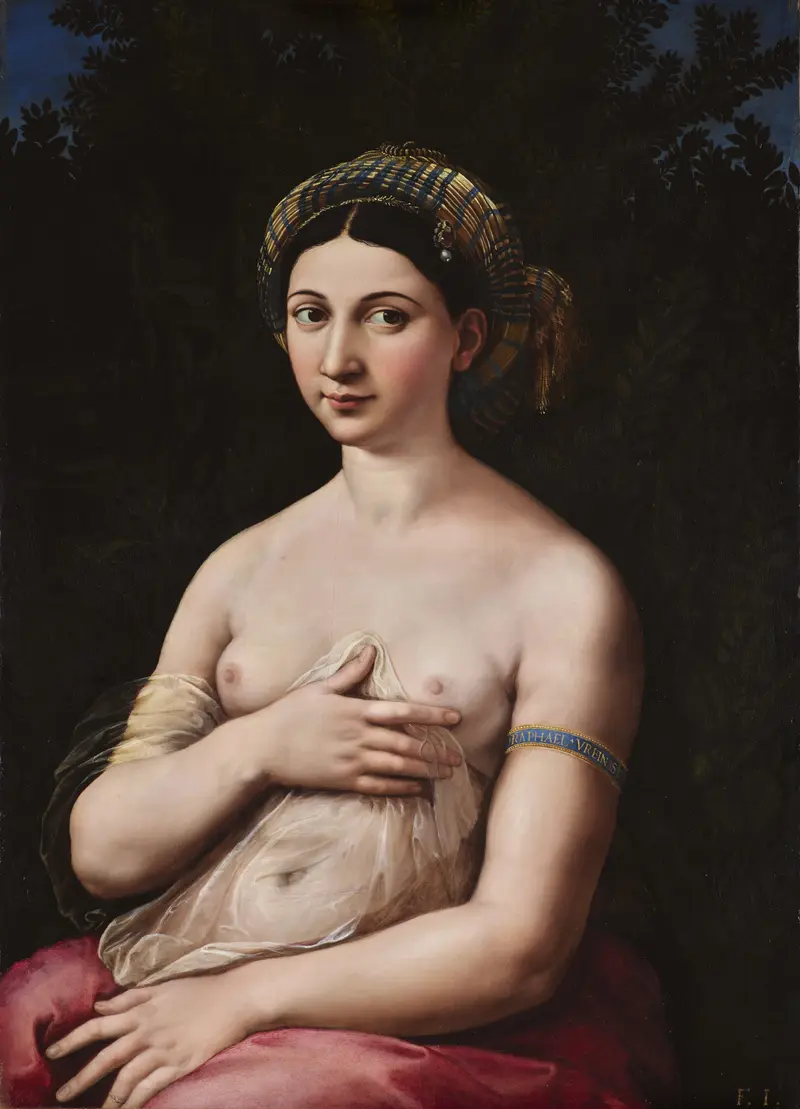
No. 13Renaissance
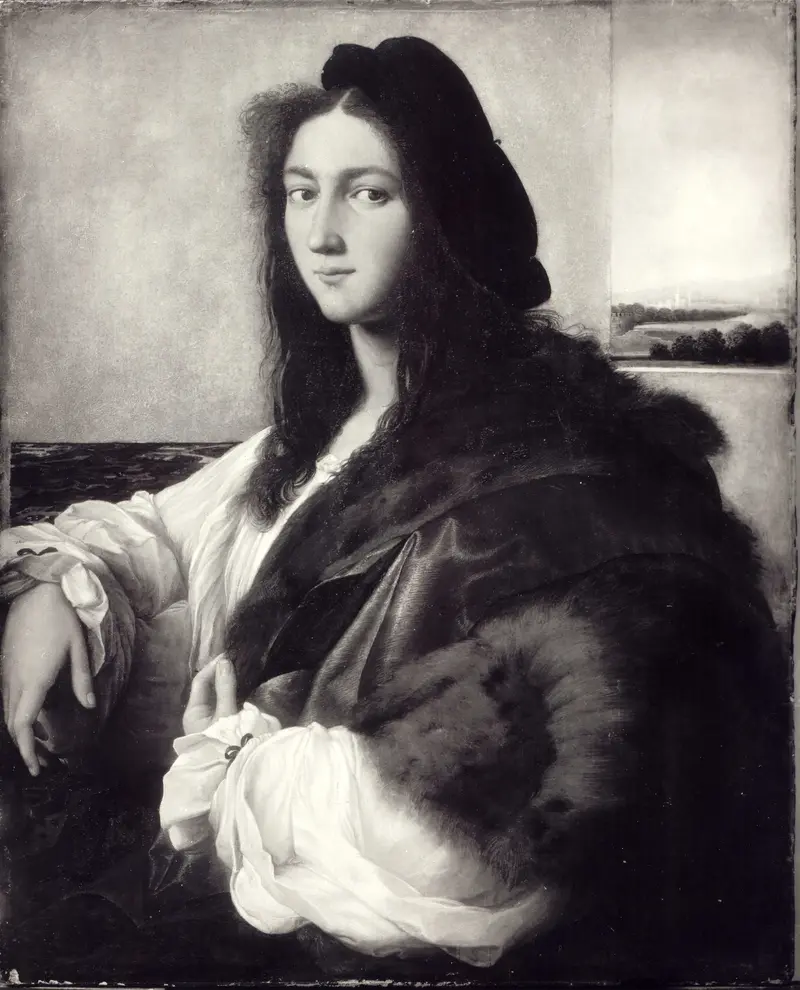
La Fornarina by Raphael
Sitter: Traditionally Margherita Luti
1519–1520 · Oil on panel · 87 × 63 cm
Palazzo Barberini, Rome
Tradition says she is Margherita Luti, Raphael's lover and the daughter of a baker in Rome's Trastevere district, hence “Fornarina,” the baker's girl. Her armband carries his name, RAPHAEL VRBINAS, both signature and pledge, and no patron is recorded, so he may have painted it for himself. It hangs in Palazzo Barberini in Rome.
Sources: Palazzo Barberini
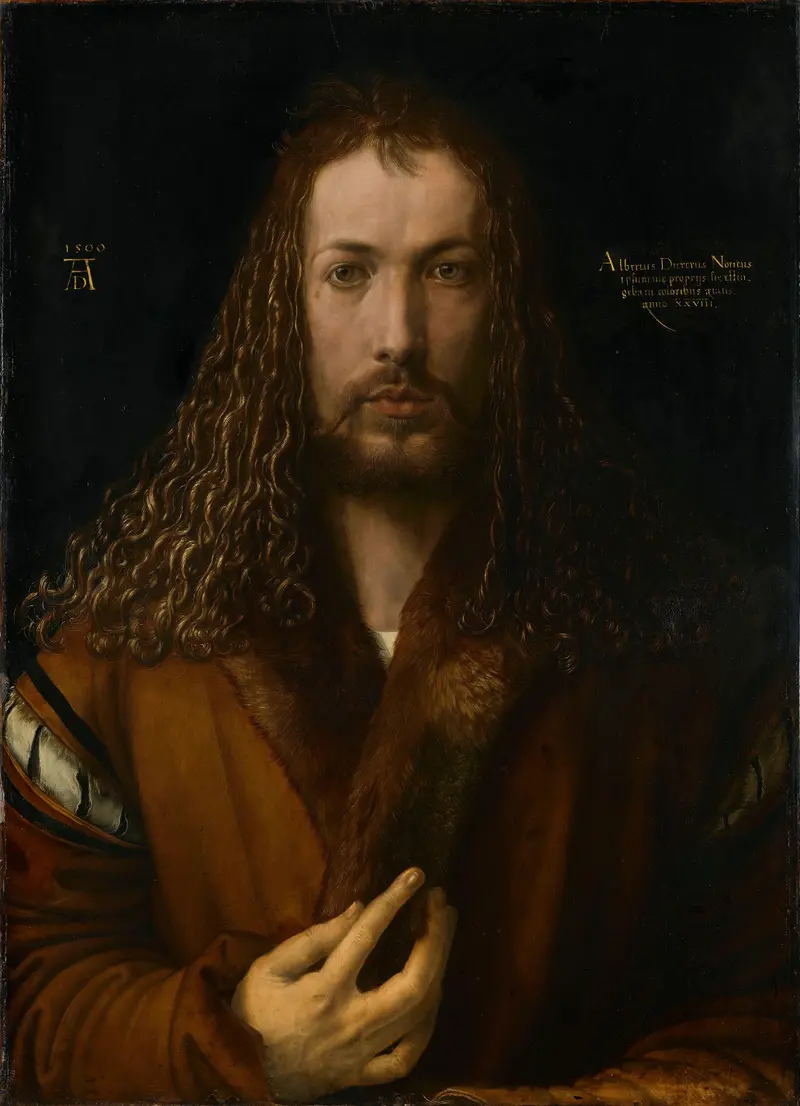
No. 14Northern Renaissance
Self-Portrait with Fur-Trimmed Robe by Albrecht Dürer
Sitter: Albrecht Dürer himself, aged 28
1500 · Oil on lime panel · 67.1 × 48.9 cm
Alte Pinakothek, Munich
Dürer was 28 when he painted himself head-on like an image of Christ, one hand raised as if in blessing, and the Latin inscription spells it out: “I, Albrecht Dürer of Nuremberg, portrayed myself in appropriate colors aged twenty-eight years.” The museum calls it probably the most unusual self-portrait in the history of art. It is in the Alte Pinakothek in Munich.
Sources: Alte Pinakothek
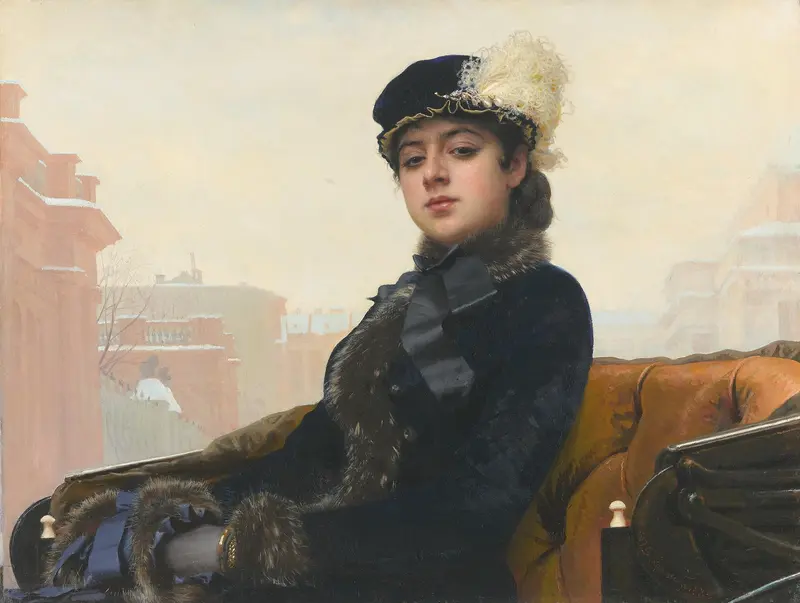
No. 15Realism
Portrait of an Unknown Woman by Ivan Kramskoi
Sitter: No real sitter: a composite figure
1883 · Oil on canvas · 76.1 × 102.3 cm
Tretyakov Gallery, Moscow
There is no real sitter behind this woman in a carriage: the Tretyakov describes her as a composite image of a woman unknown to anyone. In 1883 critics took her for a coquette, and the collector Pavel Tretyakov refused to buy the picture; in Soviet times she was reborn as the “Russian Mona Lisa.” It is in the Tretyakov Gallery in Moscow.
Sources: Tretyakov Gallery
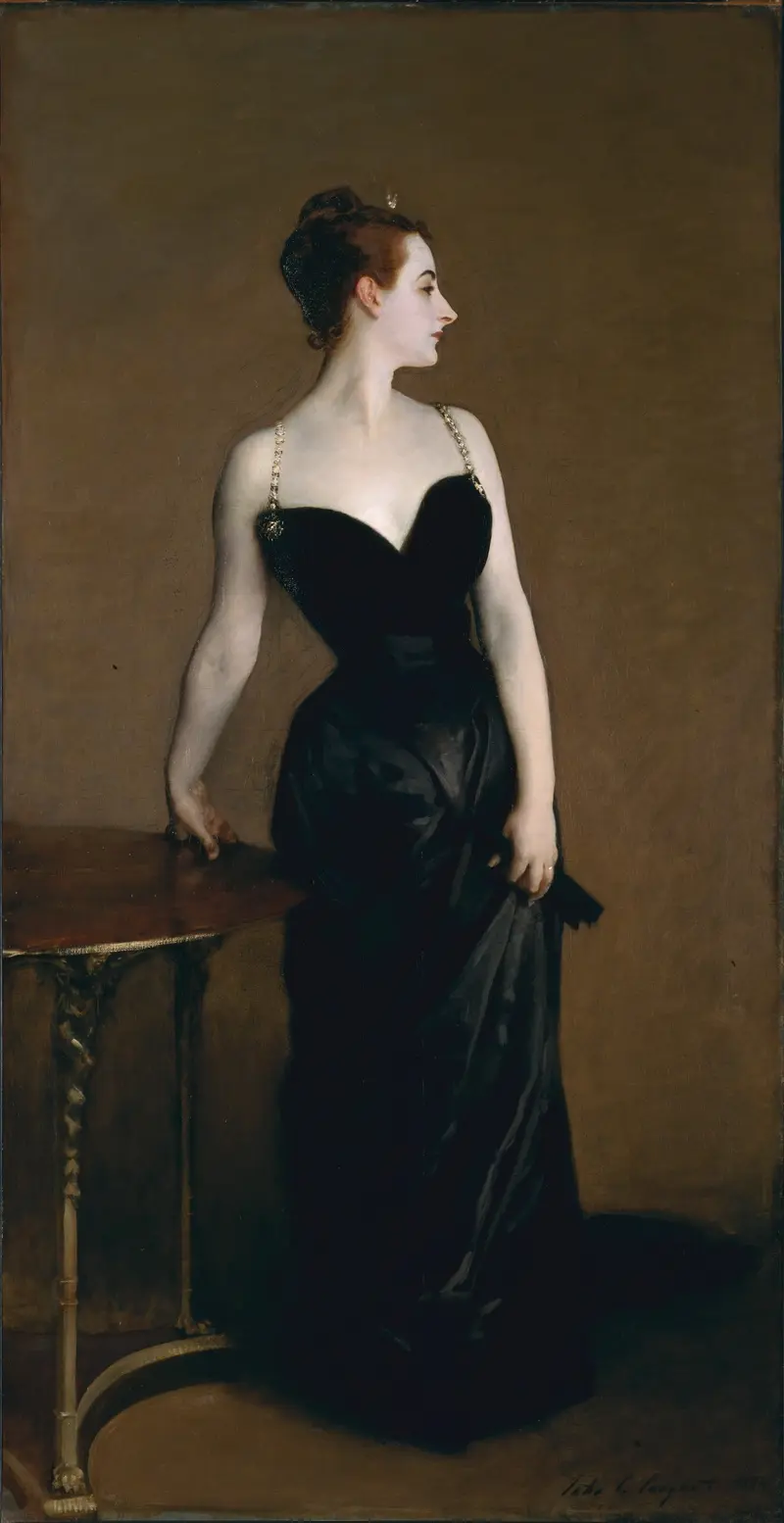
No. 16Academic
Madame X by John Singer Sargent
Sitter: Virginie Amélie Avegno Gautreau
1883–84 · Oil on canvas · 208.6 × 109.9 cm
Metropolitan Museum of Art, New York
Virginie Gautreau, a Louisiana-born beauty famous in Paris for her looks, sat for Sargent without a commission, and he hoped the portrait would make his name. At the 1884 Salon it drew more ridicule than praise, partly because of a strap slipping off her shoulder, which he later repainted. Sargent called it “the best thing I have done” when he sold it to the Met in New York in 1916.
Sources: Metropolitan Museum of Art
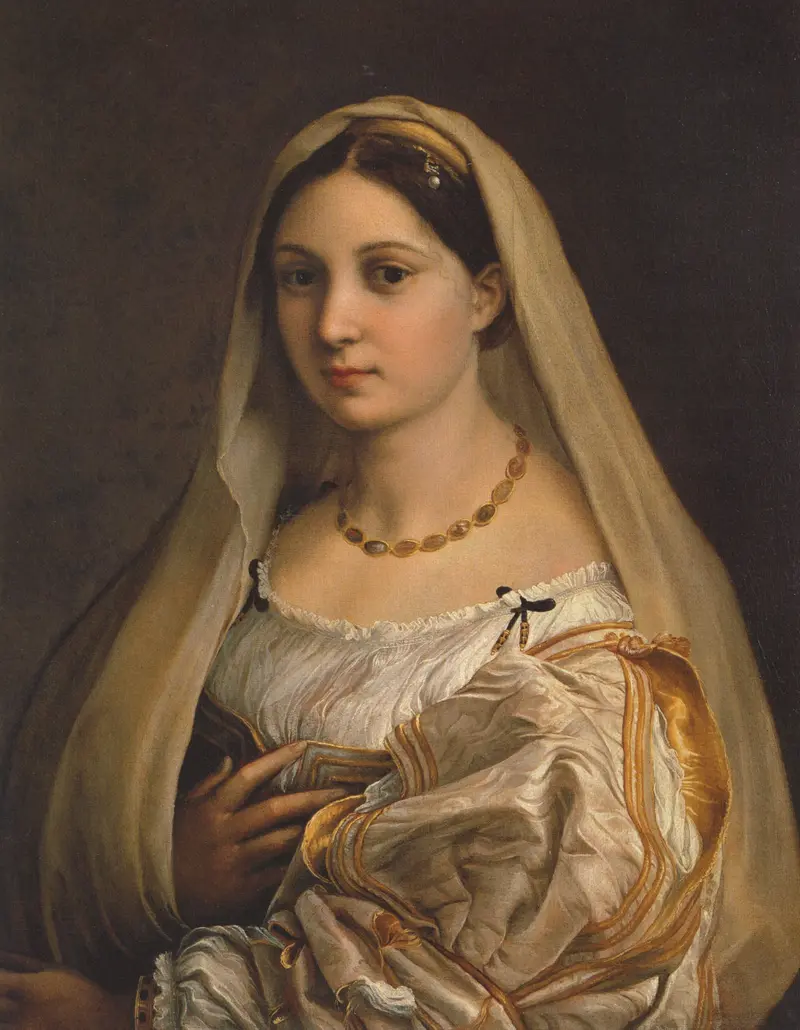
No. 17Renaissance
La Velata by Raphael
Sitter: An unidentified married woman
c. 1512–1515 · Oil on canvas · 82 × 60.5 cm
Palazzo Pitti, Florence
The veil tells us she was married, but not who she was. Vasari believed she was the woman Raphael loved, while her rich silk gown and jewels suggest a commissioned portrait of a young noblewoman. Look at the sleeve, which is the real show of the painting. It is in the Palatine Gallery of Palazzo Pitti in Florence.
Sources: Palazzo Pitti
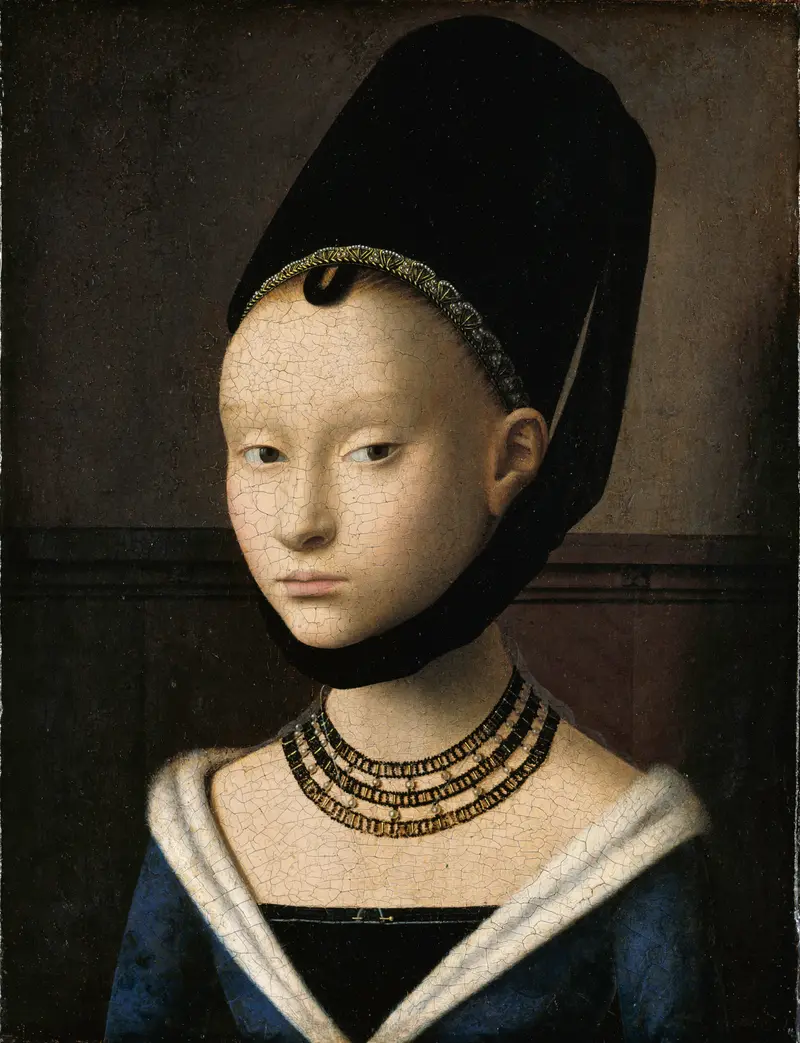
No. 18Northern Renaissance
Portrait of a Young Girl by Petrus Christus
Sitter: An unidentified young aristocrat
c. 1470 · Oil on oak panel · 29.1 × 22.7 cm
Gemäldegalerie, Berlin
This is the only portrait of a woman by Petrus Christus that is known, and her name is lost. Scholars have linked her to the family of the Earl of Shrewsbury, perhaps painted in Bruges at a Burgundian wedding in 1468, but the museum stresses that every name remains unproven. Look at her tall black hat and sideways glance. It is in the Gemäldegalerie in Berlin.
Sources: Gemäldegalerie
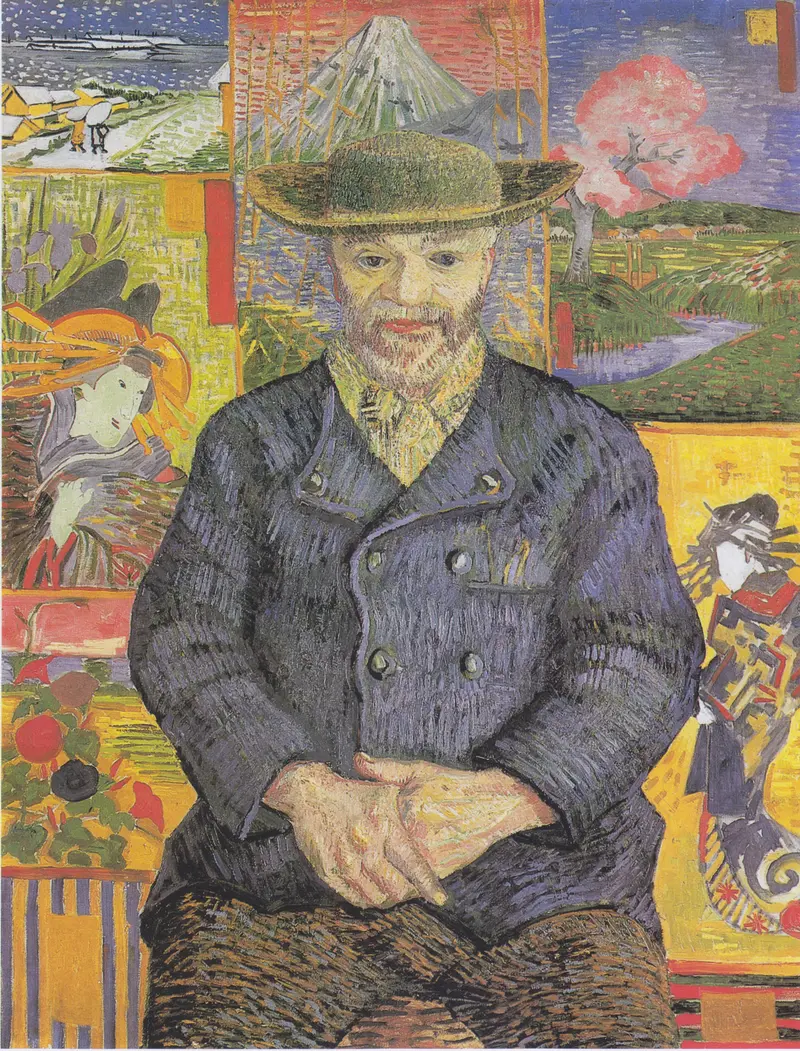
No. 19Post-Impressionism
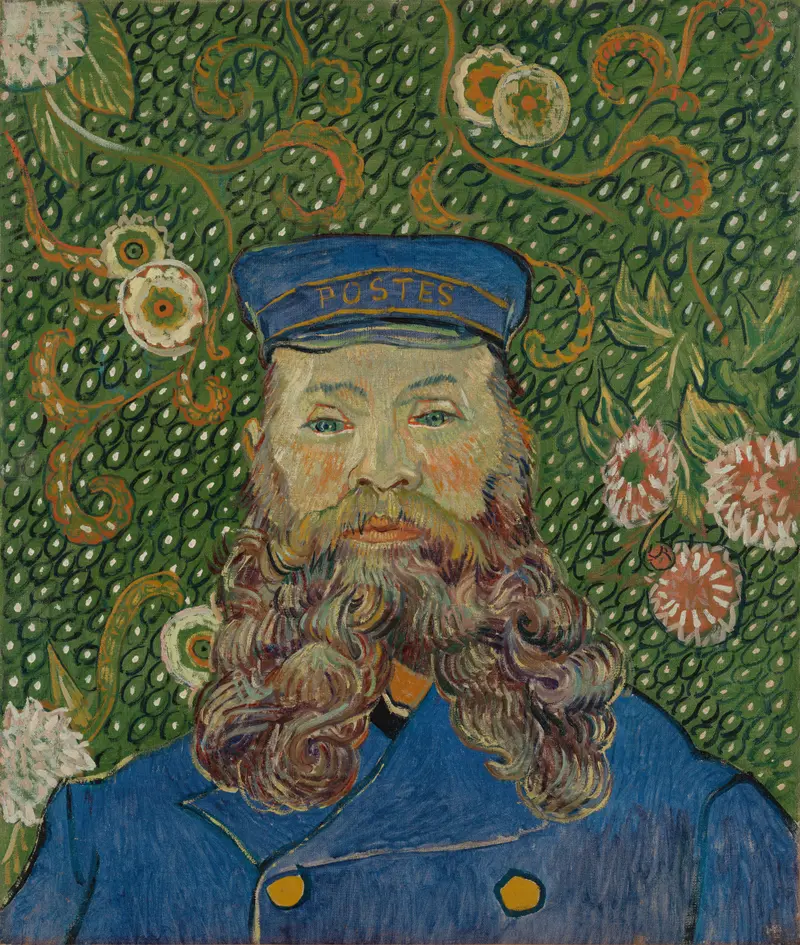
Portrait of Père Tanguy by Vincent van Gogh
Sitter: Julien “Père” Tanguy, a Paris art-supply dealer
1887 · Oil on canvas · 92 × 73 cm
Musée Rodin, Paris
Julien Tanguy sold paints in Paris and often gave struggling artists credit they rarely repaid, and Van Gogh painted him three times. Here he sits against a wall of Japanese prints. Tanguy refused to part with this version, and after his death in 1894 the sculptor Auguste Rodin bought it, which is why it is in the Musée Rodin in Paris.
Sources: Musée Rodin
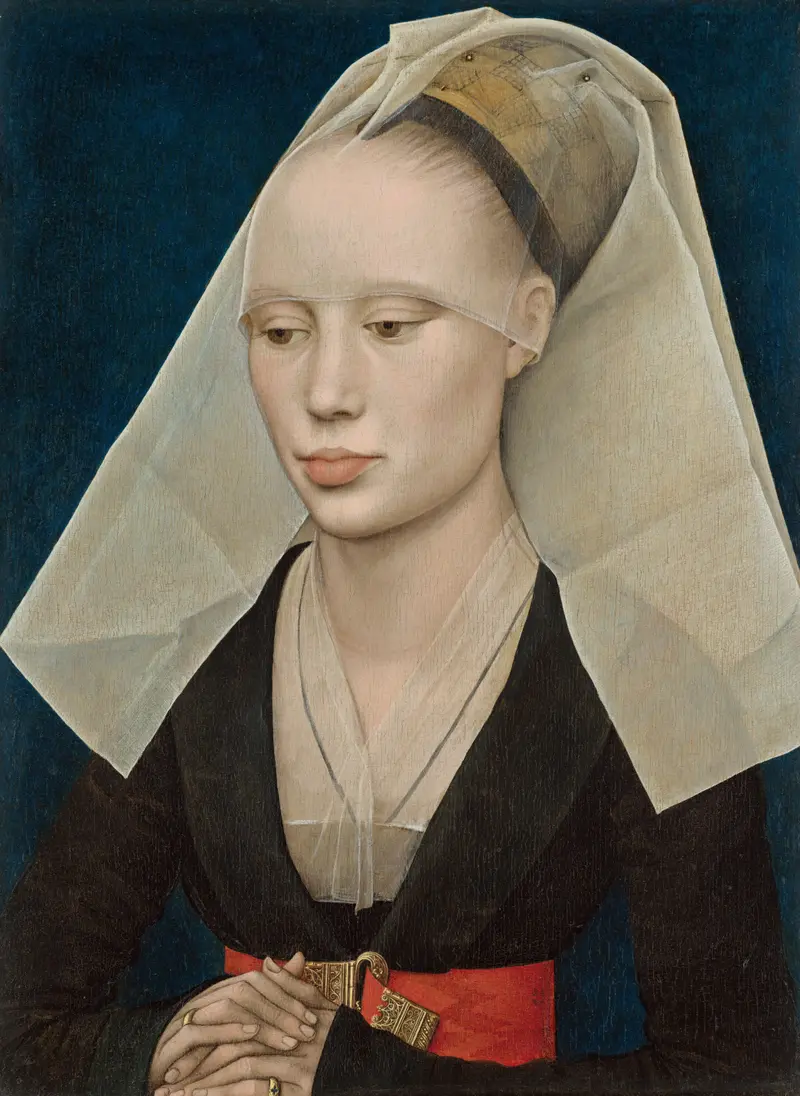
No. 20Northern Renaissance
Portrait of a Lady by Rogier van der Weyden
Sitter: An unidentified noblewoman
c. 1460 · Oil on panel · 34 × 25.5 cm
National Gallery of Art, Washington, DC
We do not know her name, but her plucked hairline and costume follow the fashion of high-born ladies at the Burgundian court. Look at her tense fingers and downcast eyes: the museum calls the effect “passionate austerity.” It is in the National Gallery of Art in Washington, DC.
Sources: National Gallery of Art

No. 21Baroque
Portrait of Innocent X by Diego Velázquez
Sitter: Pope Innocent X
c. 1649–1650 · Oil on canvas · 141 × 119 cm
Galleria Doria Pamphilj, Rome
Velázquez did not flatter Pope Innocent X, and contemporaries read a “contumacious spirit” in the hard face he gave him. Sir Joshua Reynolds reportedly called it “the finest picture in Rome,” and three centuries later it obsessed the painter Francis Bacon. It hangs in a room built just for it in the Galleria Doria Pamphilj in Rome.
Sources: Galleria Doria Pamphilj
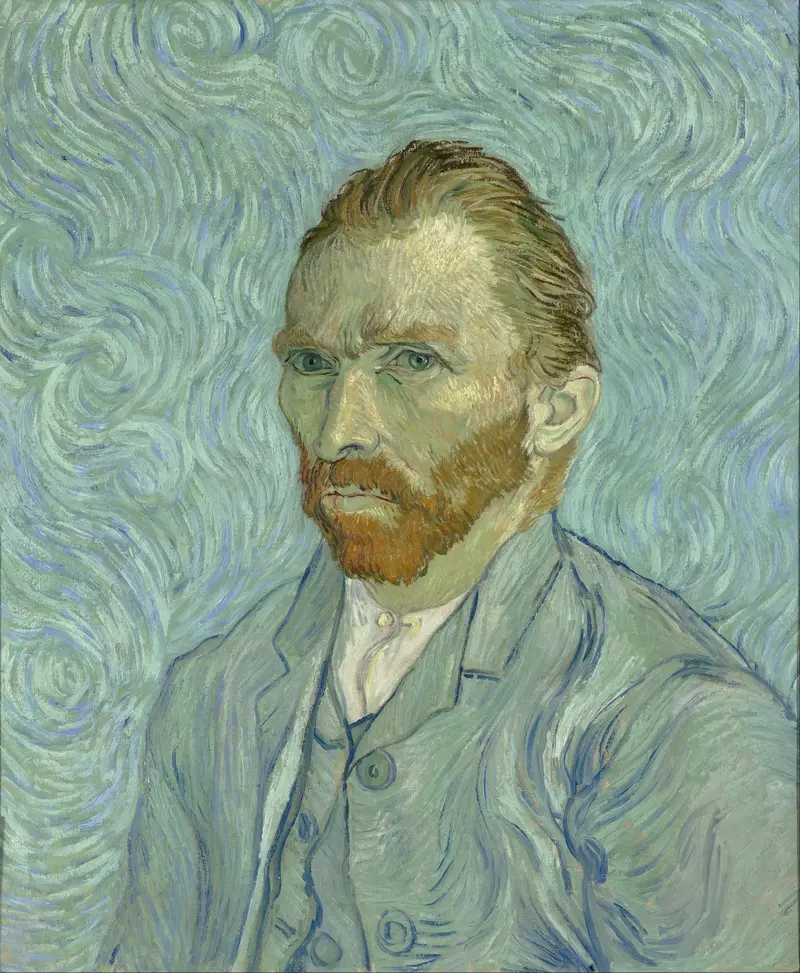
No. 22Post-Impressionism
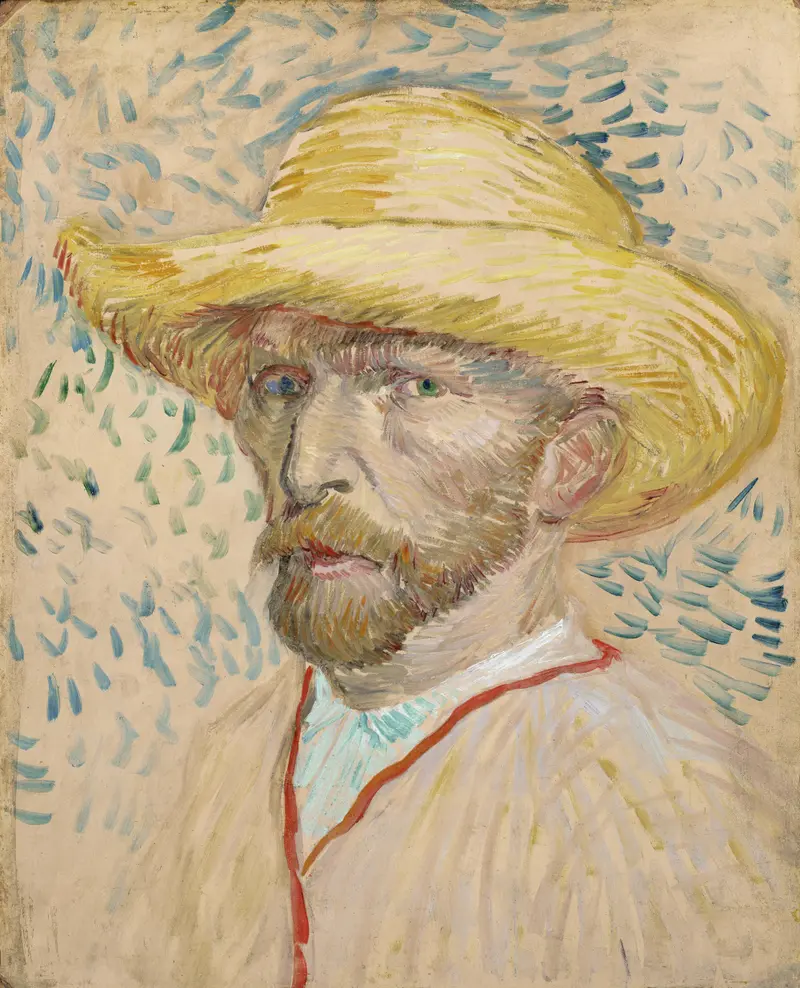
Self-Portrait (1889) by Vincent van Gogh
Sitter: Vincent van Gogh himself
1889 · Oil on canvas · 65 × 54.2 cm
Musée d'Orsay, Paris
Van Gogh painted or drew himself more than 43 times in ten years. Here, unusually, he wears a suit instead of his work jacket, and the ripples of his orange hair and beard are echoed in the swirling green and turquoise background. The children of Dr. Gachet gave it to France in 1949, and it is in the Musée d'Orsay in Paris.
Sources: Musée d'Orsay
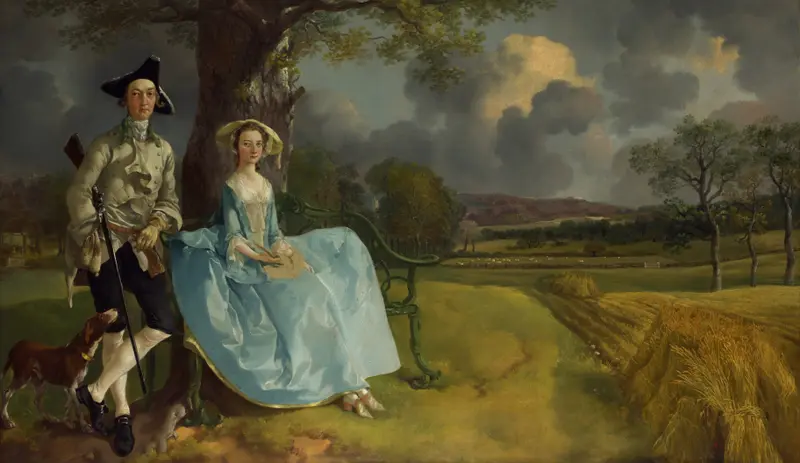
No. 23Romanticism
Mr and Mrs Andrews by Thomas Gainsborough
Sitter: Robert Andrews and his wife Frances
c. 1750 · Oil on canvas · 69.8 × 119.4 cm
National Gallery, London
Robert Andrews, a landowner who had been at school with Gainsborough, married 16-year-old Frances Carter in 1748, and the couple pose on their estate near Sudbury with their land stretching behind them. Look at her lap: the unpainted patch may have been meant for a pheasant or a baby. It stayed in the family for 200 years and is now in the National Gallery in London.
Sources: National Gallery
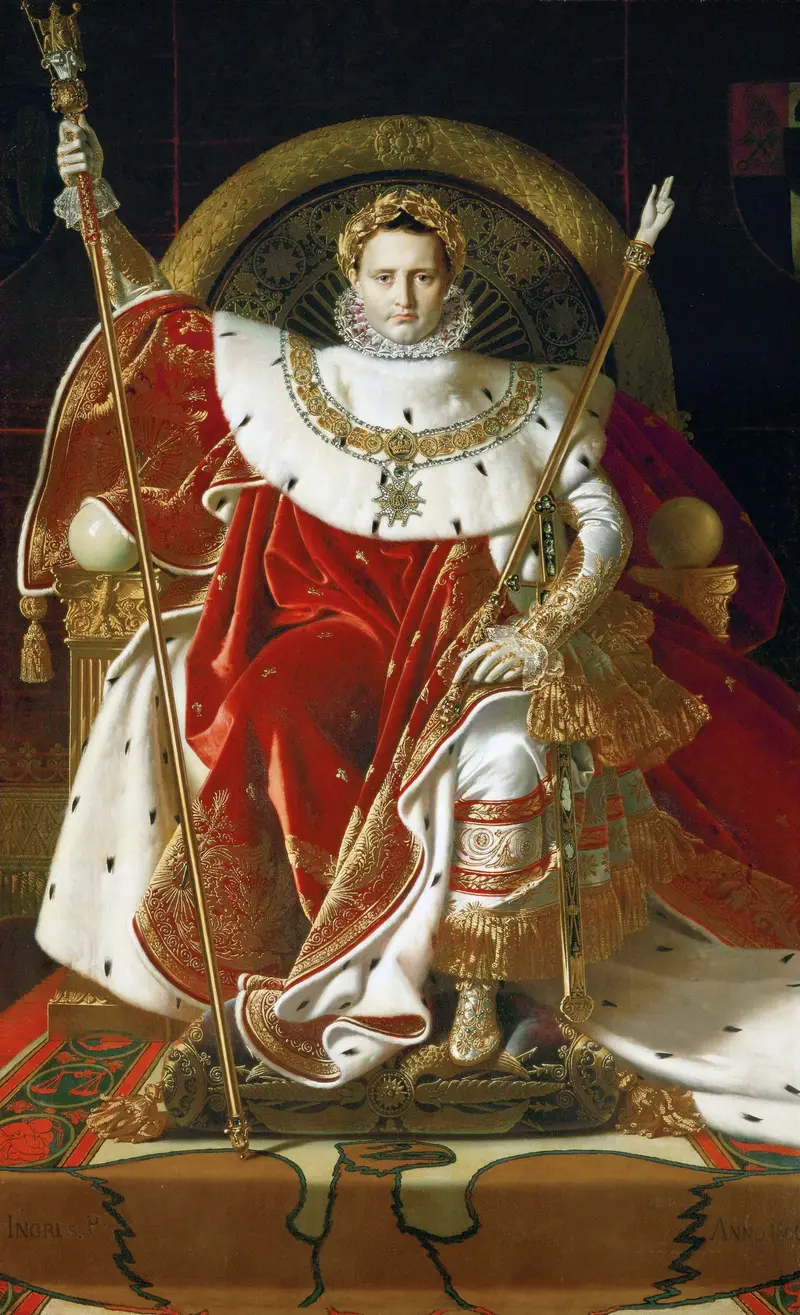
No. 24Neoclassicism
Napoleon I on His Imperial Throne by Jean-Auguste-Dominique Ingres
Sitter: Napoleon I as emperor
1806 · Oil on canvas · 260 × 163 cm
Musée de l'Armée, Paris
Ingres painted the new emperor in his coronation robes, sewn with golden bees, with the scepter, the hand of Justice and a laurel crown like a Roman emperor's. Contemporaries found the stiff, face-on pose “Gothic” and “barbarous”; today it is one of the most famous portraits of Napoleon. It belongs to the Louvre and hangs in the Musée de l'Armée in Paris.
Sources: Musée de l'Armée
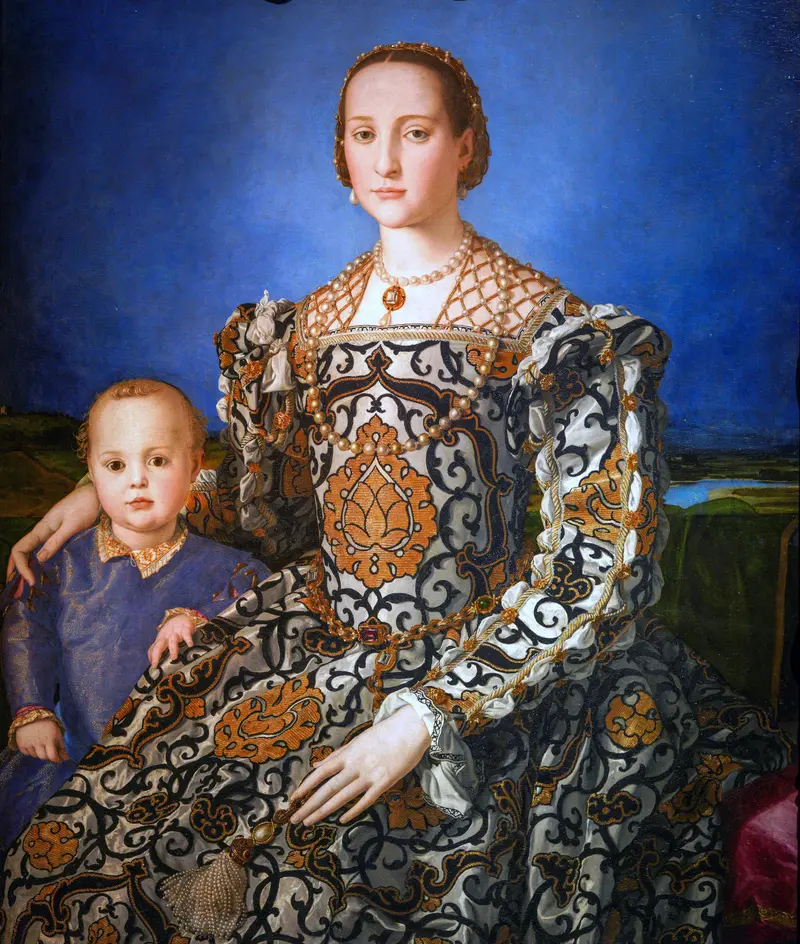
No. 25Mannerism
Eleanor of Toledo with Her Son Giovanni by Bronzino
Sitter: Eleanor of Toledo and her son Giovanni de' Medici
c. 1545 · Oil on wood · 115 × 96 cm
Uffizi, Florence
Eleanor of Toledo, wife of Duke Cosimo I de' Medici, poses with her son Giovanni to show she had secured the Medici line. The blue behind her is lapis lazuli, the costliest pigment of all, and her brocade gown repeats pomegranates, a symbol of fertility. While Bronzino painted her in 1545, she had already governed Florence three times in Cosimo's absence. It is in the Uffizi in Florence.
Sources: Uffizi
Want to see more? Browse every portrait in the collection.
Browse all 13,354 portraitsMore famous portraits of women
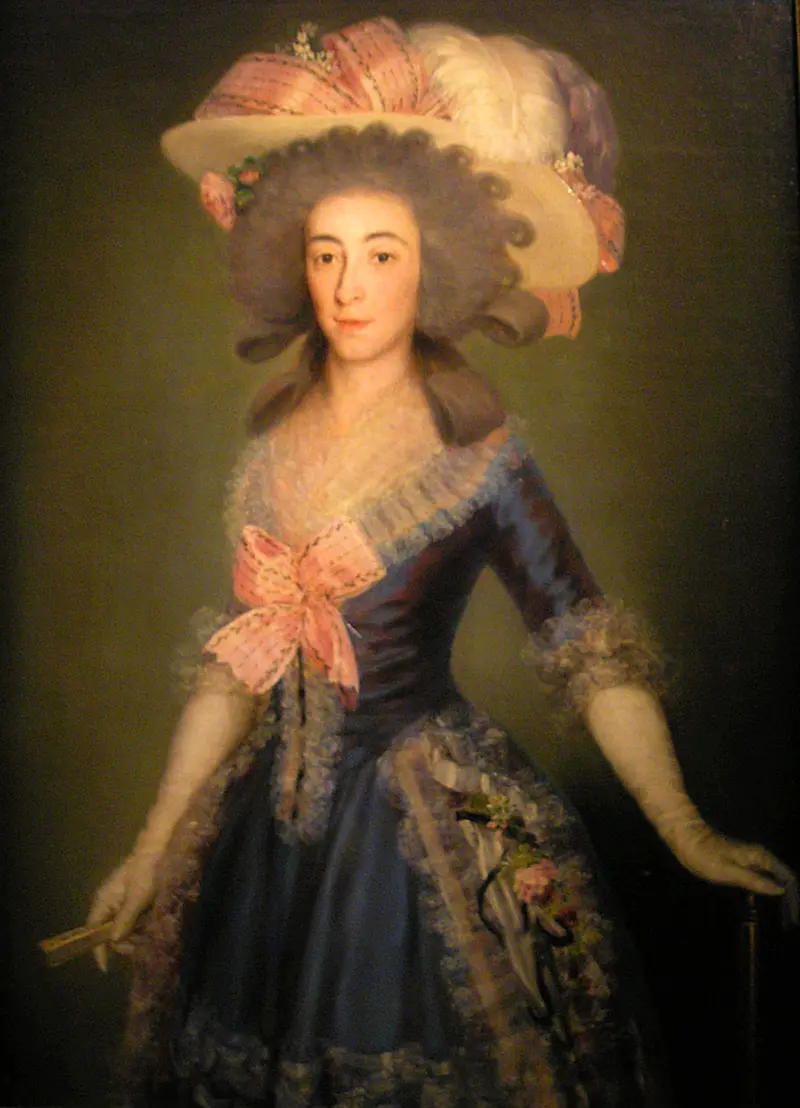
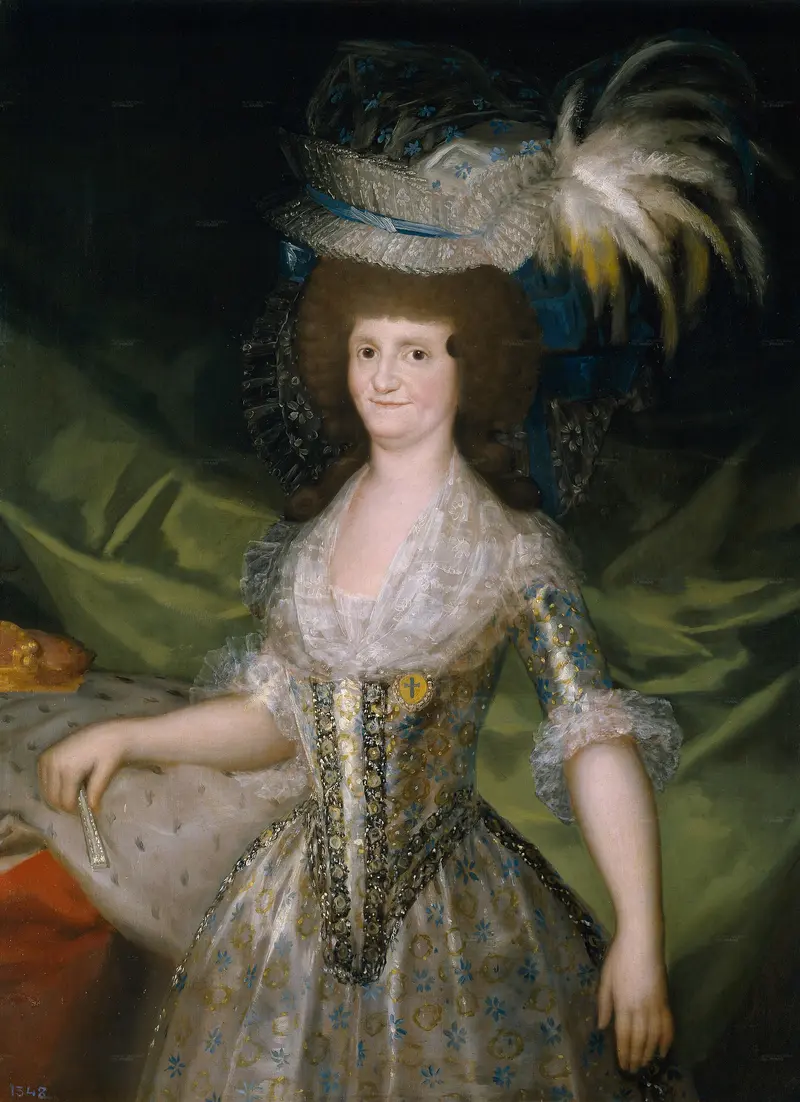
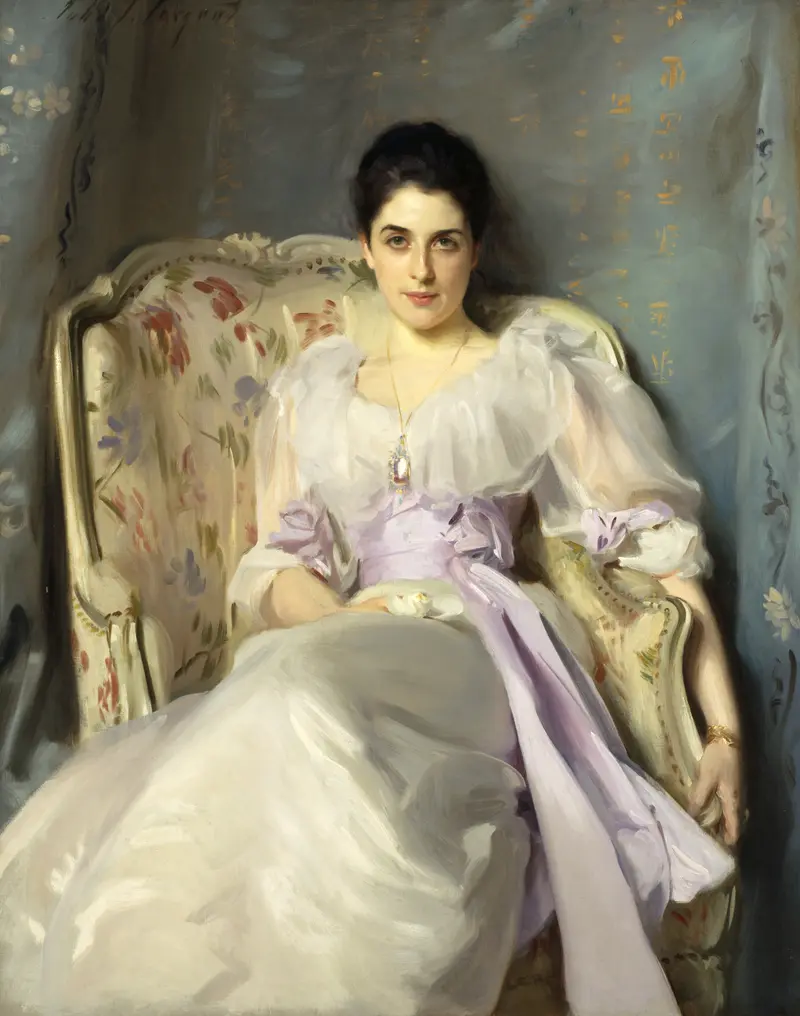
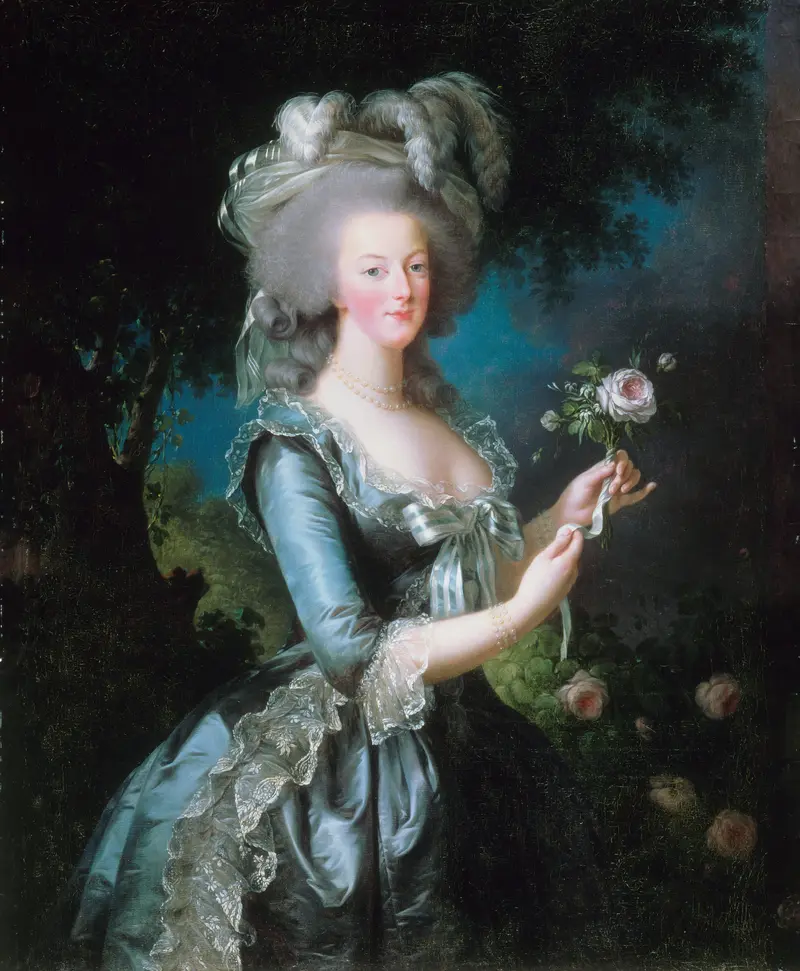
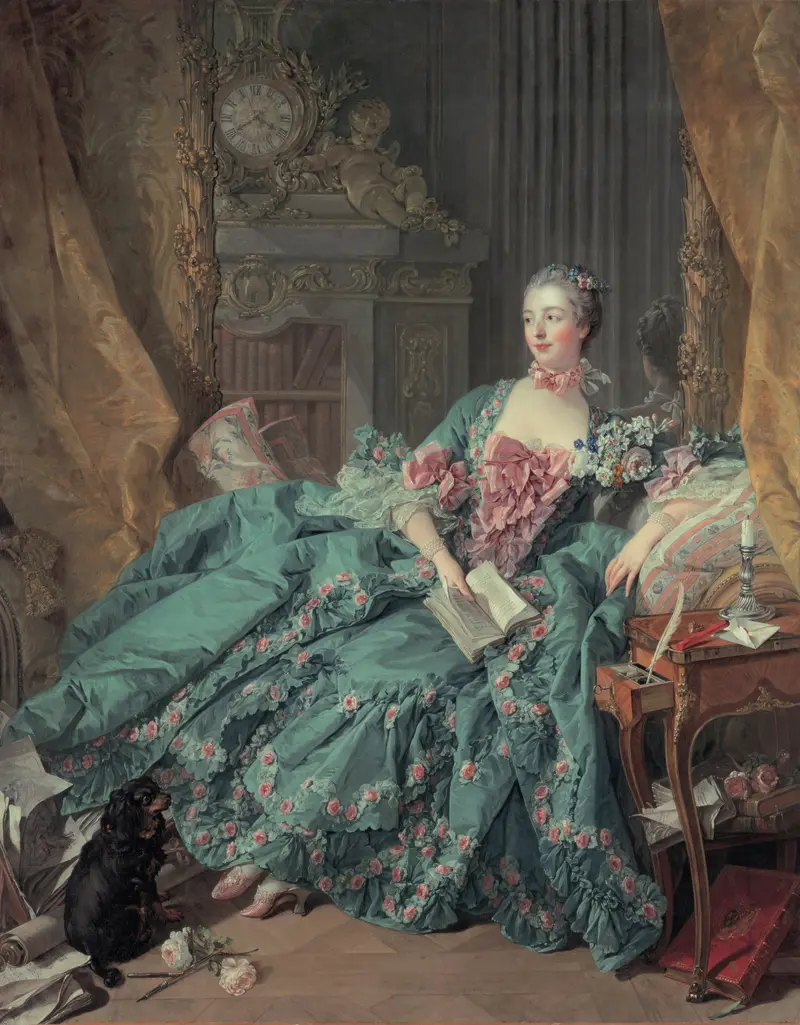
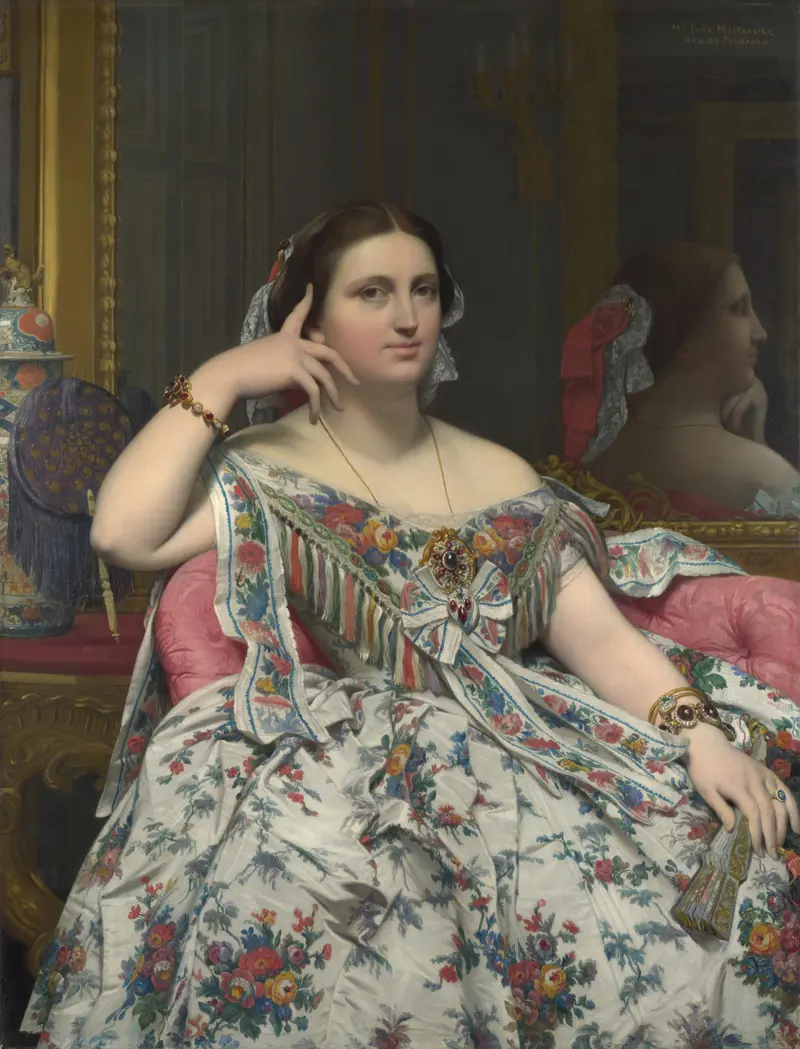
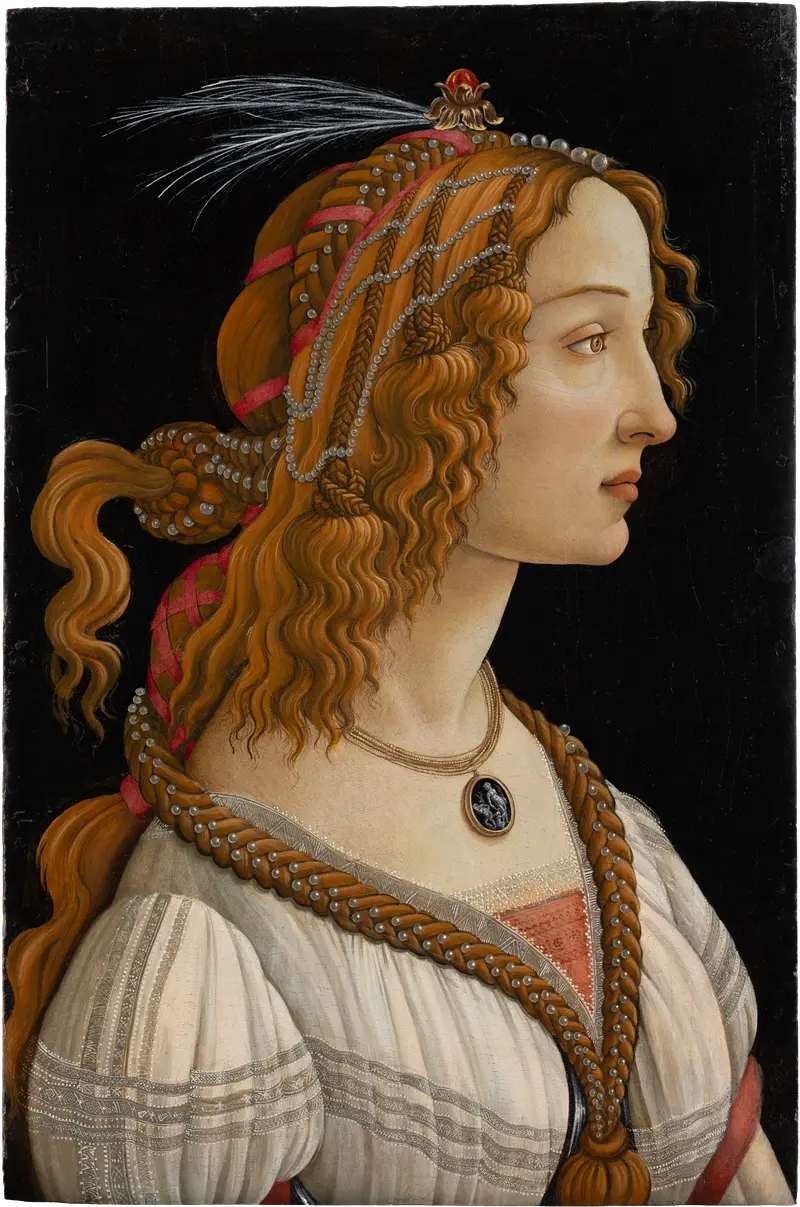
More famous portraits of women that people still look up by name, from Queen Marie Antoinette and Madame de Pompadour to Sargent's elegant Lady Agnew.
Famous self-portraits
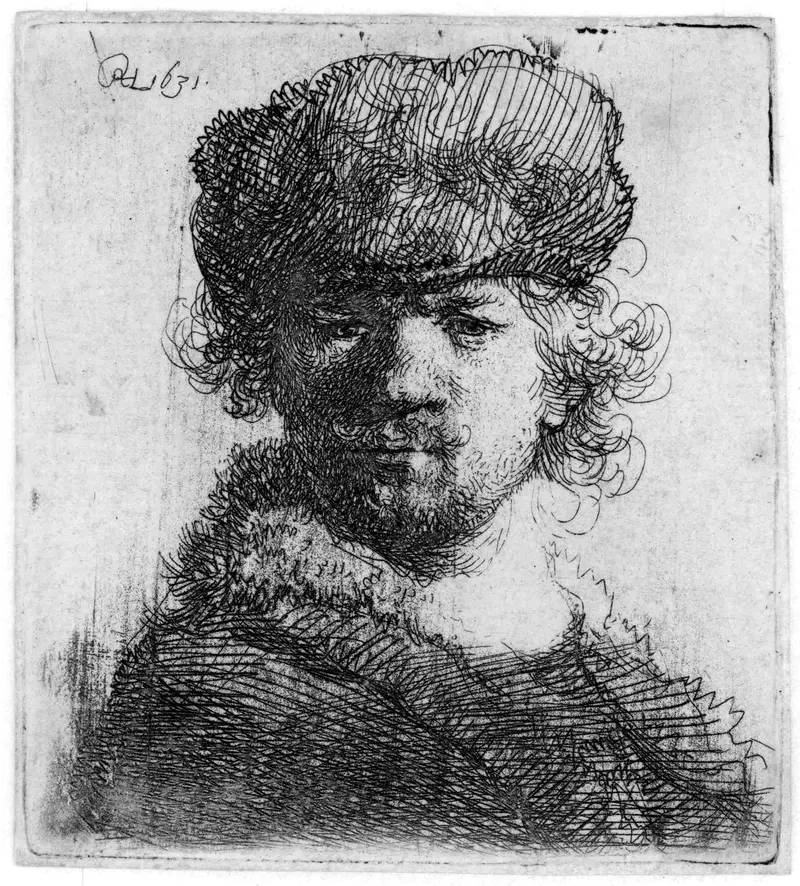
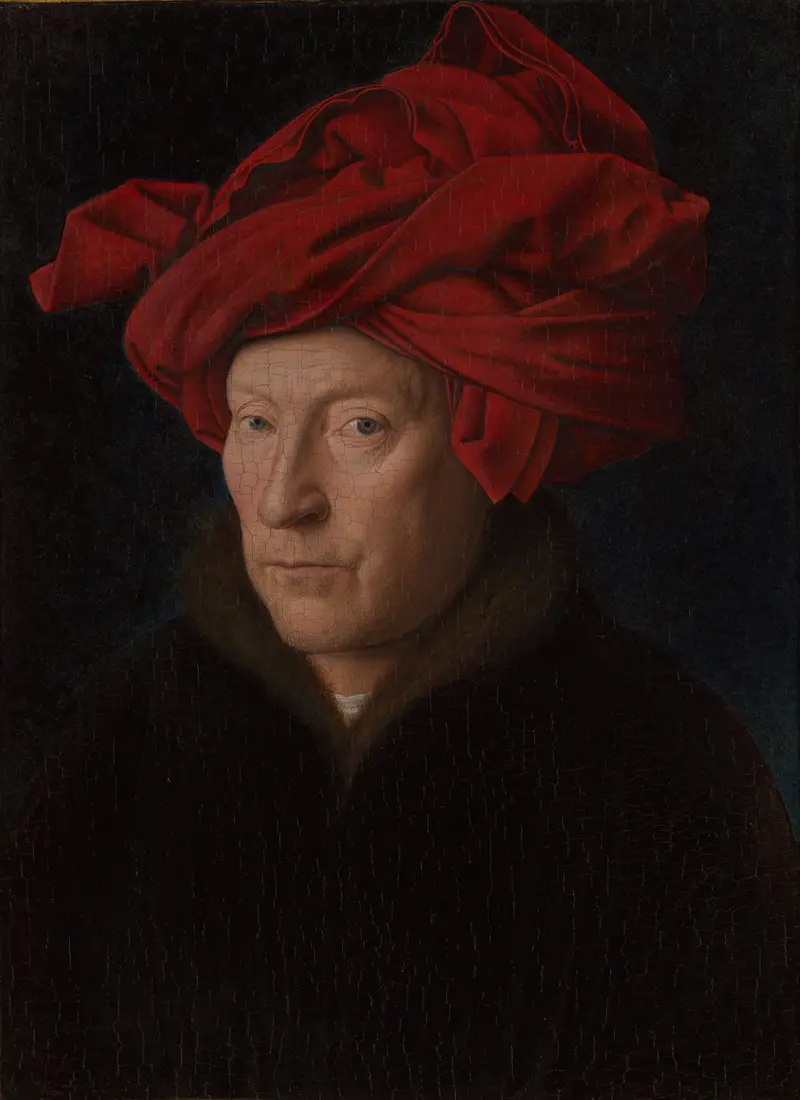
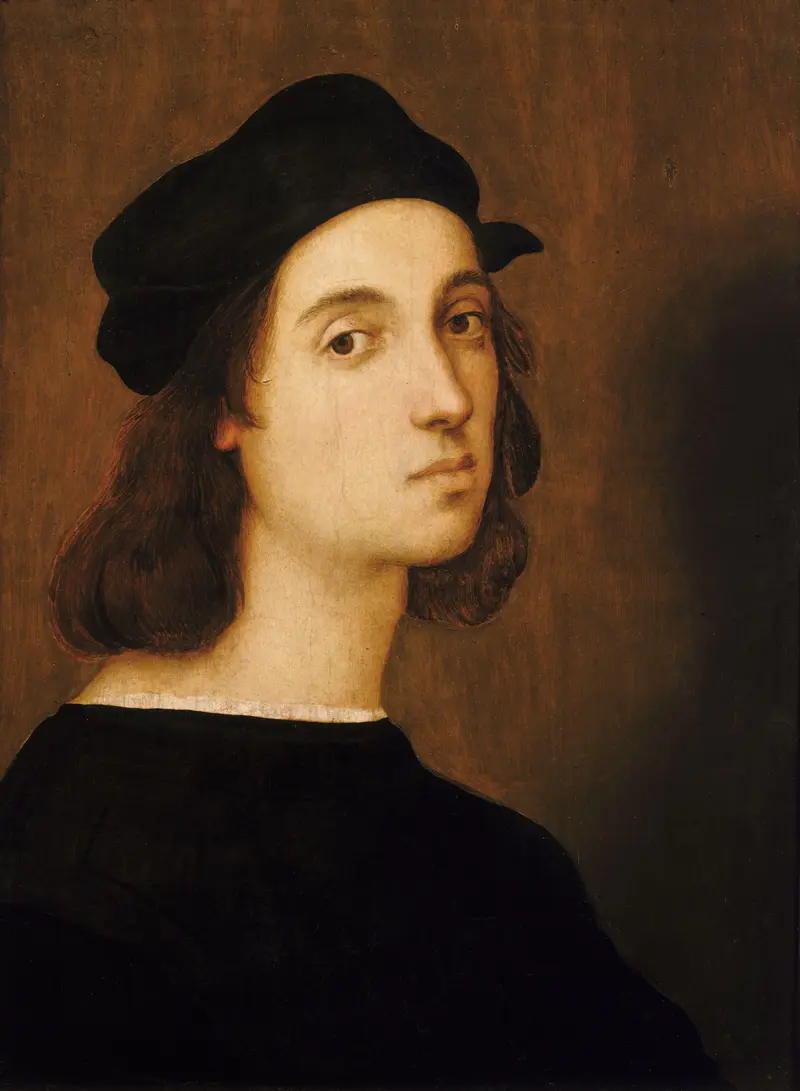
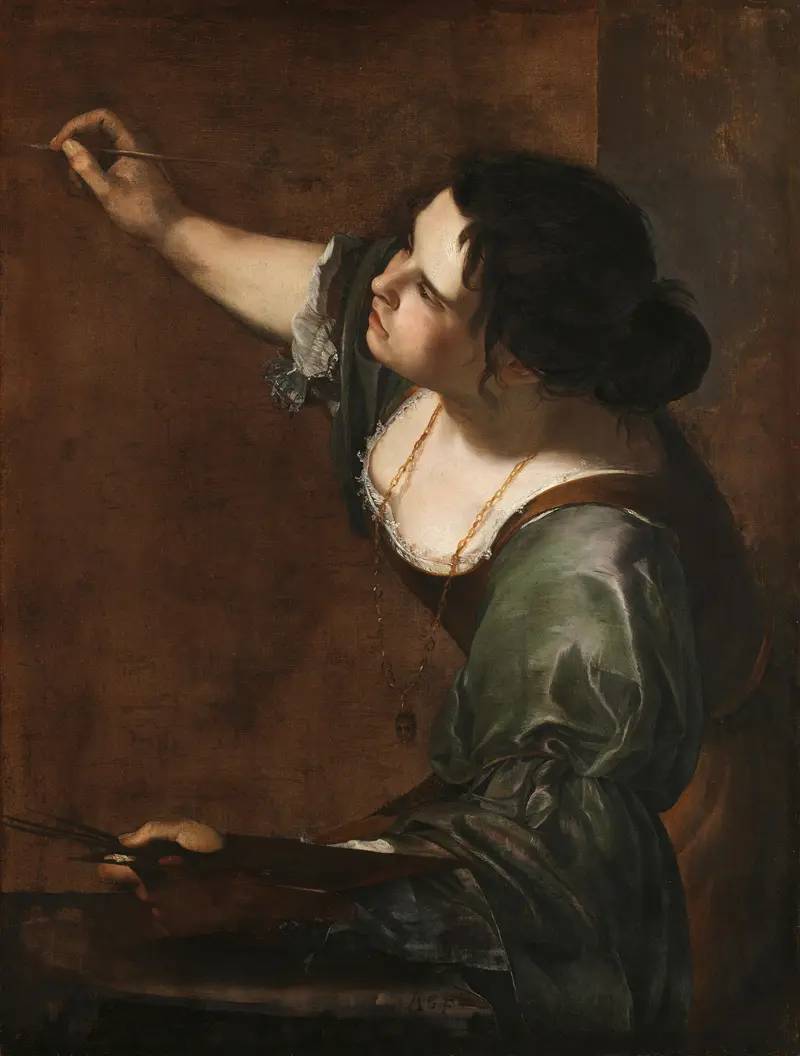
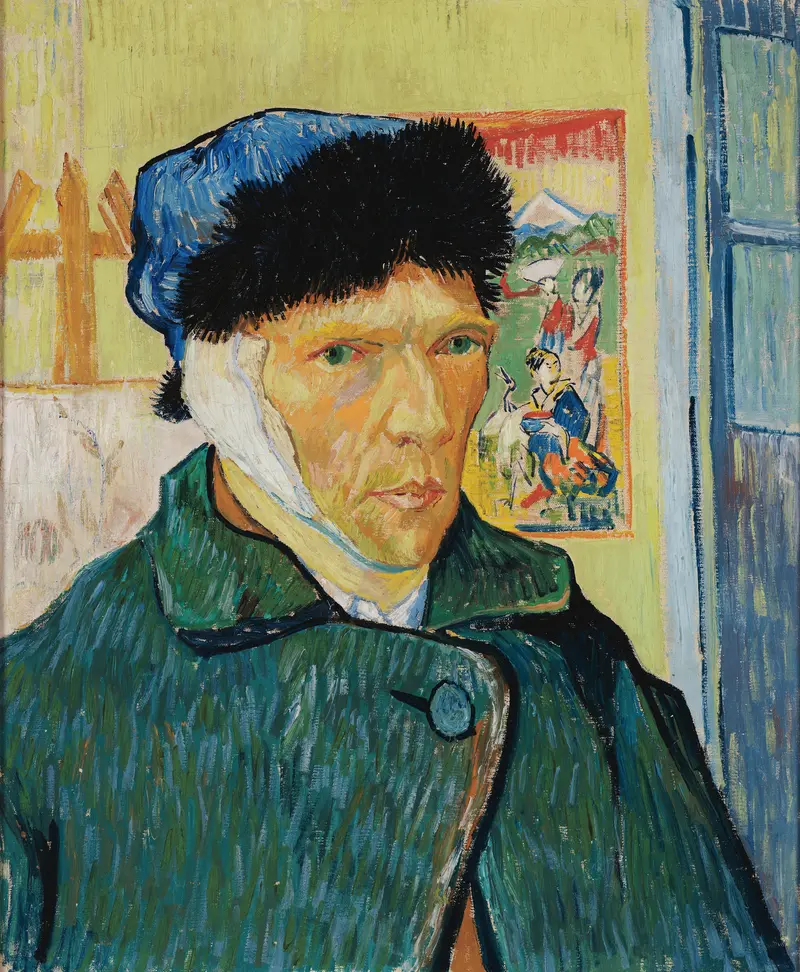
Painters have always been their own most patient model. These famous self-portraits, from Jan van Eyck to Rembrandt and Van Gogh, show how great artists saw themselves.
Famous portraits of kings, queens and presidents
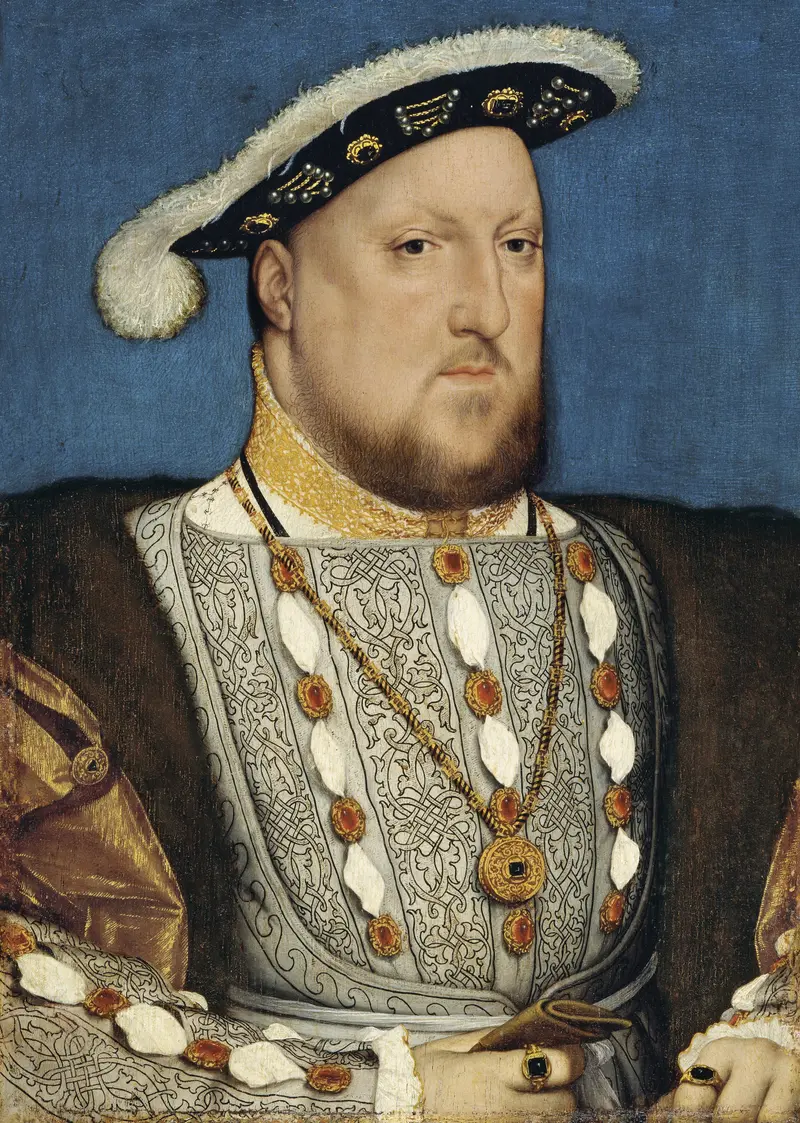
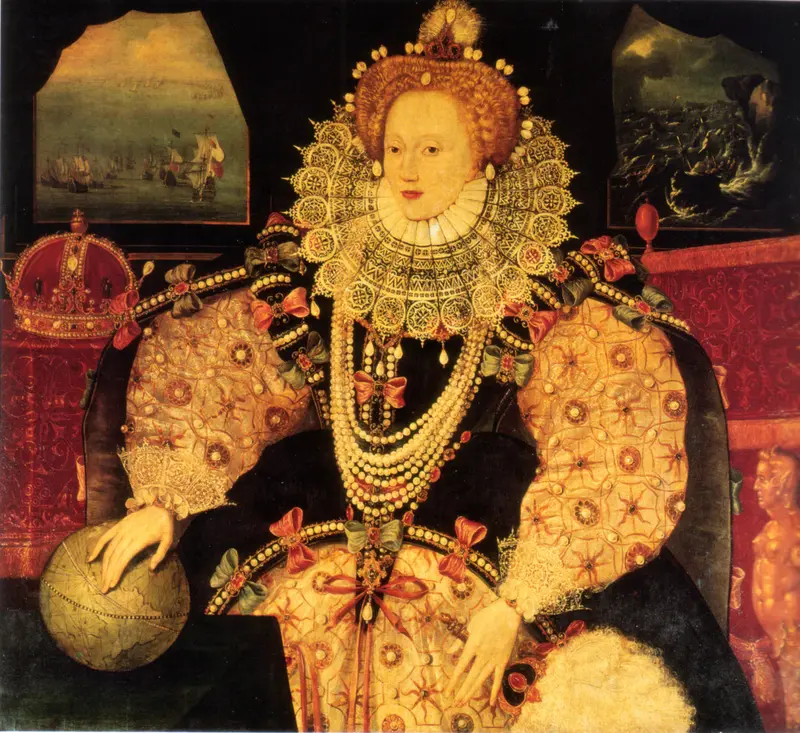
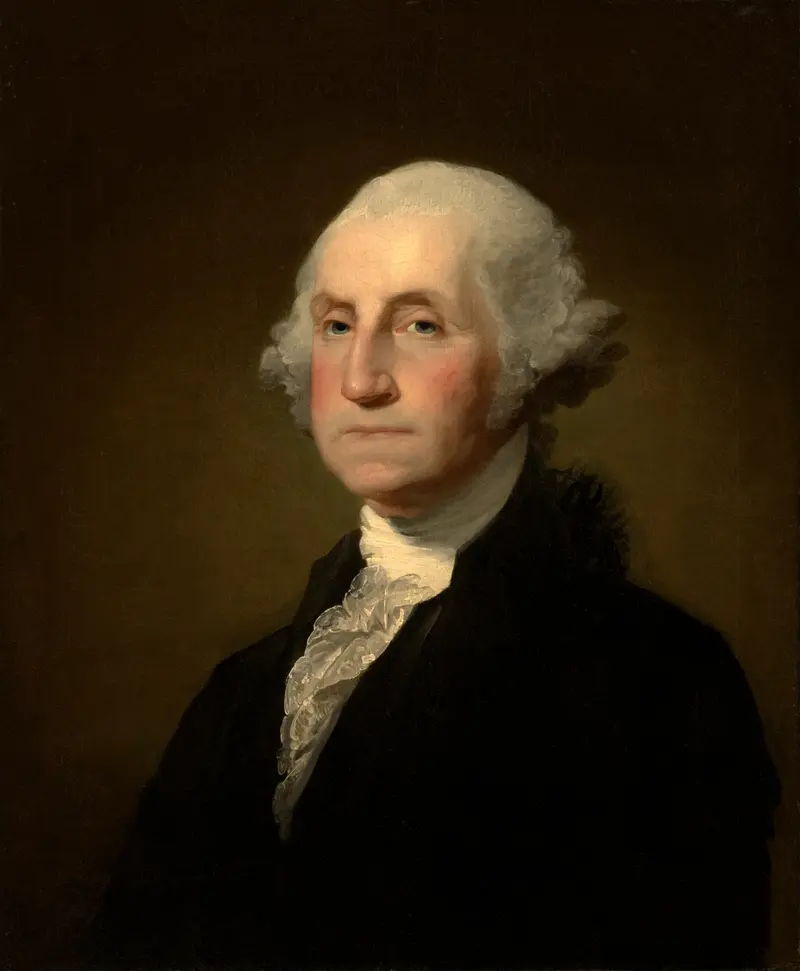
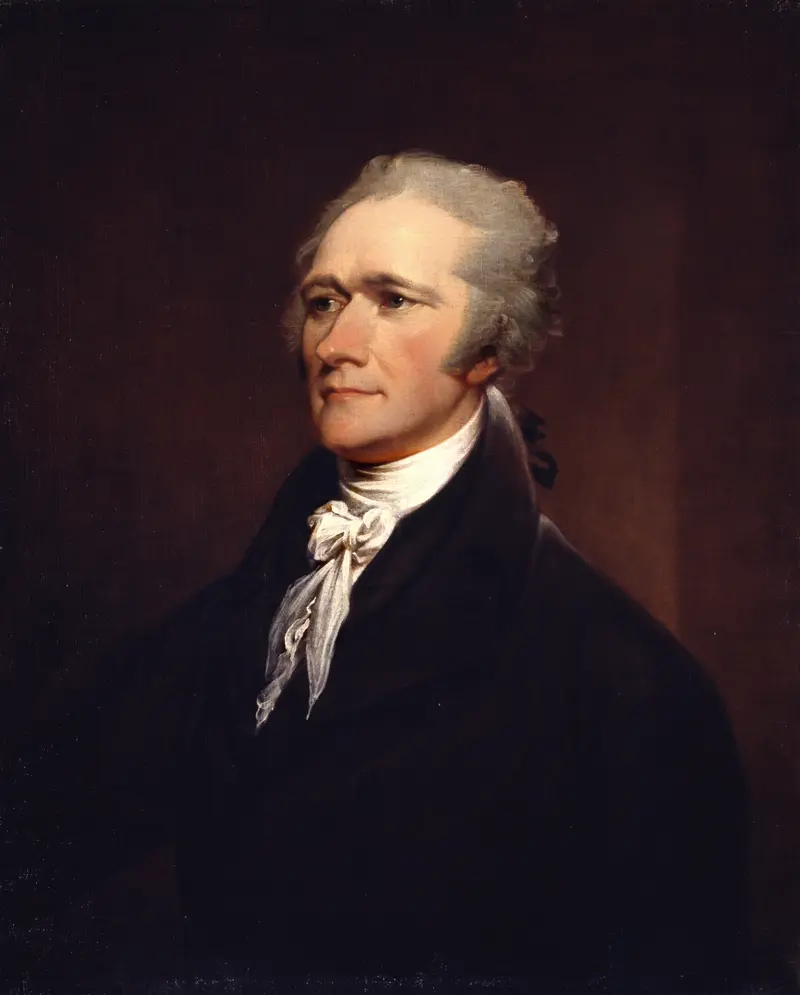
Famous portraits of kings, queens and presidents were painted to show power, and many still shape how we picture these leaders today. Here are six of the best known, from Henry VIII and Elizabeth I to George Washington and Abraham Lincoln.

Famous portrait painters
Eight painters who shaped the portrait, from Leonardo to Sargent. Each link opens all their paintings.
- Leonardo da VinciPainted only a handful of portraits, among them the Mona Lisa and Lady with an Ermine.
- RaphaelLa Fornarina, La Velata and portraits of the popes and scholars of Rome.
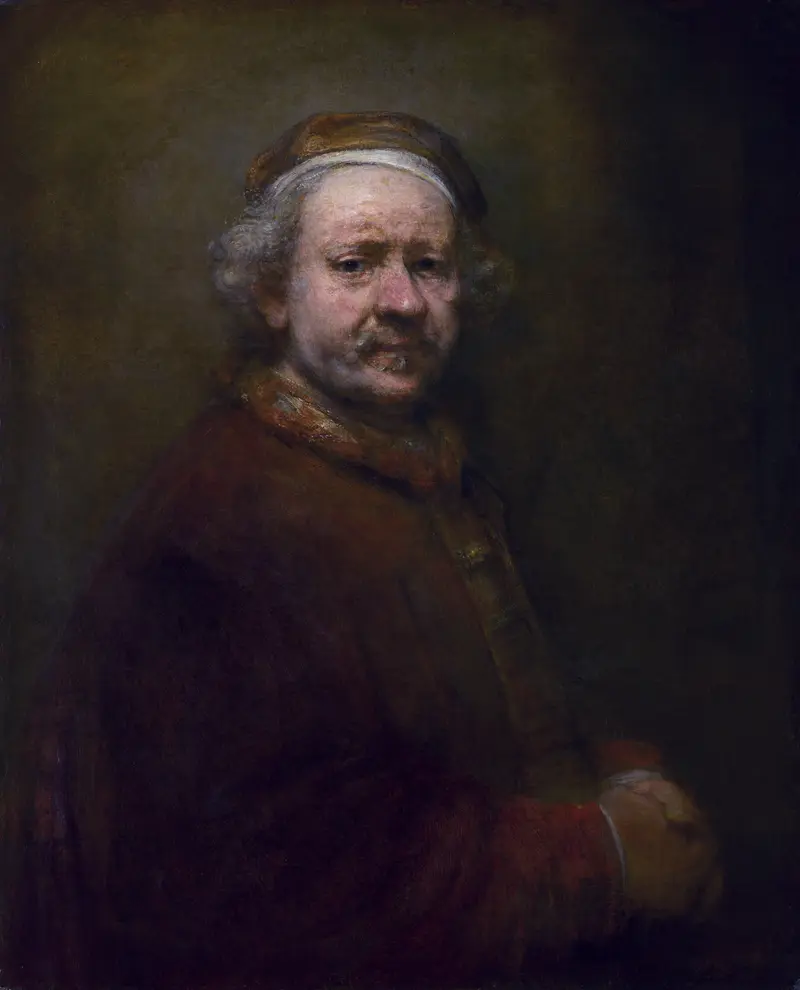 RembrandtGroup portraits for Amsterdam’s guilds and about 80 self-portraits.
- Diego VelázquezCourt painter to Philip IV of Spain from 1623: Las Meninas, Innocent X.
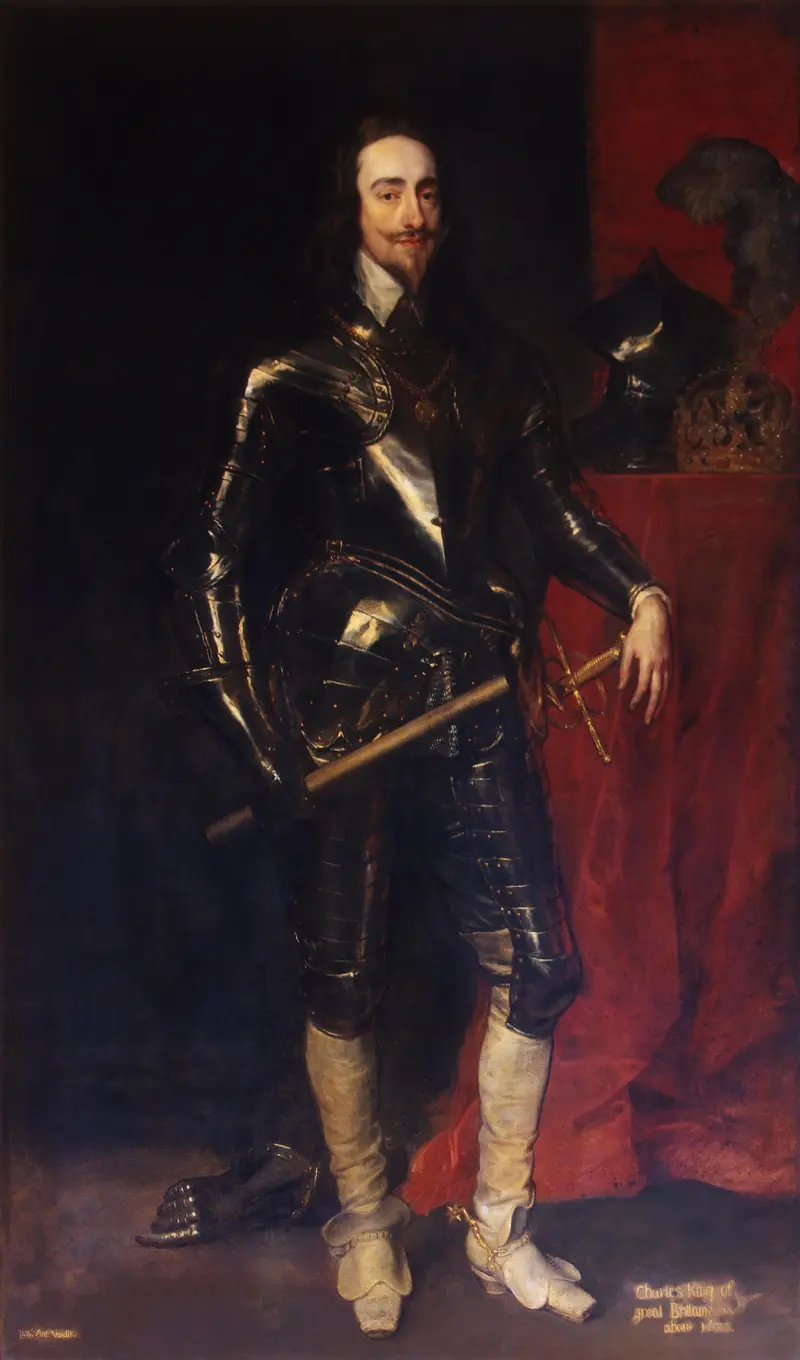
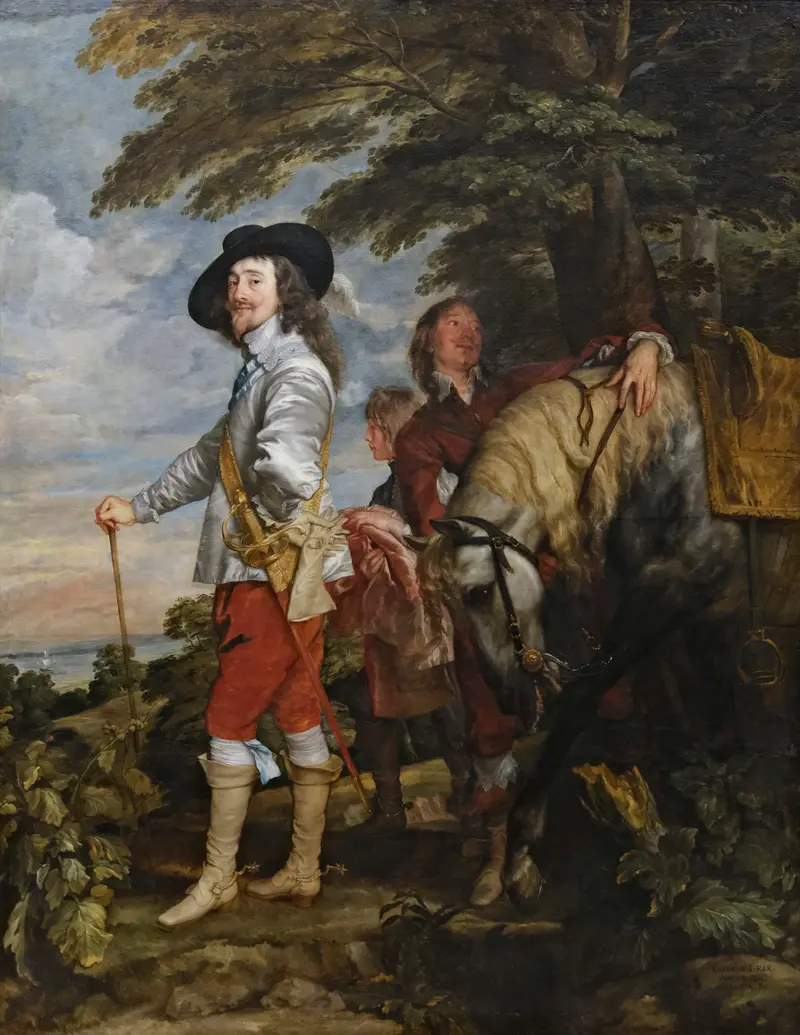 Anthony van DyckPainter to Charles I of England, master of the elegant full-length portrait.
- Thomas GainsboroughEnglish gentry in their landscapes, from Mr and Mrs Andrews to The Blue Boy.
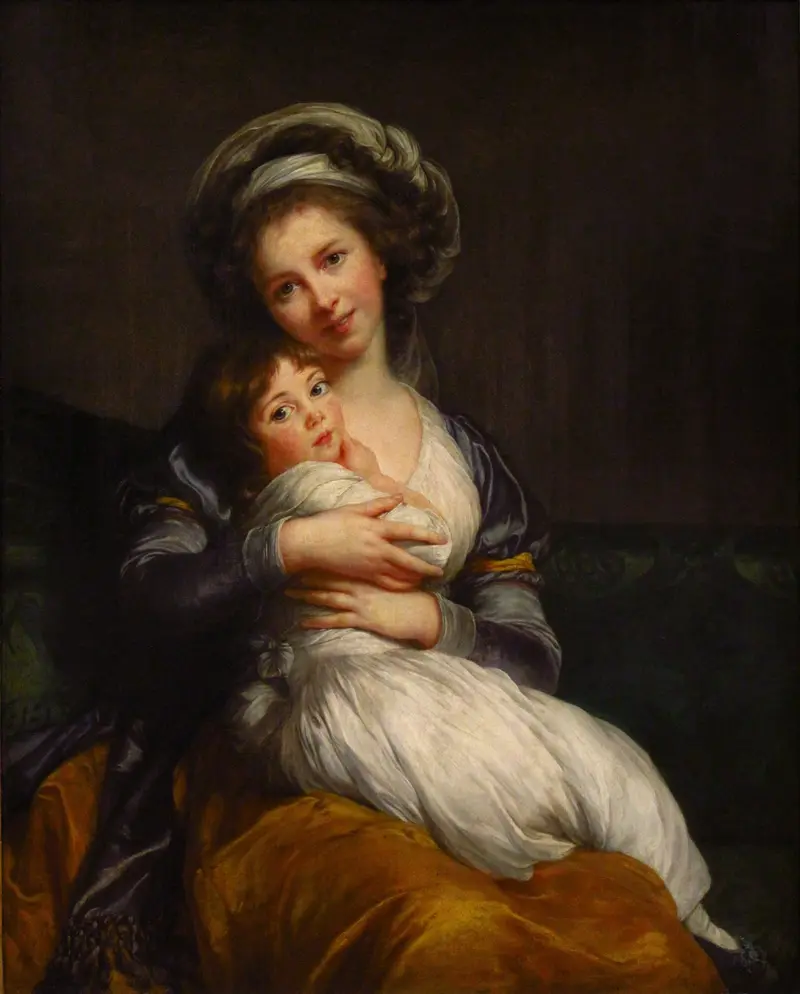 Élisabeth Vigée Le BrunMarie Antoinette’s portraitist, and the painter of herself with her daughter.
- John Singer SargentTate calls him the most celebrated portraitist of his generation.
List of famous portrait paintings and their sitters
The 25 most famous portraits: who sat for them, who painted them, when, and where each one is today.
Show the list of 25 portraitsHide the list
| # | Painting | Sitter | Painted by | Year | Medium | Size | Located in | City |
|---|---|---|---|---|---|---|---|---|
| 1 | Mona Lisa | Lisa Gherardini (Lisa del Giocondo) | Leonardo da Vinci | 1503–1519 | Oil on poplar panel | 79.4 × 53.4 cm (31.3 × 21 in) | Louvre | Paris |
| 2 | Girl with a Pearl Earring | Unknown model (a tronie, not a portrait) | Johannes Vermeer | c. 1665 | Oil on canvas | 44.5 × 39 cm (17.5 × 15.4 in) | Mauritshuis | The Hague |
| 3 | Las Meninas | The Infanta Margarita and her court | Diego Velázquez | 1656 | Oil on canvas | 318 × 276 cm (125.2 × 108.7 in) | Museo del Prado | Madrid |
| 4 | Lady with an Ermine | Cecilia Gallerani | Leonardo da Vinci | c. 1490 | Oil and tempera on walnut panel | 53.4 × 39.3 cm (21 × 15.5 in) | National Museum in Kraków | Kraków |
| 5 | The Anatomy Lesson of Dr. Nicolaes Tulp | Dr. Nicolaes Tulp and members of the Surgeons' Guild | Rembrandt | 1632 | Oil on canvas | 169.5 × 216.5 cm (66.7 × 85.2 in) | Mauritshuis | The Hague |
| 6 | Arnolfini Portrait | Probably Giovanni di Nicolao Arnolfini and his wife | Jan van Eyck | 1434 | Oil on oak panel | 82.2 × 60 cm (32.4 × 23.6 in) | National Gallery | London |
| 7 | The Blue Boy | An unidentified boy | Thomas Gainsborough | c. 1770 | Oil on canvas | 179.4 × 123.8 cm (70.6 × 48.7 in) | The Huntington | San Marino, California |
| 8 | Portrait of Adele Bloch-Bauer I | Adele Bloch-Bauer | Gustav Klimt | 1907 | Oil, gold, and silver on canvas | 140 × 140 cm (55.1 × 55.1 in) | Neue Galerie | New York |
| 9 | The Ambassadors | Jean de Dinteville and Georges de Selve | Hans Holbein the Younger | 1533 | Oil on oak panel | 207 × 209.5 cm (81.5 × 82.5 in) | National Gallery | London |
| 10 | Napoleon Crossing the Alps | Napoleon Bonaparte as First Consul | Jacques-Louis David | 1800 | Oil on canvas | 259 × 221 cm (102 × 87 in) | Château de Malmaison | Rueil-Malmaison |
| 11 | The Jewish Bride | An unknown couple posing as Isaac and Rebecca | Rembrandt | c. 1665–1669 | Oil on canvas | 121.5 × 166.5 cm (47.8 × 65.6 in) | Rijksmuseum | Amsterdam |
| 12 | Whistler's Mother | Anna McNeill Whistler, the artist's mother | James McNeill Whistler | 1871 | Oil on canvas | 144.3 × 163 cm (56.8 × 64.2 in) | Musée d'Orsay | Paris |
| 13 | La Fornarina | Traditionally Margherita Luti | Raphael | 1519–1520 | Oil on panel | 87 × 63 cm (34.3 × 24.8 in) | Palazzo Barberini | Rome |
| 14 | Self-Portrait with Fur-Trimmed Robe | Albrecht Dürer himself, aged 28 | Albrecht Dürer | 1500 | Oil on lime panel | 67.1 × 48.9 cm (26.4 × 19.3 in) | Alte Pinakothek | Munich |
| 15 | Portrait of an Unknown Woman | No real sitter: a composite figure | Ivan Kramskoi | 1883 | Oil on canvas | 76.1 × 102.3 cm (30 × 40.3 in) | Tretyakov Gallery | Moscow |
| 16 | Madame X | Virginie Amélie Avegno Gautreau | John Singer Sargent | 1883–84 | Oil on canvas | 208.6 × 109.9 cm (82.1 × 43.3 in) | Metropolitan Museum of Art | New York |
| 17 | La Velata | An unidentified married woman | Raphael | c. 1512–1515 | Oil on canvas | 82 × 60.5 cm (32.3 × 23.8 in) | Palazzo Pitti | Florence |
| 18 | Portrait of a Young Girl | An unidentified young aristocrat | Petrus Christus | c. 1470 | Oil on oak panel | 29.1 × 22.7 cm (11.5 × 8.9 in) | Gemäldegalerie | Berlin |
| 19 | Portrait of Père Tanguy | Julien “Père” Tanguy, a Paris art-supply dealer | Vincent van Gogh | 1887 | Oil on canvas | 92 × 73 cm (36.2 × 28.7 in) | Musée Rodin | Paris |
| 20 | Portrait of a Lady | An unidentified noblewoman | Rogier van der Weyden | c. 1460 | Oil on panel | 34 × 25.5 cm (13.4 × 10 in) | National Gallery of Art | Washington, DC |
| 21 | Portrait of Innocent X | Pope Innocent X | Diego Velázquez | c. 1649–1650 | Oil on canvas | 141 × 119 cm (55.5 × 46.9 in) | Galleria Doria Pamphilj | Rome |
| 22 | Self-Portrait (1889) | Vincent van Gogh himself | Vincent van Gogh | 1889 | Oil on canvas | 65 × 54.2 cm (25.6 × 21.3 in) | Musée d'Orsay | Paris |
| 23 | Mr and Mrs Andrews | Robert Andrews and his wife Frances | Thomas Gainsborough | c. 1750 | Oil on canvas | 69.8 × 119.4 cm (27.5 × 47 in) | National Gallery | London |
| 24 | Napoleon I on His Imperial Throne | Napoleon I as emperor | Jean-Auguste-Dominique Ingres | 1806 | Oil on canvas | 260 × 163 cm (102.4 × 64.2 in) | Musée de l'Armée | Paris |
| 25 | Eleanor of Toledo with Her Son Giovanni | Eleanor of Toledo and her son Giovanni de' Medici | Bronzino | c. 1545 | Oil on wood | 115 × 96 cm (45.3 × 37.8 in) | Uffizi | Florence |
Famous portrait paintings: questions and answers
What is the most famous portrait in the world?
The Mona Lisa by Leonardo da Vinci, which the Louvre itself calls the most famous portrait in the world. It shows Lisa Gherardini, the wife of a Florentine silk merchant, and Leonardo began it around 1503. Its theft from the Louvre in 1911 and its recovery two years later made it even more famous. The next most famous portraits are Girl with a Pearl Earring and Las Meninas.
Sources: Louvre: From the Mona Lisa to The Wedding Feast at Cana · Louvre: Mona Lisa
What is the most famous self-portrait?
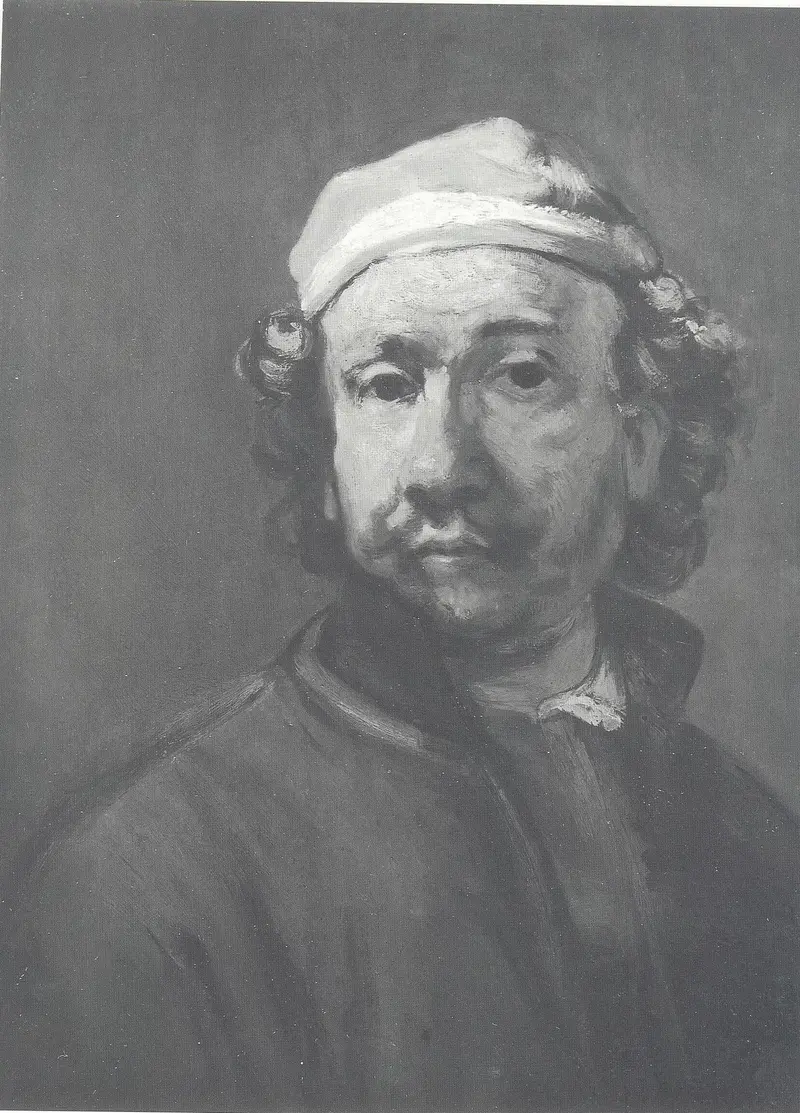
By our measure it is Albrecht Dürer's Self-Portrait with Fur-Trimmed Robe (1500), which the Alte Pinakothek in Munich calls probably the most unusual self-portrait in the history of art. Two other answers come up again and again: Rembrandt, about 80 of whose self-portraits survive, far more than any other painter of his time, and Van Gogh's Self-Portrait with Bandaged Ear (1889), painted a week after he left the hospital.
Sources: Alte Pinakothek: Self-Portrait with Fur-Trimmed Robe · National Gallery: Self Portrait at the Age of 63 · Courtauld: Self-Portrait with Bandaged Ear
Who is the most famous portrait painter?
There is no official ranking, but a few names are hard to leave out: Leonardo da Vinci, for the Mona Lisa; Rembrandt, for his group portraits and self-portraits; and Diego Velázquez, court painter to Philip IV of Spain. For the beginnings of the genre, the National Gallery in London says portraiture as we know it begins with Jan van Eyck. For the modern era, Tate calls John Singer Sargent the most celebrated portraitist of his generation.
Sources: National Gallery: Van Eyck, The Portraits · National Gallery: Diego Velázquez · Tate: Sargent and Fashion
What is a portrait painting, and what makes something a portrait?
A portrait is a picture of a particular, real person, and a portrait painting is one made in paint. That is why Girl with a Pearl Earring is strictly not a portrait: the Mauritshuis calls it a tronie, a study of an imaginary figure. Before photography, a portrait was the only way to record how someone looked, but it was always more than a record: pose, clothes and objects show the sitter's status, wealth, beauty or learning.
Sources: Tate: Art Term, Portrait · Mauritshuis: Girl with a Pearl Earring
What makes a good portrait painting?
There is no single formula, but curators keep pointing to two things. The first is a convincing sense of a real individual: the National Gallery in London says Jan van Eyck's sitters, painted 600 years ago, still feel alive today. The second is going beyond the face, using pose, expression, clothing, props and setting to tell you who the sitter was. Look at The Ambassadors or Mr and Mrs Andrews: every object in them says something about the people.
Sources: National Gallery: Van Eyck, The Portraits · National Portrait Gallery: Expressing identity through portraiture
What is the oldest portrait painting in the world?
No single painting can claim the title, but some of the oldest surviving painted portraits are the mummy portraits of Roman Egypt, often called Fayum portraits, painted between the 1st and 3rd centuries AD; nearly a thousand survive. In European painting after antiquity, an early landmark is the profile of King John II the Good of France in the Louvre, from about 1355 to 1360, one of the earliest ruler portraits painted on a wooden panel.
Sources: Getty: Mummy Portraits of Roman Egypt · Louvre: Jean II le Bon
What was the first self-portrait?
Nobody knows for certain. One of the best-known early examples in European painting is Jan van Eyck's Portrait of a Man (Self Portrait?), dated October 21, 1433, in the National Gallery in London. The gallery says the face is almost certainly van Eyck's own, since the sitter leans forward as if looking in a mirror. Another is the self-portrait Albrecht Dürer drew with a mirror at the age of 13, in 1484, now in the Albertina in Vienna.
Sources: National Gallery: Portrait of a Man (Self Portrait?) · Albertina: Self-Portrait at the Age of Thirteen
What are the most famous portraits of women?
By our measure, the Mona Lisa, Girl with a Pearl Earring and Leonardo's Lady with an Ermine come first, followed by Klimt's Portrait of Adele Bloch-Bauer I, Raphael's La Fornarina, Whistler's Mother and Sargent's Madame X. Other portraits of women that people search for by name include Marie Antoinette with a Rose by Élisabeth Vigée Le Brun, Madame de Pompadour by François Boucher and Sargent's Lady Agnew of Lochnaw.
Sources: National Museum in Kraków: Lady with an Ermine · Neue Galerie: The Woman in Gold
What is the most famous portrait of George Washington?
Gilbert Stuart's unfinished Athenaeum portrait of 1796, the face on the $1 bill. Stuart never finished it and kept it as the model for the many copies he sold; the original is jointly owned by the Museum of Fine Arts, Boston, and the National Portrait Gallery in Washington, DC. His full-length Lansdowne portrait, also from 1796, is the other famous image. The version on this page is one of Stuart's own copies, at the Clark Art Institute.
Sources: U.S. Currency Education Program: The Athenaeum Portrait · MFA Boston: George Washington · National Portrait Gallery: Lansdowne portrait
What is the most famous portrait of Napoleon?
Jacques-Louis David's Napoleon Crossing the Alps, which the Palace of Versailles calls the definitive icon of the Napoleonic legend. King Charles IV of Spain ordered the first version in 1800, now at the Château de Malmaison, and David painted five versions in all. Its main rival is Ingres's Napoleon I on His Imperial Throne (1806, Musée de l'Armée, Paris), which contemporaries found "Gothic" and "barbarous."
Sources: Château de Versailles: Jacques Louis David · Malmaison: Bonaparte Crossing the Alps · Musée de l'Armée: Napoleon on the Throne
Who is the girl with the pearl earring?
Nobody knows. The Mauritshuis in The Hague, which owns Vermeer's painting, says that everyone knows her, yet nobody knows who she is. That is because it is not a portrait but a tronie: a study of an imaginary figure, here a girl in exotic dress with an oriental turban and an improbably large pearl.
Sources: Mauritshuis: Face to face with the Girl with a Pearl Earring · Mauritshuis: Girl with a Pearl Earring
Can I download famous portrait paintings for free, and are they public domain?
Yes. Every portrait on this page is in the public domain, so you can download it free and use it for anything, including commercial projects. In the United States, works published before 1931 are in the public domain, and a faithful photograph of a public-domain painting does not get a new copyright. A few countries have different rules, so check them if you publish outside the U.S.
Sources: Cornell University Library: Copyright Term and the Public Domain · U.S. Copyright Office: Compendium, Chapter 900
How we chose the most famous portraits
We ranked the portraits by how widely each one is known around the world: the number of languages that have an encyclopedia entry about it, checked in October 2026. The more cultures write about a portrait, the higher it ranks.
A few rules keep the list useful. Every painting is in the public domain, so you can download and use it freely. No painter has more than two places. We kept two famous paintings that are not strictly portraits, Girl with a Pearl Earring and Kramskoi's Portrait of an Unknown Woman, because they are what many people mean by a famous portrait, and their entries tell you why. When a portrait exists in several versions, we show the one most people mean and tell you which.
Sitters, dates, sizes and locations come from the museums' own records, and each entry links to its sources.
Spotted a mistake? Tell us and we will correct it.
Browse all 13,354 portrait paintings
Every one is public domain and free to download, most famous first.