Bullfight — History & Analysis
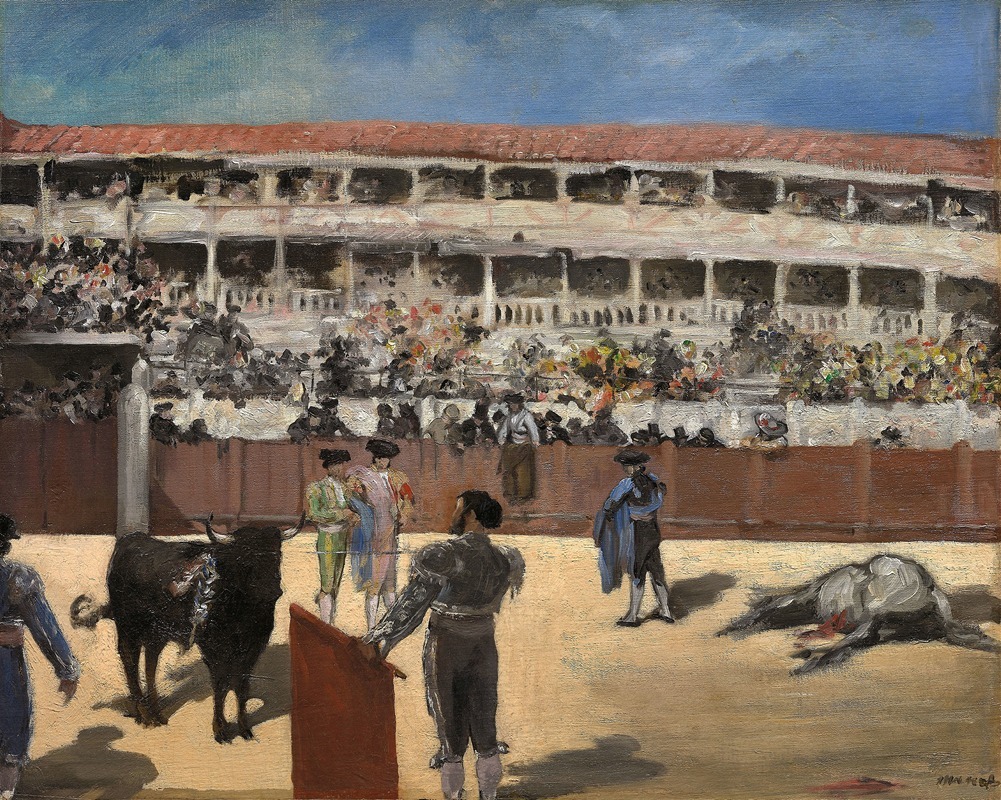
What if beauty was never meant to be finished? In Édouard Manet’s Bullfight, the canvas brims with unresolved tension, inviting the viewer into a fleeting moment of chaos and spectacle. Look to the center of the painting where a bull, powerful and defiant, dominates the frame. The brilliant red of the matador's cape draws your eye, contrasting sharply with the muted earth tones of the spectators and the bullring. The brushstrokes pulse with energy, evoking a sense of movement, as if the scene might erupt into pandemonium at any moment.
Notice how the light casts shadows across the bull’s muscular frame, imbuing it with a sense of looming danger, while the faces in the background fade into a blur of anticipation and anxiety. Amidst these vivid extremes, a deeper narrative unfolds. The tension between the bull and the matador mirrors the struggle between man and nature, suggesting a fragile balance where beauty and brutality coexist. Additionally, the spectators' varying expressions capture a spectrum of emotions—some reveling in the violence, others recoiling in horror.
This duality reflects society's complicated relationship with violence and entertainment, provoking questions about morality and the allure of the spectacle. In the years leading to 1865, Manet was deeply engaged in the exploration of modern life and the human condition. He created Bullfight during a period of artistic upheaval, where traditional forms were being challenged by the burgeoning Impressionist movement. The work embodies his desire to capture the raw essence of contemporary experiences, marking a significant moment in his evolution as a pivotal figure in art history.