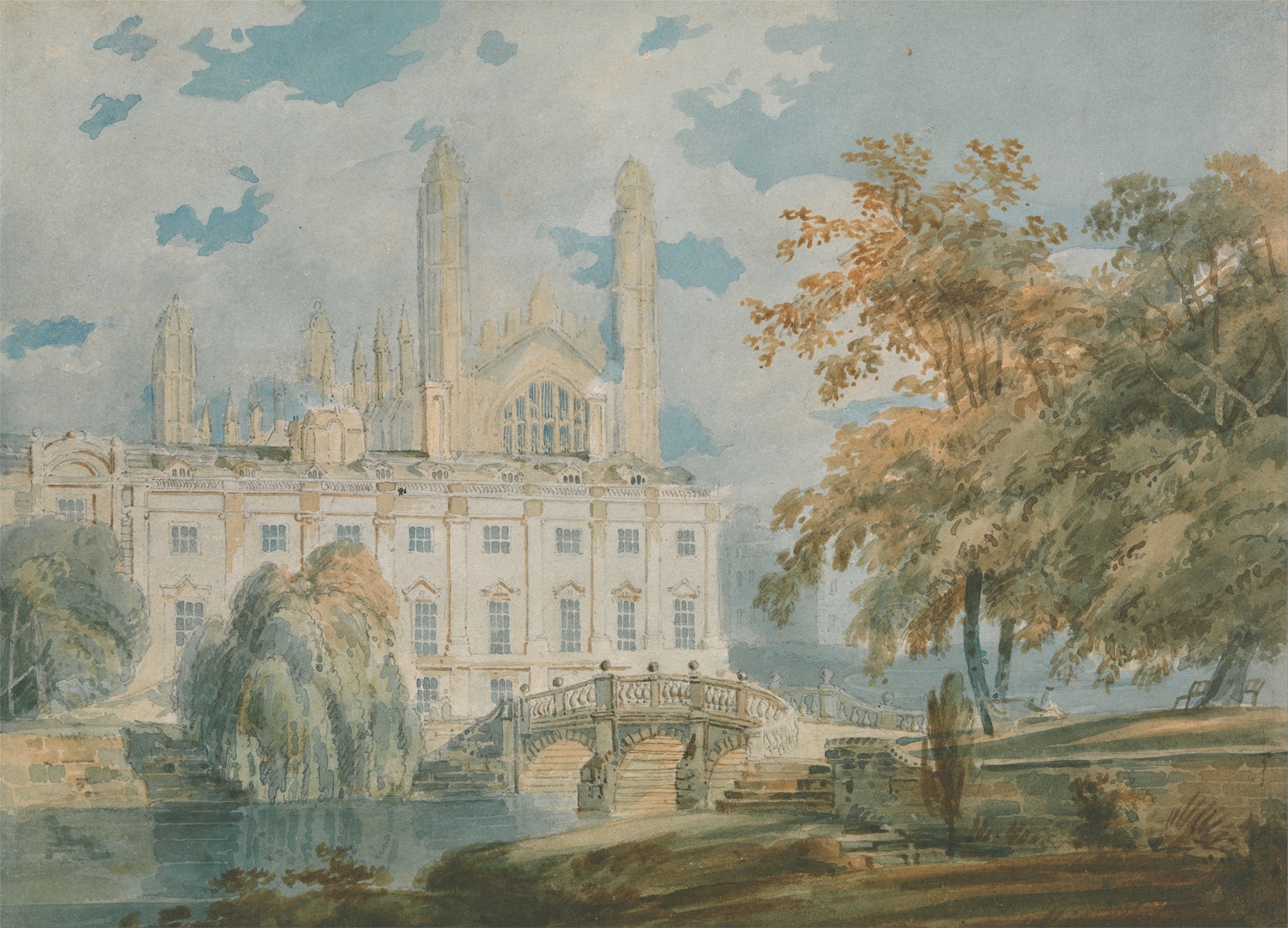
Clare Hall and King’s College Chapel, Cambridge, from the Banks of the River Cam — History & Analysis
“Under the brush, chaos becomes grace.” This notion resonates profoundly as we gaze upon a moment captured in time, where yearning for beauty dances between the strokes of a master. In each corner of the canvas, a story unfolds—a longing for connection to the sublime and transcendent. Focus first on the luminous reflection shimmering in the river’s surface, where water meets sky—a delicate interplay of blues and silvers. Notice how Turner’s brushwork transforms the ethereal light into an almost palpable sensation, guiding our eyes towards the majestic King’s College Chapel.
The soft, diffused hues evoke a sense of tranquility, inviting contemplation while the vibrant greens of the riverbanks cradle the architectural wonder, creating a harmonious balance between nature and human endeavor. Delve deeper into the intricate details: the billowing clouds that suggest an impending storm, yet bathe the scene in tranquility. They echo the tension between human aspiration and the forces of nature—an eternal struggle that brings forth a bittersweet longing. The composition evokes a nostalgia, not just for the beauty present but for the moments forever slipping through our fingers, urging us to reflect on our own yearnings and the fragility of existence.
In 1793, as Turner painted this view of Clare Hall and King’s College Chapel, he was in his mid-twenties, freshly recognized in the art world for his innovative approach. Living in London at a time of great change, he was influenced by the burgeoning Romantic movement, which sought to evoke emotional responses to nature and society. The contrast between tranquil reflection and the unsettling presence of nature’s power would come to define much of his work, marking the evolution of landscape painting.