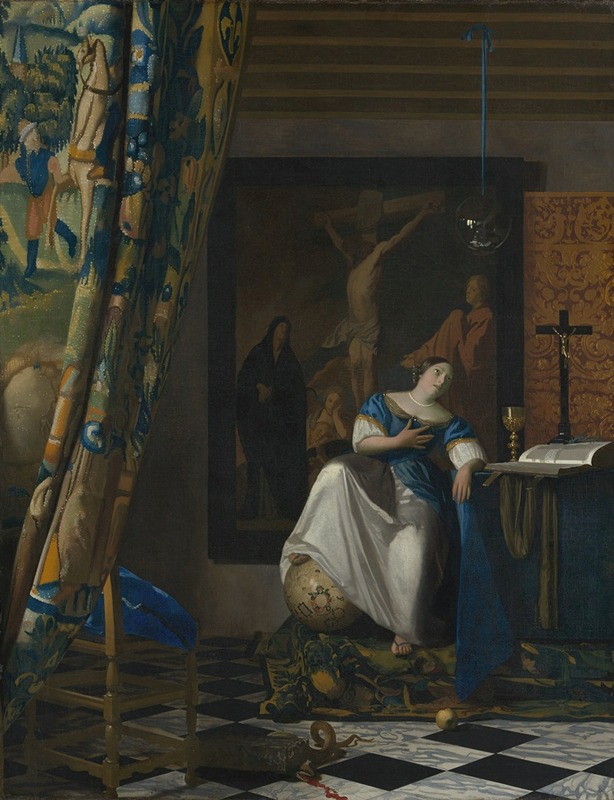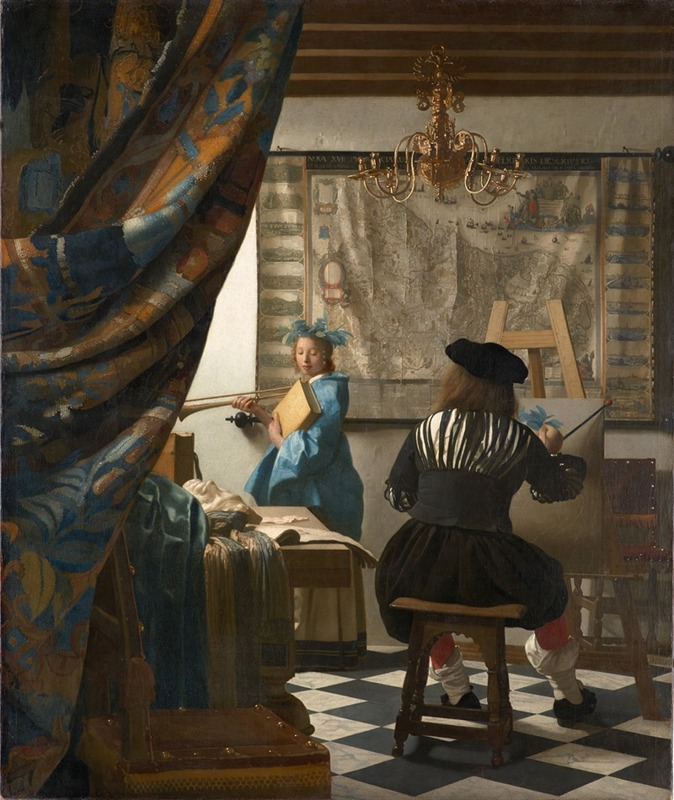

Welcome, everyone. Before us is Johannes Vermeer’s masterpiece, The Art of Painting (c. 1666–1668), a stunning example of Dutch Baroque painting. Notice immediately the remarkable play of light pouring through the tall window on the left. Vermeer’s delicate use of natural light bathes the scene, illuminating both the artist and his model, while casting gentle shadows that create an almost tangible sense of space and depth. Every detail, from the texture of the drapery to the sheen of the floor, is rendered with painstaking precision, reflecting Vermeer’s obsession with realism. In the center, we see the painter himself, positioned behind an easel, meticulously capturing the likeness of a young woman dressed in a classical costume. This figure is more than a model; she embodies the allegorical figure of Clio, the muse of history, holding a trumpet and a book. Through this subtle symbolism, Vermeer elevates the act of painting to a noble, almost sacred pursuit. The placement of objects—the maps, the chandelier, the rich fabrics—serves not just to decorate but to anchor the scene in the intellectual and cultural context of 17th-century Amsterdam. As you observe, take note of Vermeer’s genius in composition. The geometrical lines guide your eye naturally across the room, from the light source to the model, to the details in the foreground. There’s a serene intimacy here, a quiet celebration of art itself. Unlike many of his contemporaries, Vermeer doesn’t overwhelm with drama; instead, he invites us into a contemplative space where the creation of art is both meticulous craft and transcendent experience.