Public domain · Free to download
Famous Paintings of People
From Munch's The Scream to Grant Wood's American Gothic, these are the 25 most famous paintings of people of all time: lovers and loners, farmers and dancers, friends who posed for each other and strangers caught in a café. We added the most famous paintings of women and of dancers.
For each one you get who the people in it were, when it was painted, a detail to look for and where to see it today. Every image is a public-domain reproduction of the real painting, free to download and free to use.
Many of these faces belong to real people the painters knew: Manet's favorite model Victorine Meurent, Renoir's future wife Aline Charigot, Grant Wood's sister Nan. Portraits, painted to record what one person looked like, are on our list of famous portrait paintings.
Selected and written by Pavel MazuelasUpdated October 30, 2026
Part of The Most Famous Paintings in the WorldRelated: Famous Portrait Paintings, Famous Historical Paintings, Greek Mythology Paintings
The 25 most famous paintings of people of all time
Ranked from 1 to 25 by worldwide fame. Click any painting to see it up close and download it free.

No. 1Expressionism
The Scream by Edvard Munch
Who is in it: A figure on a bridge and two friends
1893 · Tempera and crayon on cardboard · 91 × 73.5 cm
National Museum, Oslo
The figure at the front is no one in particular: in Munch's earlier Despair, painted from the same spot, it was a clearly defined man in a hat and coat, and here it became a face that is hard to place. The two small men on the path behind are, in Edvard Munch's own account, the friends who walked on while he stopped at the railing. A faint pencil line at the top left reads “Can only be painted by a madman!”, and a 2020 study showed Munch wrote it himself. It is in the National Museum in Oslo.
Sources: National Museum

No. 2Art Nouveau
The Kiss by Gustav Klimt
Who is in it: Two lovers, perhaps Klimt and Emilie Flöge
1908–1909 · Oil and gold leaf on canvas · 180 × 180 cm
Belvedere, Vienna
Who the lovers are is still debated. Many see Gustav Klimt and his lifelong companion Emilie Flöge, who ran a fashion salon in Vienna with her sisters, but the Belvedere notes that Klimt never said so and that the pair may simply stand for love itself. The flowered meadow may recall the summers the two spent on Lake Attersee. The Austrian state bought the painting at the 1908 Kunstschau for 25,000 crowns, and it is in the Belvedere in Vienna.
Sources: Belvedere
No. 3Impressionism
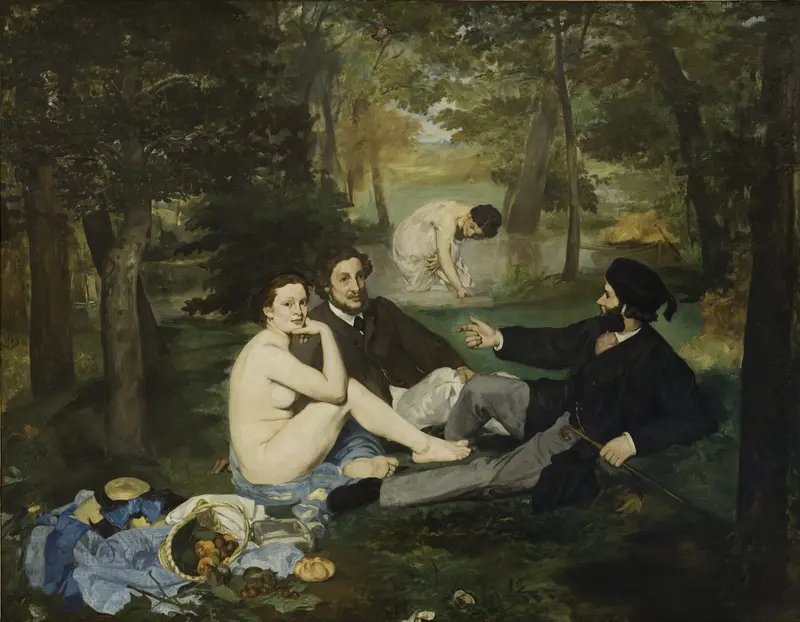
Luncheon on the Grass by Édouard Manet
Who is in it: Victorine Meurent, Eugène Manet and Ferdinand Leenhoff
1863 · Oil on canvas · 207 × 265 cm
Musée d'Orsay, Paris
The French state's record names all three: the nude is Victorine Meurent, Édouard Manet's favorite model of the 1860s, who first sat for him at about 18, and the two men are the artist's brother Eugène Manet and Ferdinand Leenhoff. Manet exhibited the painting as Le Bain (The Bath) and, the Musée d'Orsay says, jokingly called it “la partie carrée,” a foursome. The collector Étienne Moreau-Nélaton gave it to the French state in 1906. It is in the Musée d'Orsay in Paris.
Sources: Musée d'Orsay
No. 4
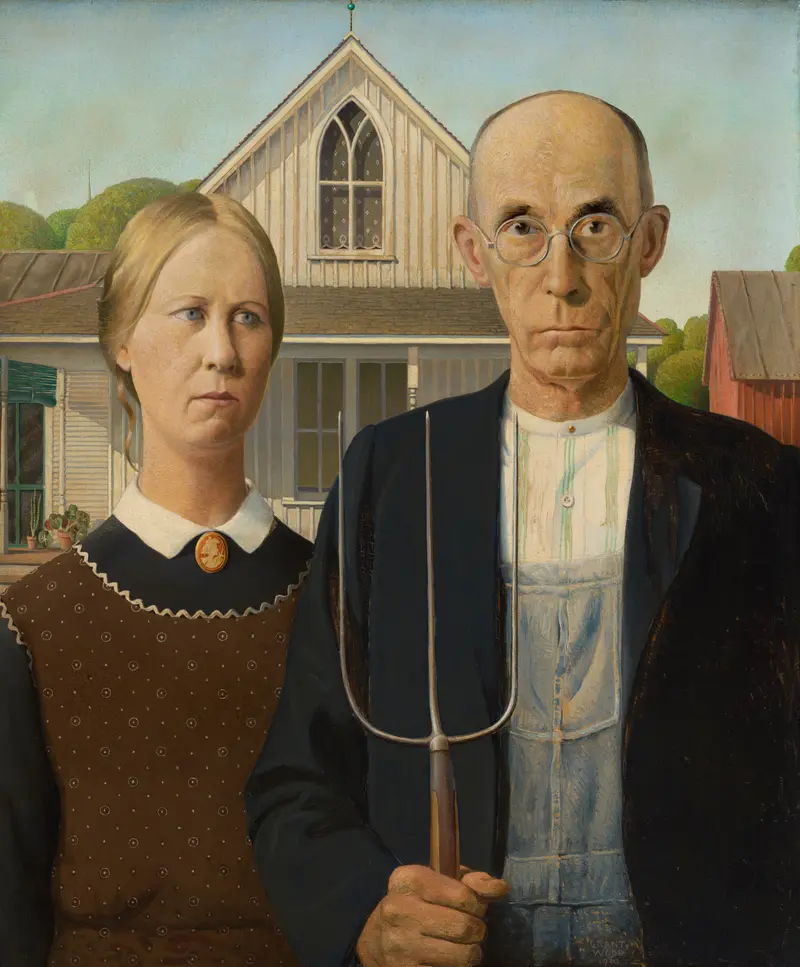
American Gothic by Grant Wood
Who is in it: Nan Wood Graham and Byron McKeeby
1930 · Oil on beaverboard · 78 × 65.3 cm
Art Institute of Chicago, Chicago
Grant Wood found the house first: a small farmhouse in Eldon, Iowa, with one oversized Gothic window, for which he imagined “American Gothic people” with long faces. To play the pair he dressed his sister Nan and his dentist, Byron McKeeby, like “tintypes from my old family album.” The Art Institute says Wood meant a positive picture of rural values, not satire. Shown there first in 1930, it won a $300 prize and made him famous. It is in the Art Institute of Chicago.
Sources: Art Institute of Chicago
No. 5Romanticism
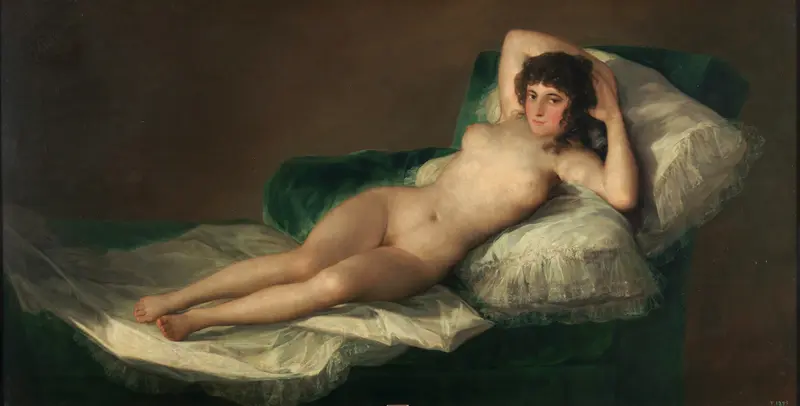
The Nude Maja by Francisco Goya
Who is in it: An unknown model
c. 1795–1800 · Oil on canvas · 98 × 191 cm
Museo del Prado, Madrid
No one knows who posed. The two names suggested are the Duchess of Alba and Pepita Tudó, the lover of the minister Manuel Godoy, but the Fundación Goya en Aragón calls the model a mystery. The painting is first recorded in 1800, hanging above a doorway in Godoy's palace. In 1815 the Inquisition summoned Francisco Goya to say whether the two Majas were his and who had commissioned them; his answers have not survived. It is in the Museo del Prado in Madrid.
Sources: Museo del Prado
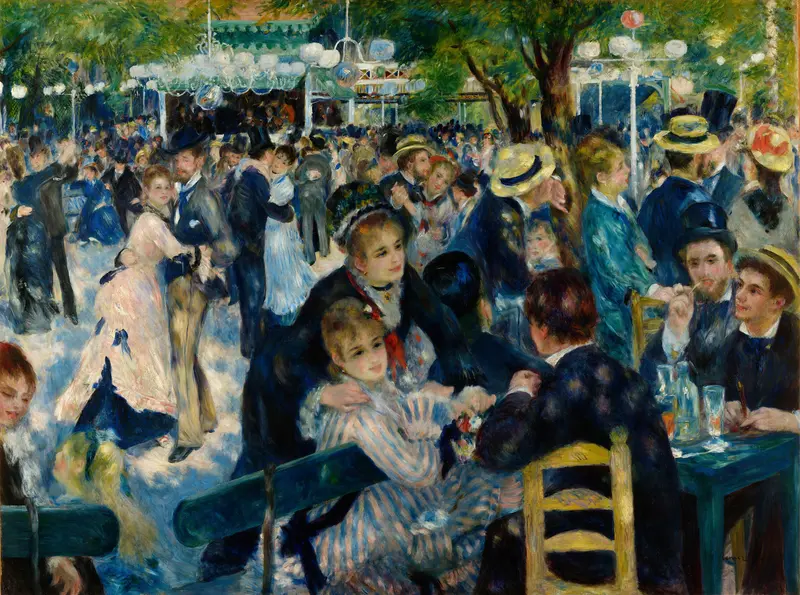
No. 6Impressionism
Bal du moulin de la Galette by Pierre-Auguste Renoir
Who is in it: Renoir's friends among the dancers
1876 · Oil on canvas · 131.5 × 176.5 cm
Musée d'Orsay, Paris
Renoir put his friends in the crowd: at the table on the right sit his friend and champion Georges Rivière and the painter Norbert Goeneutte. According to Rivière, Pierre-Auguste Renoir painted the whole canvas on the spot at the Montmartre dance garden, and every day his friends helped carry it there from his studio on the nearby Rue Cortot. Shown at the third Impressionist exhibition in 1877, it outraged most critics. It is in the Musée d'Orsay in Paris.
Sources: Musée d'Orsay
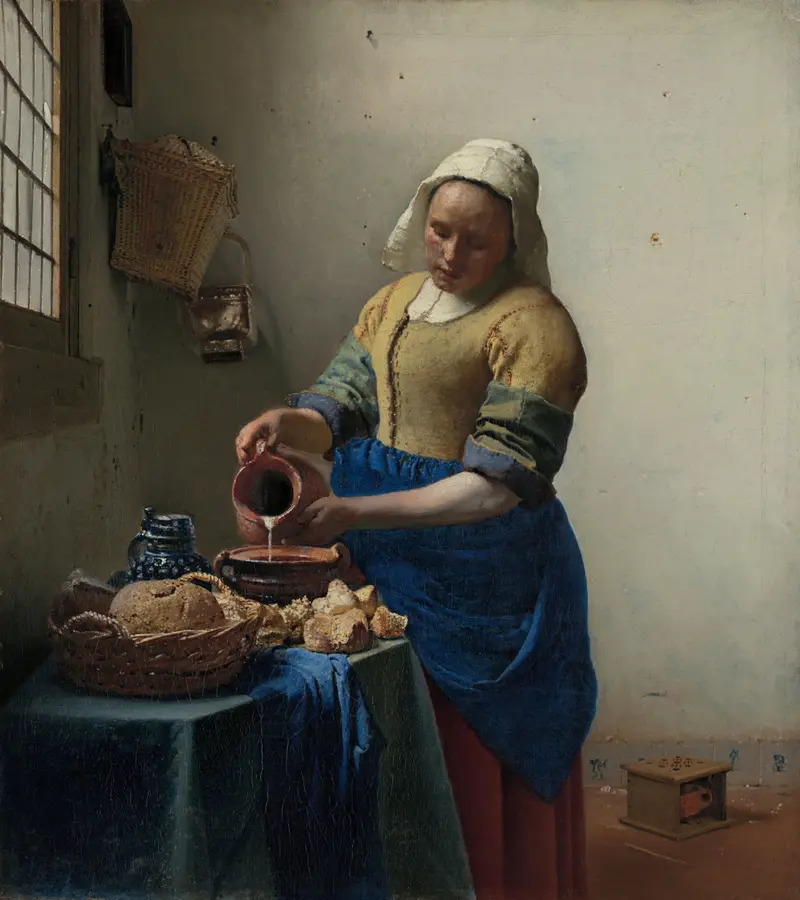
No. 7Dutch Golden Age
The Milkmaid by Johannes Vermeer
Who is in it: A maidservant
c. 1660 · Oil on canvas · 45.5 × 41 cm
Rijksmuseum, Amsterdam
No one knows who she was: the Rijksmuseum calls her simply a maidservant, absorbed in her work, and records no model. Johannes Vermeer made the room feel lived in with small details; look for the crack in a windowpane and the mold on the wall. The picture sold for 175 guilders at an Amsterdam auction in 1696, and in 1908 the museum bought it from the heirs of the Six family, with 38 other paintings, for 550,000 guilders. It is in the Rijksmuseum in Amsterdam.
Sources: Rijksmuseum
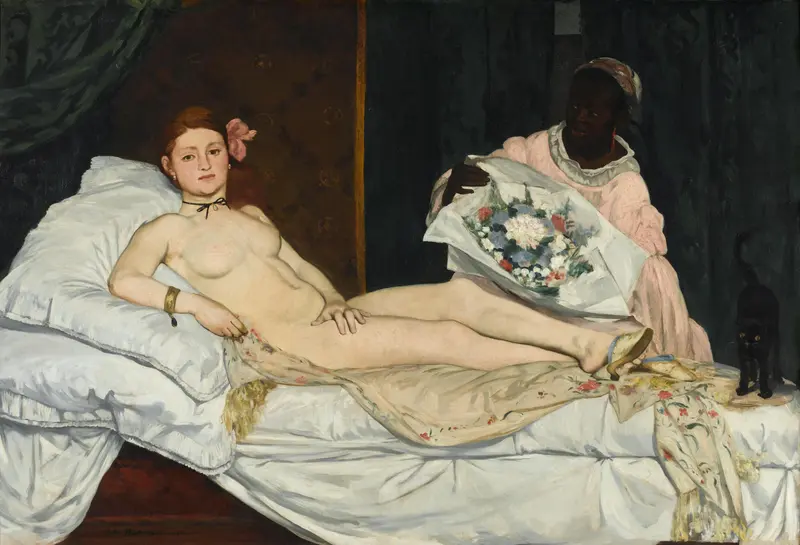
No. 8Impressionism
Olympia by Édouard Manet
Who is in it: Victorine Meurent and Laure
1863 · Oil on canvas · 130.5 × 191 cm
Musée d'Orsay, Paris
Two women posed for Olympia. The reclining nude is Victorine Meurent, who later became a painter herself and exhibited at the Salon from 1876 to 1904; the maid with the bouquet is Laure, a Black model whose address, 11 rue Vintimille, Manet noted in his notebook, and who posed for three of his paintings. Édouard Manet painted it in 1863, quoting Titian's Venus of Urbino and Goya's Nude Maja. It is in the Musée d'Orsay in Paris.
Sources: Musée d'Orsay
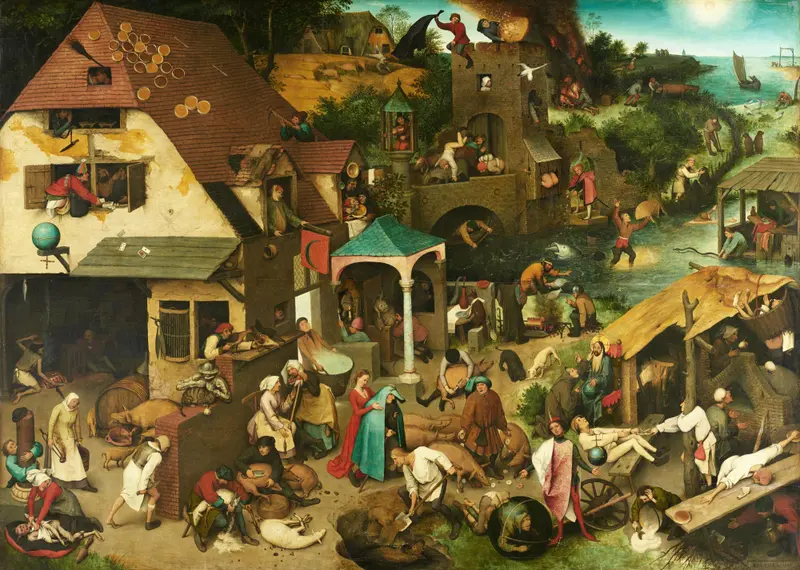
No. 9Northern Renaissance
Netherlandish Proverbs by Pieter Bruegel the Elder
Who is in it: Villagers acting out proverbs
1559 · Oil on oak panel · 117.2 × 163.8 cm
Gemäldegalerie, Berlin
At the center, a young woman in a red dress drapes a blue cloak over her old husband, a common sign, the museum notes, that she is deceiving him. Around them a whole village, peasants, nobles and clergy alike, acts out more than 100 sayings: a woman ties the devil to a pillow, a man hangs a bell on a cat, a monk ties a false beard on God. The Gemäldegalerie reads the figures as types of society rather than portraits. Pieter Bruegel the Elder painted it in 1559, and it is in the Gemäldegalerie in Berlin.
Sources: Gemäldegalerie

No. 10Post-Impressionism
The Night Café by Vincent van Gogh
Who is in it: Night customers and the landlord
1888 · Oil on canvas · 72.4 × 92.1 cm
Yale University Art Gallery, New Haven
Late at night in a café in Arles, a few customers slump over their tables while a man in white stands by the billiard table; Vincent van Gogh wrote that this was the landlord, watching from a corner of the “furnace.” The Café de la Gare was run by Joseph-Michel Ginoux and his wife, Marie, and Van Gogh said he painted it partly to pay himself back for the rent, sitting up three nights in a row. It is in the Yale University Art Gallery in New Haven.
Sources: Yale University Art Gallery
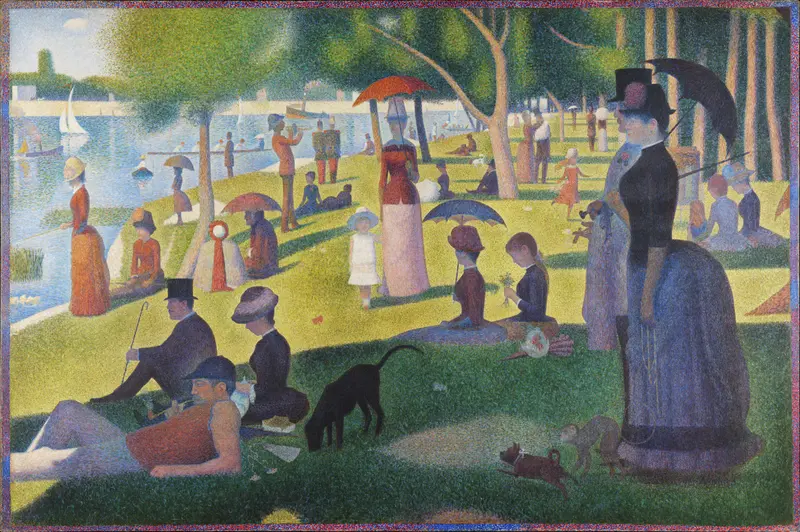
No. 11Post-Impressionism
A Sunday on La Grande Jatte — 1884 by Georges Seurat
Who is in it: Parisians on a Sunday
1884–1886 · Oil on canvas · 207.5 × 308.1 cm
Art Institute of Chicago, Chicago
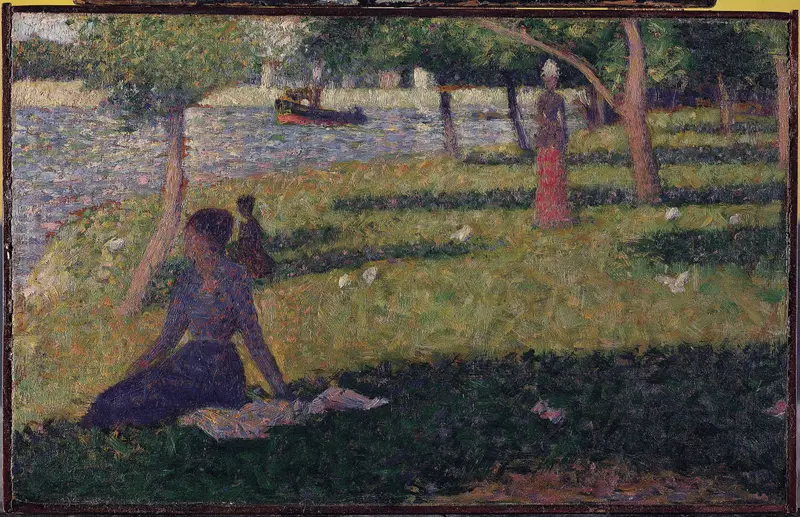
Parisians of every class stroll, sit, sail and fish on an island in the Seine; look for the monkey on a leash, one of the figures Georges Seurat added after he began, and a tiny man with a rolled newspaper in the far distance. Seurat “auditioned” the people he had observed in drawings and oil sketches, as a curator at the Art Institute puts it, and a century later the picture inspired Stephen Sondheim's musical Sunday in the Park with George. It is in the Art Institute of Chicago.
Sources: Art Institute of Chicago
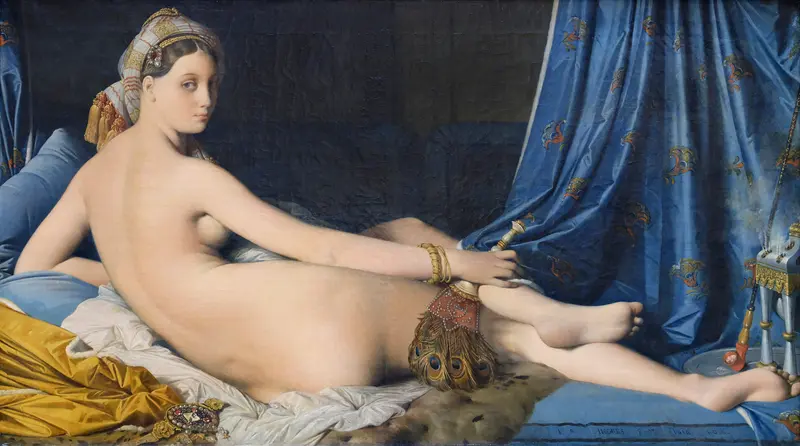
No. 12Romanticism
Grande Odalisque by Jean-Auguste-Dominique Ingres
Who is in it: An imaginary odalisque
1814 · Oil on canvas · 91 × 162 cm
Musée du Louvre, Paris
She is not a real woman but an imaginary slave of an Ottoman sultan, the Louvre says, holding a fan of peacock feathers, with a turban knotted at the back of her head. Jean-Auguste-Dominique Ingres painted her in Rome in 1814 for Caroline Murat, Queen of Naples, and showed her at the Salon of 1819. Ingres cared most for the purity of the line, the museum says, freeing himself from anatomical truth: look at the length of her back. It is in the Musée du Louvre in Paris.
Sources: Musée du Louvre

No. 13Realism
A Burial at Ornans by Gustave Courbet
Who is in it: The people of Ornans
1849–1850 · Oil on canvas · 315 × 668 cm
Musée d'Orsay, Paris
About 46 people of Ornans, Gustave Courbet's hometown, gather at an open grave, and nearly all of them have been identified: his grandfather Oudot at the far left, his own sisters among the weeping women, the local lawyer Hippolyte Proudhon in a black coat at the center. Whose funeral it is remains unknown. Courbet began it in 1849, and at the Salon of 1850–51 many decried the “ugliness” of its ordinary people, painted on the scale of a history picture. It is in the Musée d'Orsay in Paris.
Sources: Musée d'Orsay
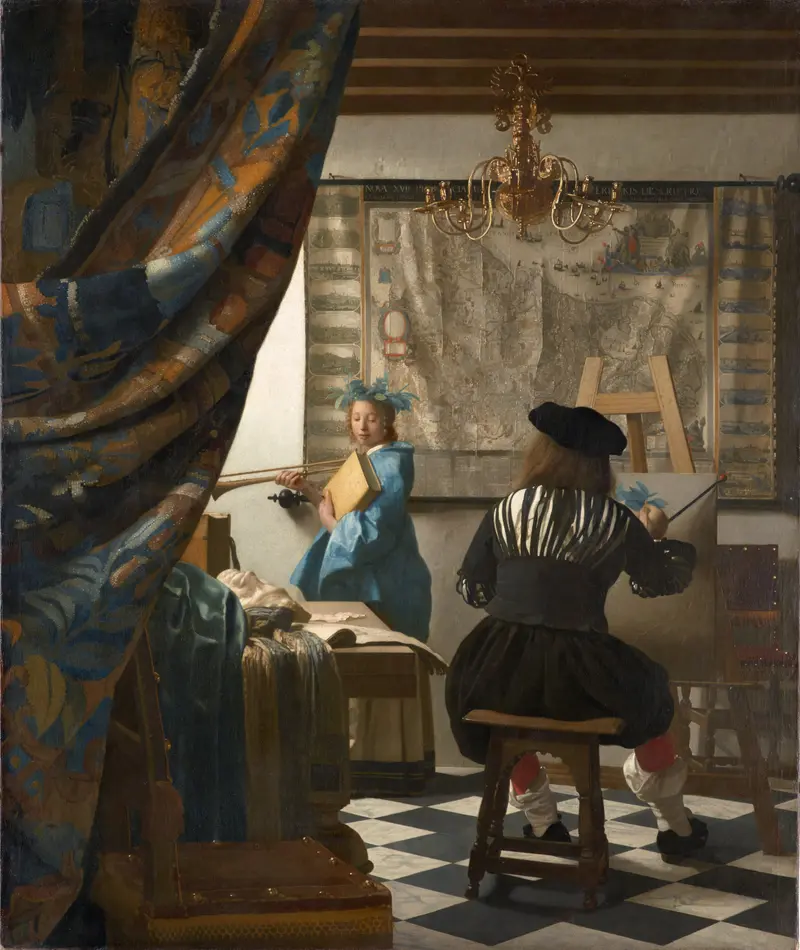
No. 14Dutch Golden Age
The Art of Painting by Johannes Vermeer
Who is in it: A painter and a model posing as Clio
c. 1666–1668 · Oil on canvas · 120 × 100 cm
Kunsthistorisches Museum, Vienna
A painter, seen from behind in a slashed black doublet, works at his easel while a young woman poses as Clio, the Muse of history, with a trumpet, a book and a laurel wreath. It is tempting to see Johannes Vermeer himself at the easel, but the Kunsthistorisches Museum says nothing indicates it. After his death his widow handed the picture to her mother to keep it from his creditors, and in 1940 Adolf Hitler bought it for his planned museum in Linz. It is in the Kunsthistorisches Museum in Vienna.
Sources: Kunsthistorisches Museum
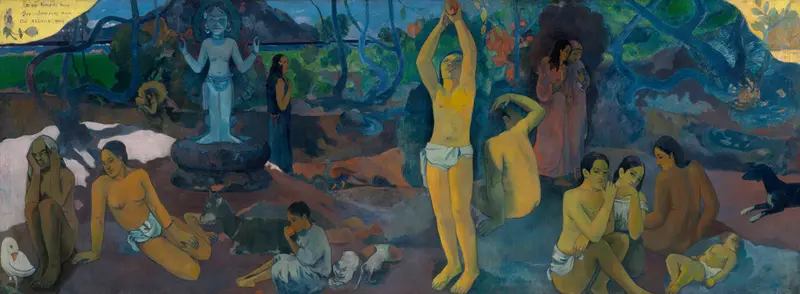
No. 15Post-Impressionism
Where Do We Come From? What Are We? Where Are We Going? by Paul Gauguin
Who is in it: Tahitians from birth to old age
1897–1898 · Oil on canvas · 139.1 × 374.6 cm
Museum of Fine Arts, Boston, Boston
Read from right to left, as Paul Gauguin explained, the picture runs from a sleeping baby to an old woman near death, with a blue idol and figures of every age in a Tahitian landscape between them. It is the largest painting he ever attempted. He told a friend in February 1898 that he had decided to die but first wished to paint this canvas, working day and night for a month; afterward he went into the mountains with arsenic, and survived. It is in the Museum of Fine Arts in Boston.
Sources: Museum of Fine Arts, Boston
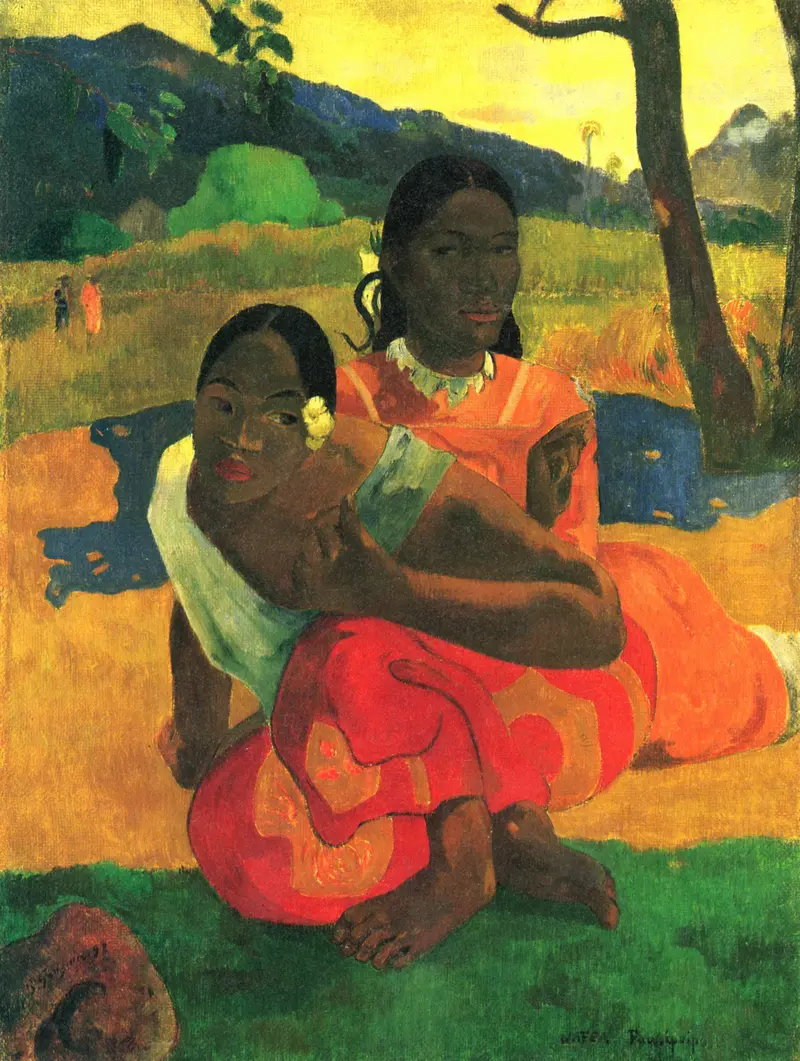
No. 16Post-Impressionism
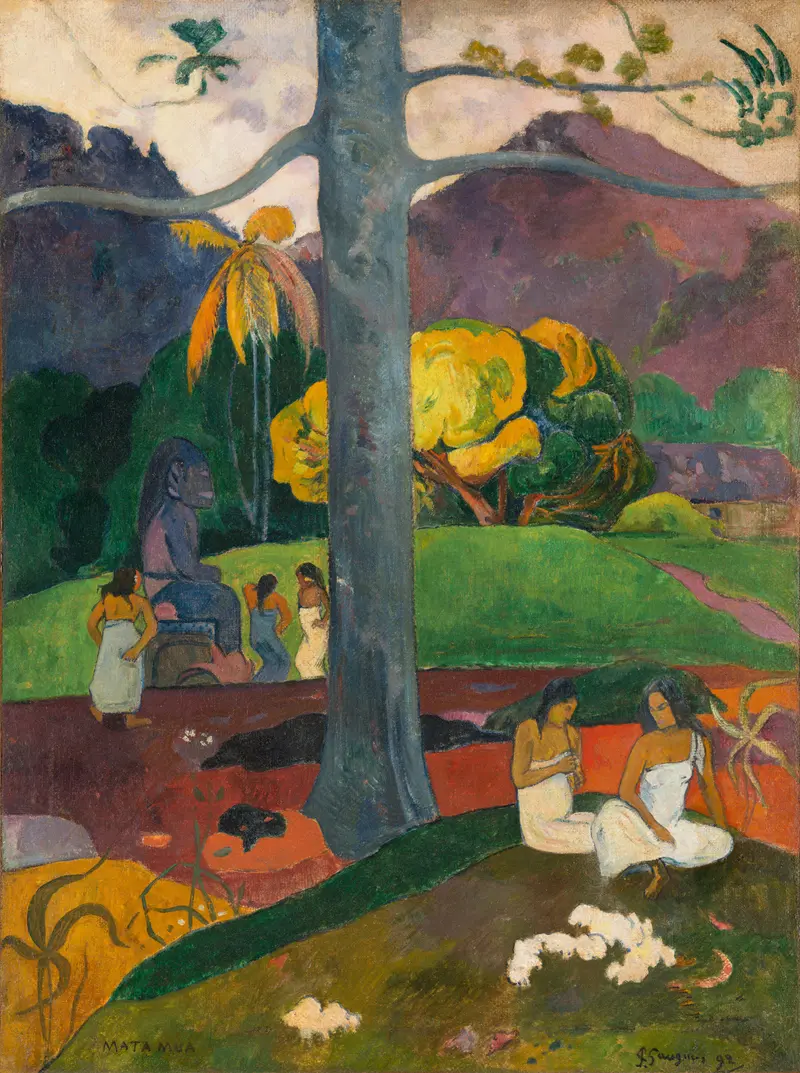
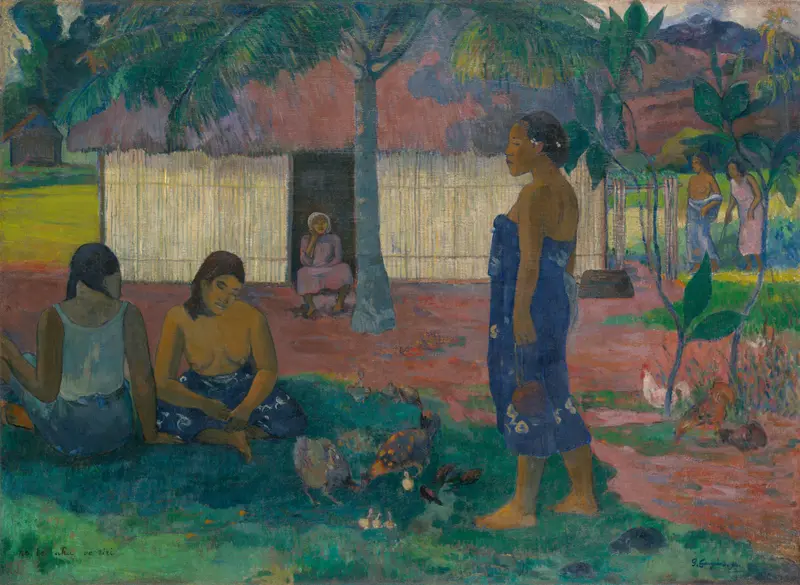
When Will You Marry? by Paul Gauguin
Who is in it: Two Tahitian women
1892 · Oil on canvas · 101 × 77 cm
Private collection
Two Tahitian women sit on the grass, one in front with a white flower behind her ear, the other behind her in a high-necked pink dress. Paul Gauguin painted it in 1892, during his first stay in Tahiti. For almost 50 years it hung on loan at the Kunstmuseum Basel, until the Staechelin family trust sold it privately in 2015 for a reported price of nearly $300 million, then the highest ever reported for an artwork. It is in a private collection.
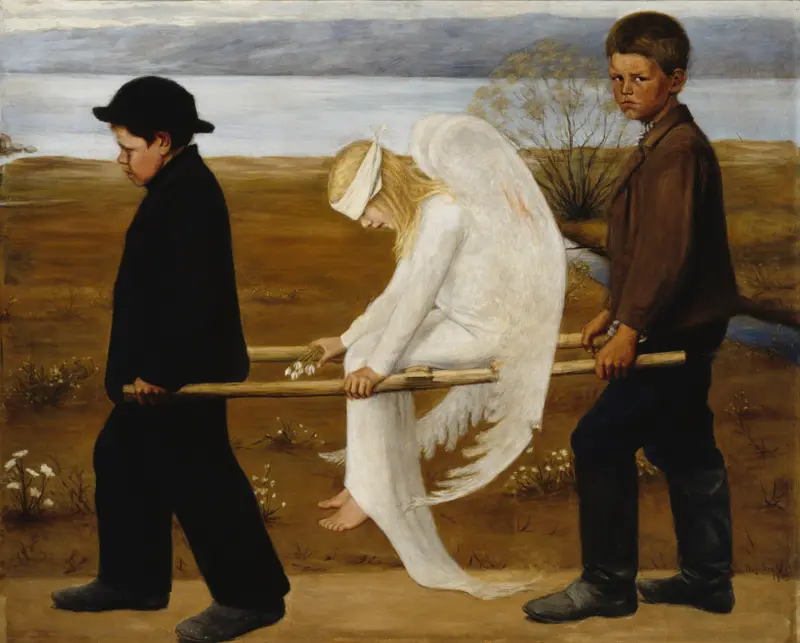
No. 17Symbolism
The Wounded Angel by Hugo Simberg
Who is in it: Two boys and a wounded angel
1903 · Oil on canvas · 127 × 154 cm
Ateneum, Helsinki
Two boys carry a wounded angel on a stretcher, her eyes bandaged and one wing stained with blood, along a path by the water in Helsinki. Hugo Simberg showed it with only a long dash where the title should be, and the Ateneum says there are as many readings as viewers, probably as he intended. He painted it after recovering from a serious illness, and the scene can be placed in a park near the hospital where he was treated. In 2006 it won the Ateneum's public vote for Finland's national painting. It is in the Ateneum in Helsinki.
Sources: Ateneum
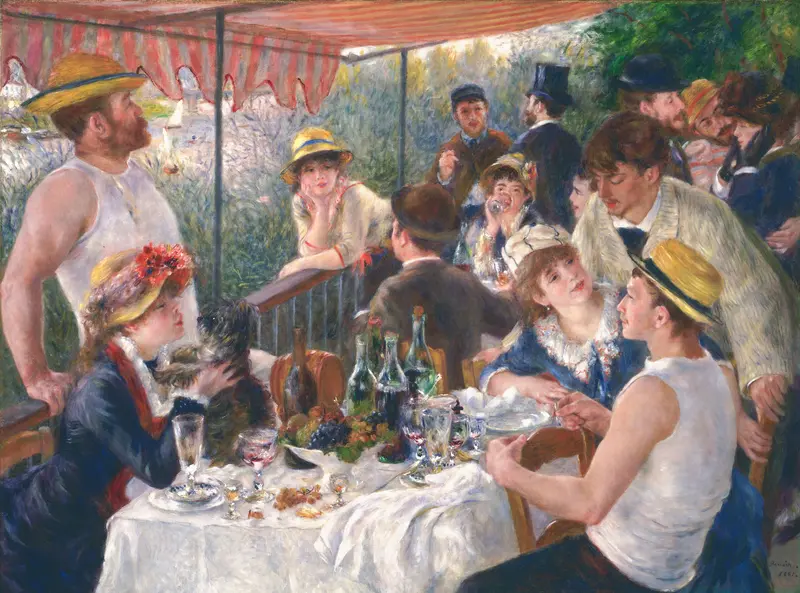
No. 18Impressionism
Luncheon of the Boating Party by Pierre-Auguste Renoir
Who is in it: Renoir's friends, Aline Charigot and Gustave Caillebotte among them
1880–1881 · Oil on canvas · 130.2 × 175.6 cm
The Phillips Collection, Washington, DC
Most of the people at this lunch on a restaurant balcony by the Seine have been identified, the Phillips Collection says: Renoir's future wife Aline Charigot plays with her terrier at the left, the painter Gustave Caillebotte sits backward on his chair at the right, and the actress Ellen Andrée drinks from a glass. Pierre-Auguste Renoir painted it in 1880–81 straight onto the canvas, with no known drawings. Duncan Phillips bought it in 1923, sure it was “one of the greatest paintings in the world.” It is in the Phillips Collection in Washington, DC.
Sources: The Phillips Collection
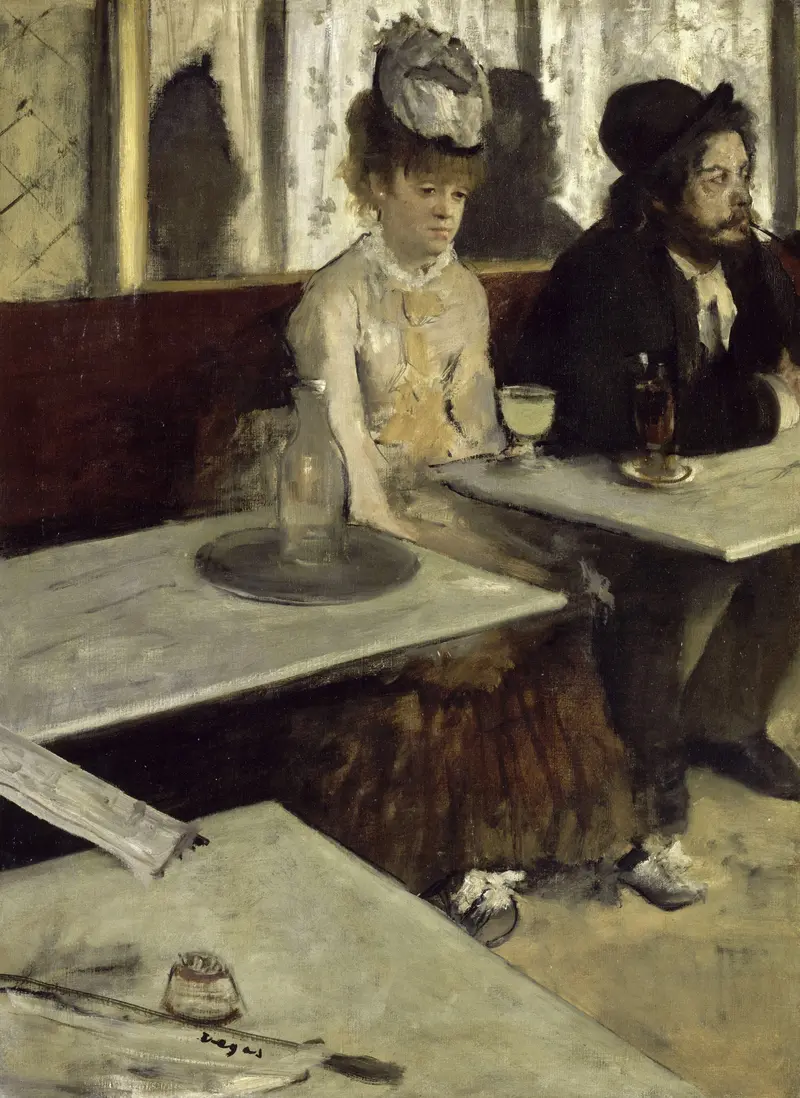
No. 19Impressionism
L'Absinthe by Edgar Degas
Who is in it: Ellen Andrée and Marcellin Desboutin
1875–1876 · Oil on canvas · 92 × 68.5 cm
Musée d'Orsay, Paris
The actress Ellen Andrée, who also appears in Renoir's Luncheon of the Boating Party, and the engraver Marcellin Desboutin posed for Edgar Degas as a woman with a glass of absinthe and a man with a pipe in a Paris café, La Nouvelle Athènes. He actually painted it in his studio. The picture damaged both models' reputations, and Degas had to state publicly that they were not alcoholics; shown in London in 1893, it was condemned as immoral and vulgar. It is in the Musée d'Orsay in Paris.
Sources: Musée d'Orsay
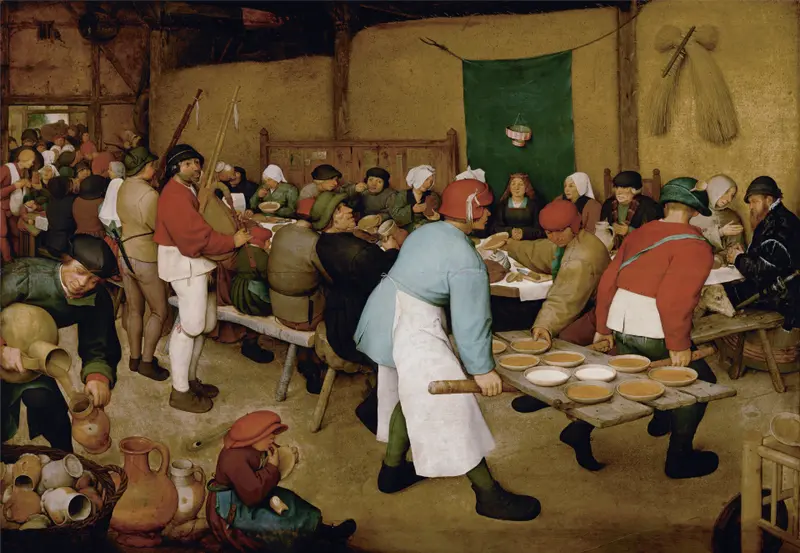
No. 20Northern Renaissance
The Peasant Wedding by Pieter Bruegel the Elder
Who is in it: A bride and her wedding guests
1568 · Oil on oak panel · 113 × 164 cm
Kunsthistorisches Museum, Vienna
The bride sits before the green hanging with a paper crown above her head; the groom is nowhere to be seen, since by Flemish custom he did not attend the feast. Among the guests the Kunsthistorisches Museum points out a lawyer in a mortarboard, a Franciscan monk and, at the far right, the lord of the manor with his dog, while two men carry in porridge on a door taken off its hinges. Pieter Bruegel the Elder painted it in 1568. It is in the Kunsthistorisches Museum in Vienna.
Sources: Kunsthistorisches Museum
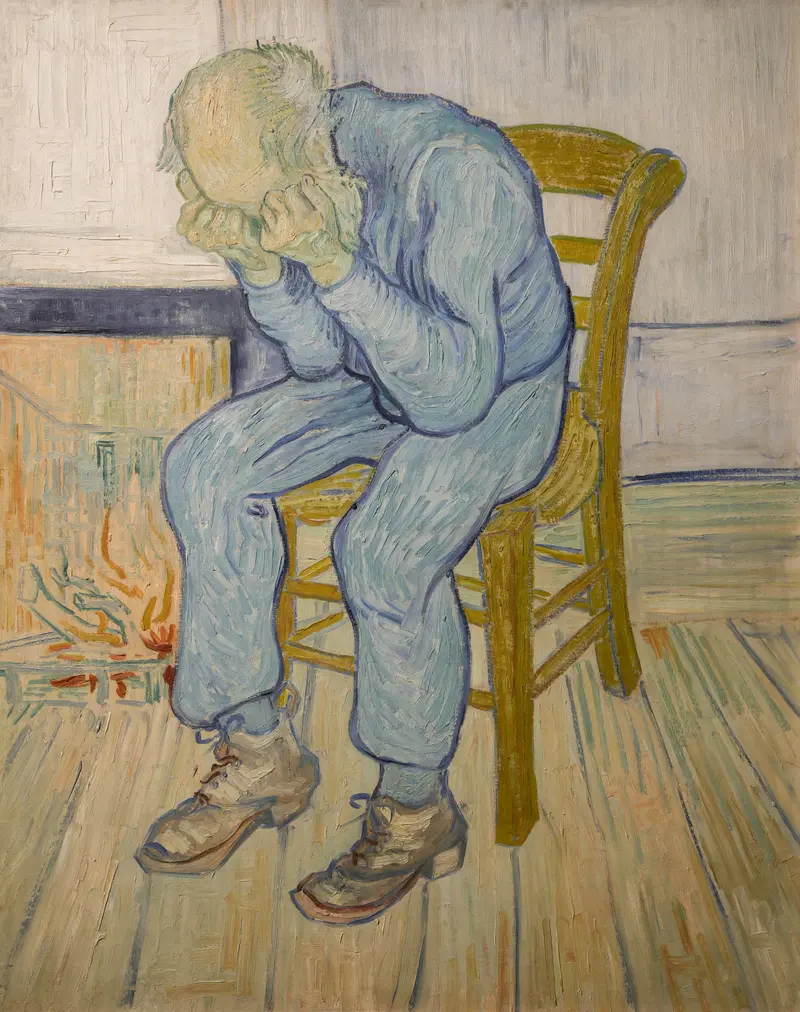
No. 21Post-Impressionism
At Eternity's Gate by Vincent van Gogh
Who is in it: An old man, probably a patient at Saint-Rémy
1890 · Oil on canvas · 81.8 × 65.5 cm
Kröller-Müller Museum, Otterlo
An old man sits by the fire with his face buried in his fists. Vincent van Gogh painted him in May 1890 at the asylum in Saint-Rémy, reworking a drawing he had made in The Hague in 1882 of Adrianus Zuyderland, an elderly almshouse resident he drew at least 40 times; the Kröller-Müller Museum thinks a patient of the asylum probably posed this time. Van Gogh had called his 1882 lithograph of the subject At Eternity's Gate. It is in the Kröller-Müller Museum in Otterlo.
Sources: Kröller-Müller Museum
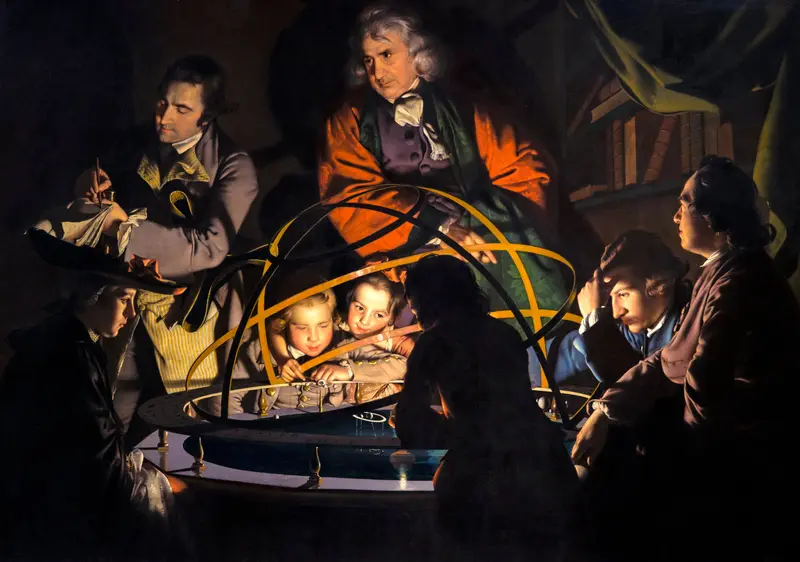
No. 22
A Philosopher Lecturing on the Orrery by Joseph Wright of Derby
Who is in it: Wright's friends, by tradition
1764–1766 · Oil on canvas · 147.3 × 203.2 cm
Derby Museum and Art Gallery, Derby
A philosopher in a red gown explains the solar system with an orrery, a clockwork model, while a lamp standing in for the sun lights up the faces around him. By tradition the man taking notes is Joseph Wright's friend Peter Perez Burdett, and the boy with his back to us is Lawrence Shirley, nephew of Earl Ferrers, who bought the picture for £210. Wright showed it in 1766, when science lectures were popular entertainment. It belongs to the Derby Museum and Art Gallery.
Sources: Derby Museum and Art Gallery
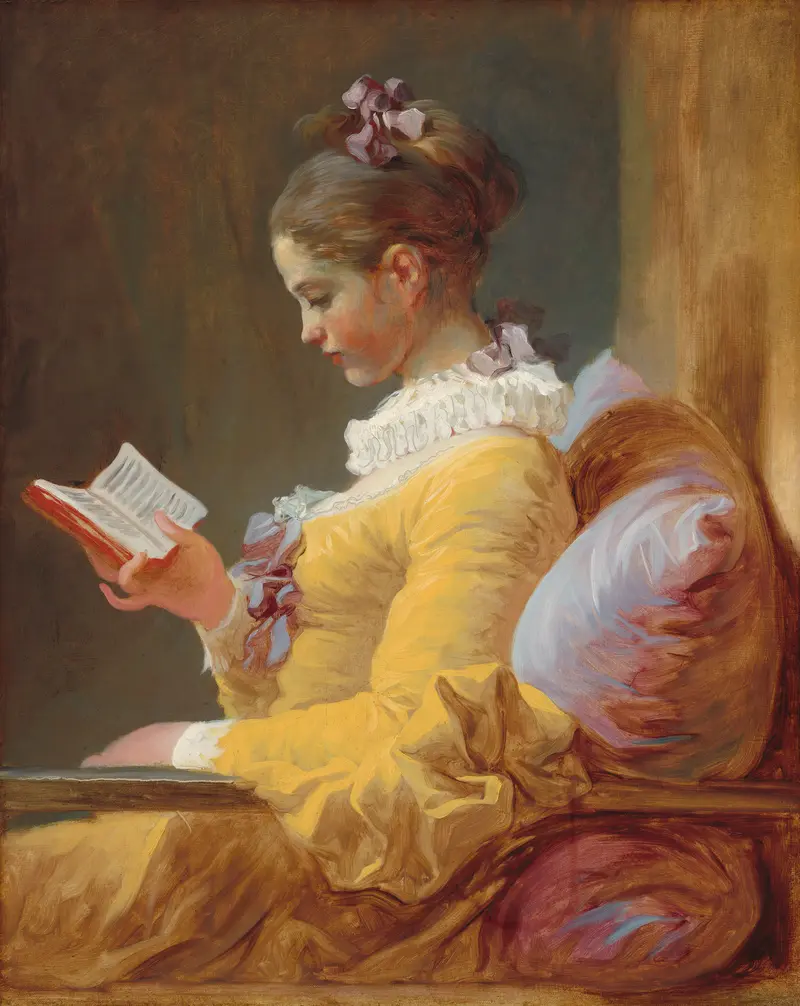
No. 23Rococo
A Young Girl Reading by Jean-Honoré Fragonard
Who is in it: An unidentified young woman
c. 1769 · Oil on canvas · 81.1 × 64.8 cm
National Gallery of Art, Washington, DC
A young woman in a yellow dress reads a small book, leaning against a cushion. She is one of Jean-Honoré Fragonard's fantasy figures of about 1769, quick half-length pictures said to have taken him about an hour each, and X-rays show she first looked straight out at us. A sheet of Fragonard's sketches discovered in 2012 names the sitters of these pictures, but not this one, so she remains anonymous. It is in the National Gallery of Art in Washington, DC.
Sources: National Gallery of Art
No. 24Romanticism
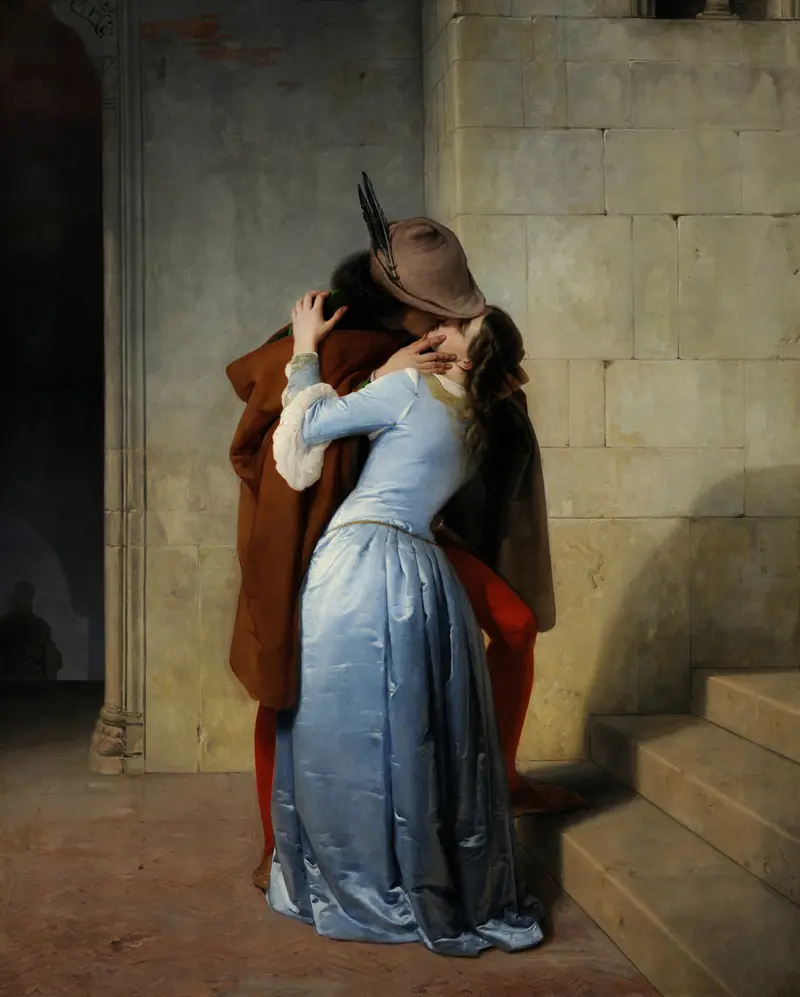
The Kiss by Francesco Hayez
Who is in it: A young couple in medieval costume
1859 · Oil on canvas · 112 × 88 cm
Pinacoteca di Brera, Milan
A young couple in medieval costume kiss on a stone staircase; the man's cloak and his foot on the step suggest he is about to leave. Francesco Hayez showed it in Milan in 1859, months after Victor Emmanuel II and Napoleon III entered the city, and the Brera says viewers saw the flags of Italy and France in its colors; with his hat marking him as a patriot, it was soon called The Volunteer's Kiss, a farewell before war. It is in the Pinacoteca di Brera in Milan.
Sources: Pinacoteca di Brera
No. 25Folk Art
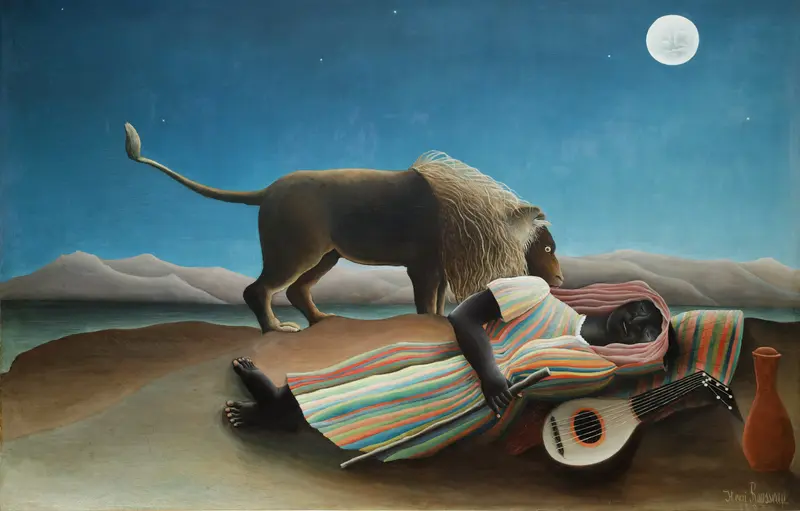
The Sleeping Gypsy by Henri Rousseau
Who is in it: A wandering mandolin player
1897 · Oil on canvas · 129.5 × 200.7 cm
Museum of Modern Art, New York
A woman in a striped robe sleeps in the desert under the moon while a lion sniffs at her and moves on. Henri Rousseau described her himself as a wandering mandolin player, worn out, with her water jar beside her, whom the lion does not harm. A self-taught painter who worked as a toll collector in Paris, Rousseau showed it at the Salon des Indépendants in 1897, and his style later inspired Picasso and Kandinsky. It is in the Museum of Modern Art in New York.
Sources: Museum of Modern Art
Want to see more? Browse every figurative painting in the collection.
Browse all 6,042 figurative paintingsFamous paintings of women
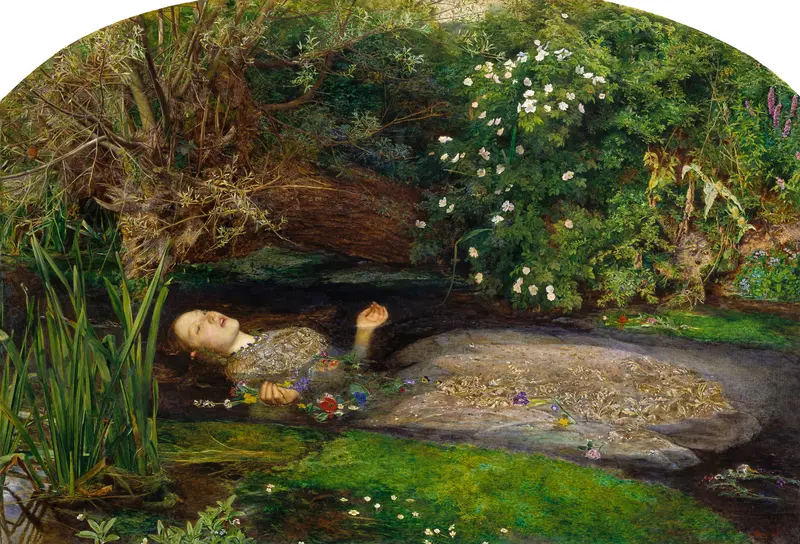
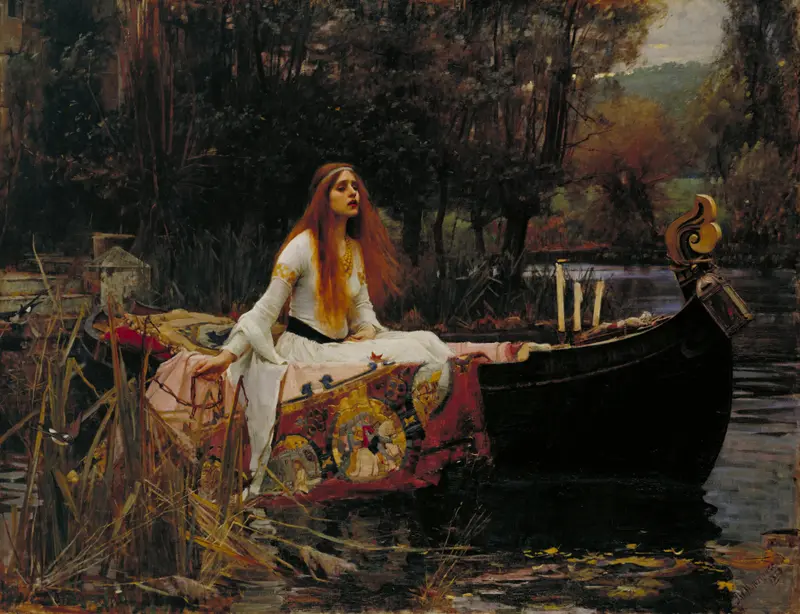
Six more famous paintings of women, from Millais's Ophelia to Monet's Woman with a Parasol.
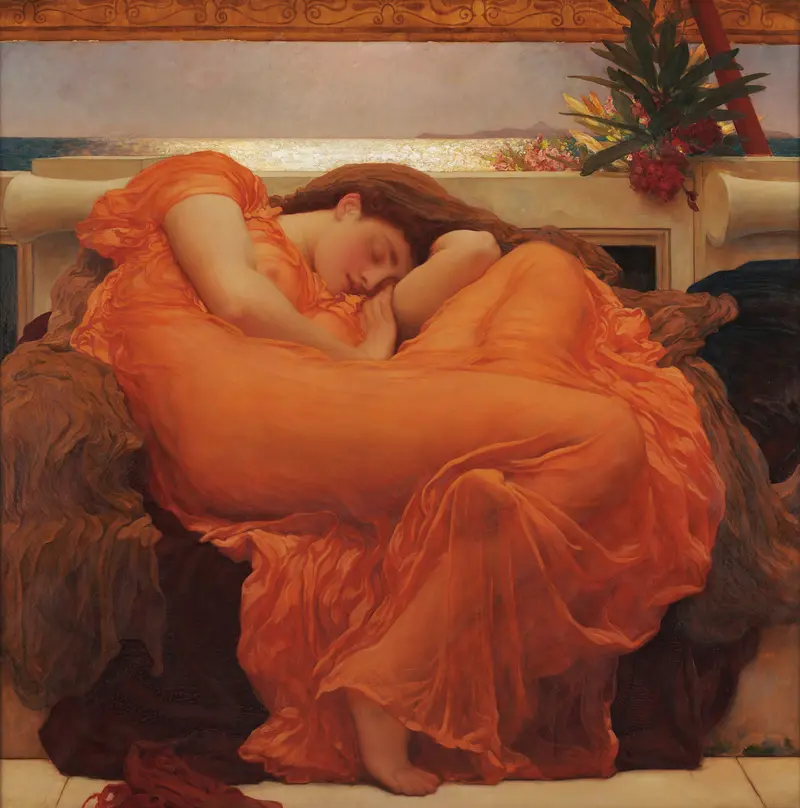
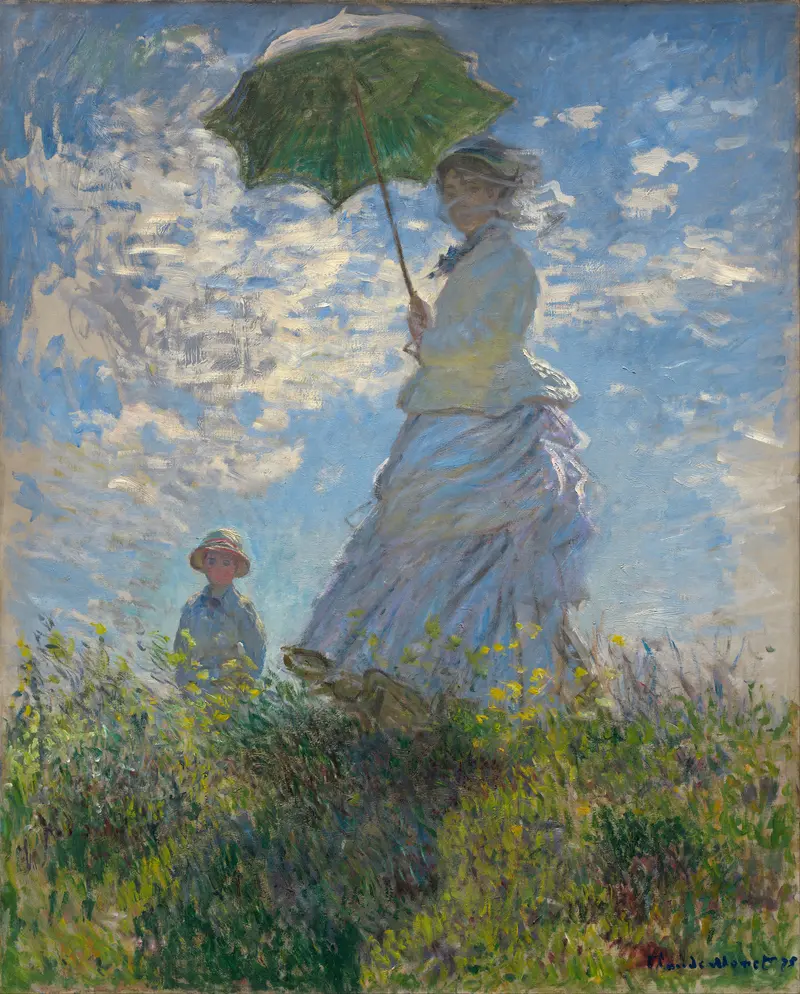
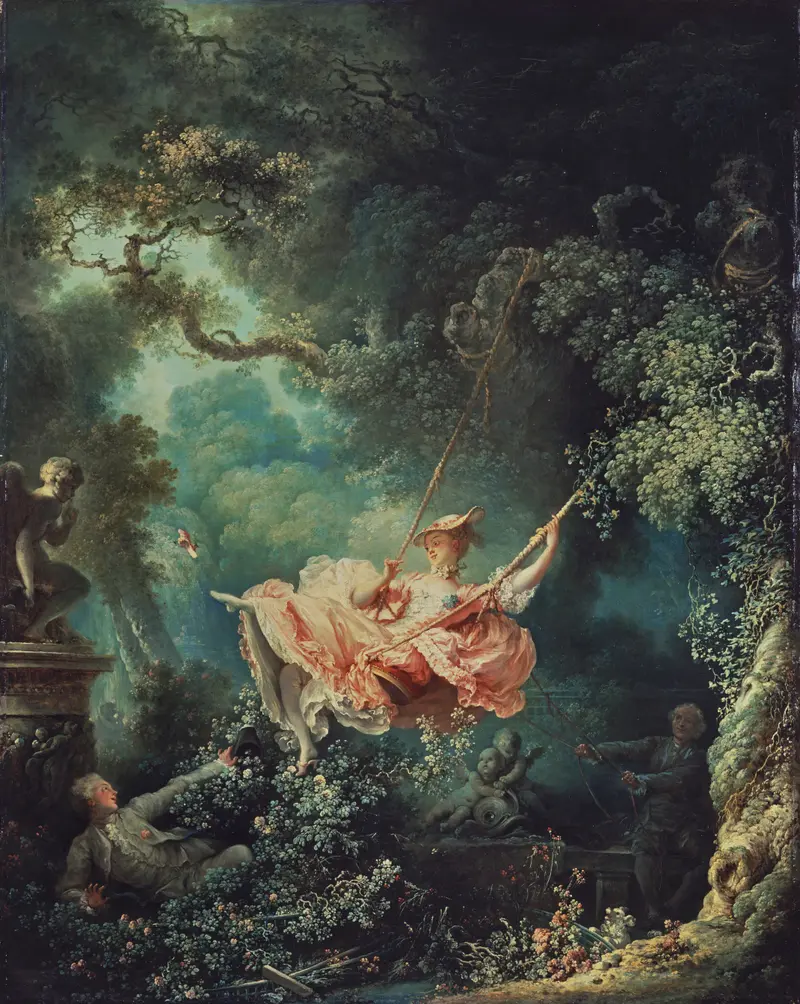
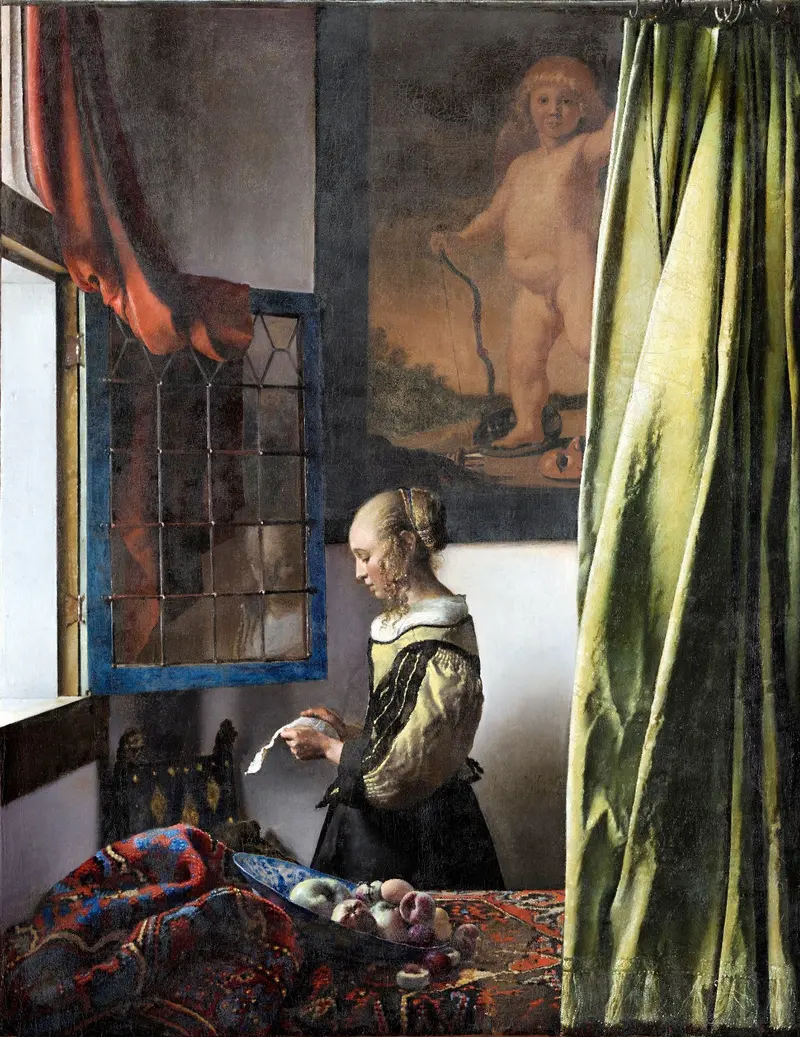
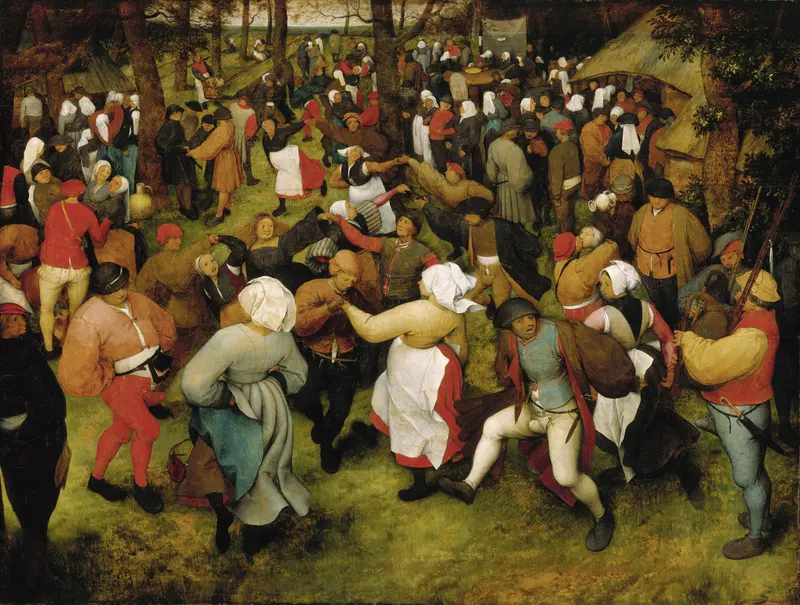
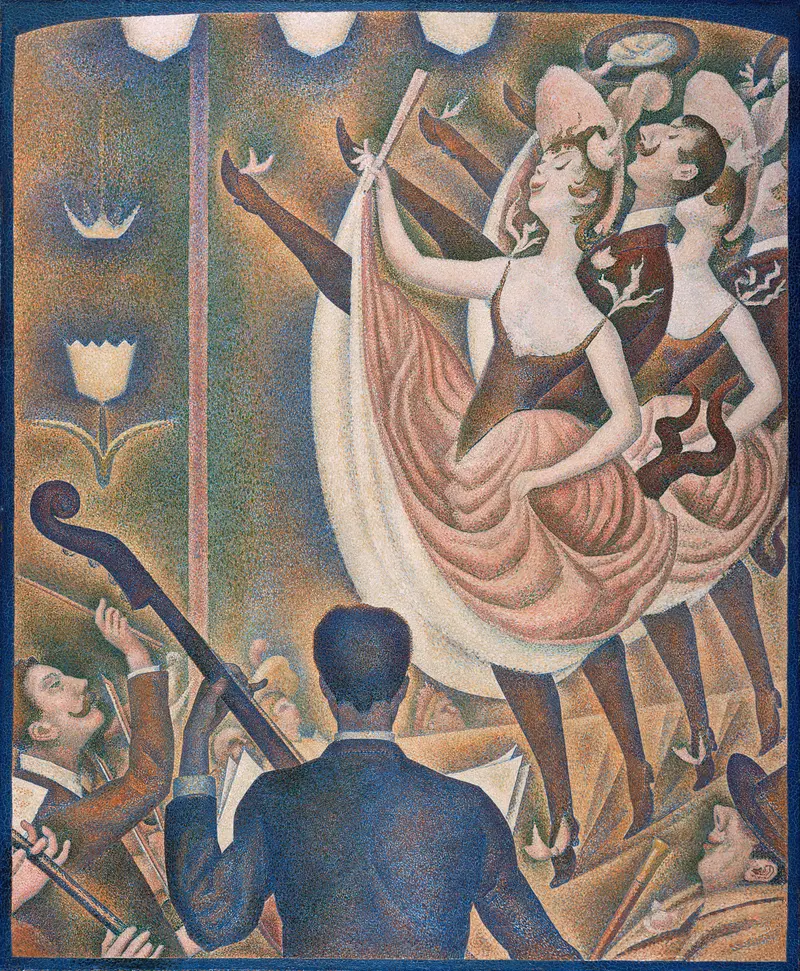
Famous dancer paintings
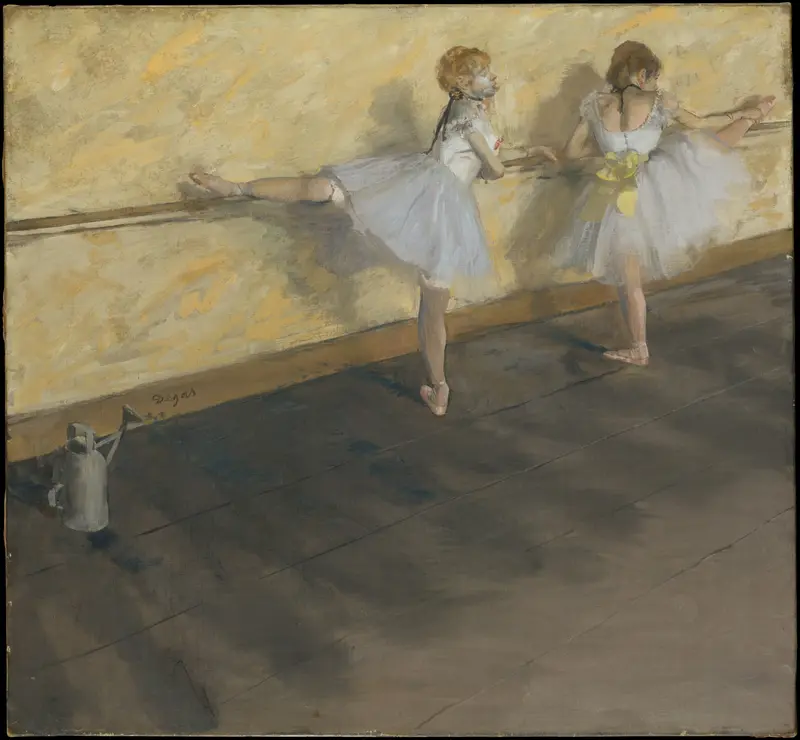
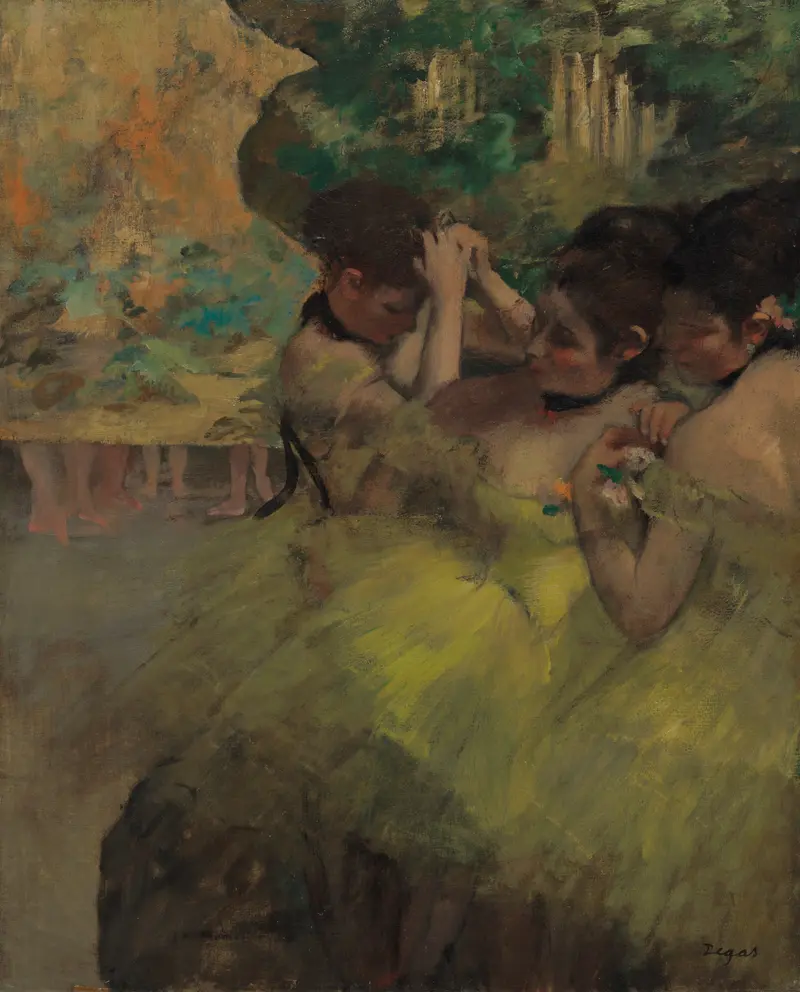
Six famous paintings of dancers, from Degas's ballet class to Toulouse-Lautrec's Moulin Rouge.
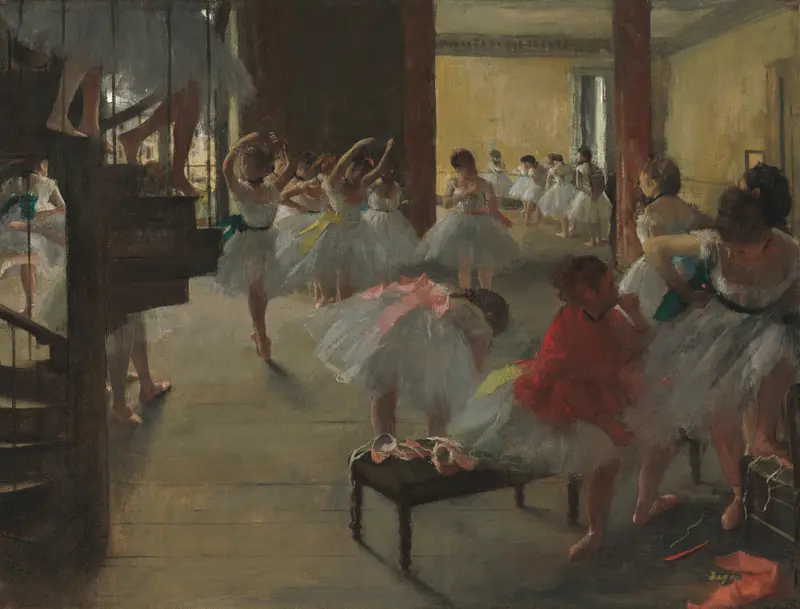
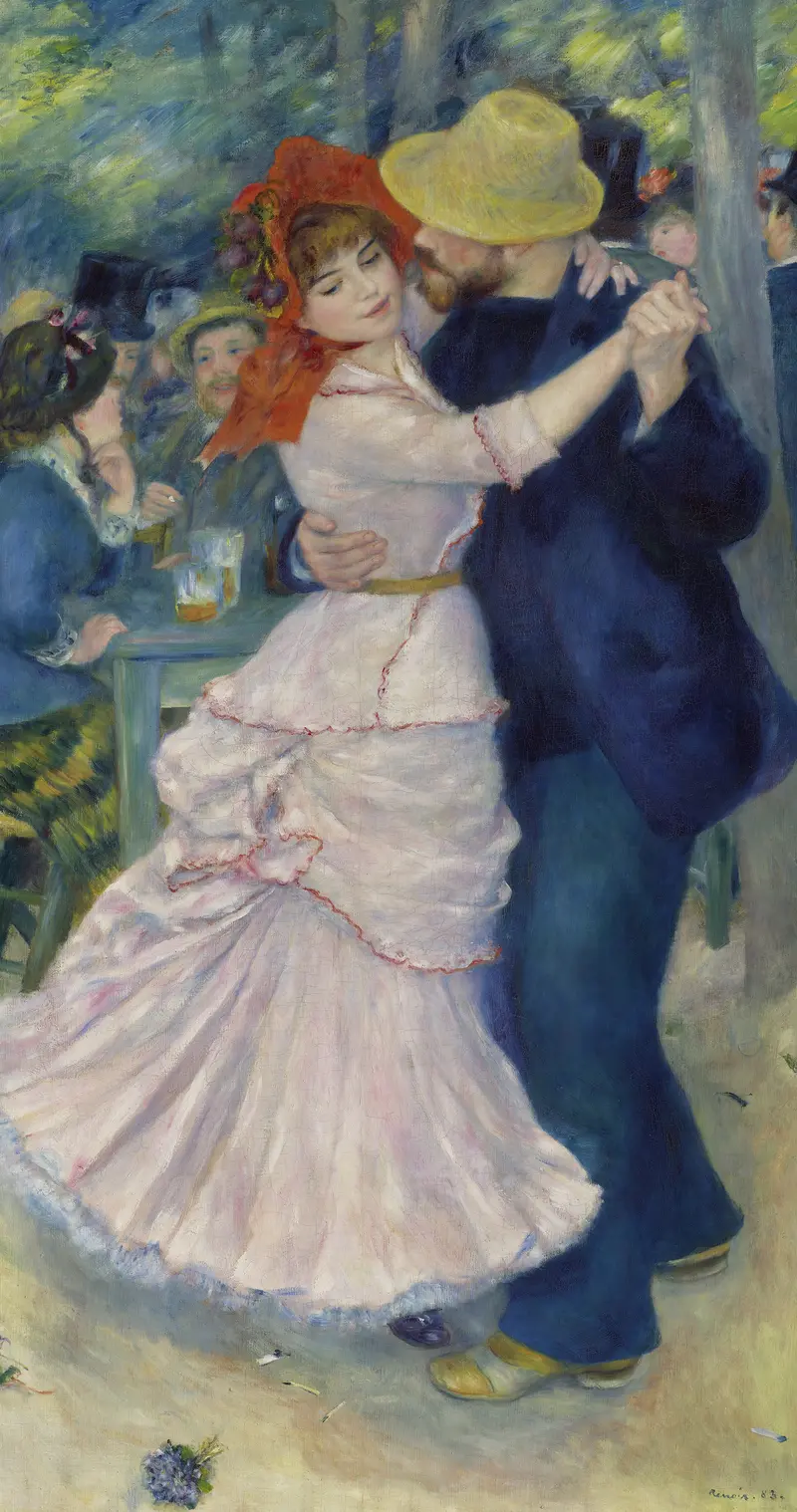
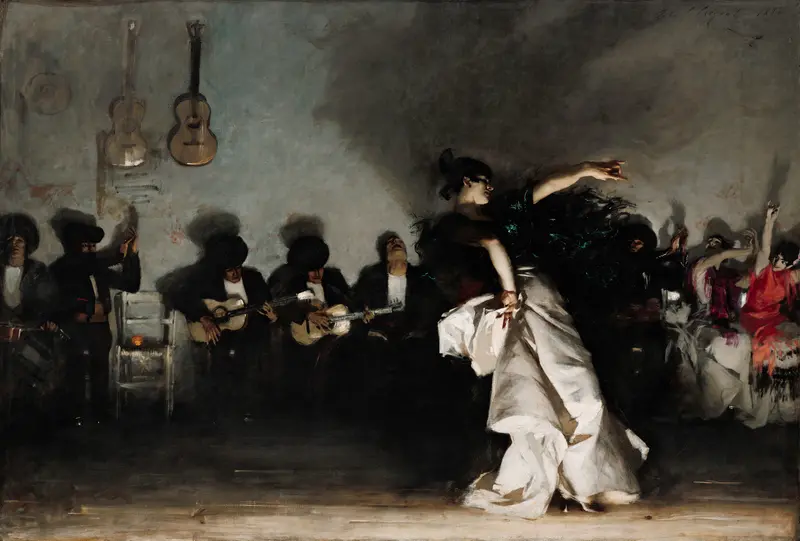
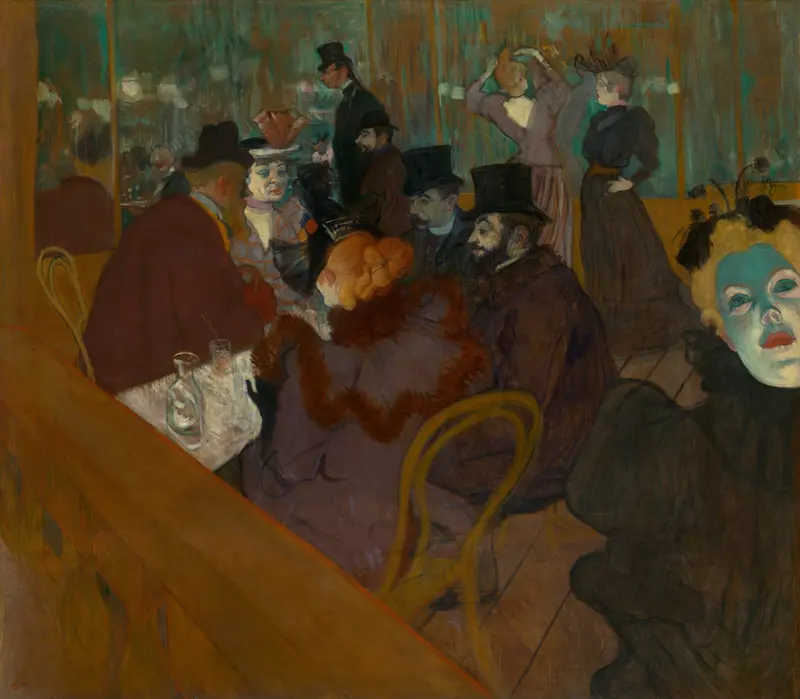
Famous painters of people and everyday life
Famous painters of people and everyday life, from Bruegel and Vermeer to Manet, Renoir and Degas. Each link opens all their paintings.
- Johannes VermeerVermeer made a simple everyday task, a maidservant pouring milk, the subject of a painting in which she stands like a statue in bright light.
- Pieter Bruegel the ElderIn The Peasant Wedding, Bruegel gave a familiar peasant subject unusual compositional density and viewed it from what the museum calls a benevolent distance.
- Édouard ManetManet sketched at the Folies-Bergère but painted A Bar at the Folies-Bergère entirely in his studio, where a barmaid named Suzon posed.
- Pierre-Auguste RenoirFor Luncheon of the Boating Party, Renoir used friends as models, including the painter Gustave Caillebotte and Aline Charigot, Renoir's future wife.
- Edgar DegasDegas painted L'Absinthe in his studio, not the café, and asked people he knew, an actress and an engraver, to pose.
- Paul GauguinGauguin's Tahitian Women on the Beach (1891) shows two women, one in Tahitian dress and one in a missionary robe.
List of famous paintings of people and their artists
The 25 most famous paintings of people: who painted them, who is in them, when, and where each one is today.
Show the list of 25 figurative paintingsHide the list
| # | Painting | Who is in it | Painted by | Year | Medium | Size | Located in | City |
|---|---|---|---|---|---|---|---|---|
| 1 | The Scream | A figure on a bridge and two friends | Edvard Munch | 1893 | Tempera and crayon on cardboard | 91 × 73.5 cm (35.8 × 28.9 in) | National Museum | Oslo |
| 2 | The Kiss | Two lovers, perhaps Klimt and Emilie Flöge | Gustav Klimt | 1908–1909 | Oil and gold leaf on canvas | 180 × 180 cm (70.9 × 70.9 in) | Belvedere | Vienna |
| 3 | Luncheon on the Grass | Victorine Meurent, Eugène Manet and Ferdinand Leenhoff | Édouard Manet | 1863 | Oil on canvas | 207 × 265 cm (81.5 × 104.3 in) | Musée d'Orsay | Paris |
| 4 | American Gothic | Nan Wood Graham and Byron McKeeby | Grant Wood | 1930 | Oil on beaverboard | 78 × 65.3 cm (30.7 × 25.7 in) | Art Institute of Chicago | Chicago |
| 5 | The Nude Maja | An unknown model | Francisco Goya | c. 1795–1800 | Oil on canvas | 98 × 191 cm (38.6 × 75.2 in) | Museo del Prado | Madrid |
| 6 | Bal du moulin de la Galette | Renoir's friends among the dancers | Pierre-Auguste Renoir | 1876 | Oil on canvas | 131.5 × 176.5 cm (51.8 × 69.5 in) | Musée d'Orsay | Paris |
| 7 | The Milkmaid | A maidservant | Johannes Vermeer | c. 1660 | Oil on canvas | 45.5 × 41 cm (17.9 × 16.1 in) | Rijksmuseum | Amsterdam |
| 8 | Olympia | Victorine Meurent and Laure | Édouard Manet | 1863 | Oil on canvas | 130.5 × 191 cm (51.4 × 75.2 in) | Musée d'Orsay | Paris |
| 9 | Netherlandish Proverbs | Villagers acting out proverbs | Pieter Bruegel the Elder | 1559 | Oil on oak panel | 117.2 × 163.8 cm (46.1 × 64.5 in) | Gemäldegalerie | Berlin |
| 10 | The Night Café | Night customers and the landlord | Vincent van Gogh | 1888 | Oil on canvas | 72.4 × 92.1 cm (28.5 × 36.3 in) | Yale University Art Gallery | New Haven |
| 11 | A Sunday on La Grande Jatte — 1884 | Parisians on a Sunday | Georges Seurat | 1884–1886 | Oil on canvas | 207.5 × 308.1 cm (81.7 × 121.3 in) | Art Institute of Chicago | Chicago |
| 12 | Grande Odalisque | An imaginary odalisque | Jean-Auguste-Dominique Ingres | 1814 | Oil on canvas | 91 × 162 cm (35.8 × 63.8 in) | Musée du Louvre | Paris |
| 13 | A Burial at Ornans | The people of Ornans | Gustave Courbet | 1849–1850 | Oil on canvas | 315 × 668 cm (124 × 263 in) | Musée d'Orsay | Paris |
| 14 | The Art of Painting | A painter and a model posing as Clio | Johannes Vermeer | c. 1666–1668 | Oil on canvas | 120 × 100 cm (47.2 × 39.4 in) | Kunsthistorisches Museum | Vienna |
| 15 | Where Do We Come From? What Are We? Where Are We Going? | Tahitians from birth to old age | Paul Gauguin | 1897–1898 | Oil on canvas | 139.1 × 374.6 cm (54.8 × 147.5 in) | Museum of Fine Arts, Boston | Boston |
| 16 | When Will You Marry? | Two Tahitian women | Paul Gauguin | 1892 | Oil on canvas | 101 × 77 cm (39.8 × 30.3 in) | Private collection | |
| 17 | The Wounded Angel | Two boys and a wounded angel | Hugo Simberg | 1903 | Oil on canvas | 127 × 154 cm (50 × 60.6 in) | Ateneum | Helsinki |
| 18 | Luncheon of the Boating Party | Renoir's friends, Aline Charigot and Gustave Caillebotte among them | Pierre-Auguste Renoir | 1880–1881 | Oil on canvas | 130.2 × 175.6 cm (51.3 × 69.1 in) | The Phillips Collection | Washington, DC |
| 19 | L'Absinthe | Ellen Andrée and Marcellin Desboutin | Edgar Degas | 1875–1876 | Oil on canvas | 92 × 68.5 cm (36.2 × 27 in) | Musée d'Orsay | Paris |
| 20 | The Peasant Wedding | A bride and her wedding guests | Pieter Bruegel the Elder | 1568 | Oil on oak panel | 113 × 164 cm (44.5 × 64.6 in) | Kunsthistorisches Museum | Vienna |
| 21 | At Eternity's Gate | An old man, probably a patient at Saint-Rémy | Vincent van Gogh | 1890 | Oil on canvas | 81.8 × 65.5 cm (32.2 × 25.8 in) | Kröller-Müller Museum | Otterlo |
| 22 | A Philosopher Lecturing on the Orrery | Wright's friends, by tradition | Joseph Wright of Derby | 1764–1766 | Oil on canvas | 147.3 × 203.2 cm (58 × 80 in) | Derby Museum and Art Gallery | Derby |
| 23 | A Young Girl Reading | An unidentified young woman | Jean-Honoré Fragonard | c. 1769 | Oil on canvas | 81.1 × 64.8 cm (31.9 × 25.5 in) | National Gallery of Art | Washington, DC |
| 24 | The Kiss | A young couple in medieval costume | Francesco Hayez | 1859 | Oil on canvas | 112 × 88 cm (44.1 × 34.6 in) | Pinacoteca di Brera | Milan |
| 25 | The Sleeping Gypsy | A wandering mandolin player | Henri Rousseau | 1897 | Oil on canvas | 129.5 × 200.7 cm (51 × 79 in) | Museum of Modern Art | New York |
Famous paintings of people: questions and answers
What is the most famous painting of a person?
There is no official answer, but museums back several of these works. Norway's National Museum calls The Scream one of the best-known pictures in the history of art. The Art Institute of Chicago says American Gothic quickly became one of America's most famous paintings. The Belvedere in Vienna counts Klimt's The Kiss among the icons of European modern art. Leonardo's Mona Lisa is a portrait, so it is on our portraits page.
Sources: Nasjonalmuseet, Oslo: Edvard Munch, The Scream · Art Institute of Chicago, via Google Arts & Culture: American Gothic · Belvedere, Vienna, via Google Arts & Culture: The Kiss · Musée du Louvre: Portrait of Lisa Gherardini (Mona Lisa)
Who are the people in American Gothic?
The woman was modeled by Grant Wood's sister, Nan Wood Graham, and the man by his dentist, Byron McKeeby, so they were not father and daughter in life. Wood described the figures as a farmer and his daughter, although early viewers took them for husband and wife. The Art Institute of Chicago, which owns the painting, uses that same description of a farmer and his daughter.
Sources: Art Institute of Chicago: Celebrities in the Galleries, Part 2 · Art Institute of Chicago, via Google Arts & Culture: American Gothic · Whitney Museum of American Art: Grant Wood, American Gothic and Other Fables
Who was the model for Manet's Olympia?
Manet's nude Olympia was modeled by Victorine Meurent, who later became a painter and showed at the Paris Salon. The maid was posed by Laure, a Black Parisian model known only by her first name. A Columbia University exhibition on the Black model grew from Denise Murrell's research on Laure, and the Musée d'Orsay, which owns the painting, now names her as well.
Sources: Museum of Fine Arts, Boston, via Google Arts & Culture: Victorine Meurent · Cleveland Museum of Art: Manet, Olympia (etching) · Musée d'Orsay: Some Black Parisians, Glenn Ligon · Columbia University: The Black Model from Manet and Matisse to Today
What is the famous painting of Ophelia?
The famous Ophelia is Sir John Everett Millais's painting of Shakespeare's drowning heroine, made in 1851–52 and shown at Tate Britain in London. His model was Elizabeth Siddal, aged nineteen, who lay in a bath of water kept warm by oil lamps. Tate says Millais painted the river landscape outdoors by the Hogsmill River in Surrey and the figure of Ophelia indoors, in his London studio.
Sources: Tate: The Story of Ophelia · Tate: Tate Britain Welcomes Home Ophelia (press release) · Tate: Think you know the Pre-Raphaelites?
What is figurative art?
Figurative art keeps clear links to the real world, above all the human figure. Tate describes it as art with strong references to real subjects and the human figure, and Getty's Art & Architecture Thesaurus adds that the forms can be altered or distorted and still count. Everything on this page is figurative, and many of the works are also genre painting, which Tate defines as scenes of everyday life.
Sources: Tate Art Terms: Figurative art · Getty Art & Architecture Thesaurus: figurative art · Tate Art Terms: Genre painting
Are these famous paintings in the public domain, and can I download them for free?
Yes. Cornell Library's copyright chart lists U.S. works first published before 1931 as public domain, which includes American Gothic (1930); Grant Wood died in 1942, and Duke's public domain center says its copyright was not renewed. The U.S. Copyright Office will not register a photograph that is merely a slavish copy of a painting, and EU Directive 2019/790, Article 14, sets a similar rule. Every work on this page is public domain and its standard download is free for any use, including commercial.
Sources: Cornell University Library: Copyright Term and the Public Domain · U.S. Copyright Office: Compendium (Third), Chapter 900, section 909.3(A) · Directive (EU) 2019/790, Article 14 (text as published by legislation.gov.uk; official copy on EUR-Lex) · Duke Center for the Study of the Public Domain: Public Domain Day 2026
How we chose the most famous paintings of people
We ranked the paintings by how widely each one is known around the world: the number of languages that have an encyclopedia entry about it, checked in October 2026. The more cultures write about a painting, the higher it ranks.
A few rules keep the list useful. Every painting is in the public domain, so you can download and use it freely. No painter has more than two places. A painting qualifies when people and what they are doing are its subject: everyday life, figures and nudes. Portraits, religious scenes, myths and history paintings have their own pages, and explicit works such as Courbet's L'Origine du monde are left out.
Names of models, dates, sizes and locations come from the museums' own records, and each entry links to its sources.
Spotted a mistake? Tell us and we will correct it.
Browse all 6,042 figurative paintings
Every one is public domain and free to download, most famous first: figurative paintings by famous artists, from the 1500s to the 1900s.