The Dance Class — History & Analysis
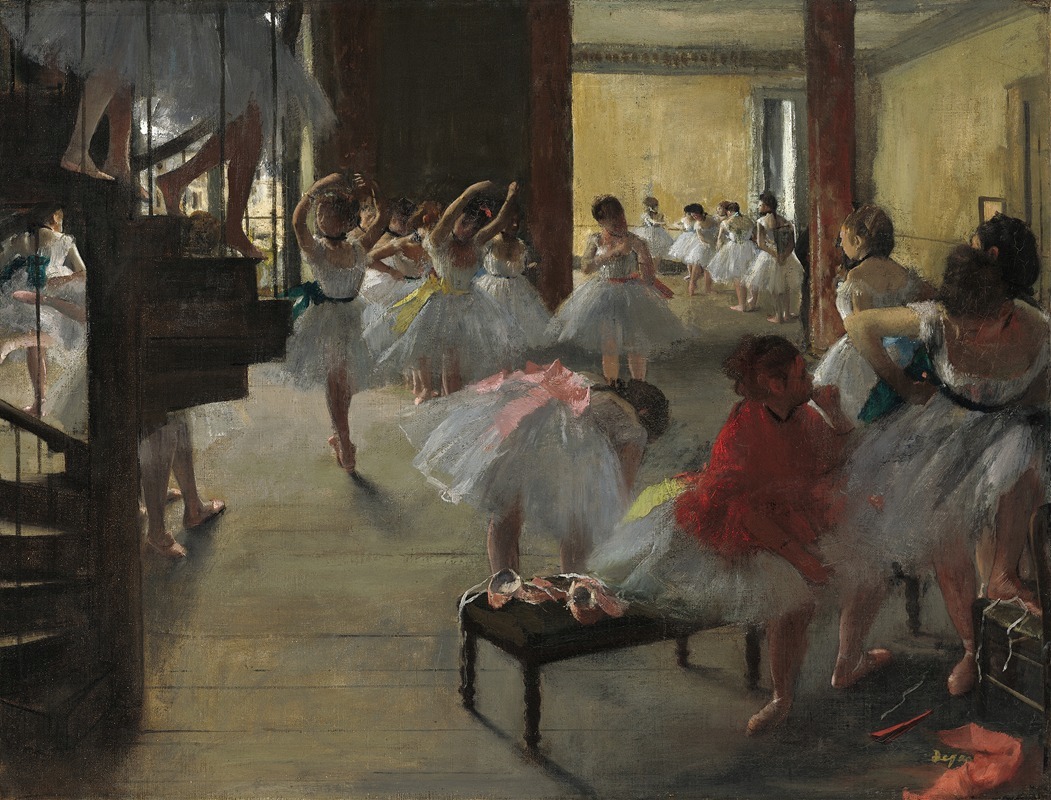
Step a little closer—this is The Dance Class, painted around 1873 by Edgar Degas. Rather than a staged performance, Degas invites us behind the curtain, into a rehearsal room where discipline, fatigue, and fleeting moments coexist. Notice how your eye doesn’t settle on a single focal point. Instead, it wanders—just as it would if you were actually standing in the room. On the right, the stern ballet master, Jules Perrot, stands with his cane, commanding attention. Around him, the dancers are scattered in seemingly casual positions: one adjusts her dress, another stretches, a few appear distracted or tired.
This isn’t the glamour of the stage—it’s the reality behind it. Degas was fascinated by movement, but here he captures something subtler: the pauses between movements. Look at the asymmetry of the composition—the empty floor space, the off-center grouping. It almost feels like a snapshot, as if the scene continues beyond the frame. This was revolutionary at the time, influenced by photography and Japanese prints. The light filters softly across the studio, illuminating tutus in delicate whites and pale pastels, contrasting with the darker tones of the room.
There’s a quiet rhythm here—not of music, but of repetition, effort, and practice. What makes this work so compelling is its honesty. Degas doesn’t idealize these dancers; he humanizes them. You’re not watching a performance—you’re witnessing preparation, discipline, and the quiet reality of becoming an artist. Stay with it for a moment longer, and you might almost hear the shuffle of slippers on the floor, the murmur of instruction, the breath between movements.