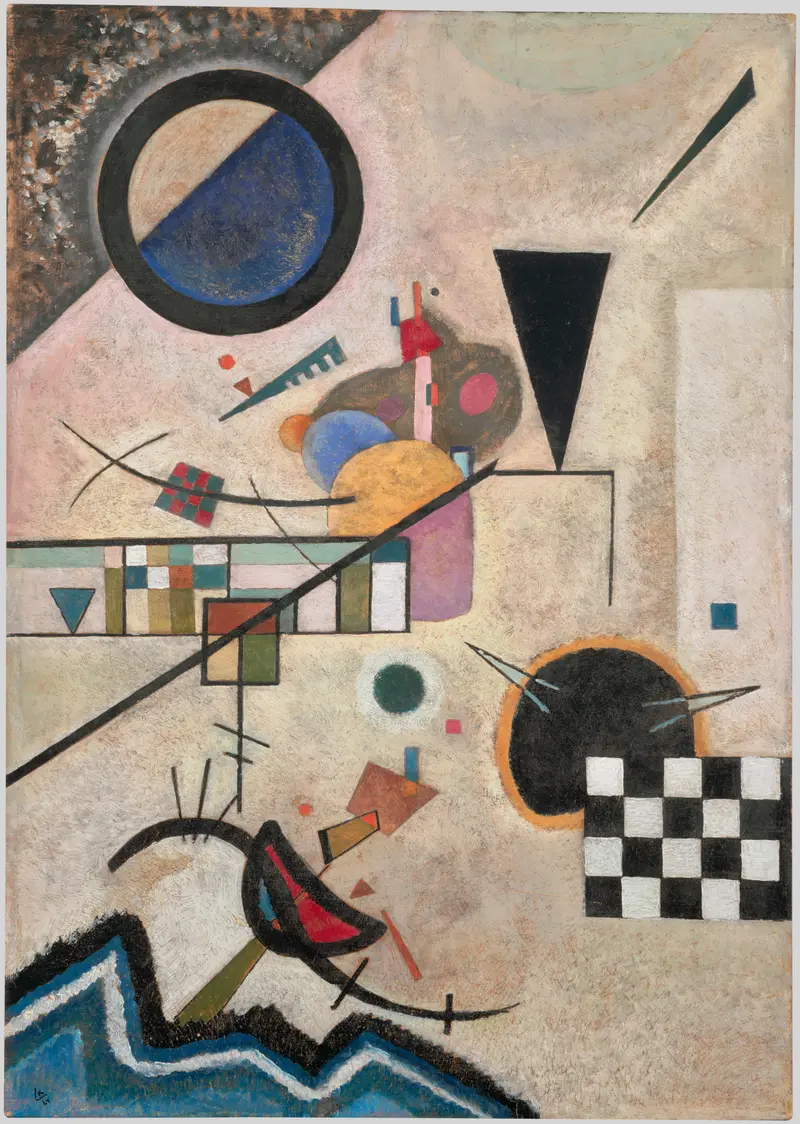
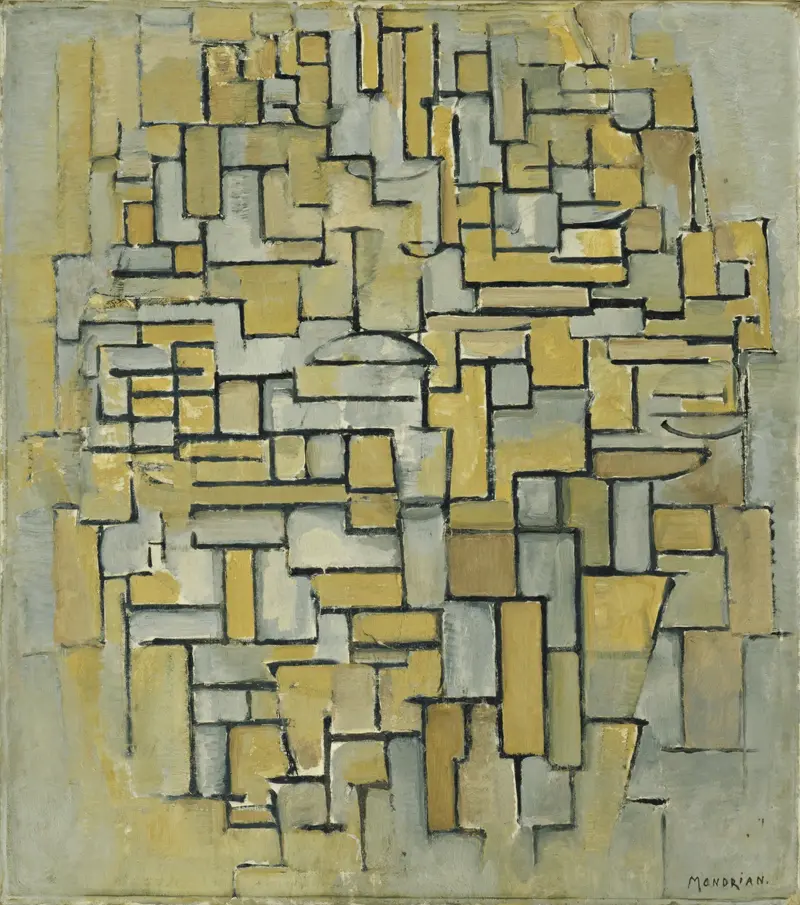
Public domain · Free to download
Famous Abstract Paintings
From Malevich's Black Square to Mondrian's grid of red, blue and yellow, these are the most famous early abstract paintings: the pictures in which painters stopped showing things and let color, line and shape speak for themselves. We added more of the most famous paintings by Wassily Kandinsky and Hilma af Klint's series The Ten Largest.
For each one you get what you see, the idea behind it, when it was made and where it hangs today. Every image is a public-domain reproduction of the real painting, free to download and free to use.
All of them were painted by 1930 by artists who died by 1955. Abstract art made later, such as Jackson Pollock's or Mark Rothko's, is still under copyright, so it is not here.
Selected and written by Pavel MazuelasUpdated October 30, 2026
Part of The Most Famous Paintings in the WorldRelated: Famous Paintings of People, Famous Still Life Paintings
The 13 most famous early abstract paintings
Ranked from 1 to 13 by worldwide fame. Click any painting to see it up close and download it free.
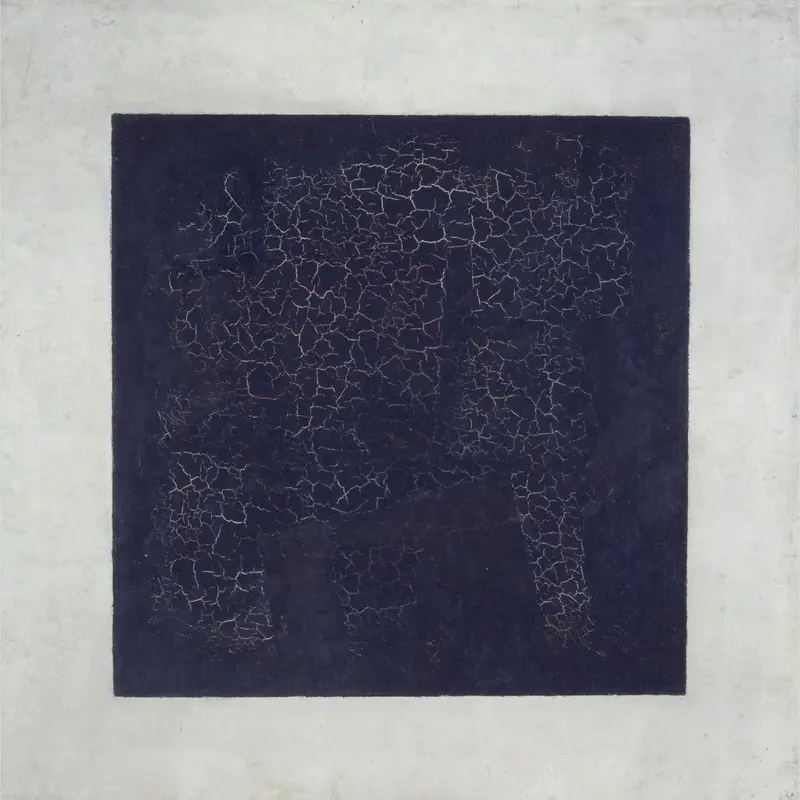
No. 1
Black Square by Kazimir Malevich
Idea: Suprematism
1915 · Oil on canvas · 79.5 × 79.5 cm
Tretyakov Gallery, Moscow
A black quadrilateral on a white ground, its surface now covered in fine cracks. Kazimir Malevich showed it in Petrograd in December 1915 at the exhibition 0,10, hung high in the corner of the room where Russians placed icons. The catalog called it a “quadrilateral,” since its angles are not quite square, and in 2015 the Tretyakov found two earlier geometric compositions under the black paint. Malevich later painted three more versions; this 1915 original is in the Tretyakov Gallery in Moscow.
Sources: Tretyakov Gallery
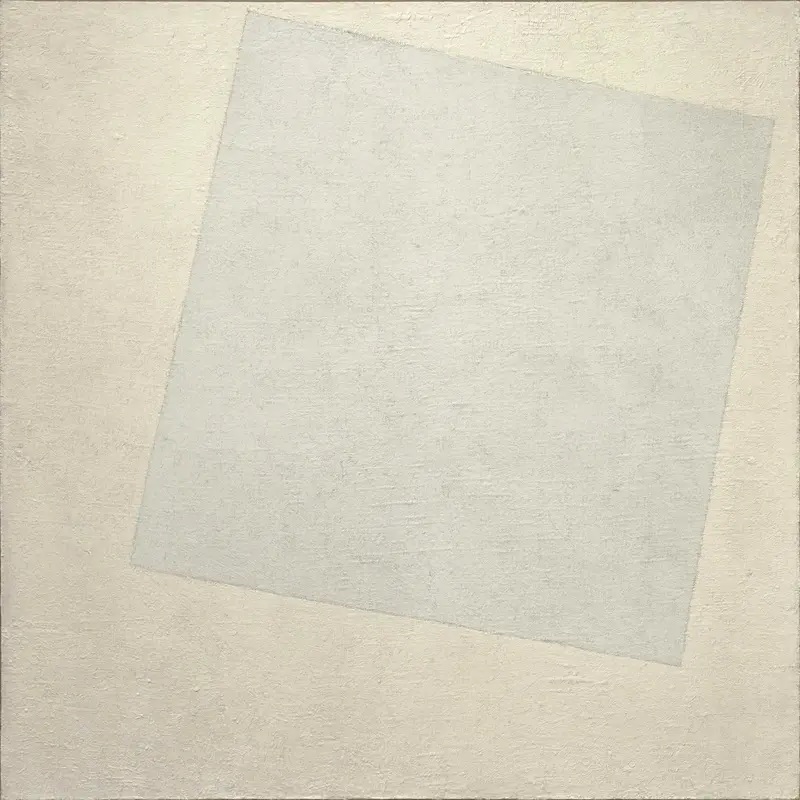
No. 2
Suprematist Composition: White on White by Kazimir Malevich
Idea: Suprematism
1918 · Oil on canvas · 79.4 × 79.4 cm
Museum of Modern Art, New York
A white square, tilted and edged toward the top right corner, floats on a slightly different white. Look closely: MoMA points out that the two whites are not the same, one cooler and bluish, the other warmer and yellowish. Kazimir Malevich painted it in 1918, after dropping color and black altogether, and a MoMA essay reads it as his answer to Black Square. In 1919 it hung beside Aleksandr Rodchenko's Black on Black in Moscow. It is in the Museum of Modern Art in New York.
Sources: Museum of Modern Art
No. 3
Red Square by Kazimir Malevich
Idea: Suprematism
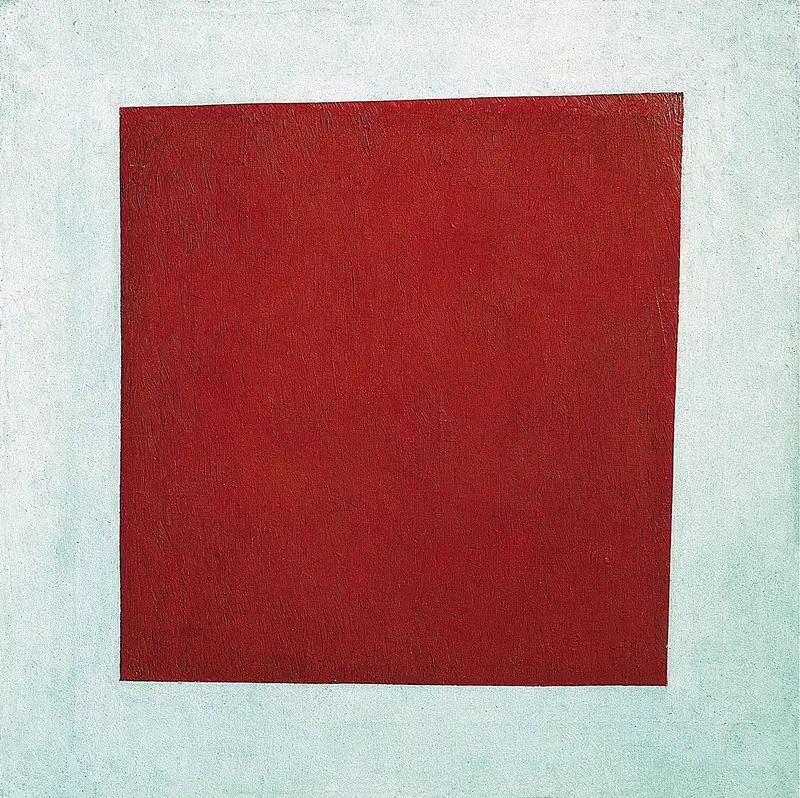
1915 · Oil on canvas · 53 × 53 cm
Russian Museum, St. Petersburg
A single red square, slightly askew, sits on a white ground. Its full title, Painterly Realism of a Peasant Woman in Two Dimensions, is the key: the Russian Museum says Kazimir Malevich recast the traditional image of a peasant woman in a red sarafan using only color and a bare form. He showed it with Black Square at 0,10 in Petrograd in 1915, and in 1920 he urged artists to draw “the red square as a sign of the world revolution of the arts.” It is in the Russian Museum in St. Petersburg.
Sources: Russian Museum
No. 4Modernism
Composition VII by Wassily Kandinsky
Idea: Pure abstraction
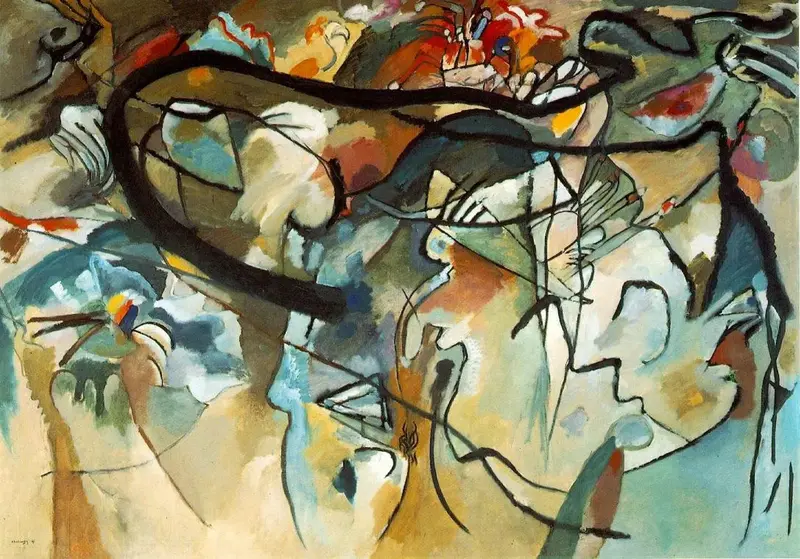
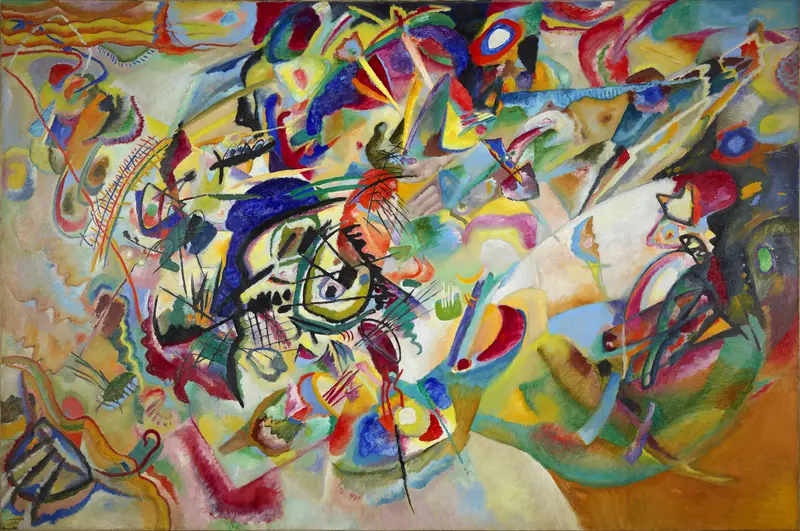
1913 · Oil on canvas · 200 × 300 cm
Tretyakov Gallery, Moscow
Swirls, patches and lines of color crowd a canvas three meters wide, with no recognizable subject at all. Wassily Kandinsky made more than thirty sketches and studies for it in the autumn of 1913, then painted the big canvas in four days, from November 25 to 28. He insisted it started from no object, though the Tretyakov notes that its forms grew out of his earlier pictures of the Last Judgment and the Resurrection. It is in the Tretyakov Gallery in Moscow.
Sources: Tretyakov Gallery

No. 5De Stijl
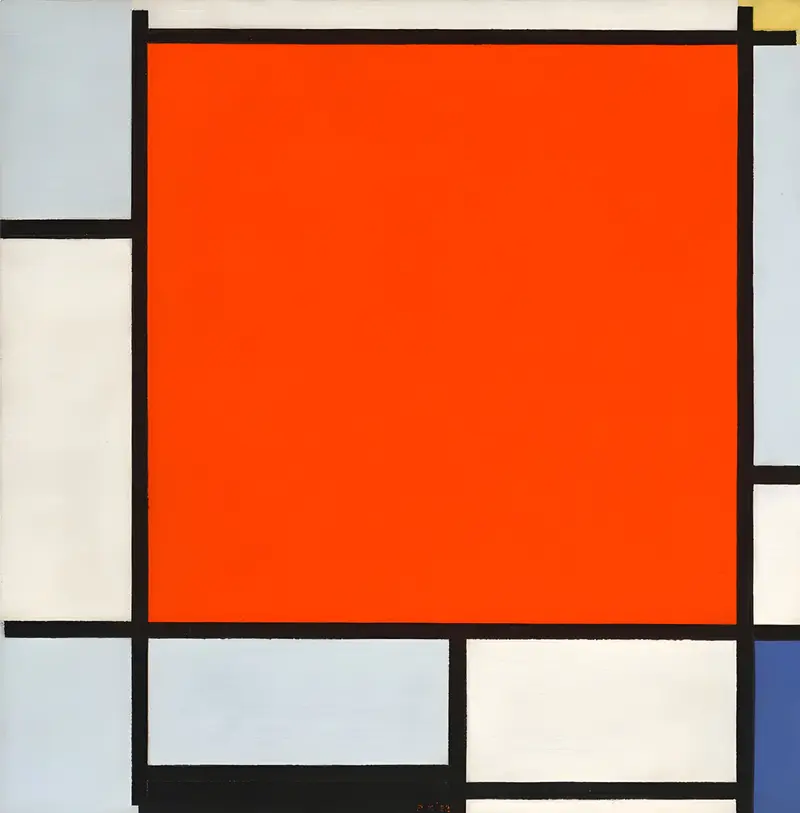
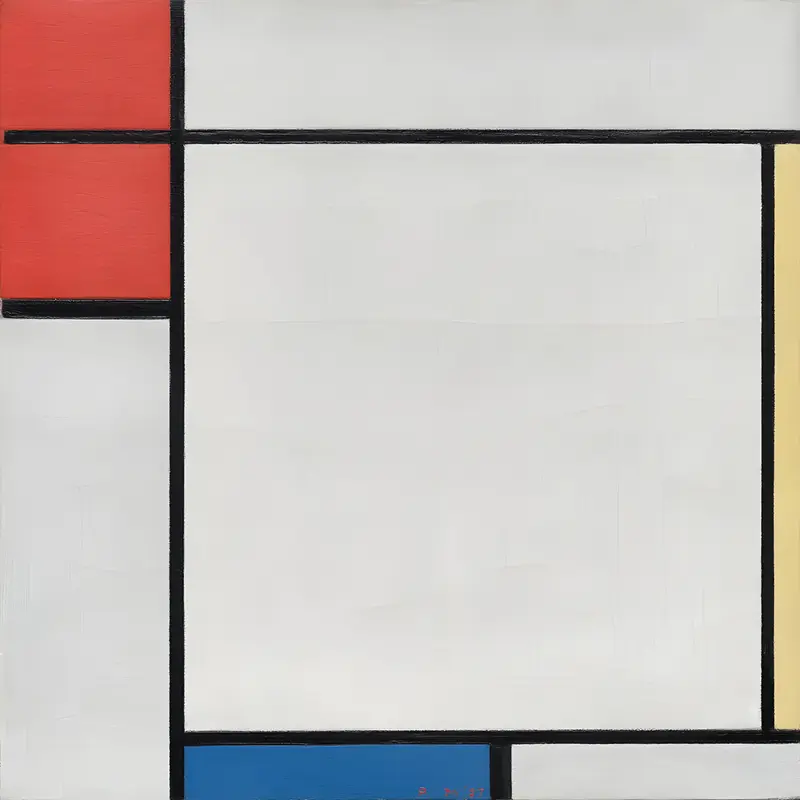
Composition II in Red, Blue, and Yellow by Piet Mondrian
Idea: Neo-Plasticism (De Stijl)
1930 · Oil on canvas · 45 × 45 cm
Kunsthaus Zürich, Zurich
A large red square fills most of the canvas, with smaller blocks of blue and yellow and black bars pushed to the edges. Piet Mondrian painted it in Paris in 1930 for his friend, the Zurich architect Alfred Roth, and dedicated it to him on the back; the museum calls it Composition with Red, Blue and Yellow. Using only straight lines and primary colors, Mondrian aimed at a balance he saw as universal. Roth gave it to the Kunsthaus Zürich in 1987, and it is there today.
Sources: Kunsthaus Zürich
No. 6Modernism
Composition VI by Wassily Kandinsky
Idea: Pure abstraction
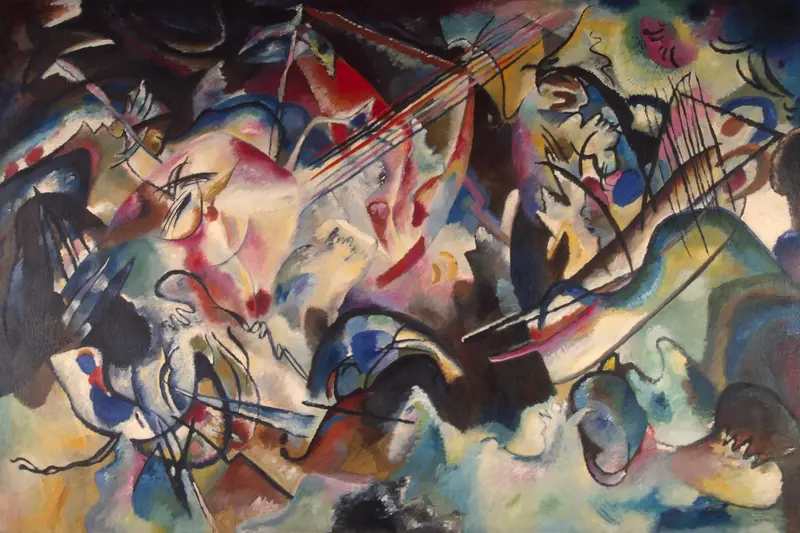
1913 · Oil on canvas · 195 × 300 cm
Hermitage Museum, St. Petersburg
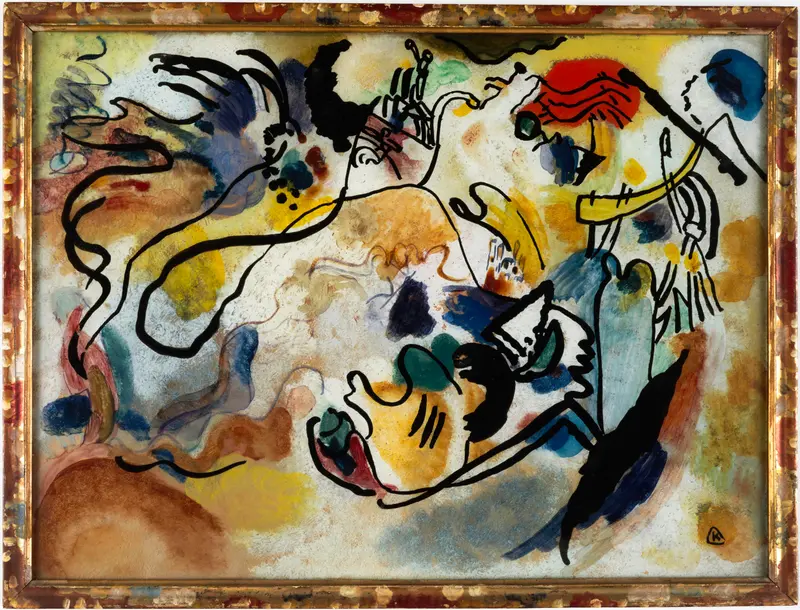
Colors collide and wash across a canvas three meters wide; its starting point was a picture on glass of the biblical Flood that Wassily Kandinsky wanted to rethink. He carried the idea for a year and a half, he wrote in May 1913, until “in two or three days the picture as a whole was there.” He warned against reading it as the Flood and called its destruction also a song of praise for new life. It came to the Hermitage in 1948 and is in the Hermitage Museum in St. Petersburg.
Sources: Hermitage Museum
No. 7Modernism
Yellow-Red-Blue by Wassily Kandinsky
Idea: Bauhaus color theory
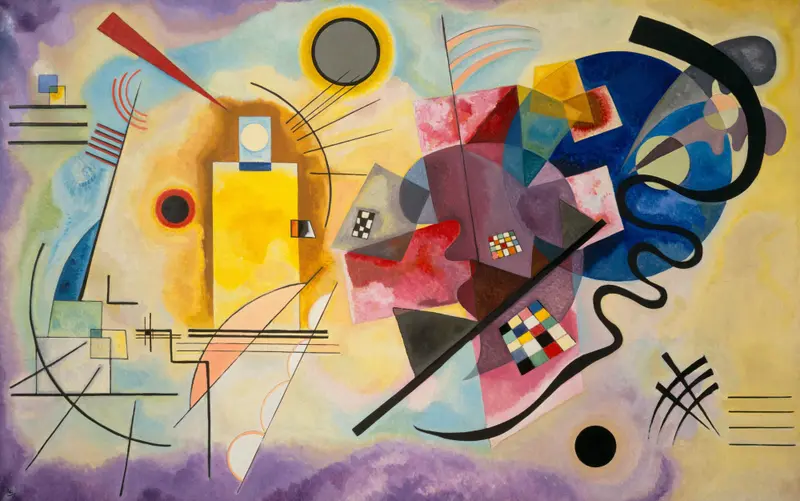
1925 · Oil on canvas · 128 × 201.5 cm
Centre Pompidou, Paris
The picture reads from left to right through the three primary colors: yellow among straight lines on the left, red at the center and blue among darker, more complex forms on the right. Wassily Kandinsky painted it in 1925 while teaching at the Bauhaus, and the Centre Pompidou calls it almost a visual illustration of his book Point and Line to Plane. His widow, Nina Kandinsky, gave it to the museum in 1976. It is in the Centre Pompidou in Paris.
Sources: Centre Pompidou
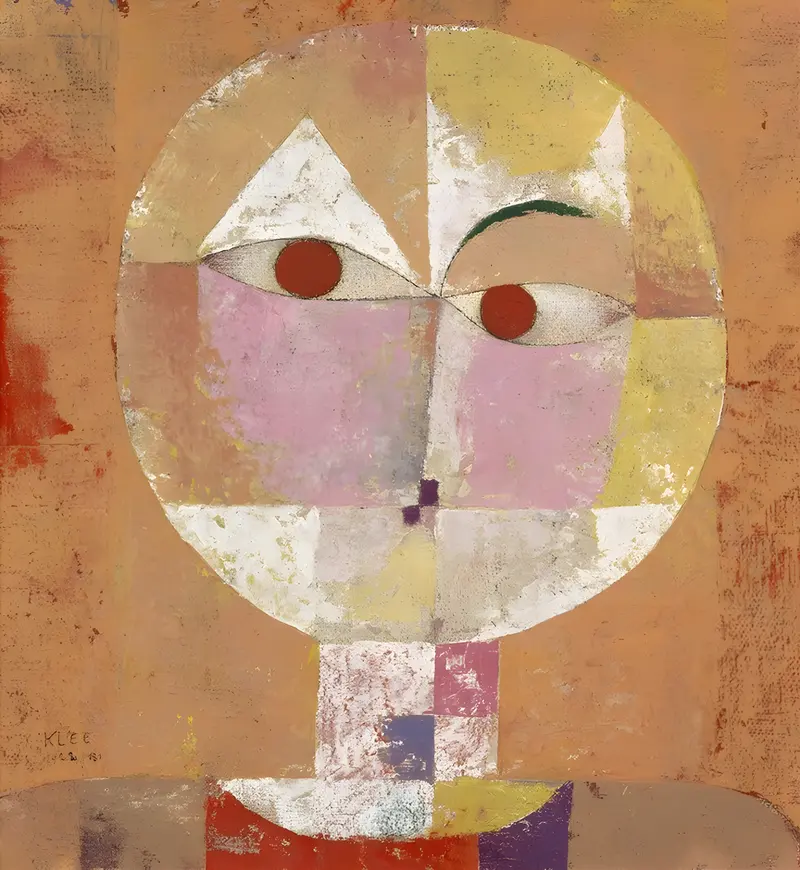
No. 8Expressionism
Senecio by Paul Klee
Idea: A face in geometric color fields
1922 · Oil on chalk ground on gauze on cardboard · 40.3 × 37.4 cm
Kunstmuseum Basel, Basel
A round face is built from squares and circles of warm orange, red and yellow, one eyebrow raised. Paul Klee painted it in 1922, during his years at the Bauhaus; in his own list of works he called it Baldgreis, roughly “soon-to-be old man,” and Senecio is the Latin name of a plant, groundsel. The Kunstmuseum Basel bought it in 1931 as one of its first purchases of modern art, and it is still in the Kunstmuseum Basel.
Sources: Kunstmuseum Basel
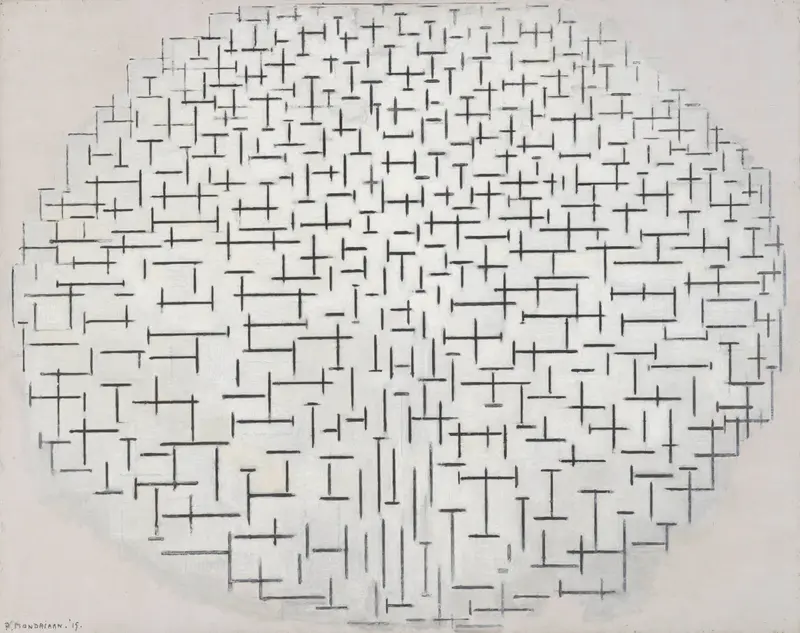
No. 9Modernism
Composition 10 in Black and White by Piet Mondrian
Idea: Pier and ocean, abstracted
1915 · Oil on canvas · 85.8 × 108.4 cm
Kröller-Müller Museum, Otterlo
Short black lines, horizontal and vertical, gather into an oval field on an off-white ground. Piet Mondrian based it on drawings of the sea and a pier he made at Domburg and Scheveningen in 1914, which is why it is also called Pier and Ocean; the museum sees the waves in the long horizontals and the breakwater in the verticals at the bottom. It is the first painting in which he used only black and white. It is in the Kröller-Müller Museum in Otterlo.
Sources: Kröller-Müller Museum
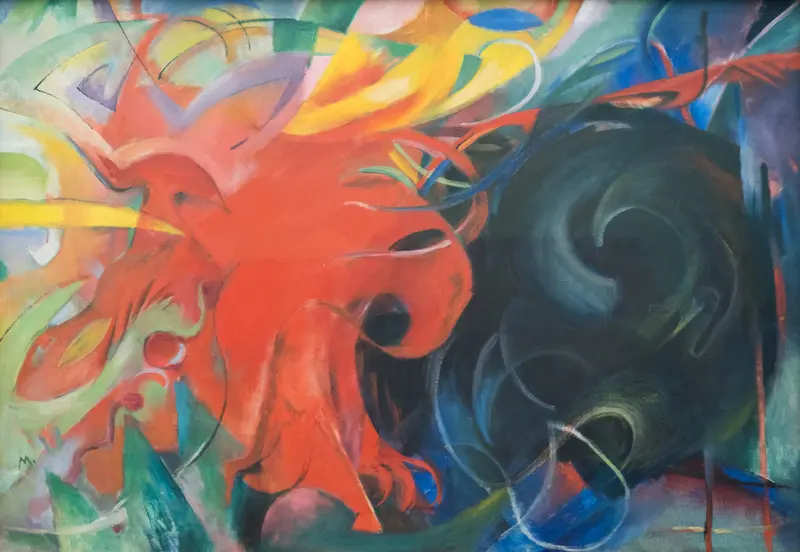
No. 10Expressionism
Fighting Forms by Franz Marc
Idea: Opposing forces
1914 · Oil on canvas · 91 × 131.5 cm
Pinakothek der Moderne, Munich
A red form and a blue-black one surge toward each other, and the dark one seems to give way. Franz Marc painted it in 1914 at his villa near Kochel, in the months before he was called up for the First World War; he gave it its title only later, in a letter from the front, and he was killed in 1916. His widow, Maria, kept it until the Bavarian State Painting Collections bought it in 1949. It belongs to the Pinakothek der Moderne in Munich.
Sources: Pinakothek der Moderne
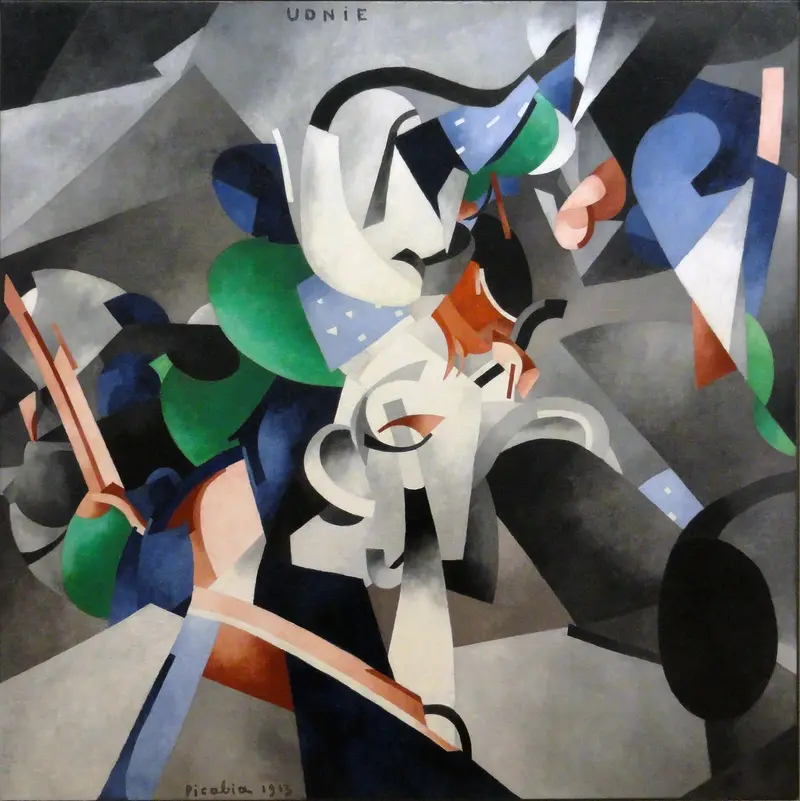
No. 11Cubism
Udnie by Francis Picabia
Idea: A dance in abstract forms
1913 · Oil on canvas · 290 × 300 cm
Centre Pompidou, Paris
Curved and sharp-edged shapes spin outward across a canvas three meters wide. Francis Picabia was inspired by a dance he saw on the ship taking him to New York in 1913, performed by the Polish actress Stasia Napierkowska, and the museum says the title may be an anagram of Jean d'Udine, a music theorist. Shown at the Salon d'Automne that year, it created a sensation. It is in the Centre Pompidou in Paris.
Sources: Centre Pompidou
No. 12Modernism
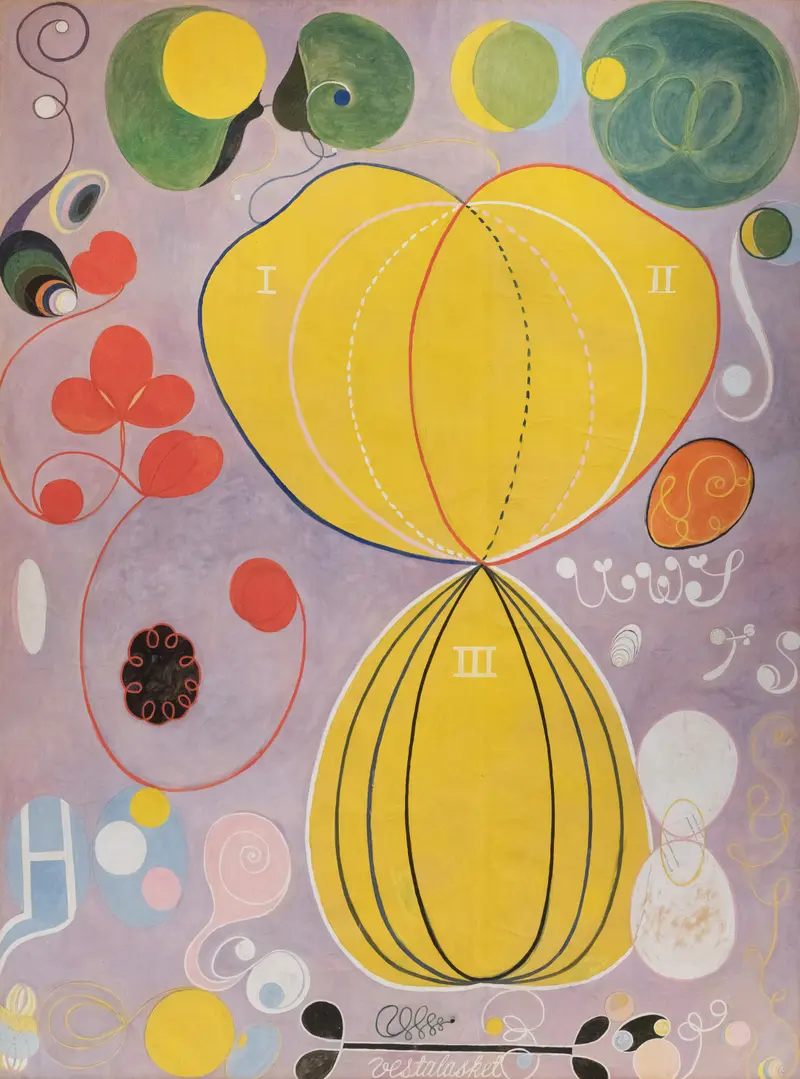
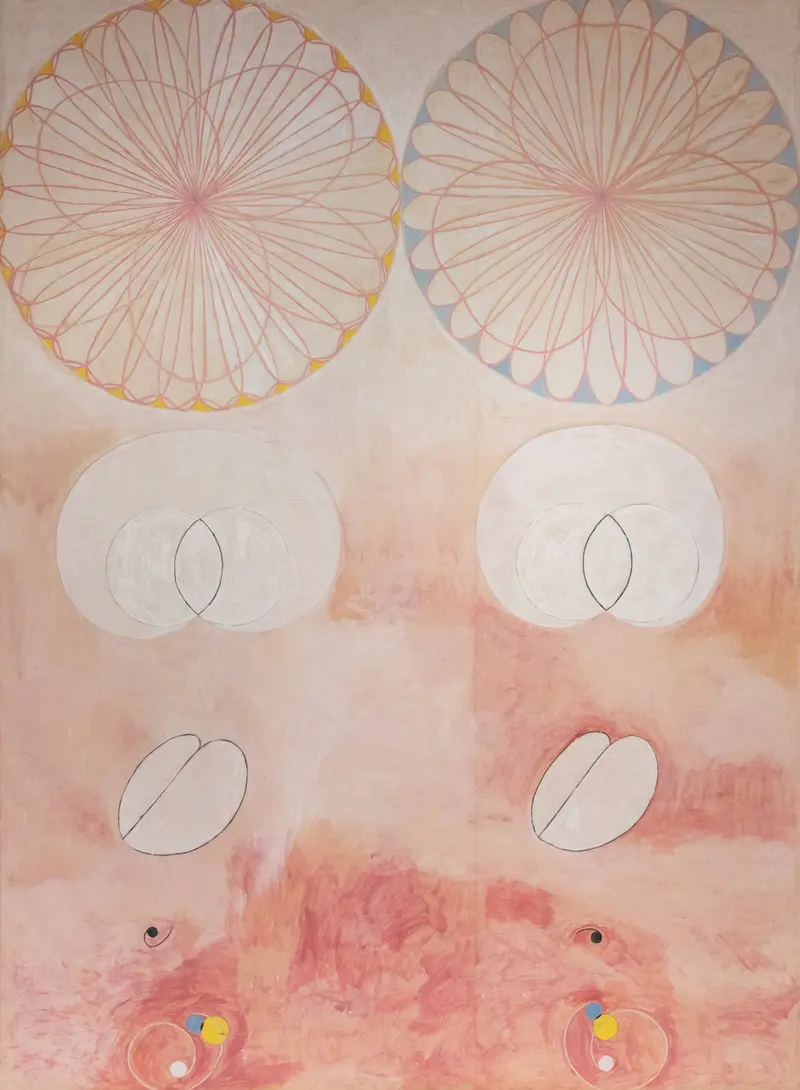
The Ten Largest, No. 7, Adulthood by Hilma af Klint
Idea: The stages of human life
1907 · Tempera on paper mounted on canvas · 315 × 235 cm
Hilma af Klint Foundation, Stockholm
Huge, soft shapes, spirals and looping lines fill a canvas more than three meters tall. It is one of The Ten Largest, Hilma af Klint's 1907 series on the stages of human life, which Moderna Museet says she painted in just 40 days, most likely on the studio floor. Convinced the world was not ready, she asked that her abstract works not be shown until twenty years after her death, and they stayed almost unseen until 1986. It belongs to the Hilma af Klint Foundation in Stockholm.
Sources: Hilma af Klint Foundation
No. 13Modernism
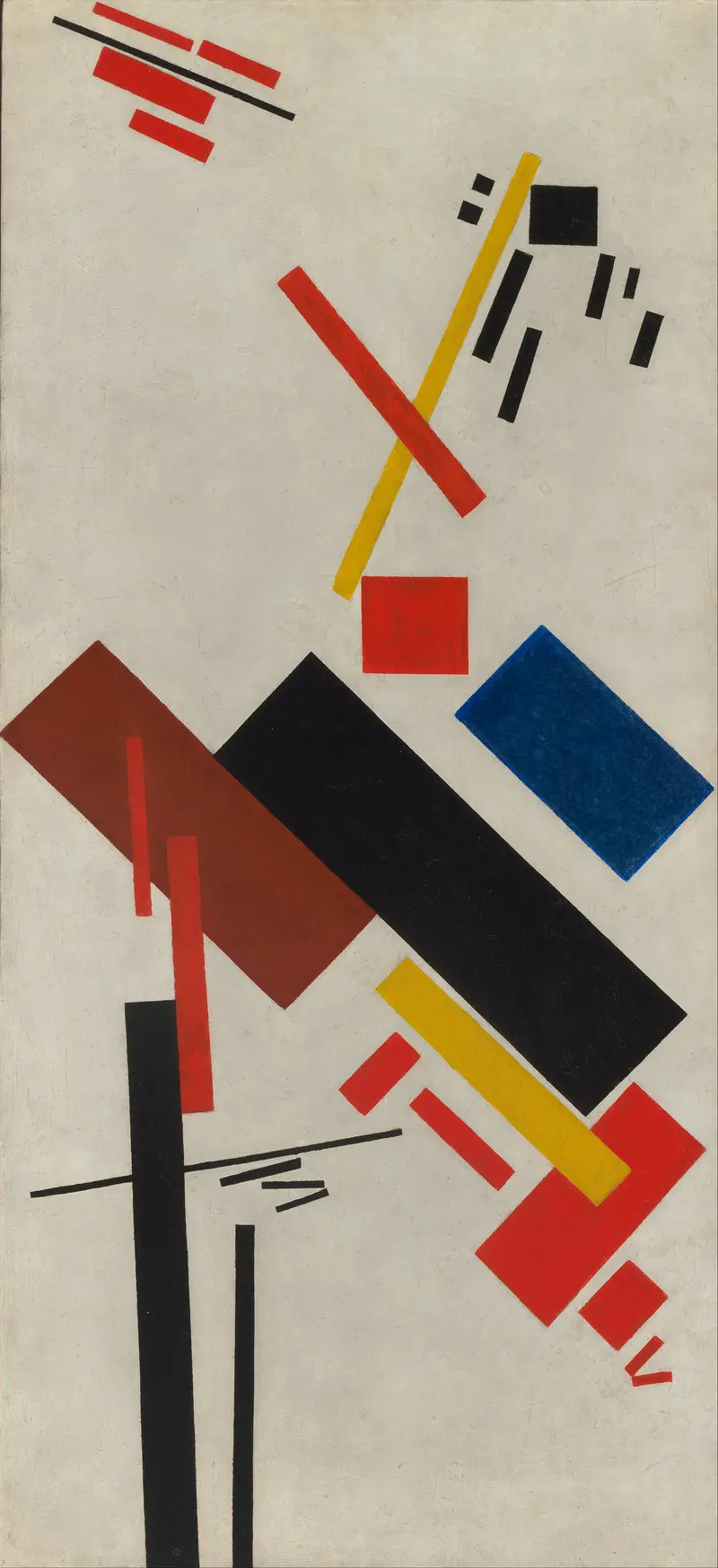
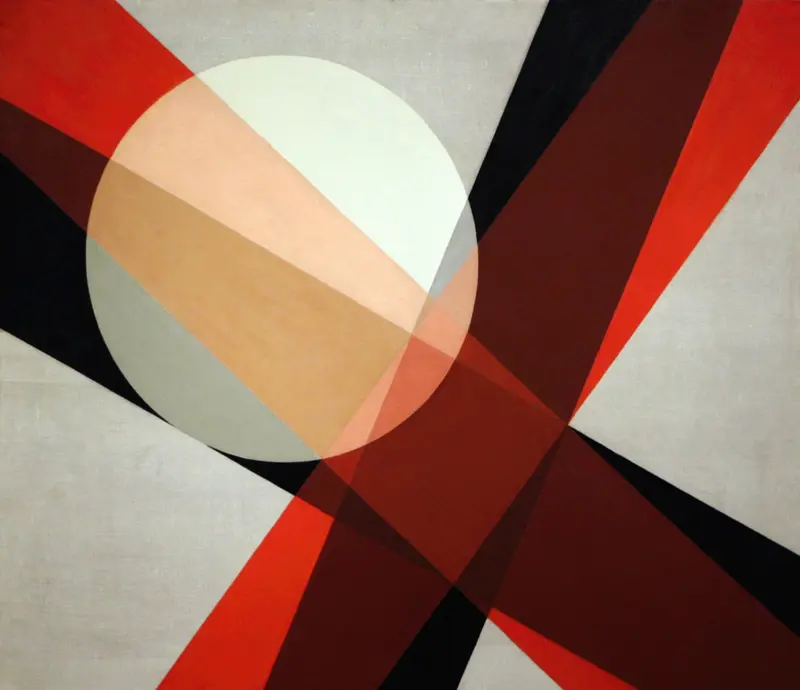
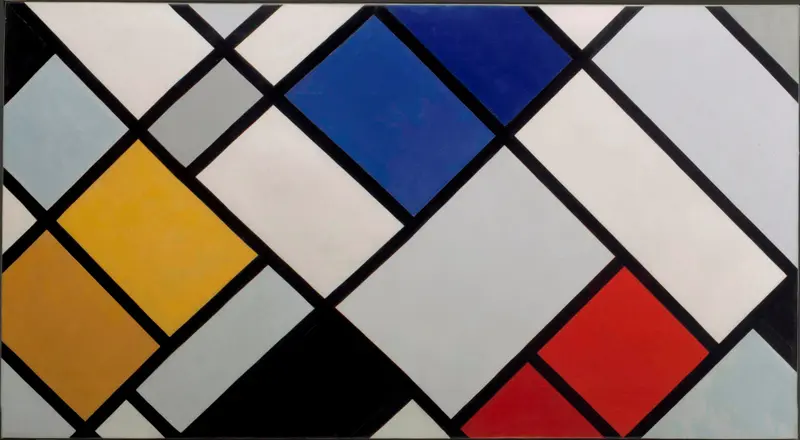
Counter-Composition of Dissonances XVI by Theo van Doesburg
Idea: Elementarism
1925 · Oil on canvas · 100 × 180 cm
Kunstmuseum Den Haag, The Hague
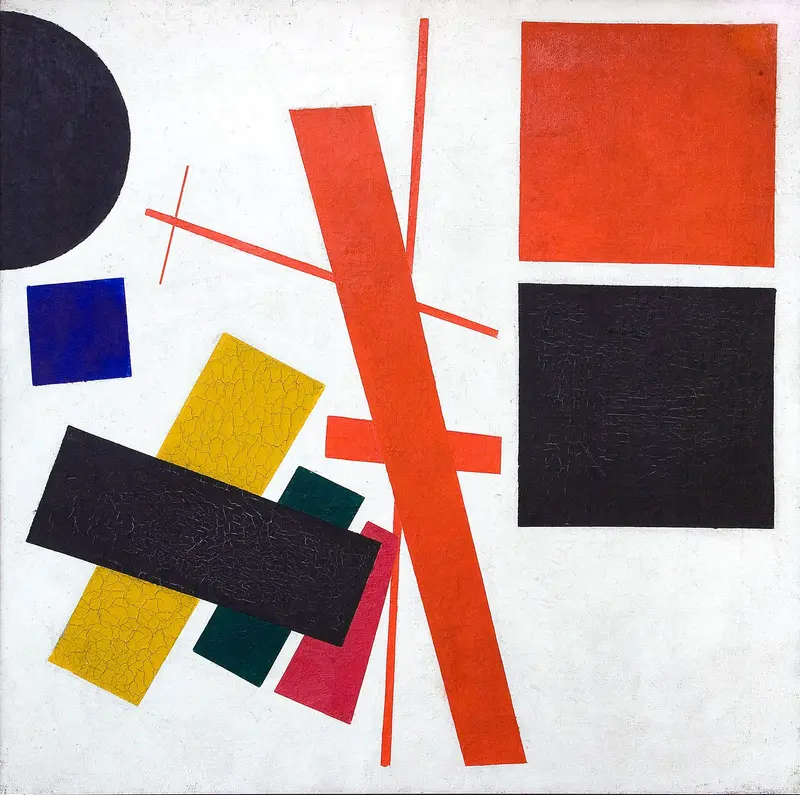
Tilted bands and blocks of color cross a long canvas on the diagonal. Theo van Doesburg painted it in 1925, after breaking with Mondrian's strictly horizontal and vertical grid for a more dynamic approach he called elementarism; Tate says Mondrian left their De Stijl group after Van Doesburg adopted diagonals. An inscription on the back, HAUT with an arrow, shows which way is up. His widow gave it to the Kunstmuseum Den Haag, where it is today.
Sources: Kunstmuseum Den Haag
Want to see more? Browse every abstract painting in the collection.
Browse all 1,475 abstract paintingsFamous Kandinsky paintings
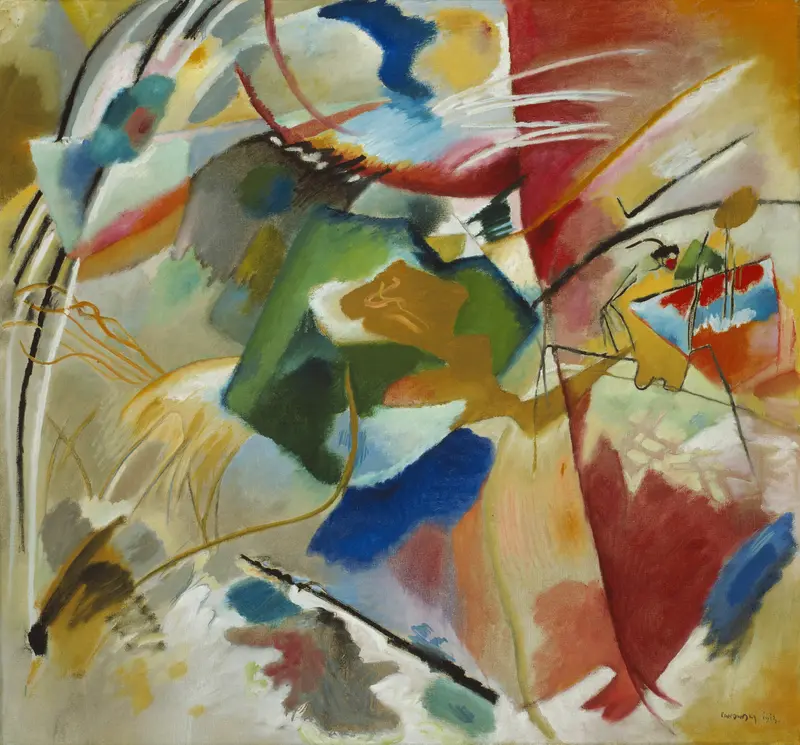
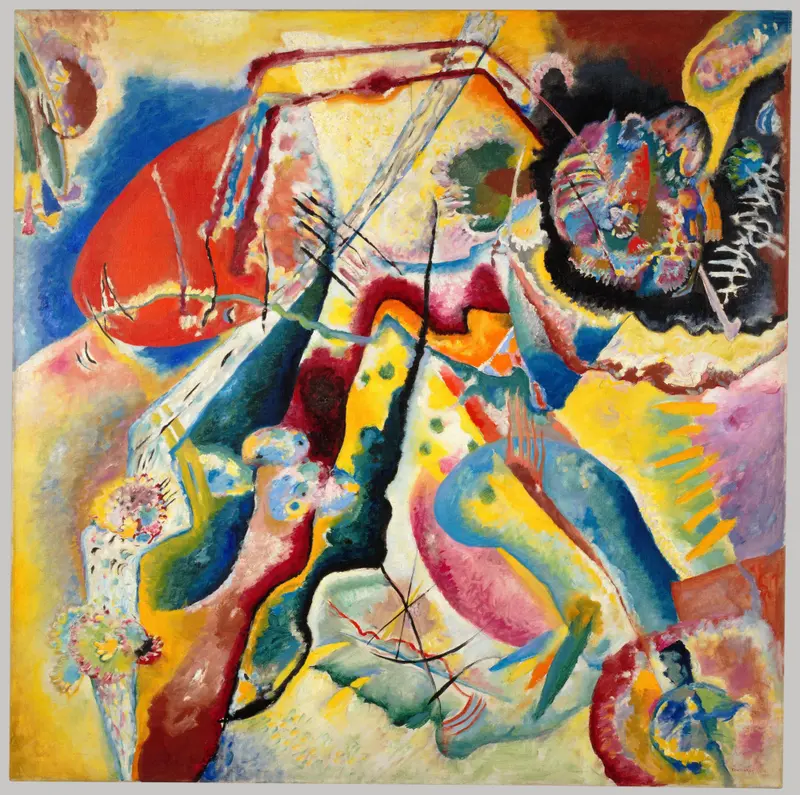
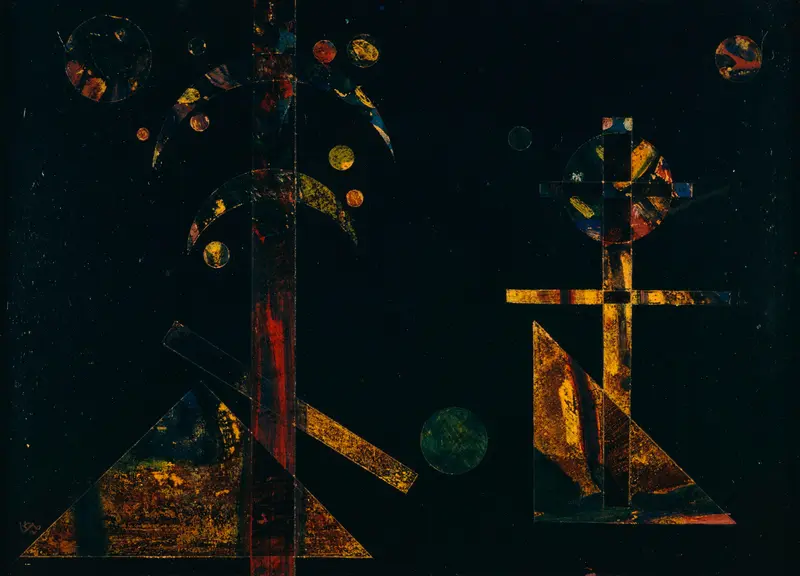
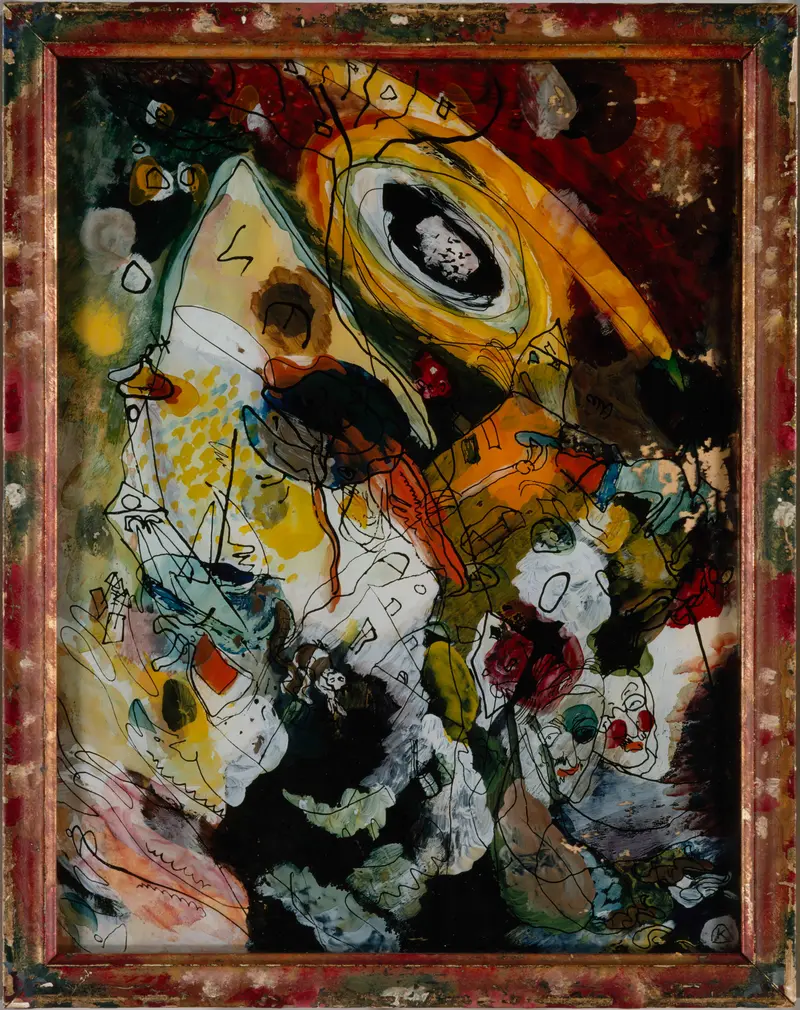
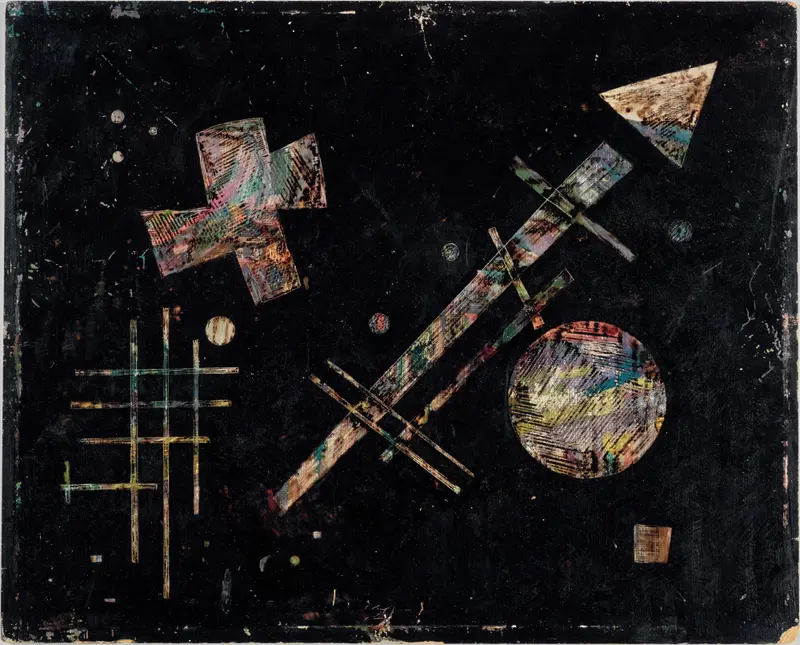
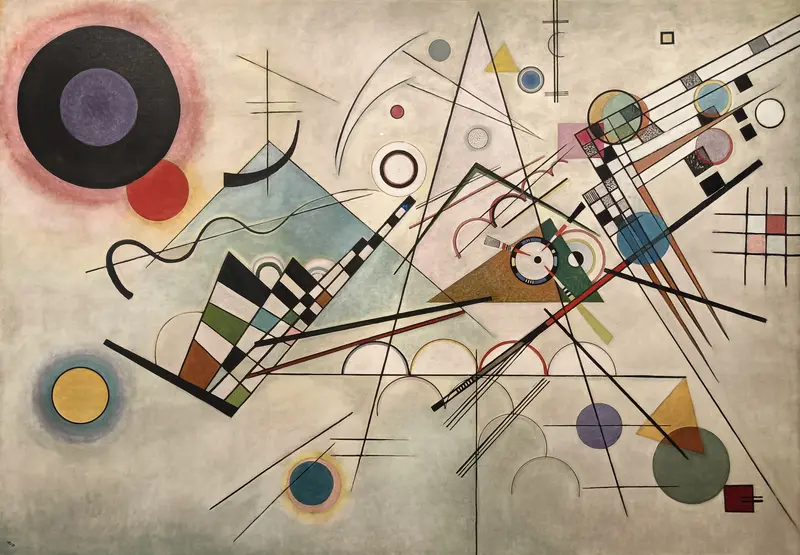
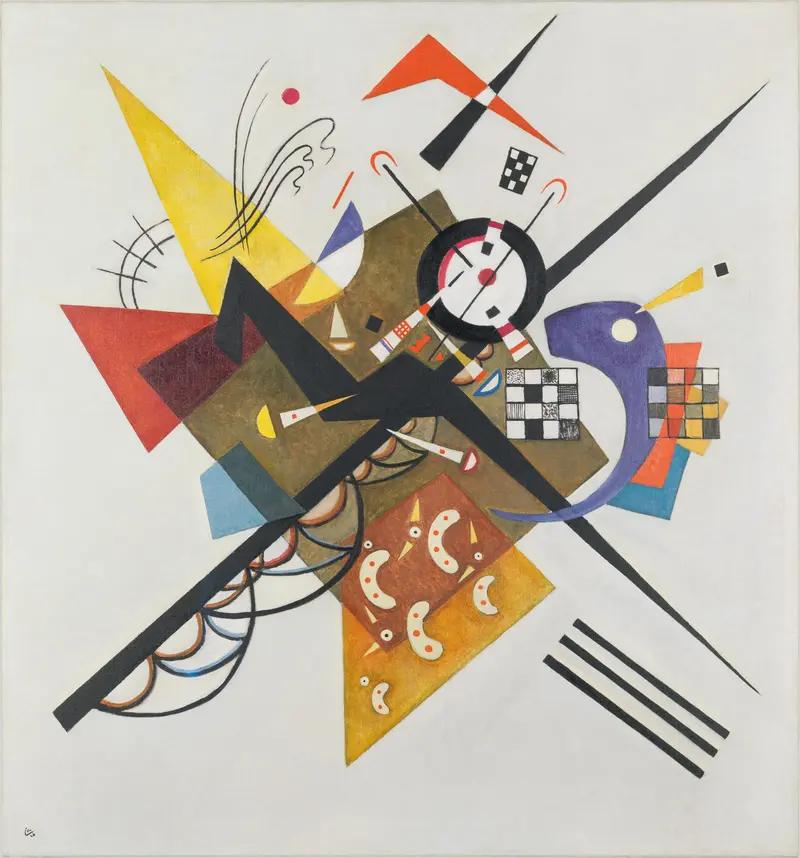
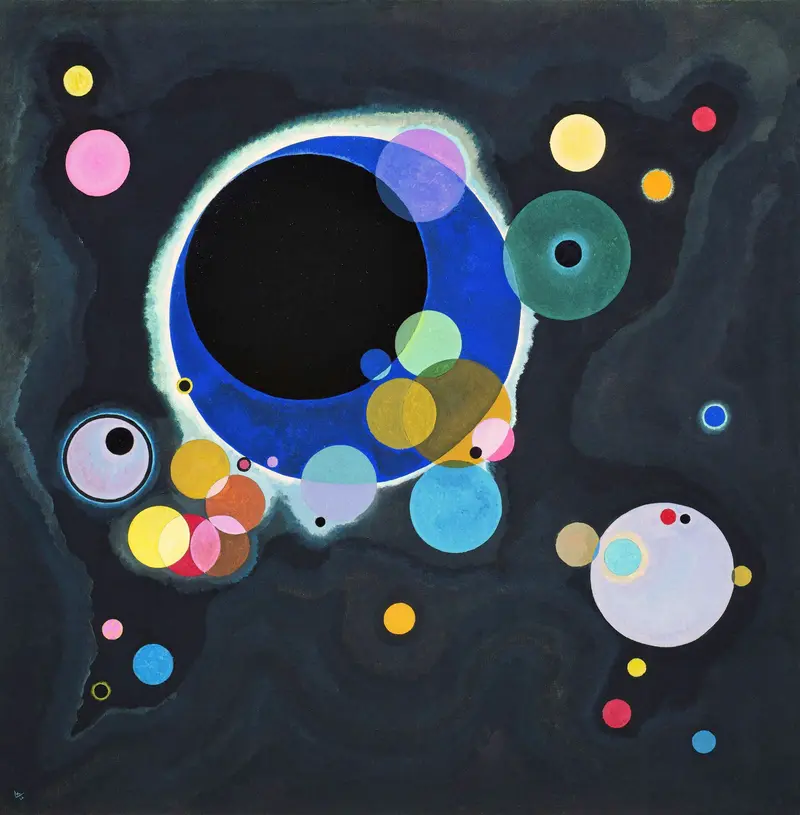
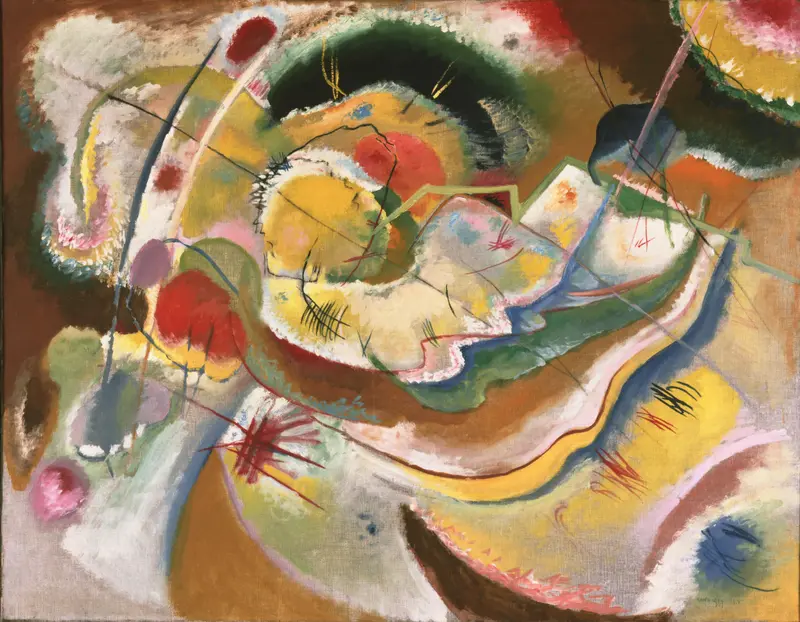
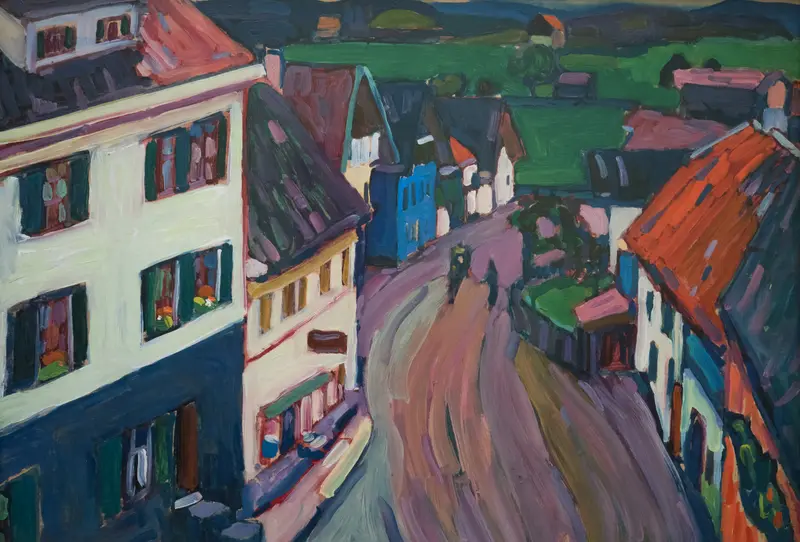
Six more famous paintings by Wassily Kandinsky, from a Murnau window view to Several Circles.

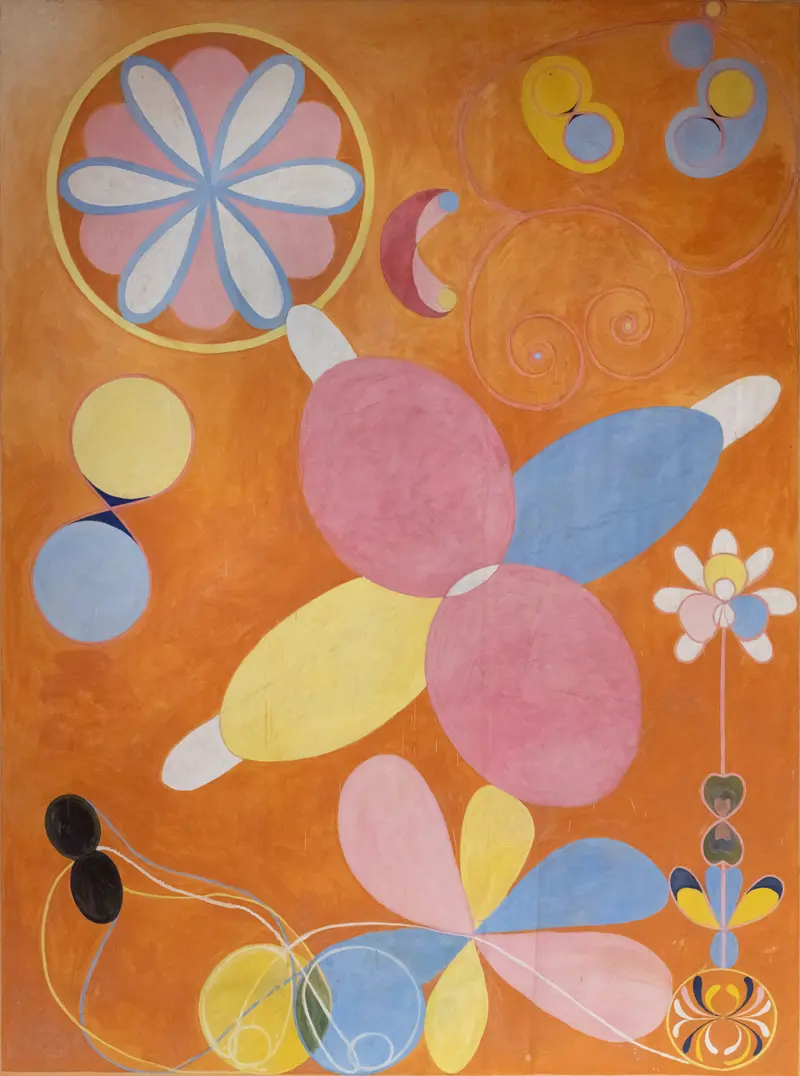
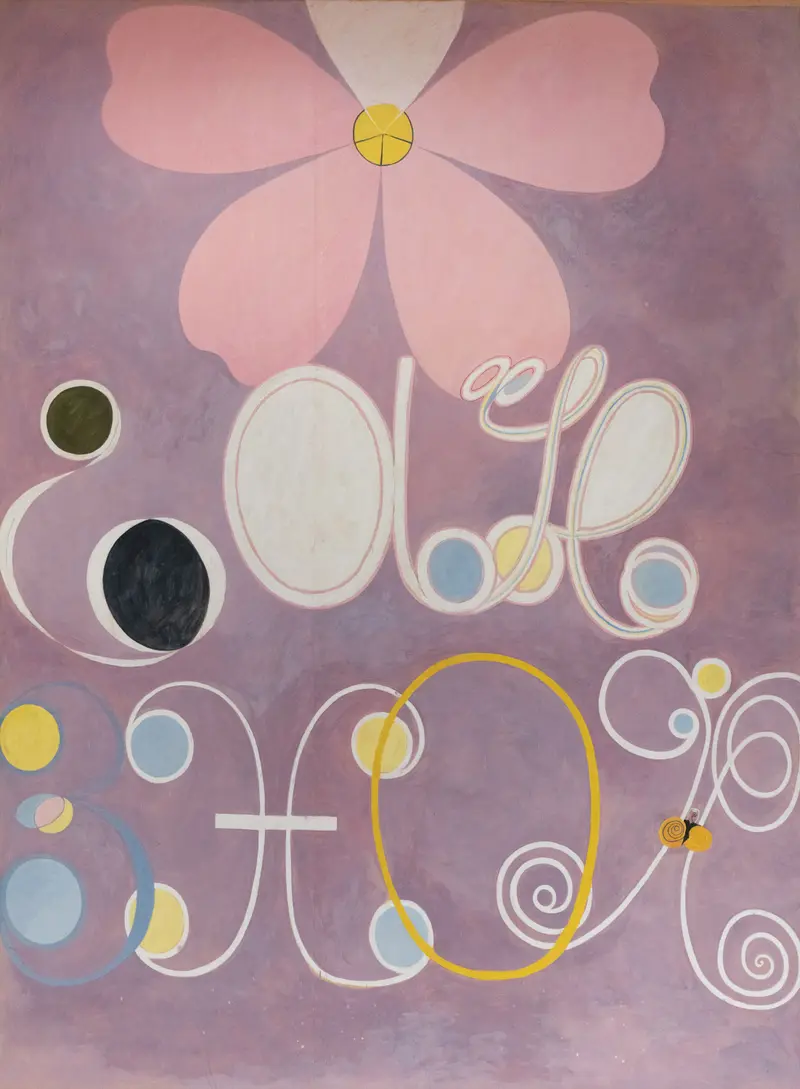
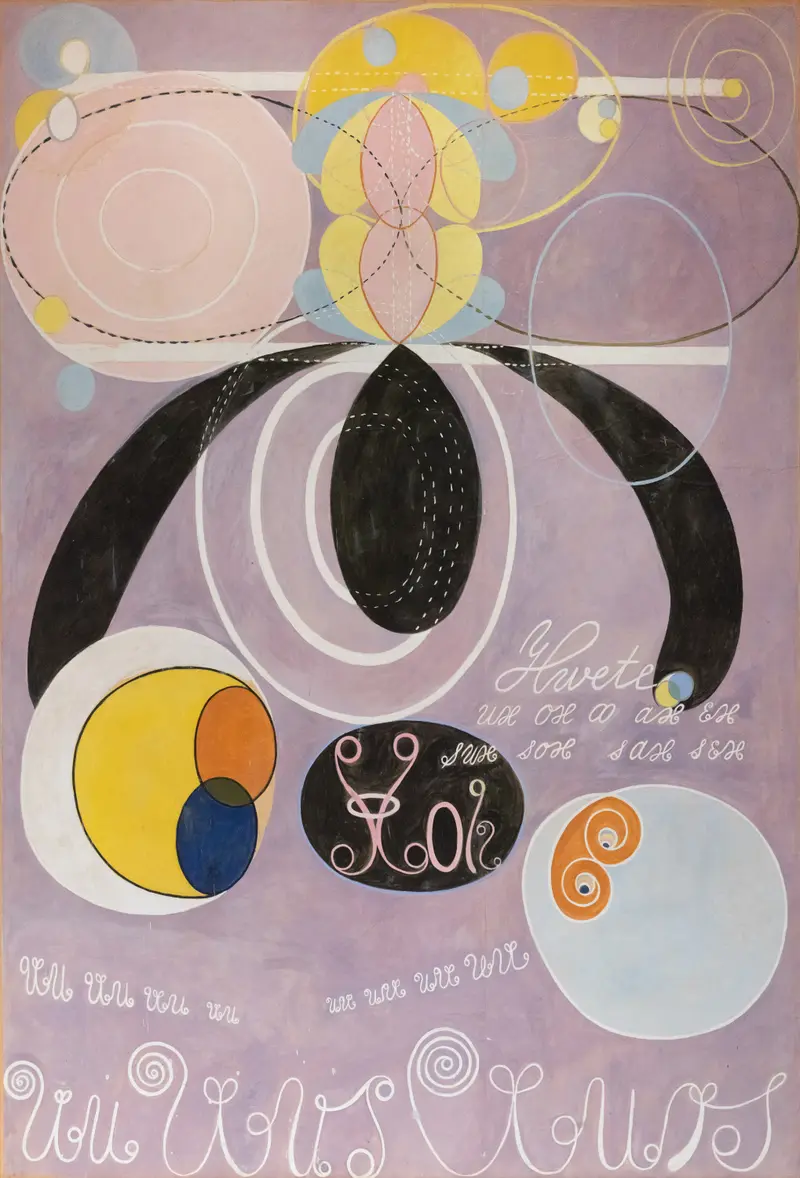
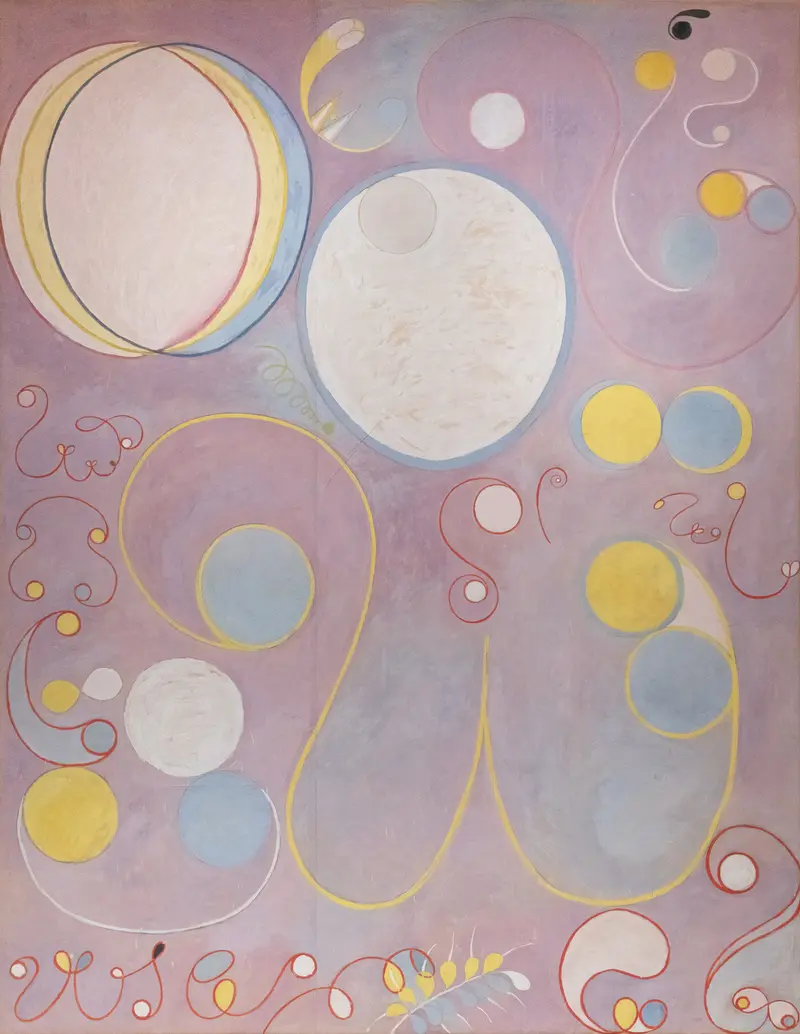
Hilma af Klint: The Ten Largest
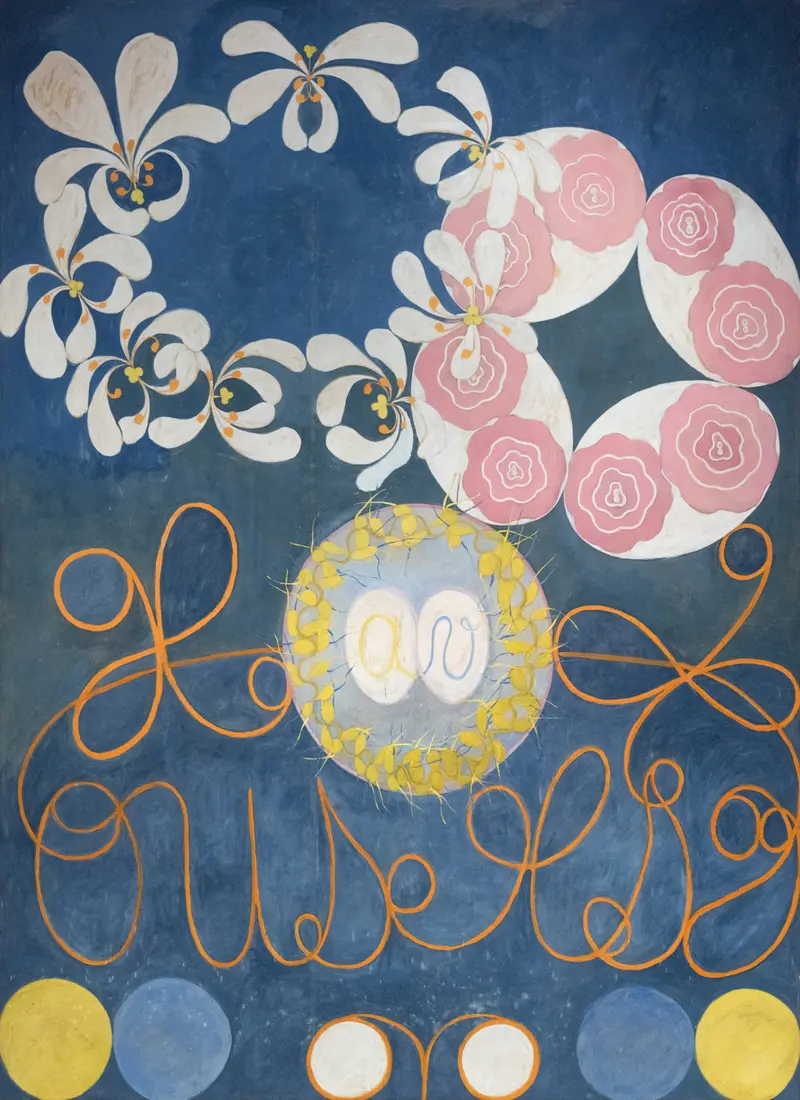
Six more paintings from Hilma af Klint's The Ten Largest, her 1907 series on the stages of human life.
Famous abstract painters
The pioneers of abstract painting, from Kandinsky and Malevich to Mondrian and Hilma af Klint. Each link opens all their paintings.
- Kazimir MalevichMalevich's first Suprematist show, 0,10 in Petrograd in December 1915, included thirty-five abstract paintings, among them the Black Square.
- Wassily KandinskyKandinsky painted ten Compositions, seven between 1910 and 1914 and three after World War I, each developed from feeling into shapes, colors and lines.
- Piet MondrianMondrian called his simplified abstract style Neo-Plasticism: only the three primary colors and a grid of black vertical and horizontal lines on white.
- Paul KleeInvited to the Bauhaus faculty in 1920, Klee developed a theory of the dynamics of pictorial form, summarized in his 1925 Pedagogical Sketchbook.
- Hilma af KlintHilma af Klint began painting radically abstract works in 1906, several years before Kandinsky, Malevich and Mondrian, but rarely exhibited them.
- Franz MarcAfter meeting Delaunay's Orphism in 1912, Franz Marc adopted its glowing colors; Futurism bolstered his move toward abstraction, yet he kept his tie to nature.
List of famous abstract paintings and their artists
The 13 most famous early abstract paintings: who painted them, the idea behind them, when, and where each one is today.
Show the list of 13 abstract paintingsHide the list
| # | Painting | Idea | Painted by | Year | Medium | Size | Located in | City |
|---|---|---|---|---|---|---|---|---|
| 1 | Black Square | Suprematism | Kazimir Malevich | 1915 | Oil on canvas | 79.5 × 79.5 cm (31.3 × 31.3 in) | Tretyakov Gallery | Moscow |
| 2 | Suprematist Composition: White on White | Suprematism | Kazimir Malevich | 1918 | Oil on canvas | 79.4 × 79.4 cm (31.3 × 31.3 in) | Museum of Modern Art | New York |
| 3 | Red Square | Suprematism | Kazimir Malevich | 1915 | Oil on canvas | 53 × 53 cm (20.9 × 20.9 in) | Russian Museum | St. Petersburg |
| 4 | Composition VII | Pure abstraction | Wassily Kandinsky | 1913 | Oil on canvas | 200 × 300 cm (78.7 × 118.1 in) | Tretyakov Gallery | Moscow |
| 5 | Composition II in Red, Blue, and Yellow | Neo-Plasticism (De Stijl) | Piet Mondrian | 1930 | Oil on canvas | 45 × 45 cm (17.7 × 17.7 in) | Kunsthaus Zürich | Zurich |
| 6 | Composition VI | Pure abstraction | Wassily Kandinsky | 1913 | Oil on canvas | 195 × 300 cm (76.8 × 118.1 in) | Hermitage Museum | St. Petersburg |
| 7 | Yellow-Red-Blue | Bauhaus color theory | Wassily Kandinsky | 1925 | Oil on canvas | 128 × 201.5 cm (50.4 × 79.3 in) | Centre Pompidou | Paris |
| 8 | Senecio | A face in geometric color fields | Paul Klee | 1922 | Oil on chalk ground on gauze on cardboard | 40.3 × 37.4 cm (15.9 × 14.7 in) | Kunstmuseum Basel | Basel |
| 9 | Composition 10 in Black and White | Pier and ocean, abstracted | Piet Mondrian | 1915 | Oil on canvas | 85.8 × 108.4 cm (33.8 × 42.7 in) | Kröller-Müller Museum | Otterlo |
| 10 | Fighting Forms | Opposing forces | Franz Marc | 1914 | Oil on canvas | 91 × 131.5 cm (35.8 × 51.8 in) | Pinakothek der Moderne | Munich |
| 11 | Udnie | A dance in abstract forms | Francis Picabia | 1913 | Oil on canvas | 290 × 300 cm (114.2 × 118.1 in) | Centre Pompidou | Paris |
| 12 | The Ten Largest, No. 7, Adulthood | The stages of human life | Hilma af Klint | 1907 | Tempera on paper mounted on canvas | 315 × 235 cm (124 × 92.5 in) | Hilma af Klint Foundation | Stockholm |
| 13 | Counter-Composition of Dissonances XVI | Elementarism | Theo van Doesburg | 1925 | Oil on canvas | 100 × 180 cm (39.4 × 70.9 in) | Kunstmuseum Den Haag | The Hague |
Famous abstract paintings: questions and answers
What is the most famous abstract painting?
There is no official answer, but Malevich's Black Square is a leading candidate: Tate calls it one of the defining works of Modernism, and the Hermitage calls it Malevich's most famous and iconic work. Kandinsky's Composition VII, the largest painting he ever made, and Mondrian's grid paintings are other strong contenders. Tate names Malevich and Mondrian as pioneers of "pure" abstract painting from about 1910 to 1920.
Sources: Tate Modern, Malevich exhibition page · State Hermitage Museum, The Black Square · Tate, art term: Abstract art · Tate, Kandinsky: The path to abstraction (press release)
Who painted the first abstract painting?
No one can say for certain, because several artists have a claim. Kandinsky insisted his first abstract picture dated from 1911, and a Pompidou watercolor once dated 1910 was long called the first, though experts now place it in 1913. Hilma af Klint was painting radically abstract works in 1906, according to the Guggenheim and Moderna Museet. Tate also lists Kupka, Delaunay, Mondrian and Malevich as contenders.
Sources: Tate Etc., The first abstract artist? (And it's not Kandinsky) · Centre Pompidou via Google Arts & Culture, Kandinsky's First Abstract Work? · Guggenheim Museum, Hilma af Klint: Paintings for the Future · Moderna Museet, Hilma af Klint
Why is Black Square so famous?
Because Malevich showed a plain black square where Russian icons usually hang. At the 0,10 exhibition in December 1915 it hung in the top corner of the room, which some viewers thought was blasphemy, Tate reports. The Hermitage says the canvas embodied his idea of "the zero of form," and Tate adds that he saw it as beginning at zero, hence the 0,10 title.
Sources: Tate, Kazimir Malevich: Black Square (curator film) · Tate, Five ways to look at Malevich's Black Square · State Hermitage Museum, The Black Square (digital collection) · Tate Modern, Malevich exhibition page
What is the difference between abstract and non-objective art?
Abstract art is the broad term for art that does not try to depict visual reality accurately; it can simplify a real object or use forms with no outside source at all. Non-objective art is a type of abstract art, usually but not always geometric, that aims for simplicity and purity. Malevich titled his 1927 book The Non-Objective World. Tate notes that artists of "pure" abstraction sometimes preferred terms like non-objective, but in practice "abstract" is used across the board.
Sources: Tate, art term: Abstract art · Tate, art term: Non-objective art · Tate, art term: Suprematism
Can abstract art from Kandinsky and Mondrian be in the public domain?
Yes, for their early work. Kandinsky and Mondrian both died in 1944, so under the EU's life-plus-70 rule their works became public domain on January 1, 2015, though some member states kept longer terms already running in 1995. In the United States, works first published before 1931 are public domain, according to Cornell's chart; later works may still be protected for 95 years from publication. Check each painting's date.
Sources: EU Directive 2006/116/EC on the term of protection (EUR-Lex) · Cornell University Library, Copyright Term and the Public Domain (updated January 1, 2026) · Tate, Lost Art: Wassily Kandinsky · Tate, Piet Mondrian 1872–1944
Can I download these paintings for free?
Yes. Every work on this page is in the public domain where we checked it, and copying a public-domain painting creates no new copyright. The U.S. Copyright Office says a mere copy of another work is not copyrightable, and Article 14 of EU Directive 2019/790 says reproductions of visual artworks whose protection has expired are not protected unless original. Each work's standard download is free for any use, including commercial.
Sources: U.S. Copyright Office, Compendium (Third) Chapter 300, section 313.4(A) Mere Copies · EU Directive (EU) 2019/790, Article 14: Works of visual art in the public domain (EUR-Lex) · Cornell University Library, Copyright Term and the Public Domain
How we chose the most famous abstract paintings
We ranked the paintings by how widely each one is known around the world: the number of languages that have an encyclopedia entry about it, checked in October 2026. The more cultures write about a painting, the higher it ranks.
A few rules keep the list useful. Every painting is in the public domain: it was made by 1930, by an artist who died by 1955, so you can download and use it freely. Because the first abstract painters were few, no painter has more than three places. A painting qualifies when shapes, colors and lines are its subject rather than recognizable things. Where the image we could find is a later version or too small, the work is left out.
Dates, sizes and locations come from the museums' own records, and each entry links to its sources.
Spotted a mistake? Tell us and we will correct it.
Browse all 1,475 abstract paintings
Every one is public domain and free to download, most famous first: abstract paintings by famous artists, from the 1900s to the 1930s.