
A young boy at the well — History & Facts
This sentiment resonates deeply when contemplating the fragility of legacy. In the delicate interplay between innocence and experience, we uncover the bittersweet essence of existence. Begin by directing your gaze to the young boy at the well, his figure framed against the earthy tones of the surrounding landscape. Notice how he leans slightly forward, a gesture of both curiosity and trepidation, as if the well is a portal to another world.
The sunlight streams down, illuminating his face and casting elongated shadows that emphasize the sense of longing and introspection. The rich ochres and deep blues create a vivid contrast that draws us into the moment, allowing us to feel the heat of the day and the weight of the water he seeks. Delving deeper, the well itself becomes a symbol of both sustenance and uncertainty. The still water represents the hopes and dreams that lie ahead, while the boy's pensive expression hints at an awareness of the challenges life may present.
This duality—with innocence juxtaposed against the gravity of expectation—invites viewers to reflect on their own legacies and the burdens that often accompany them. The meticulous details, such as the texture of the stones and the glimmer of sunlight on the water's surface, enhance the emotional tension, reminding us that beauty can be a mask for vulnerability. In 1893, Pinelo Llull painted this work during a period of artistic exploration and personal upheaval marked by the rise of Impressionism. Living in Spain, he was influenced by the cultural currents of his time, which were shifting towards modernism.
This backdrop shaped his approach to capturing the nuances of light and emotion, as he sought to immortalize not just scenes, but the complex feelings that bind us to our past.
More Artworks by José Pinelo Llull
Browse all →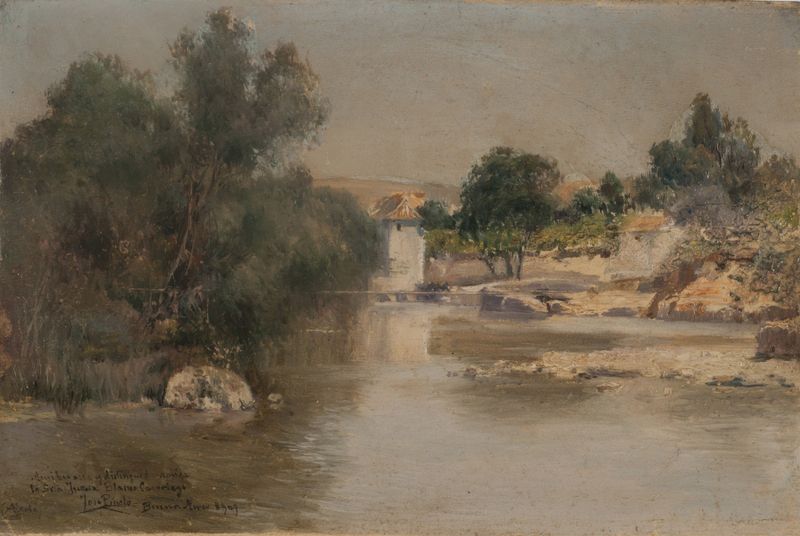
More Portrait Art
Browse all →
Las meninas
Diego Velázquez
Self-portrait with a Bandaged Ear and Pipe
Unidentified artist
Girl with a Pearl Earring
Johannes Vermeer

The Sampling Officials of the Amsterdam Drapers’ Guild, Known as ‘The Syndics’
Rembrandt van Rijn

The Hundred Guilder Print: the man seen on the back in the lower left corner
Rembrandt van Rijn

Portrait of Dr Gachet
Vincent van Gogh