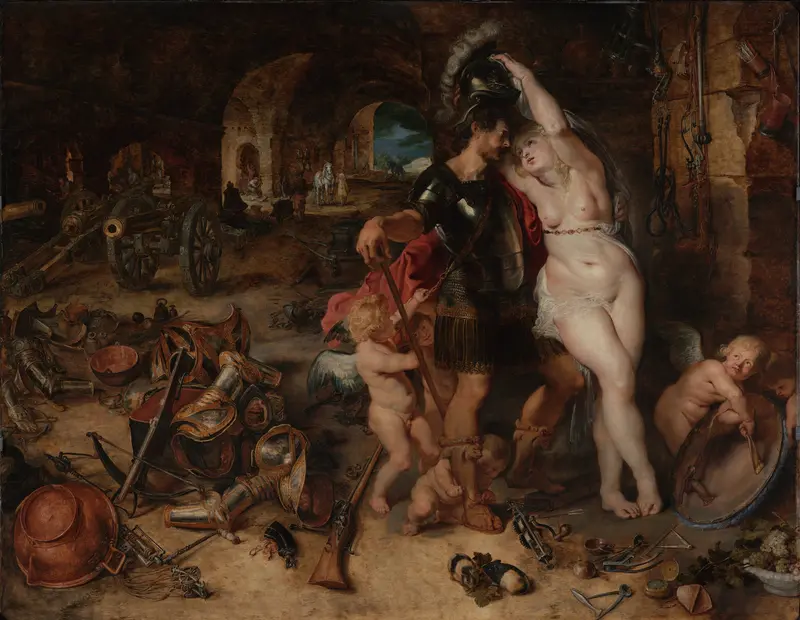
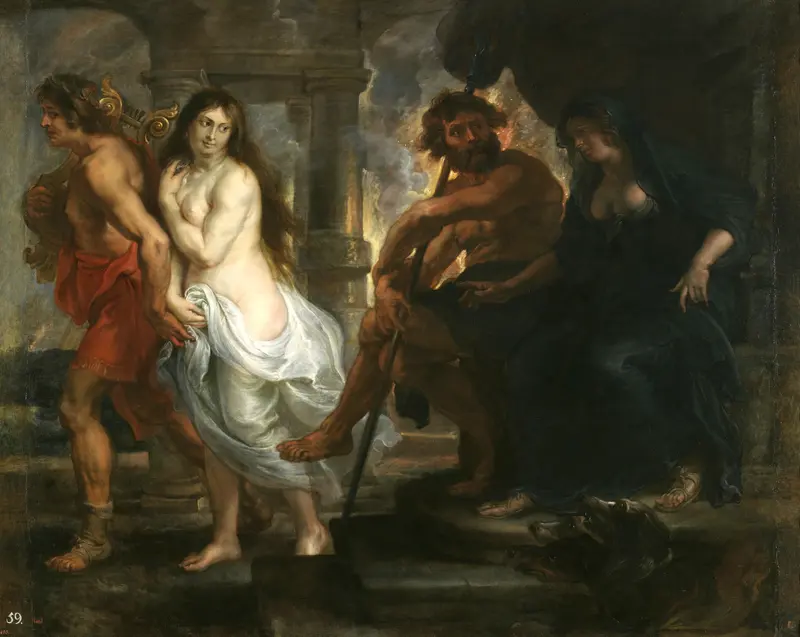
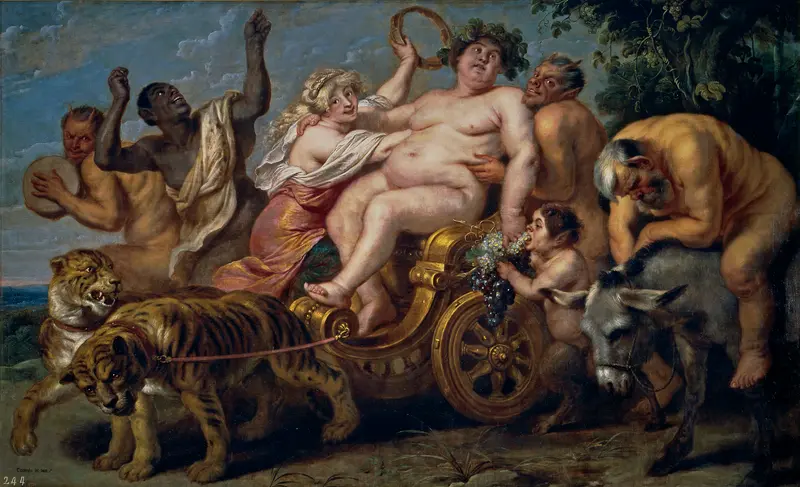
Public domain · Free to download
Greek Mythology Paintings
From Botticelli's Birth of Venus to Goya's Saturn Devouring His Son, these are the 25 most famous Greek mythology paintings of all time: gods and goddesses, heroes and nymphs, and the stories of love, jealousy and punishment that the ancient poets told. We added the most famous paintings of Venus and of the Greek gods.
For each one you get the myth it shows, who painted it and for whom, a detail to look for and where to see it today. Every image is a public-domain reproduction of the real painting, free to download and free to use.
Painters often learned these stories from the Roman poet Ovid, which is why so many of the gods here go by their Roman names: Venus for Aphrodite, Jupiter for Zeus, Bacchus for Dionysus, Diana for Artemis.
Selected and written by Pavel MazuelasUpdated October 30, 2026
Part of The Most Famous Paintings in the WorldRelated: Famous Religious Paintings, Famous Historical Paintings
The 25 most famous Greek mythology paintings of all time
Ranked from 1 to 25 by worldwide fame. Click any painting to see it up close and download it free.
No. 1Renaissance
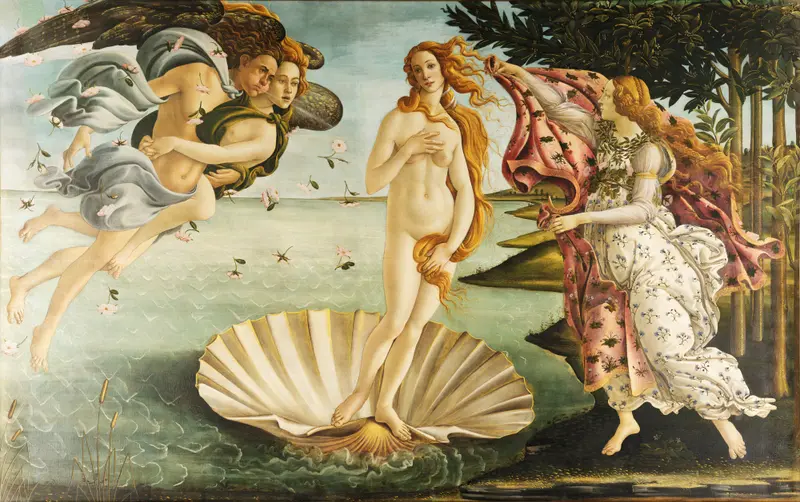
The Birth of Venus by Sandro Botticelli
Myth: Venus (Aphrodite)
c. 1485 · Tempera on canvas · 172.5 × 278.5 cm
Uffizi Gallery, Florence
Venus comes ashore on a shell, blown by two winds locked in an embrace, while a young woman hurries to wrap her in a flowered cloak. The Uffizi says the pair of winds is based on an ancient gem owned by Lorenzo the Magnificent, and that the orange trees behind are a Medici emblem, since the fruit was then called mala medica. Botticelli painted it around 1485 on canvas, a support then used for decorations in noble houses. It is in the Uffizi in Florence.
Sources: Uffizi Gallery
No. 2Renaissance
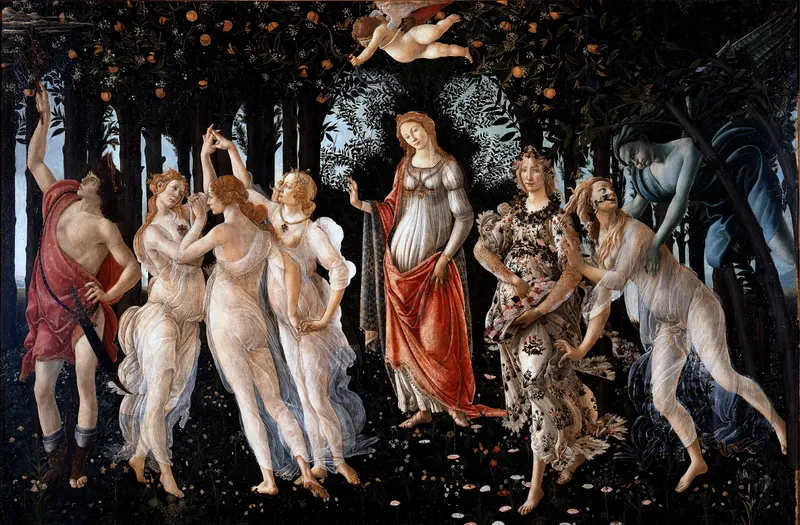
Primavera by Sandro Botticelli
Myth: Venus, Flora and the Graces
c. 1480 · Tempera on poplar panel · 207 × 319 cm
Uffizi Gallery, Florence
Botticelli's garden of the gods reads from right to left: Zephyrus seizes the nymph Chloris, who reappears transformed into Flora, goddess of spring; Venus stands at the center under a blindfolded Cupid; the three Graces dance in a circle; and Mercury, in his helmet and winged sandals, touches a cloud with his staff. The Uffizi counts at least 42 plant species, all accurately painted. Late in the 1400s it hung in a Medici house in Florence; it is now in the Uffizi.
Sources: Uffizi Gallery
No. 3Renaissance
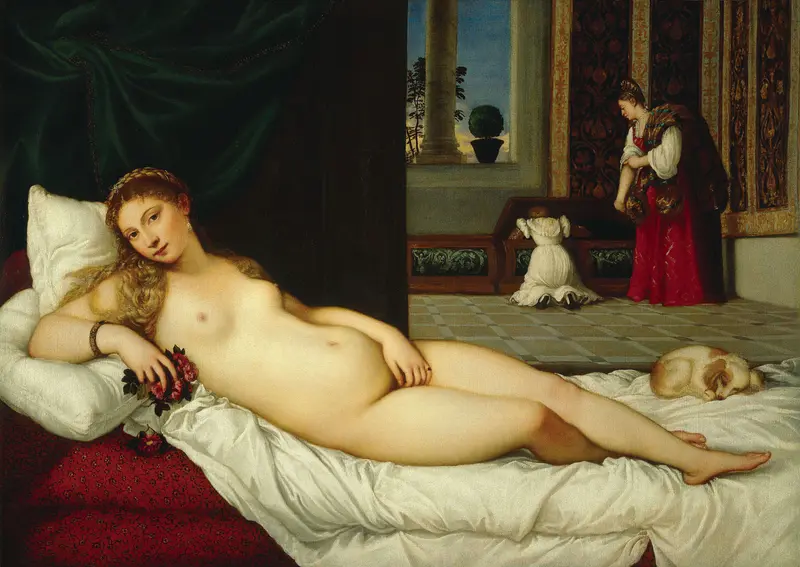
Venus of Urbino by Titian
Myth: Venus (Aphrodite)
1538 · Oil on canvas · 119 × 165 cm
Uffizi Gallery, Florence
A young woman reclines on a bed, a sleeping dog at her feet, while two maids search a chest for her clothes in the room behind. Her first owner, Guidobaldo della Rovere, called her only a “nude woman” in his letters; the name Venus comes from Giorgio Vasari. The Uffizi reads her as a bride and the dog as a sign of fidelity. After 1736 the painting was kept behind a cover painted with Sacred Love. It is in the Uffizi in Florence.
Sources: Uffizi Gallery
No. 4Romanticism
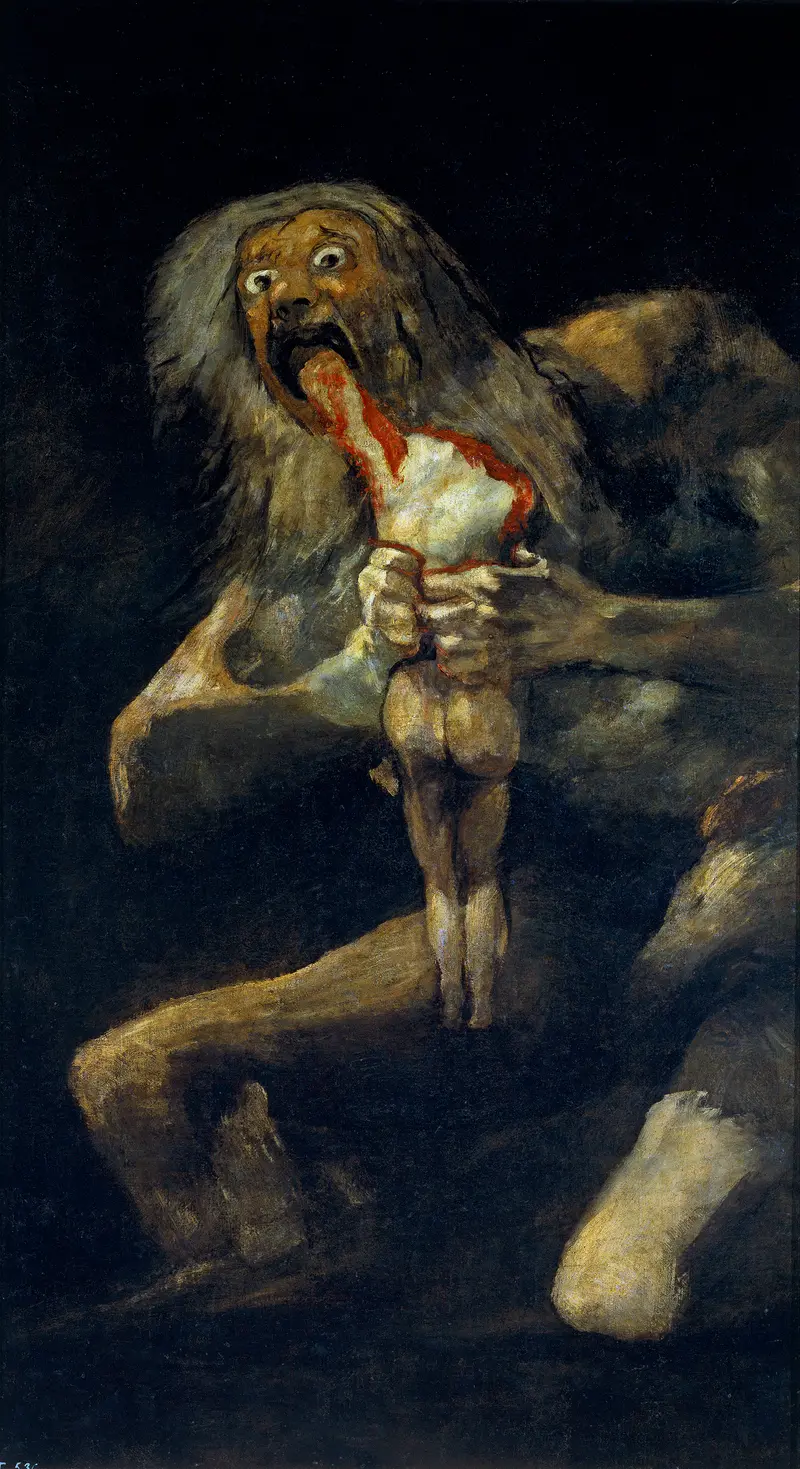
Saturn Devouring His Son by Francisco Goya
Myth: Saturn (Cronus)
1820–1823 · Mural transferred to canvas · 143.5 × 81.4 cm
Museo del Prado, Madrid
The Titan Saturn, wild-eyed, bites into the body of one of his children; a prophecy had warned him that one of them would take his throne. Goya painted it on a ground-floor wall of his house, the Quinta del Sordo, across from his portrait of Leocadia Zorrilla. The Prado suggests the god may stand for a very human fear, of losing one's power, and it also owns Rubens's Saturn of 1636–38, so the two can be compared. It is in the Museo del Prado in Madrid.
Sources: Museo del Prado
No. 5Renaissance
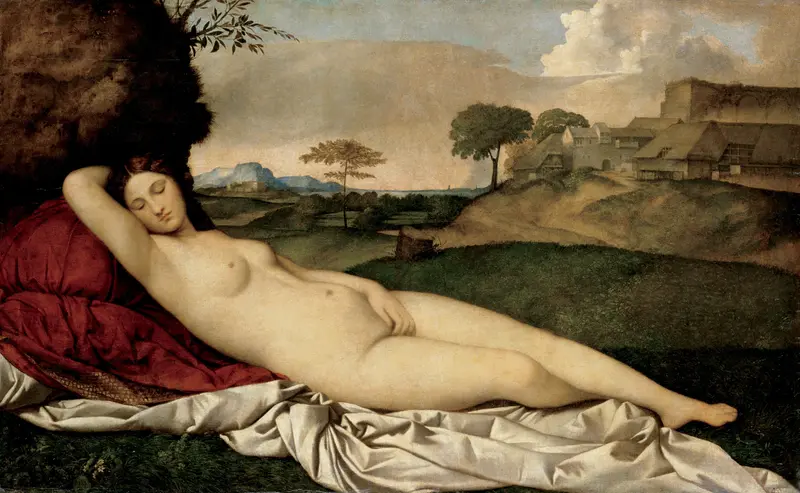
Sleeping Venus by Giorgione and Titian
Myth: Venus (Aphrodite)
c. 1508–1510 · Oil on canvas · 108.5 × 175 cm
Gemäldegalerie Alte Meister, Dresden
Venus sleeps in an open landscape, one arm behind her head, in what the Dresden museum calls the first large female nude painted in Venice. Girolamo Marcello probably commissioned it from Giorgione for his marriage in 1507, and a document of 1525 says that Giorgione began it and Titian finished it. A Cupid once sat at her feet, but he was painted over with green meadow in 1837 and survives only in X-rays. It is in the Gemäldegalerie Alte Meister in Dresden.
Sources: Gemäldegalerie Alte Meister
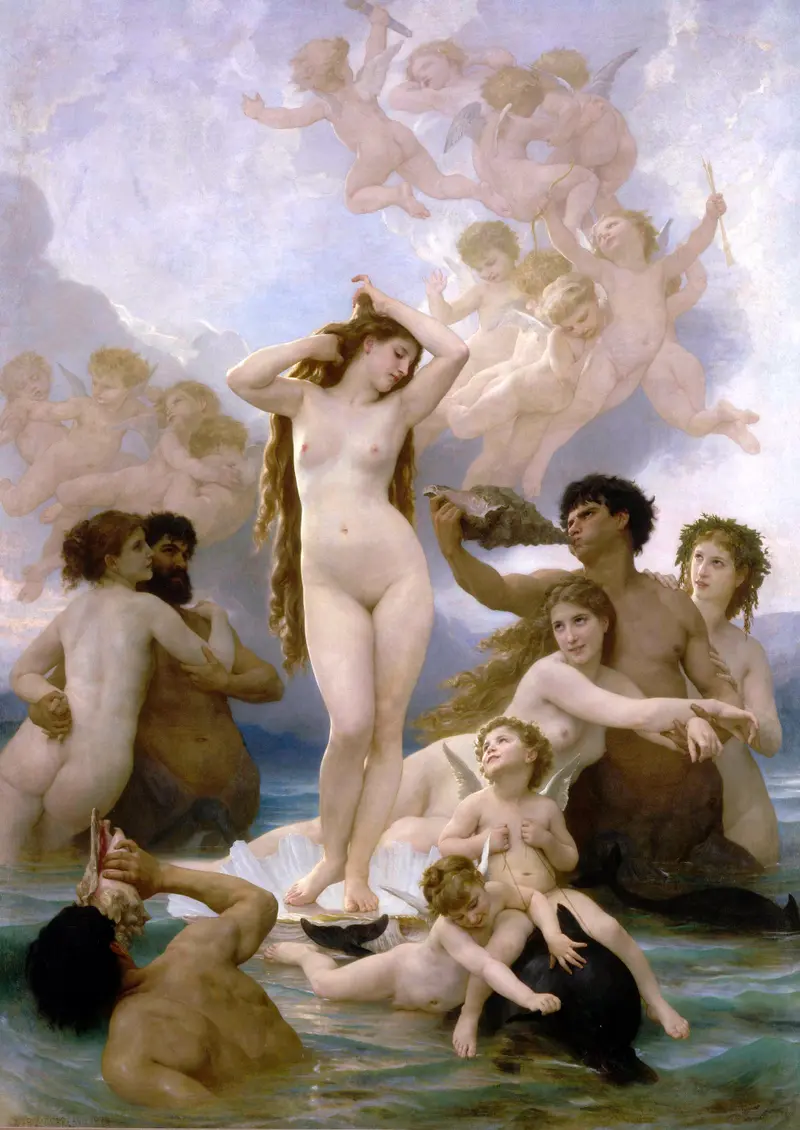
No. 6Academic
The Birth of Venus by William-Adolphe Bouguereau
Myth: Venus (Aphrodite)
1879 · Oil on canvas · 300 × 215 cm
Musée d'Orsay, Paris
Venus stands on a scallop shell, wringing out her long hair, while nymphs, tritons and a centaur crowd around her and a swarm of cupids fills the sky. William-Adolphe Bouguereau showed this huge canvas, three meters tall, at the Paris Salon of 1879, and the French state bought it from him that same year for the Musée du Luxembourg, the museum of living artists. It is in the Musée d'Orsay in Paris.
Sources: Musée d'Orsay
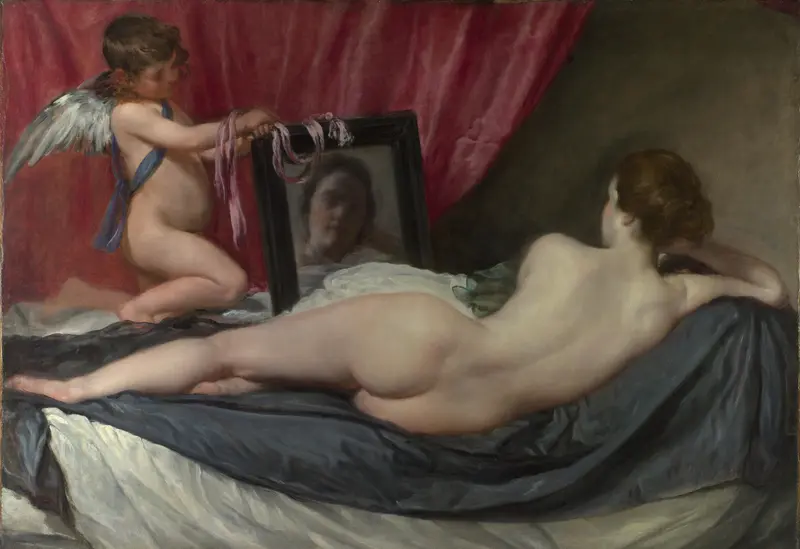
No. 7Baroque
The Rokeby Venus by Diego Velázquez
Myth: Venus (Aphrodite) and Cupid
1647–1651 · Oil on canvas · 122.5 × 177 cm
National Gallery, London
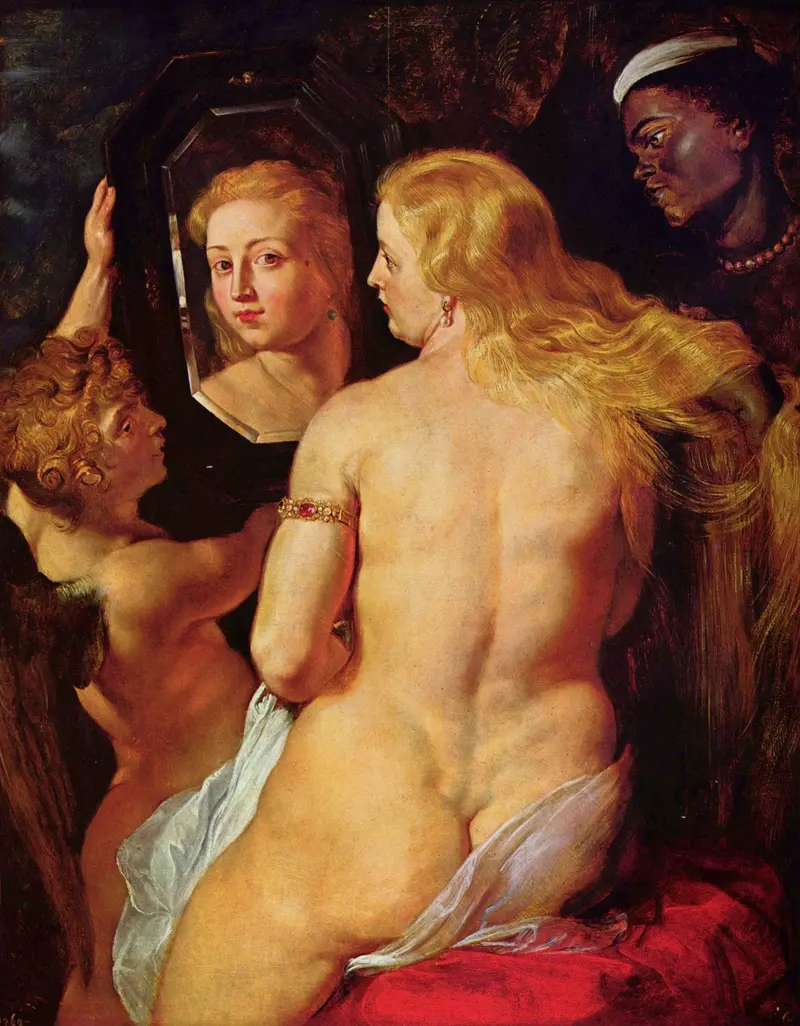
Venus lies with her back to us, gazing into a mirror held by Cupid, but her reflected face is deliberately blurred; the National Gallery suggests Velázquez did not want the goddess of beauty to be anyone recognizable. It is his only surviving female nude, a rare subject in 17th-century Spain. The minister Manuel Godoy later hung it beside Goya's two Majas, and on March 10, 1914, the suffragette Mary Richardson slashed it six times. It is in the National Gallery in London.
Sources: National Gallery
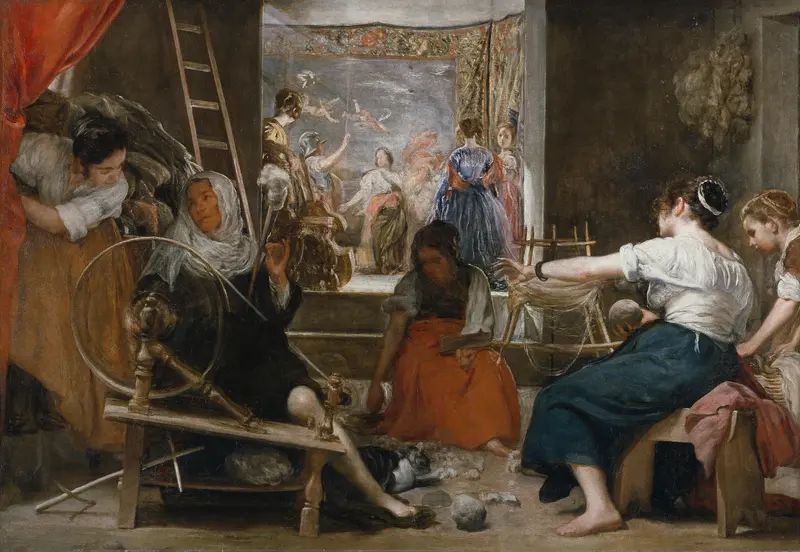
No. 8Baroque
The Spinners (The Fable of Arachne) by Diego Velázquez
Myth: Pallas (Athena) and Arachne
1655–1660 · Oil on canvas · 220 × 289 cm
Museo del Prado, Madrid
In the foreground, women spin and wind wool in a busy workshop; the real story is in the bright alcove behind, where the goddess Pallas, in her helmet, confronts the weaver Arachne, who dared to challenge her. The tapestry on the back wall copies Titian's Rape of Europa. For centuries the picture was read as a simple workshop scene, until a 1664 inventory listing a Fable of Arachne by Velázquez confirmed its subject. It is in the Museo del Prado in Madrid.
Sources: Museo del Prado
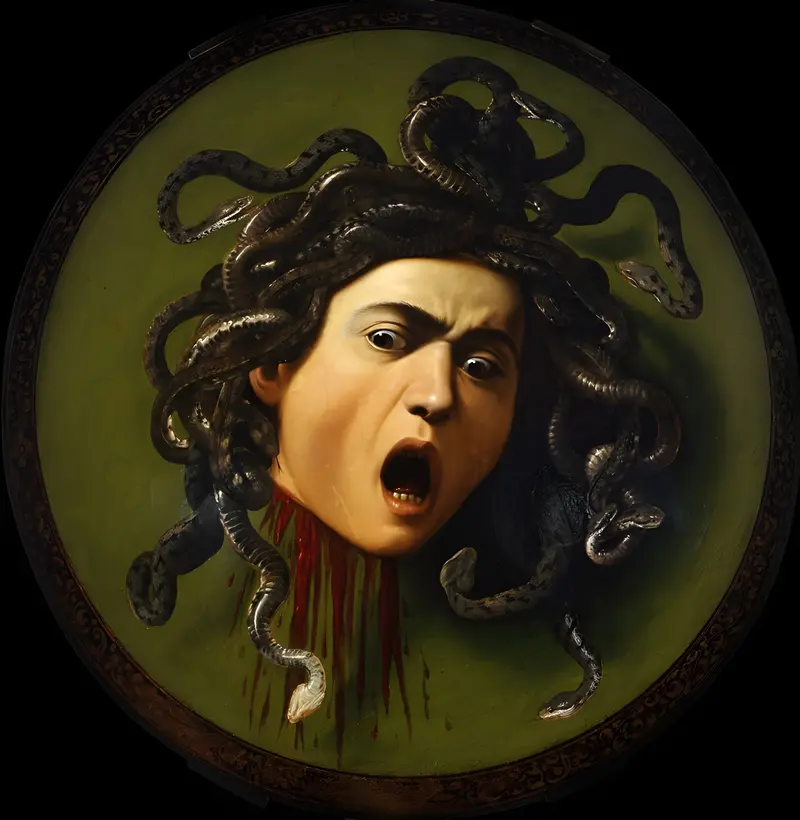
No. 9Baroque
Medusa by Caravaggio
Myth: Medusa
1595–1598 · Oil on canvas on a wooden shield · 60 × 55 cm
Uffizi Gallery, Florence
The severed head of Medusa screams, her hair a knot of writhing snakes, caught at the moment between life and death. Caravaggio painted it on canvas stretched over a wooden parade shield, a gift from Cardinal Francesco Maria del Monte to the Medici grand duke of Tuscany. It was first kept in the Medici armory without any attribution and was registered as Caravaggio's work only in 1631. It is in the Uffizi in Florence.
Sources: Uffizi Gallery
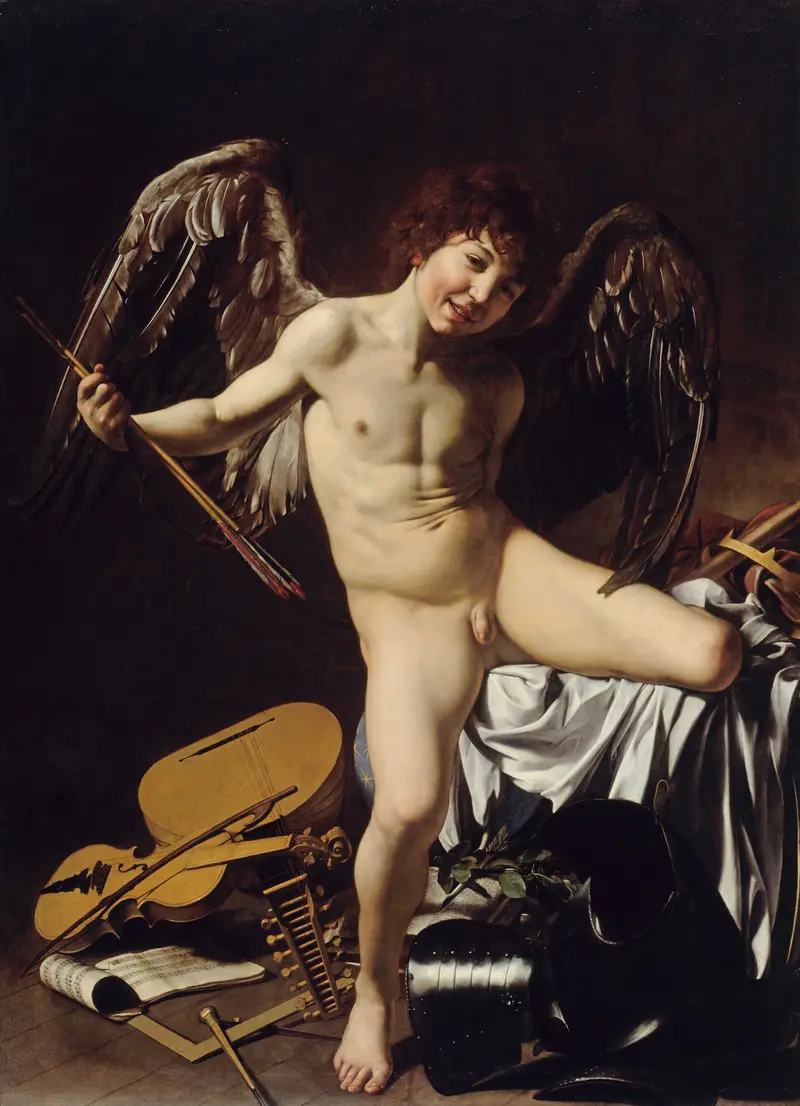
No. 10Baroque
Amor Vincit Omnia by Caravaggio
Myth: Cupid (Eros)
1601–1602 · Oil on canvas · 156.5 × 113.3 cm
Gemäldegalerie, Berlin
A grinning Cupid climbs over a heap of fallen things, a lute, a violin, a compass, armor, a crown and a scepter, to show, as Virgil wrote, that love conquers all. Caravaggio painted it in 1601–02 for the Roman collector Vincenzo Giustiniani, using a boy of the common people as his model, and X-rays show he added the starry globe later. His guests may have met it at the end of a tour of his gallery, revealed from behind a curtain. It is in the Gemäldegalerie in Berlin.
Sources: Gemäldegalerie
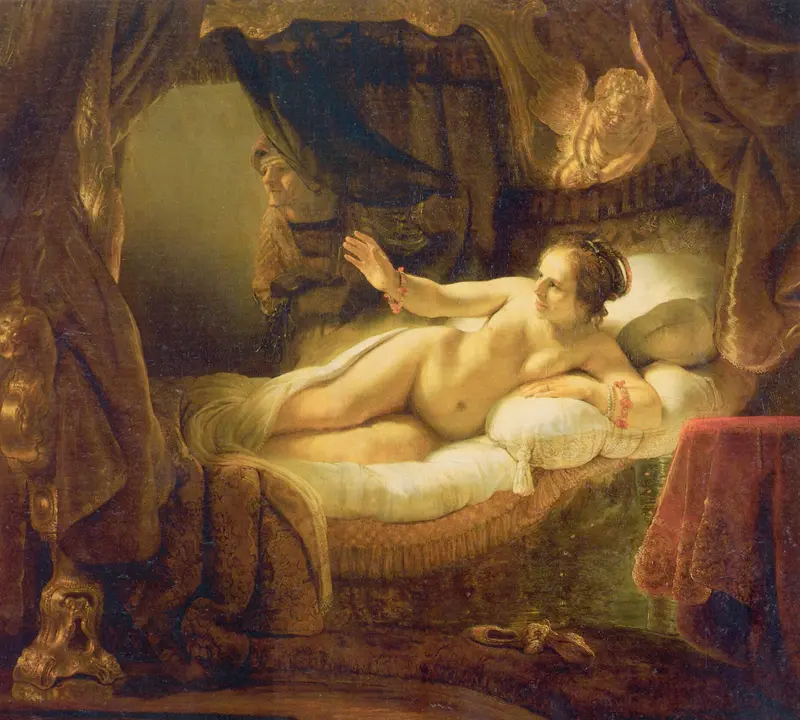
No. 11Dutch Golden Age
Danaë by Rembrandt
Myth: Danaë and Zeus
1636 · Oil on canvas · 185 × 202.5 cm
Hermitage Museum, St. Petersburg
Danaë, shut away by her father, the king of Argos, raises her hand as a golden light floods in, the form in which Zeus came to her. Rembrandt painted it in 1636 and kept it in his own house for years, reworking the central part in the early 1640s. On June 15, 1985, a visitor threw acid on the canvas and slashed it twice; Hermitage restorers spent twelve years repairing it. It is in the Hermitage Museum in St. Petersburg.
Sources: Hermitage Museum

No. 12Northern Renaissance
Landscape with the Fall of Icarus by Pieter Bruegel the Elder (attributed)
Myth: Icarus
Oil on canvas · 73.5 × 112 cm
Royal Museums of Fine Arts of Belgium, Brussels
A farmer plows, a shepherd gazes at the sky and a ship sails on; only in the lower right corner do two flailing legs show where Icarus has just fallen into the sea. The design is Pieter Bruegel the Elder's, but the museum puts a question mark after his name: the canvas may be an early copy of a lost original. The painting inspired W. H. Auden's poem “Musée des Beaux Arts.” It belongs to the Royal Museums of Fine Arts of Belgium in Brussels.
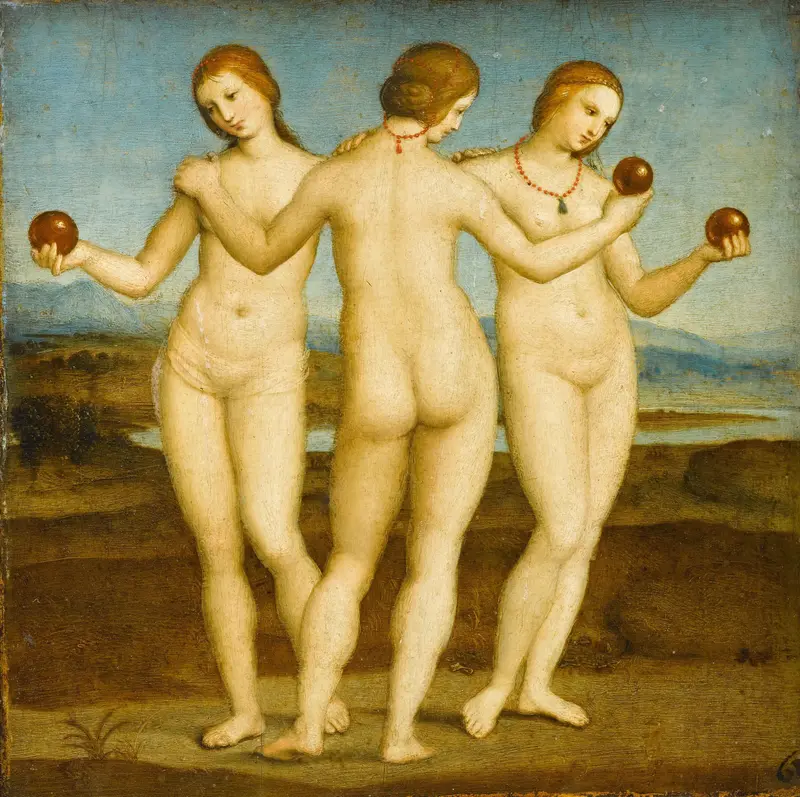
No. 13Renaissance
The Three Graces by Raphael
Myth: The Three Graces
c. 1504–1505 · Oil on poplar panel · 17 × 17 cm
Musée Condé, Chantilly
Three nude women, the Graces, stand in a close group, each holding a golden ball. Raphael painted the tiny panel, about 17 centimeters square, in Florence around 1504–05, and he took the grouping from an ancient marble then in Siena; scans show that at first only one figure held an apple. The National Gallery in London says it was probably made as a pair with his Dream of a Knight. It is in the Musée Condé in Chantilly.
Sources: Musée Condé
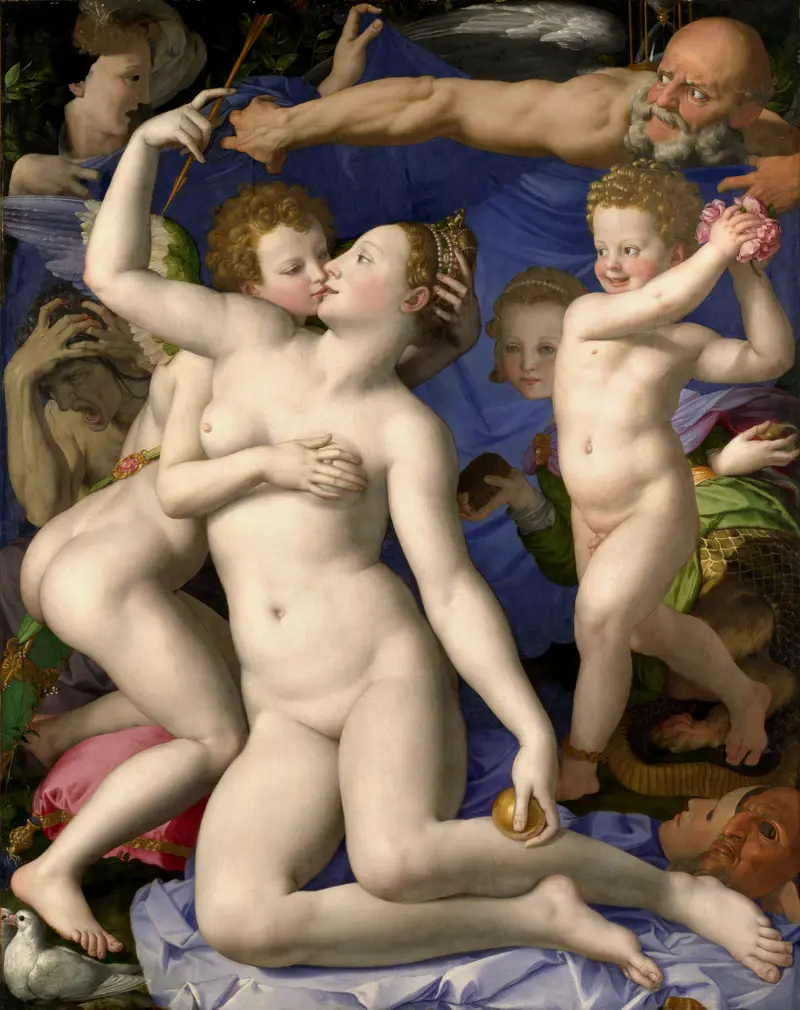
No. 14Mannerism
Venus, Cupid, Folly and Time by Agnolo Bronzino
Myth: Venus (Aphrodite) and Cupid
c. 1545 · Oil on panel · 146.1 × 116.2 cm
National Gallery, London
Venus kisses her son Cupid while quietly stealing an arrow from his quiver, as allegorical figures crowd around them, among them Time, an old man pulling back a blue curtain. Bronzino painted it around 1545 for Cosimo I de' Medici, who probably sent it to King Francis I of France as a gift. Giorgio Vasari praised “a picture of singular beauty” sent to the king, and the National Gallery thinks this is the one. It is in the National Gallery in London.
Sources: National Gallery
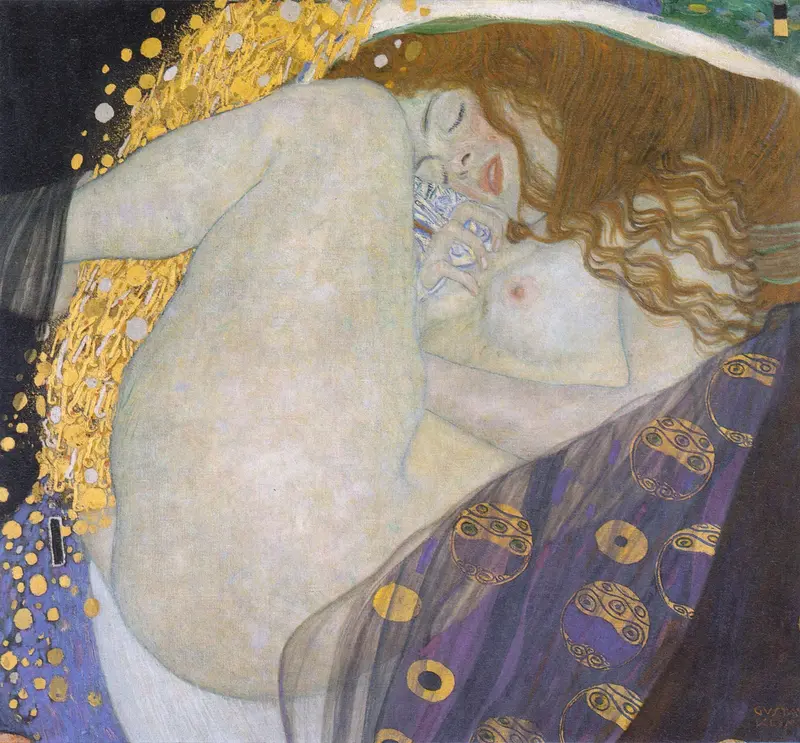
No. 15Symbolism
Danaë by Gustav Klimt
Myth: Danaë and Zeus
1907–1908 · Oil on canvas · 77 × 83 cm
Private collection
Danaë curls up asleep as Zeus pours into her lap in a shower of gold. Gustav Klimt finished the painting for the 1908 Kunstschau in Vienna, where the collector Eduard Ast bought it for 8,000 crowns and had an oval room designed for it in his villa. The Klimt Foundation says Klimt turned a traditional scene of rape into an act of love. It is in a private collection and was last shown in public in 2008.

No. 16Renaissance
Flora by Titian
Myth: Flora
c. 1517 · Oil on canvas · 79.7 × 63.5 cm
Uffizi Gallery, Florence
A young woman with copper-blond hair, the shade now called Titian red, holds out roses, violets and jasmine as her white robe slips from one shoulder. Titian painted her around 1517, and the name Flora, after the nymph who became the goddess of spring, was given later by the painter and writer Joachim von Sandrart. The Uffizi counts her among Venice's Belle, paintings of ideal beauties. It reached Florence in 1793 and is in the Uffizi.
Sources: Uffizi Gallery
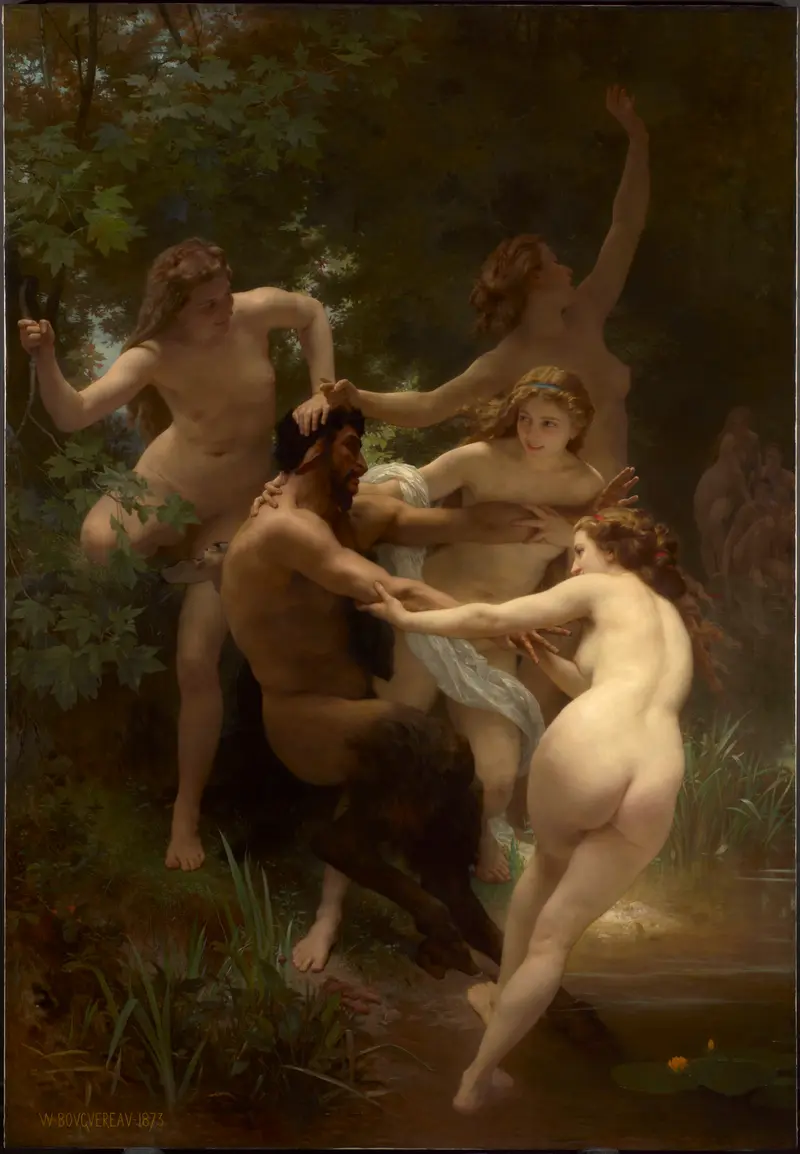
No. 17Academic
Nymphs and Satyr by William-Adolphe Bouguereau
Myth: Nymphs and a satyr
1873 · Oil on canvas · 260.4 × 182.9 cm
Clark Art Institute, Williamstown, Massachusetts
Four nymphs try to drag a reluctant satyr into a woodland pool. At about 2.6 meters tall it is the largest painting in the Clark's collection. After the Paris Salon of 1873 it hung for almost twenty years in the bar of the Hoffman House hotel in New York, where it served as a trademark for the hotel and its cigars. Sterling Clark bought it in 1942 and showed it for a 25-cent admission to raise money for the Fighting French. It is in the Clark Art Institute in Williamstown, Massachusetts.
Sources: Clark Art Institute
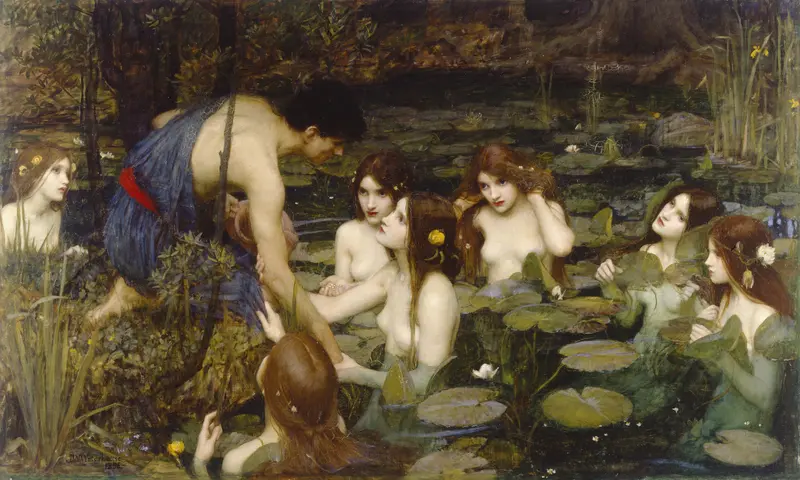
No. 18Pre-Raphaelite
Hylas and the Nymphs by John William Waterhouse
Myth: Hylas and the nymphs
1896 · Oil on canvas · 98.2 × 163.3 cm
Manchester Art Gallery, Manchester
Hylas, sent by the Argonauts to fetch water, leans toward a spring as a nymph takes hold of his arm, while six more, nearly identical, rise from the lily pads around her. John William Waterhouse painted it in 1896, and the Manchester Art Gallery bought it from him that same year. In 2018 the gallery took it down for a week to prompt a conversation about how it displays and interprets art, a move that drew accusations of censorship. It is in the Manchester Art Gallery.
Sources: Manchester Art Gallery
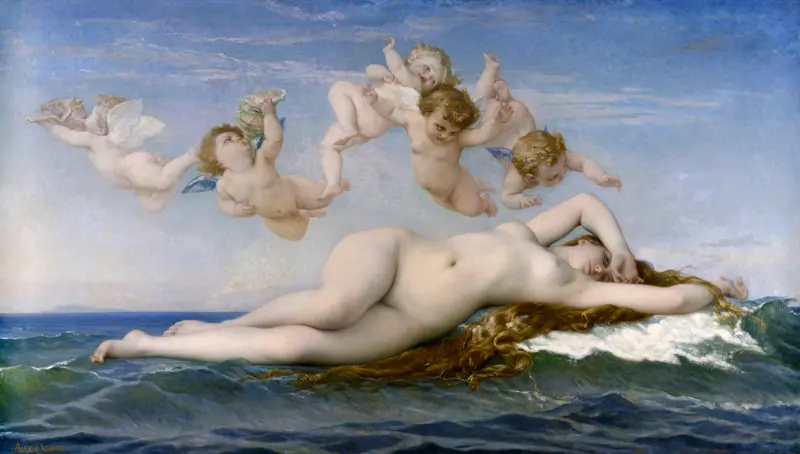
No. 19Academic
The Birth of Venus by Alexandre Cabanel
Myth: Venus (Aphrodite)
1863 · Oil on canvas · 130 × 225 cm
Musée d'Orsay, Paris
Venus lies stretched across the waves, born of the sea foam and carried ashore, while a flight of cupids circles overhead. Alexandre Cabanel's painting was one of the great successes of the 1863 Salon, where Napoleon III bought it, the same year Manet's Luncheon on the Grass was shown among the rejected works. The novelist Émile Zola mocked the goddess as made of “pink and white marzipan.” It is in the Musée d'Orsay in Paris.
Sources: Musée d'Orsay
No. 20Renaissance
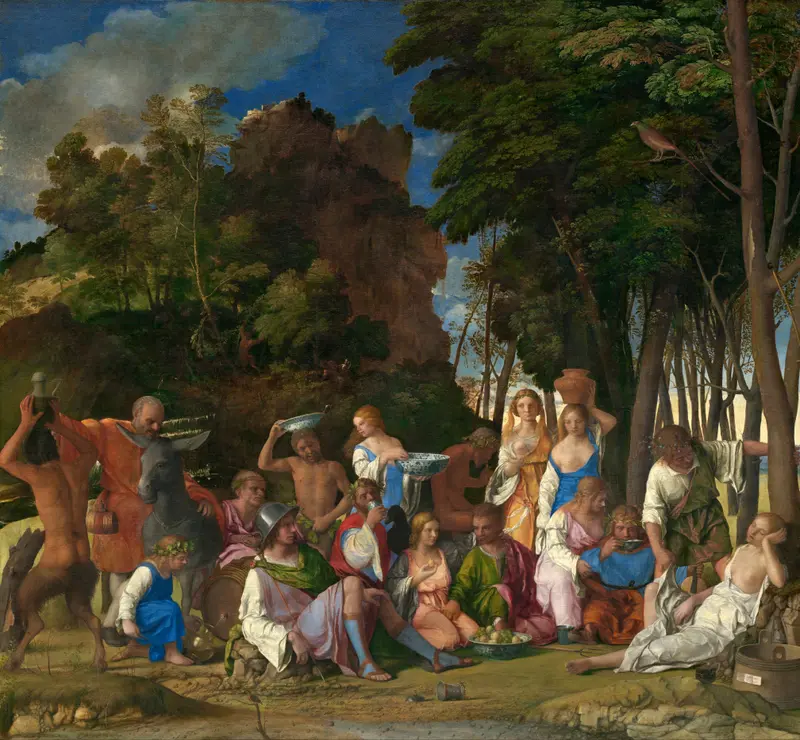
The Feast of the Gods by Giovanni Bellini and Titian
Myth: The gods at a feast, from Ovid's Fasti
1514/1529 · Oil on canvas · 170.2 × 188 cm
National Gallery of Art, Washington, DC
Gods and their companions feast in a woodland clearing, while at the right Priapus bends over the sleeping nymph Lotis beside a wooden tub, a scene from Ovid's Fasti. Giovanni Bellini signed and dated the tub in 1514, probably for Alfonso I d'Este, Duke of Ferrara; after Bellini's death, Dosso Dossi and Titian reworked the picture and added the rocky landscape behind. It came to the National Gallery of Art with the Widener Collection in 1942. It is in the National Gallery of Art in Washington, DC.
No. 21Baroque
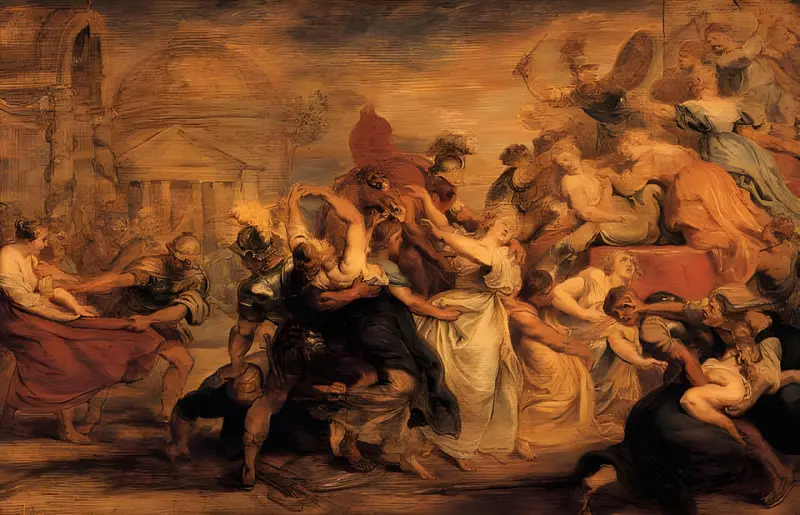
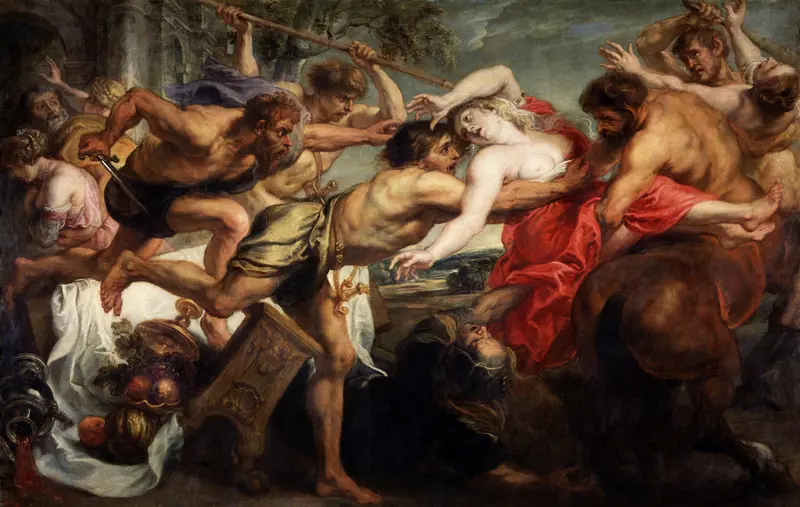
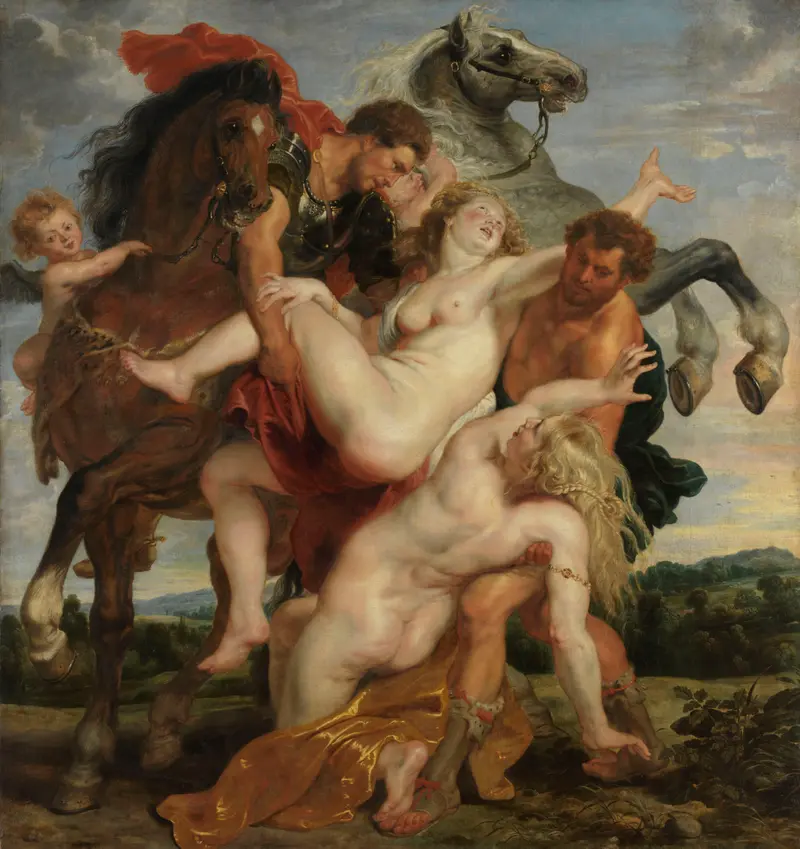
The Rape of the Daughters of Leucippus by Peter Paul Rubens
Myth: Castor and Pollux
c. 1618 · Oil on canvas · 224 × 210.5 cm
Alte Pinakothek, Munich
The twins Castor and Pollux carry off Hilaeira and Phoebe, the daughters of King Leucippus, on rearing horses shortly before the women were to be married. Peter Paul Rubens painted it around 1618 with Jan Wildens, and the museum says its many-sided composition shows painting outdoing sculpture. In the myth the abduction ends in death, and the twins are finally turned into stars. It came to Munich in 1806 and is in the Alte Pinakothek.
Sources: Alte Pinakothek
No. 22Renaissance
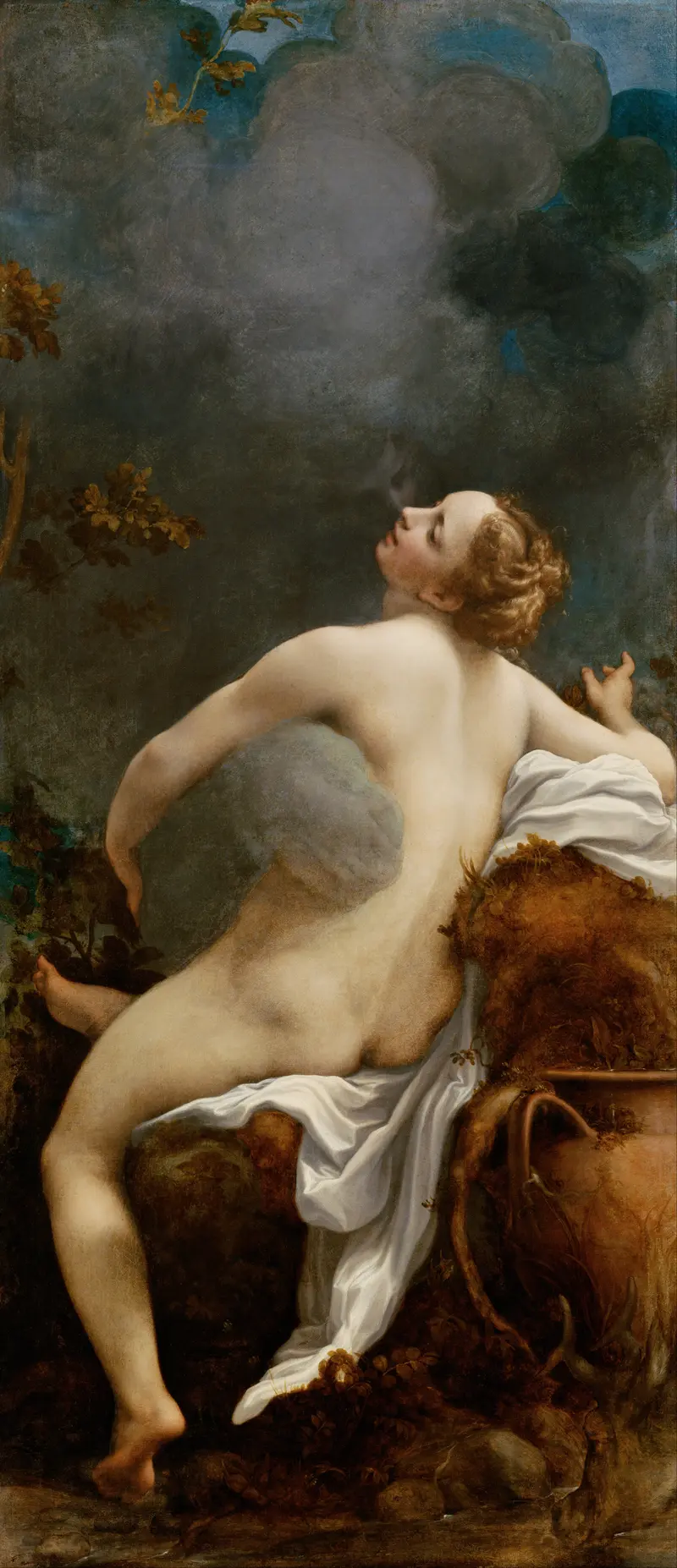
Jupiter and Io by Correggio
Myth: Jupiter (Zeus) and Io
c. 1530 · Oil on canvas · 162 × 73.5 cm
Kunsthistorisches Museum, Vienna
Jupiter, hidden in a dark cloud, embraces the nymph Io, seen from behind; look for the god's face glimmering in the mist above hers. Correggio painted it around 1530 for Federico Gonzaga, Duke of Mantua, as one of a series of Jupiter's loves, and the duke most likely gave it to Emperor Charles V. The deer drinking at the lower right, the museum notes, adds a touch of Christian decorum. It is in the Kunsthistorisches Museum in Vienna.
Sources: Kunsthistorisches Museum
No. 23Pre-Raphaelite
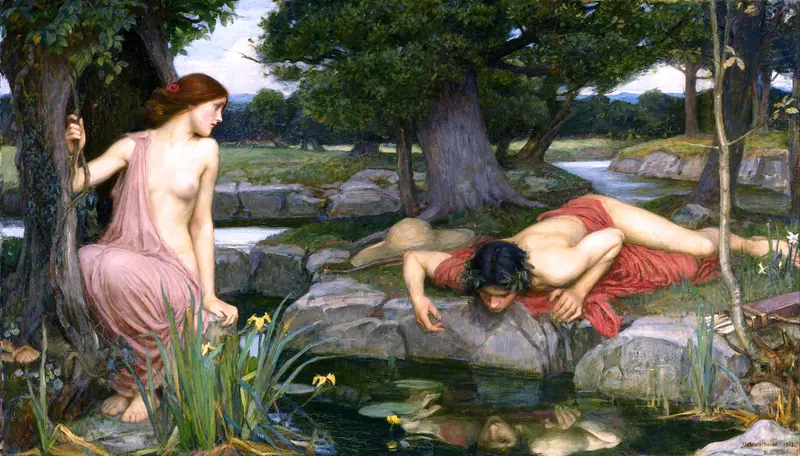
Echo and Narcissus by John William Waterhouse
Myth: Echo and Narcissus
1903 · Oil on canvas · 109 × 189 cm
Walker Art Gallery, Liverpool
The nymph Echo gazes across a stream at Narcissus, who lies on the bank staring at his own reflection and ignores her; in the myth she pines away until only her voice is left. John William Waterhouse painted it in 1903, and her cramped pose, the gallery says, conveys the frustration of unrequited love, one of his favorite themes. The Walker Art Gallery bought it that same year, and it is still in the Walker in Liverpool.
Sources: Walker Art Gallery
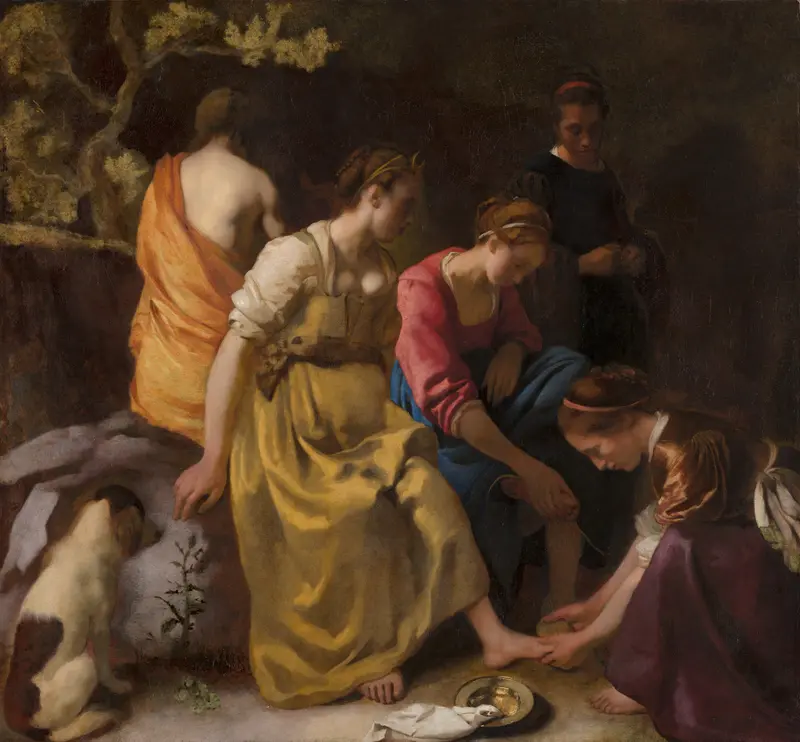
No. 24Dutch Golden Age
Diana and Her Nymphs by Johannes Vermeer
Myth: Diana (Artemis)
c. 1653–1654 · Oil on canvas · 97.8 × 104.6 cm
Mauritshuis, The Hague
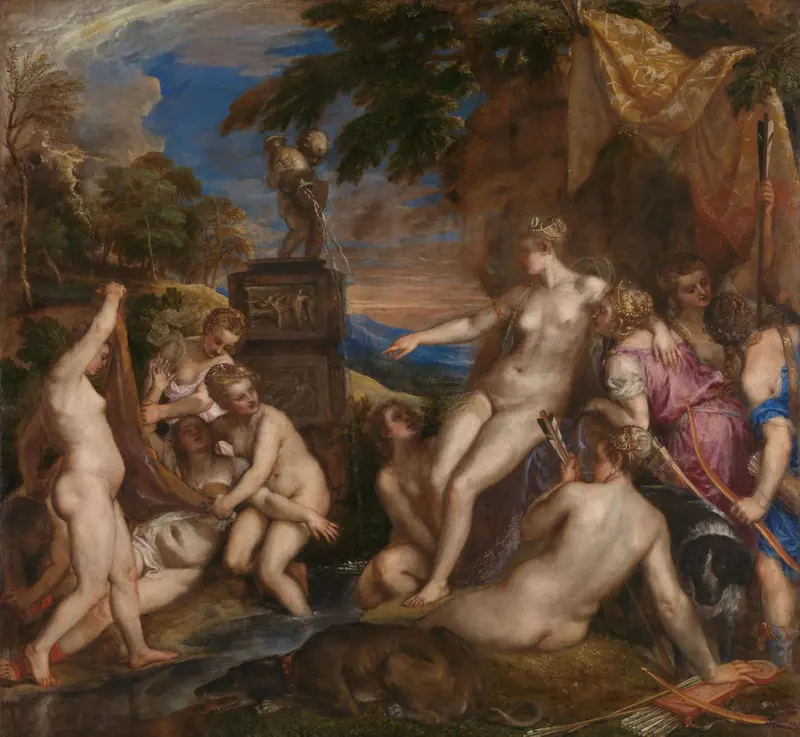
The goddess Diana, marked by the crescent diadem in her hair, rests with four nymphs after the hunt while one kneels to wash her feet. It is one of Johannes Vermeer's earliest known works, painted around 1653–54. When the Mauritshuis bought it in 1876 it was credited to Nicolaes Maes, until in 1885 his monogram turned out to be forged, with Vermeer's own signature hidden beneath. It is in the Mauritshuis in The Hague.
Sources: Mauritshuis

No. 25Rococo
Diana Leaving Her Bath by François Boucher
Myth: Diana (Artemis)
1742 · Oil on canvas · 57 × 73 cm
Musée du Louvre, Paris
Diana sits on blue drapery after her bath, a companion nymph at her feet, with two hunting dogs and the day's game beside them. François Boucher showed it at the Salon of 1742, and the Louvre bought it in 1852 for 3,200 francs. Pierre-Auguste Renoir later called it “the first picture that took my fancy” and said he loved it all his life. It is in the Musée du Louvre in Paris.
Sources: Musée du Louvre
Want to see more? Browse every Greek mythology painting in the collection.
Browse all 3,027 Greek mythology paintingsFamous Venus paintings
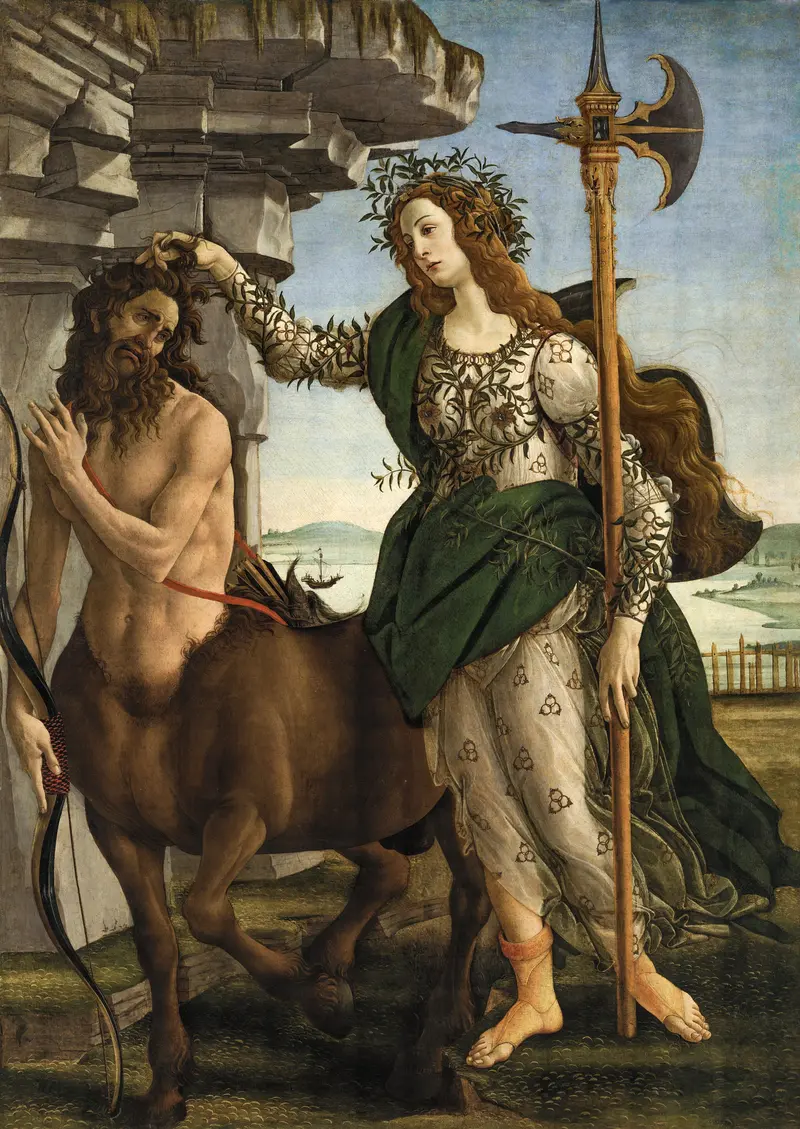
Six more famous paintings of Venus, from Botticelli's Venus and Mars to Gérôme's Venus Rising.
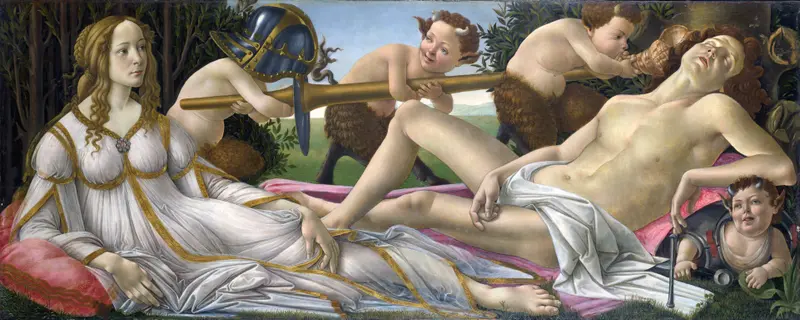
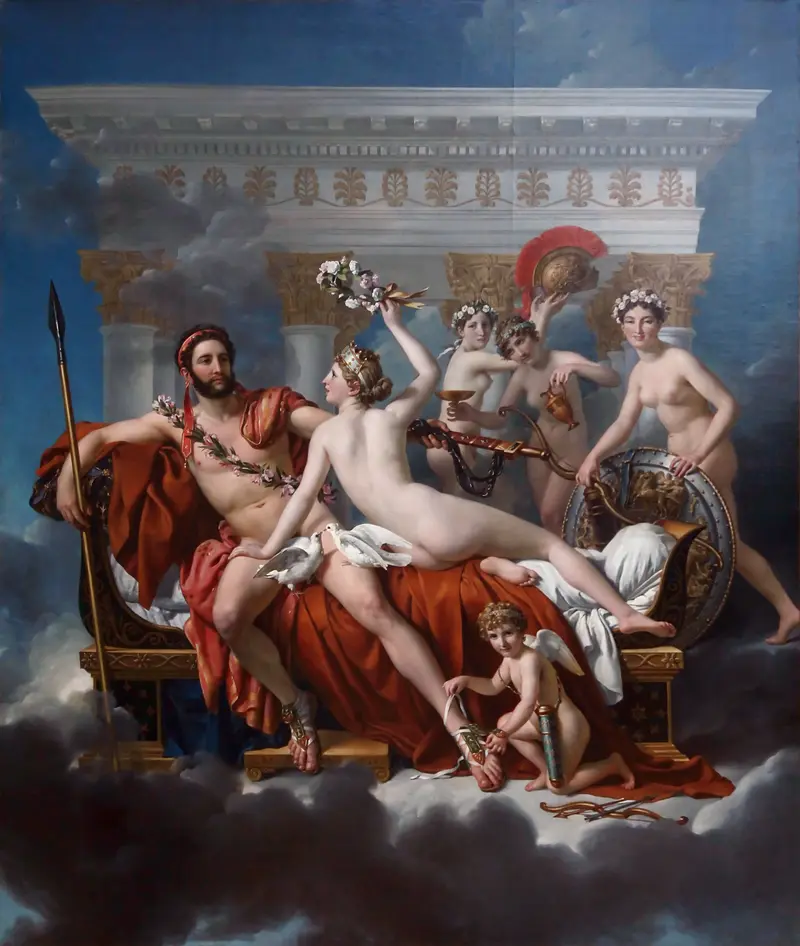
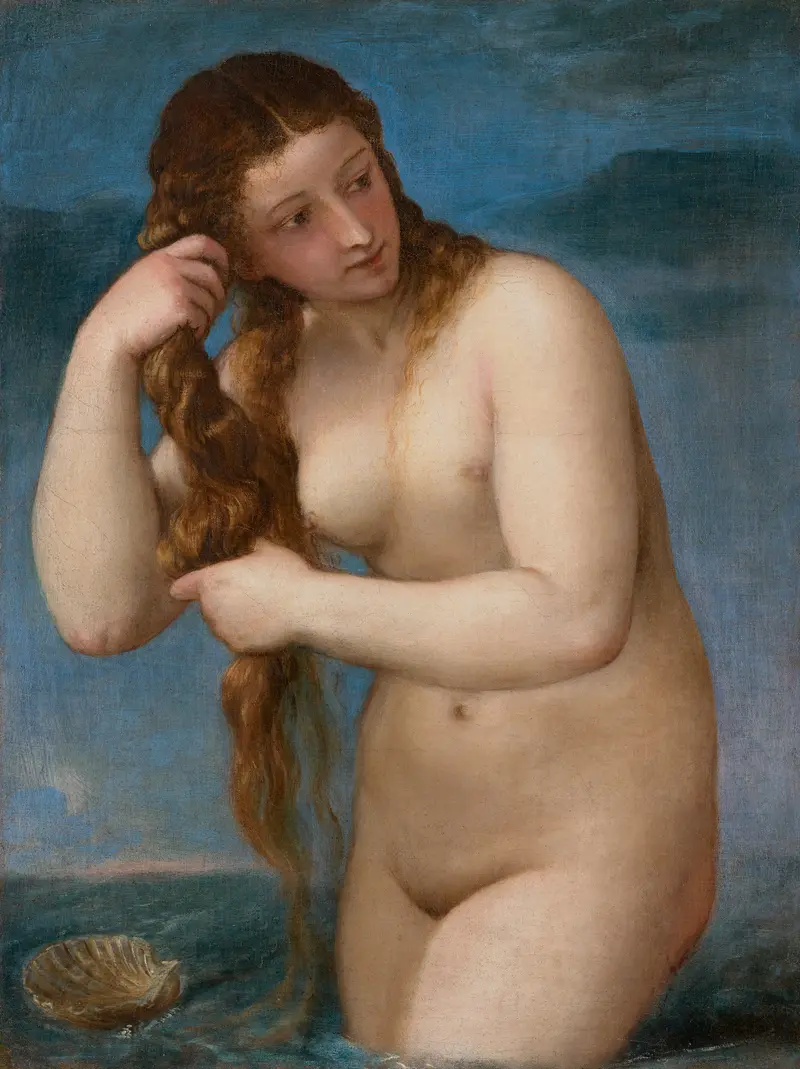
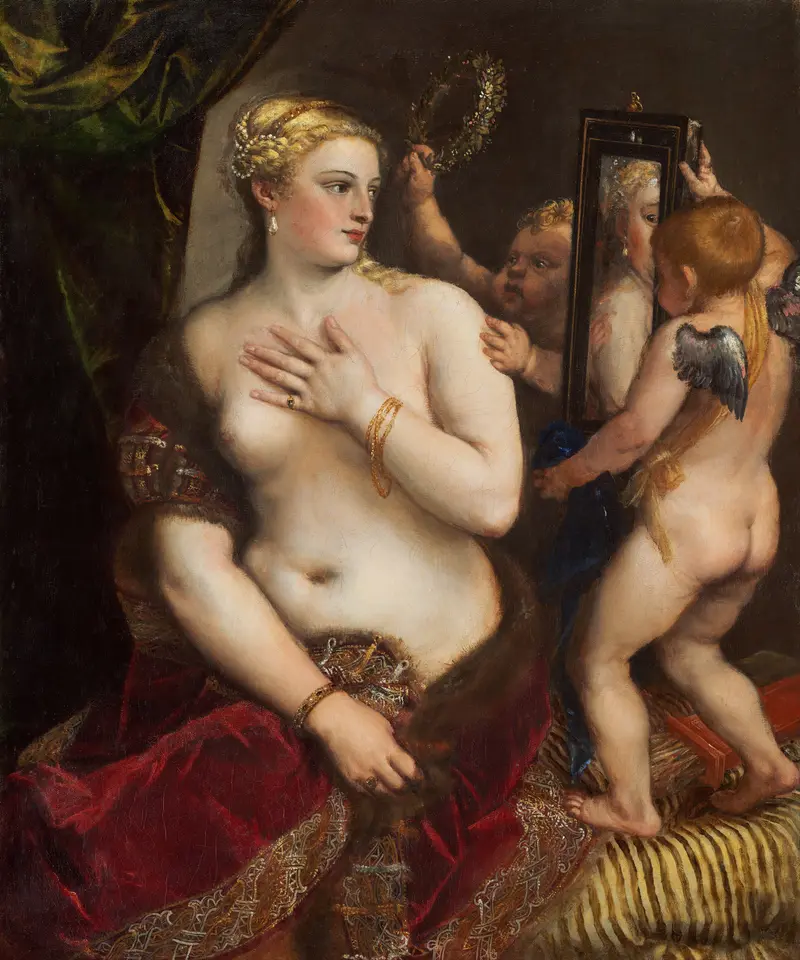
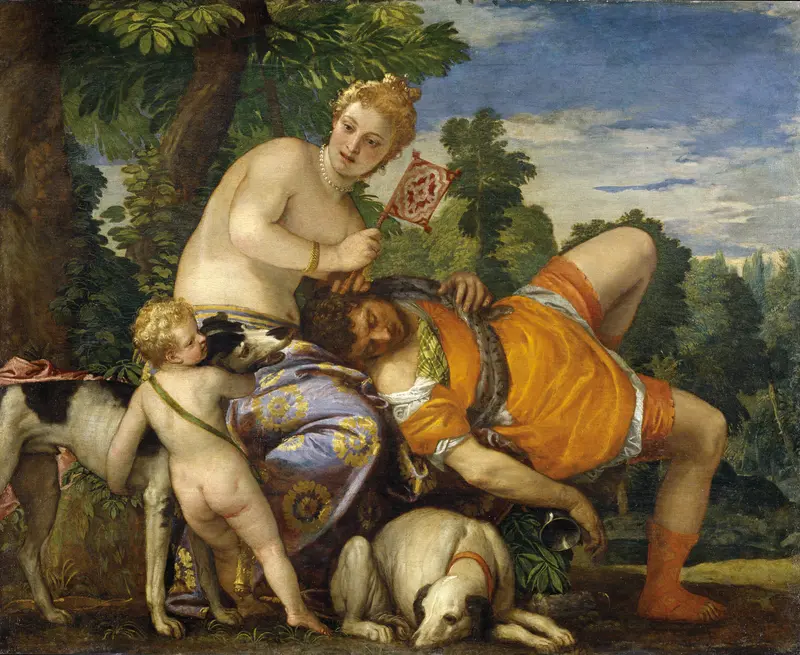
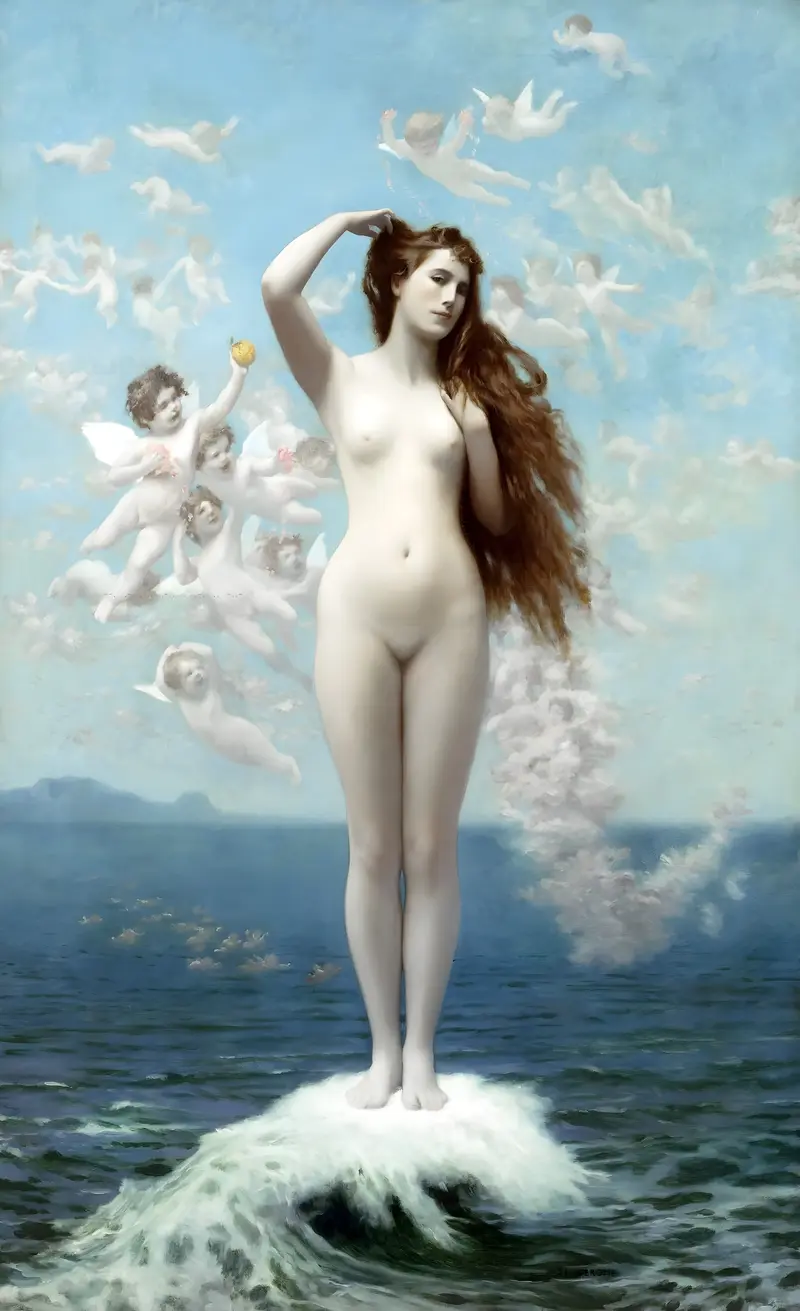
Paintings of the Greek gods
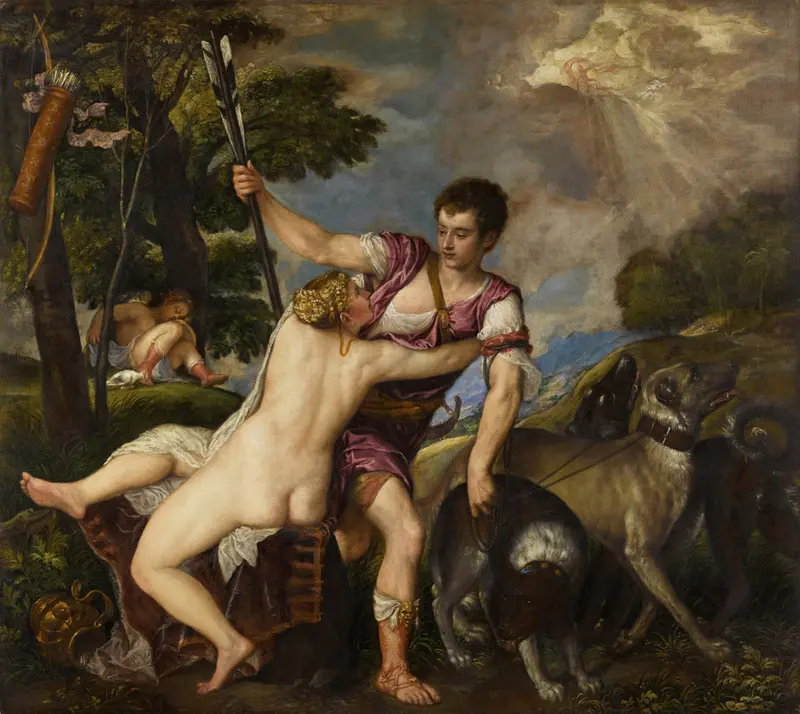
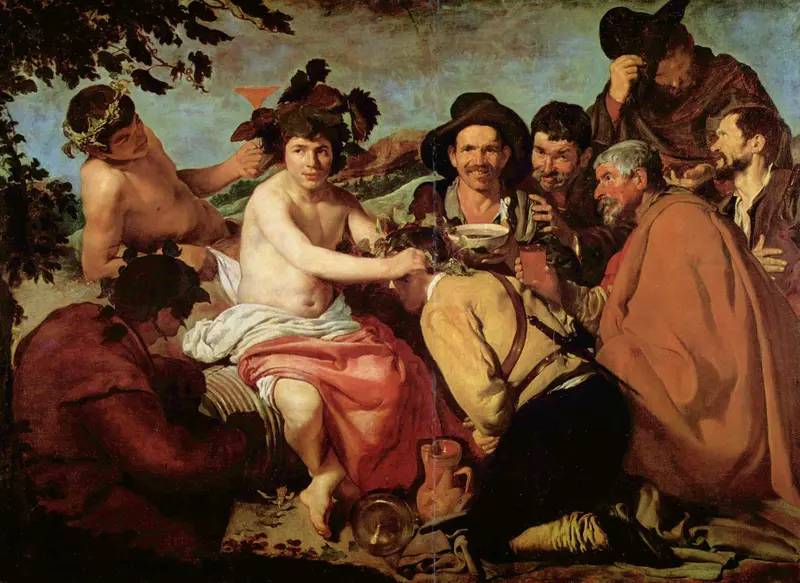
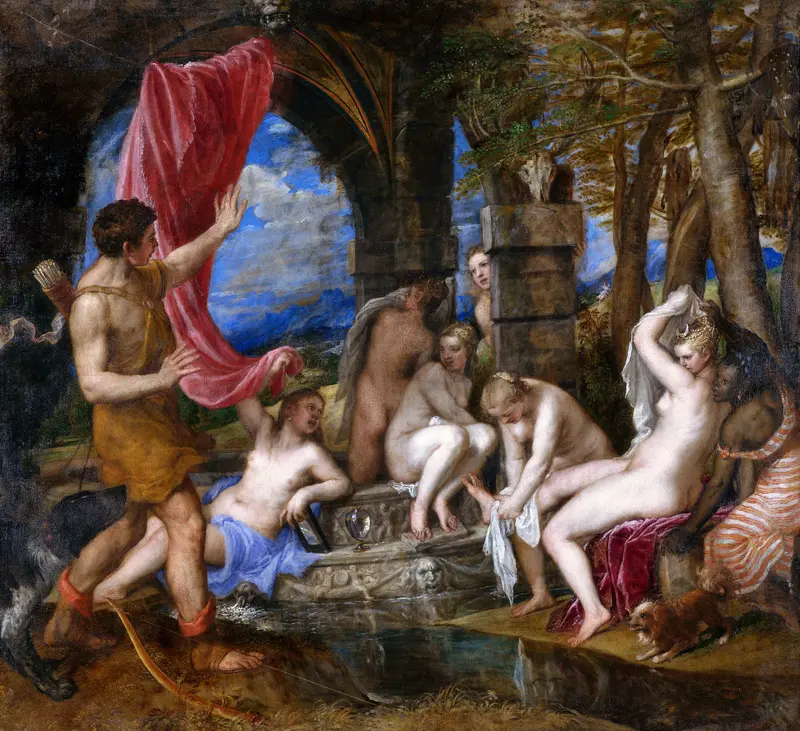
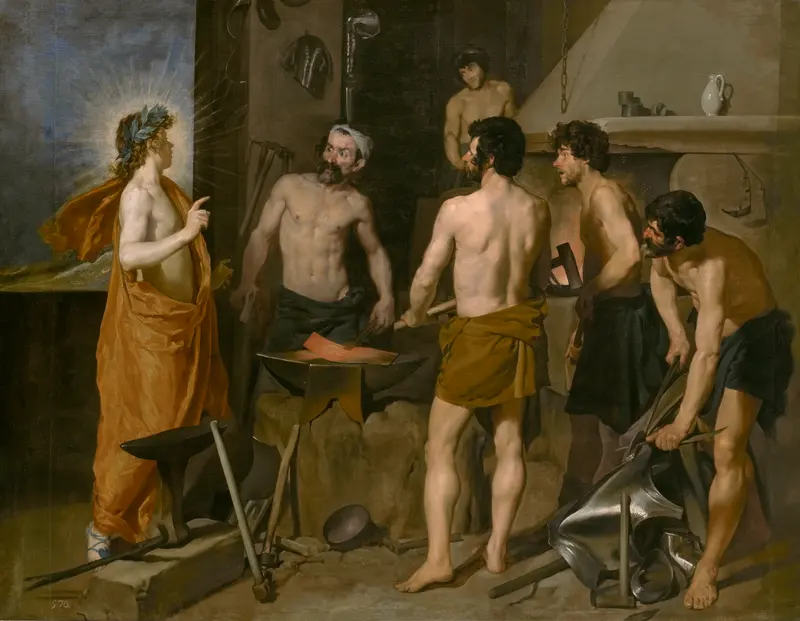
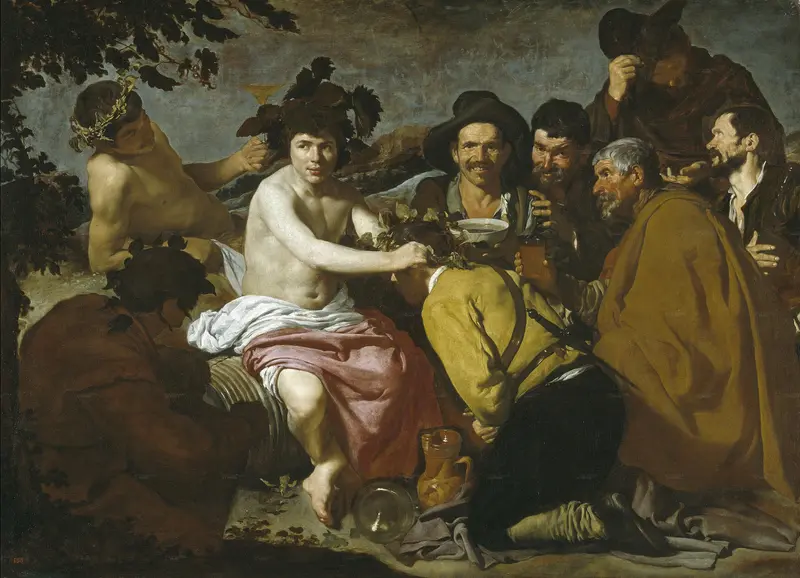
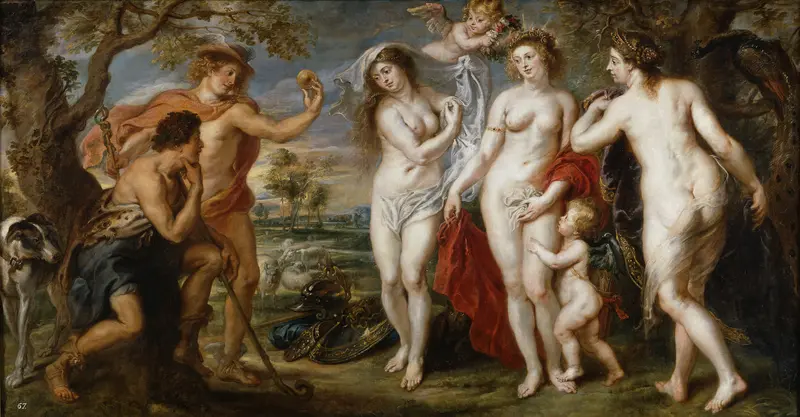
Six famous paintings of the Greek gods, from Titian's Bacchus and Ariadne to Rubens's Judgement of Paris.
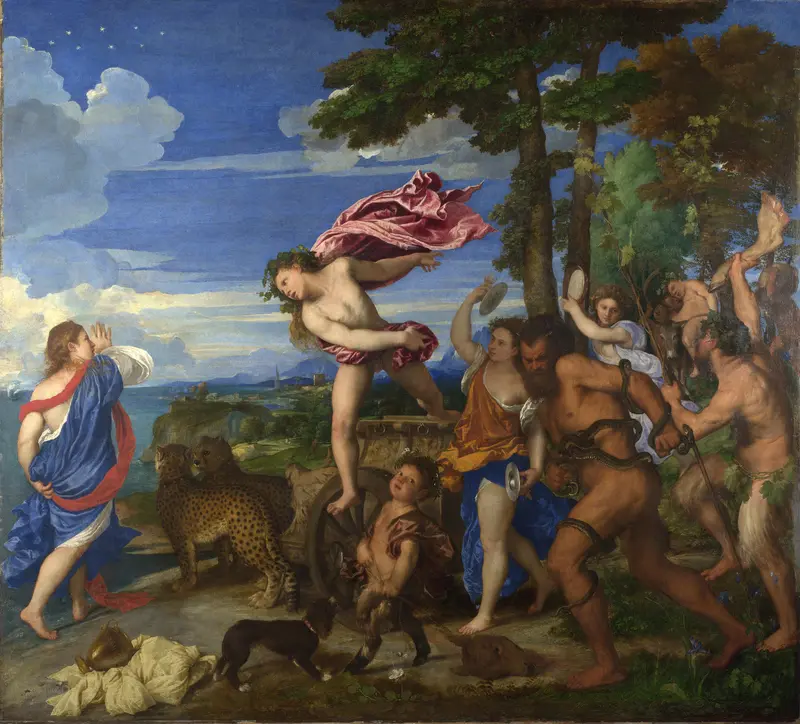
Famous painters of Greek mythology
Famous painters of the Greek myths, from Botticelli and Titian to Bouguereau and Waterhouse. Each link opens all their paintings.
- Sandro BotticelliBotticelli's Birth of Venus (about 1485) was very probably a Medici commission and, unlike his panel Spring, was painted on canvas.
- TitianTitian's Venus of Urbino was bought directly from him by Guidobaldo II della Rovere, according to a letter dated 1538.
- Diego VelázquezVelázquez's Rokeby Venus, on public display at London's National Gallery since 1906, is the only female nude by him that survives.
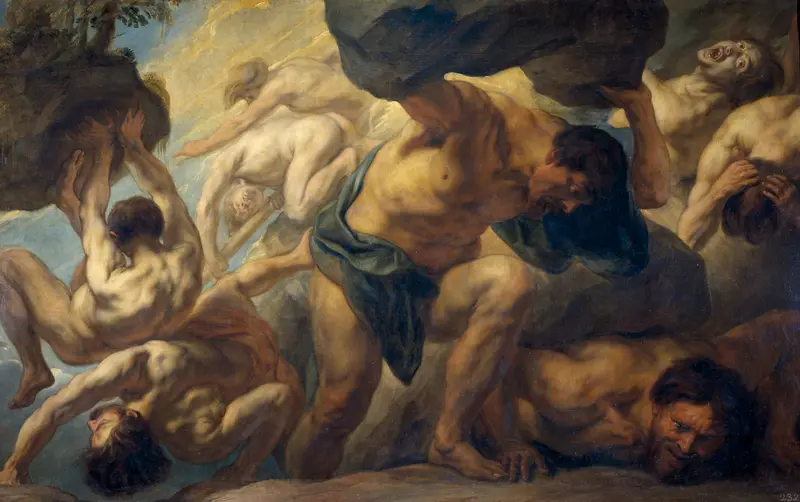
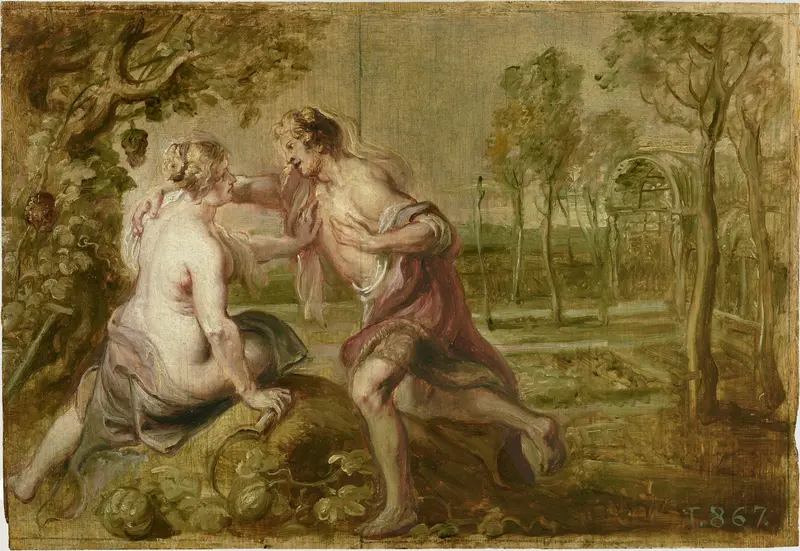
- Peter Paul RubensRubens described his Prometheus Bound, made with Frans Snyders, as "the flower of my stock," according to the Philadelphia Museum of Art.
- William-Adolphe BouguereauBouguereau's Nymphs and Satyr, exhibited at the 1873 Salon, hung for almost twenty years in the bar of New York's Hoffman House Hotel.
- John William WaterhouseWaterhouse signed and dated Echo and Narcissus in 1903, and the Walker Art Gallery bought it from the Liverpool Autumn Exhibition that year.
List of famous Greek mythology paintings and their artists
The 25 most famous Greek mythology paintings: who painted them, which myth they show, when, and where each one is today.
Show the list of 25 Greek mythology paintingsHide the list
| # | Painting | Myth | Painted by | Year | Medium | Size | Located in | City |
|---|---|---|---|---|---|---|---|---|
| 1 | The Birth of Venus | Venus (Aphrodite) | Sandro Botticelli | c. 1485 | Tempera on canvas | 172.5 × 278.5 cm (67.9 × 109.6 in) | Uffizi Gallery | Florence |
| 2 | Primavera | Venus, Flora and the Graces | Sandro Botticelli | c. 1480 | Tempera on poplar panel | 207 × 319 cm (81.5 × 125.6 in) | Uffizi Gallery | Florence |
| 3 | Venus of Urbino | Venus (Aphrodite) | Titian | 1538 | Oil on canvas | 119 × 165 cm (46.9 × 65 in) | Uffizi Gallery | Florence |
| 4 | Saturn Devouring His Son | Saturn (Cronus) | Francisco Goya | 1820–1823 | Mural transferred to canvas | 143.5 × 81.4 cm (56.5 × 32 in) | Museo del Prado | Madrid |
| 5 | Sleeping Venus | Venus (Aphrodite) | Giorgione and Titian | c. 1508–1510 | Oil on canvas | 108.5 × 175 cm (42.7 × 68.9 in) | Gemäldegalerie Alte Meister | Dresden |
| 6 | The Birth of Venus | Venus (Aphrodite) | William-Adolphe Bouguereau | 1879 | Oil on canvas | 300 × 215 cm (118.1 × 84.6 in) | Musée d'Orsay | Paris |
| 7 | The Rokeby Venus | Venus (Aphrodite) and Cupid | Diego Velázquez | 1647–1651 | Oil on canvas | 122.5 × 177 cm (48.2 × 69.7 in) | National Gallery | London |
| 8 | The Spinners (The Fable of Arachne) | Pallas (Athena) and Arachne | Diego Velázquez | 1655–1660 | Oil on canvas | 220 × 289 cm (86.6 × 113.8 in) | Museo del Prado | Madrid |
| 9 | Medusa | Medusa | Caravaggio | 1595–1598 | Oil on canvas on a wooden shield | 60 × 55 cm (23.6 × 21.7 in) | Uffizi Gallery | Florence |
| 10 | Amor Vincit Omnia | Cupid (Eros) | Caravaggio | 1601–1602 | Oil on canvas | 156.5 × 113.3 cm (61.6 × 44.6 in) | Gemäldegalerie | Berlin |
| 11 | Danaë | Danaë and Zeus | Rembrandt | 1636 | Oil on canvas | 185 × 202.5 cm (72.8 × 79.7 in) | Hermitage Museum | St. Petersburg |
| 12 | Landscape with the Fall of Icarus | Icarus | Pieter Bruegel the Elder (attributed) | Oil on canvas | 73.5 × 112 cm (28.9 × 44.1 in) | Royal Museums of Fine Arts of Belgium | Brussels | |
| 13 | The Three Graces | The Three Graces | Raphael | c. 1504–1505 | Oil on poplar panel | 17 × 17 cm (6.7 × 6.7 in) | Musée Condé | Chantilly |
| 14 | Venus, Cupid, Folly and Time | Venus (Aphrodite) and Cupid | Agnolo Bronzino | c. 1545 | Oil on panel | 146.1 × 116.2 cm (57.5 × 45.7 in) | National Gallery | London |
| 15 | Danaë | Danaë and Zeus | Gustav Klimt | 1907–1908 | Oil on canvas | 77 × 83 cm (30.3 × 32.7 in) | Private collection | |
| 16 | Flora | Flora | Titian | c. 1517 | Oil on canvas | 79.7 × 63.5 cm (31.4 × 25 in) | Uffizi Gallery | Florence |
| 17 | Nymphs and Satyr | Nymphs and a satyr | William-Adolphe Bouguereau | 1873 | Oil on canvas | 260.4 × 182.9 cm (102.5 × 72 in) | Clark Art Institute | Williamstown, Massachusetts |
| 18 | Hylas and the Nymphs | Hylas and the nymphs | John William Waterhouse | 1896 | Oil on canvas | 98.2 × 163.3 cm (38.7 × 64.3 in) | Manchester Art Gallery | Manchester |
| 19 | The Birth of Venus | Venus (Aphrodite) | Alexandre Cabanel | 1863 | Oil on canvas | 130 × 225 cm (51.2 × 88.6 in) | Musée d'Orsay | Paris |
| 20 | The Feast of the Gods | The gods at a feast, from Ovid's Fasti | Giovanni Bellini and Titian | 1514/1529 | Oil on canvas | 170.2 × 188 cm (67 × 74 in) | National Gallery of Art | Washington, DC |
| 21 | The Rape of the Daughters of Leucippus | Castor and Pollux | Peter Paul Rubens | c. 1618 | Oil on canvas | 224 × 210.5 cm (88.2 × 82.9 in) | Alte Pinakothek | Munich |
| 22 | Jupiter and Io | Jupiter (Zeus) and Io | Correggio | c. 1530 | Oil on canvas | 162 × 73.5 cm (63.8 × 28.9 in) | Kunsthistorisches Museum | Vienna |
| 23 | Echo and Narcissus | Echo and Narcissus | John William Waterhouse | 1903 | Oil on canvas | 109 × 189 cm (42.9 × 74.4 in) | Walker Art Gallery | Liverpool |
| 24 | Diana and Her Nymphs | Diana (Artemis) | Johannes Vermeer | c. 1653–1654 | Oil on canvas | 97.8 × 104.6 cm (38.5 × 41.2 in) | Mauritshuis | The Hague |
| 25 | Diana Leaving Her Bath | Diana (Artemis) | François Boucher | 1742 | Oil on canvas | 57 × 73 cm (22.4 × 28.7 in) | Musée du Louvre | Paris |
Greek mythology paintings: questions and answers
What is the most famous Greek mythology painting?
There is no official ranking, but three paintings have strong claims. Botticelli's The Birth of Venus (about 1485) hangs in the Uffizi, Florence, was probably a Medici commission, and was already described by Vasari in 1550. The Uffizi calls Titian's Venus of Urbino one of his most famous works. Velázquez's Rokeby Venus, in London's National Gallery since 1906, has inspired novels, films, documentaries and installations.
Sources: Uffizi Galleries, Birth of Venus · Uffizi Galleries, Venus of Urbino · National Gallery, London, The Toilet of Venus (The Rokeby Venus)
What is the famous painting of Medusa?
The best-known painting of Medusa is Caravaggio's Medusa in the Uffizi, Florence, painted in the 1590s on canvas applied to a wooden shield. The Uffizi says Cardinal Francesco Maria del Monte commissioned it as a gift for Grand Duke Ferdinando I de' Medici. Rubens's Head of Medusa (1617/18) at the Kunsthistorisches Museum in Vienna is another famous version; the museum attributes its animals to Frans Snyders.
Sources: Uffizi Galleries, video page for Caravaggio's Medusa · Uffizi Gallery via Google Arts & Culture, Medusa · Kunsthistorisches Museum Vienna, The Head of Medusa
What is the famous painting of Icarus?
The best-known painting of Icarus is Landscape with the Fall of Icarus in the Royal Museums of Fine Arts of Belgium, Brussels. The museum lists it as Bruegel with a question mark: the design is his, but researchers reported in 2011 that the canvas dates from 1600, after his death in 1569, and suspected a copy of a lost original. Herbert Draper's The Lament for Icarus (exhibited 1898) is at Tate Britain.
Sources: Royal Museums of Fine Arts of Belgium, collection record (inv. 4030) · Royal Museums of Fine Arts of Belgium via Google Arts & Culture · CODART, report on the KIK-IRPA findings (8 Nov 2011) · Tate Britain, display Art for the Crowd, gallery label for The Lament for Icarus
What is the famous painting of Narcissus?
The best-known painting of Narcissus is the Narciso at Palazzo Barberini in Rome, dated 1597–1598 and long linked to Caravaggio. The museum's 2019 press kit labels it "Caravaggio (?)", calls it highly controversial, and names Giovanni Antonio Galli, called Spadarino, as the most credited alternative. Another famous version is John William Waterhouse's Echo and Narcissus (1903), bought by Liverpool's Walker Art Gallery from the Liverpool Autumn Exhibition that year.
Sources: Gallerie Nazionali Barberini Corsini, press kit (Dec 2019) on the Palazzo Barberini display · Finestre sull'Arte, Caravaggio or Spadarino? The Narcissus at Palazzo Barberini (secondary source) · National Museums Liverpool (Walker Art Gallery), Echo and Narcissus, WAG 2967
What is the famous painting of Prometheus?
The best-known painting of Prometheus is Rubens's Prometheus Bound, begun around 1611–1612 and completed by 1618. It is in the Philadelphia Museum of Art, whose press office says Rubens himself called it "the flower of my stock." The animal and still-life painter Frans Snyders contributed the eagle whose beak tears open the Titan's torso, the punishment Zeus ordered in the myth.
Sources: Philadelphia Museum of Art, collection record, Prometheus Bound (W1950-3-1) · Philadelphia Museum of Art, Collection Highlight: Prometheus Bound · Philadelphia Museum of Art press office, The Wrath of the Gods
Are Greek mythology paintings in the public domain, and can I download them for free?
Yes, for works this old. Cornell University Library's U.S. chart lists works published before 1931 as public domain, and the Copyright Office's Compendium says a mere copy of another work is not copyrightable. In the EU, once copyright in a visual artwork has expired, Article 14 of Directive 2019/790 gives its reproductions no new copyright unless they are original creations. Every work on this page is public domain and its standard download is free for any use, including commercial.
Sources: Cornell University Library, Copyright Term and the Public Domain (chart updated Jan 1, 2026) · U.S. Copyright Office, Compendium (Third), Chapter 300, section 313.4(A) Mere Copies · Directive (EU) 2019/790, Article 14 (text on legislation.gov.uk)
How we chose the most famous Greek mythology paintings
We ranked the paintings by how widely each one is known around the world: the number of languages that have an encyclopedia entry about it, checked in October 2026. The more cultures write about a painting, the higher it ranks.
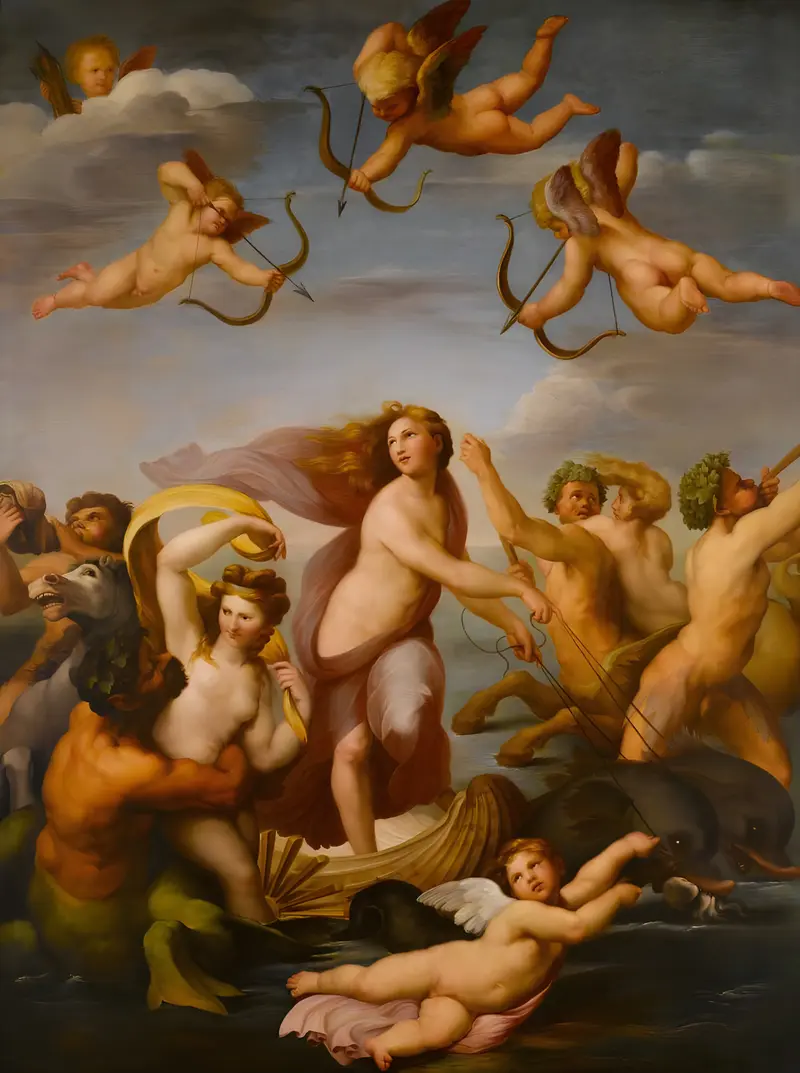
A few rules keep the list useful. Every painting is in the public domain, so you can download and use it freely. No painter has more than two places of their own; Titian also appears in two pictures he finished for other painters, Giorgione's Sleeping Venus and Bellini's The Feast of the Gods. A painting qualifies when it shows a figure or a story from Greek and Roman mythology; lost works known only from copies, such as Leonardo's Leda and the Swan, are left out. We also leave out works we can only show from a copy or a small photograph, such as Raphael's Galatea, a fresco in Rome. Where the museum itself doubts or shares the attribution, as with the Fall of Icarus in Brussels and the Sleeping Venus in Dresden, we say so.
Dates, sizes and locations come from the museums' own records, and each entry links to its sources.
Spotted a mistake? Tell us and we will correct it.
Browse all 3,027 Greek mythology paintings
Every one is public domain and free to download, most famous first: mythology paintings by famous artists, from the Renaissance to the 1900s.