
Het oordeel van Salomo — History & Facts
In Monogrammist SAF’s Het oordeel van Salomo, the act of creation becomes a revolution against the transient nature of life and authority. Look to the left at the figures, their faces twisted in anticipation and disbelief, as the young mother clutches her child with fierce devotion. The artist’s meticulous detailing of their expressions contrasts sharply with the commanding presence of King Solomon, who sits at the center, draped in regal robes that shimmer with rich, warm tones. Notice how the light cascades down, illuminating his face while casting deep shadows across the supplicants, emphasizing the gravity of his judgement and the emotional stakes of the scene. As the viewer absorbs the tension in the composition, the juxtaposition of authority and vulnerability emerges.
The two mothers reflect humanity’s primal instincts—the desperation and the pride entangled in love. The background reveals a hint of the court's opulence, suggesting a world steeped in tradition, yet the dynamic in the foreground challenges it, as it questions the moral fiber of leadership and the price of justice. Each brushstroke captures not just physical forms but the weight of ethical dilemmas that resonate far beyond this singular moment. Created between 1530 and 1540, this work emerged during a time of great upheaval in Europe, with the Reformation stirring debates about power and morality.
The artist, whose identity remains somewhat enigmatic, reflects the broader artistic movements of the period that sought to incorporate realism and emotional depth into biblical narratives, allowing viewers to engage with timeless themes of justice and human experience.
More Artworks by Monogrammist SAF
Browse all →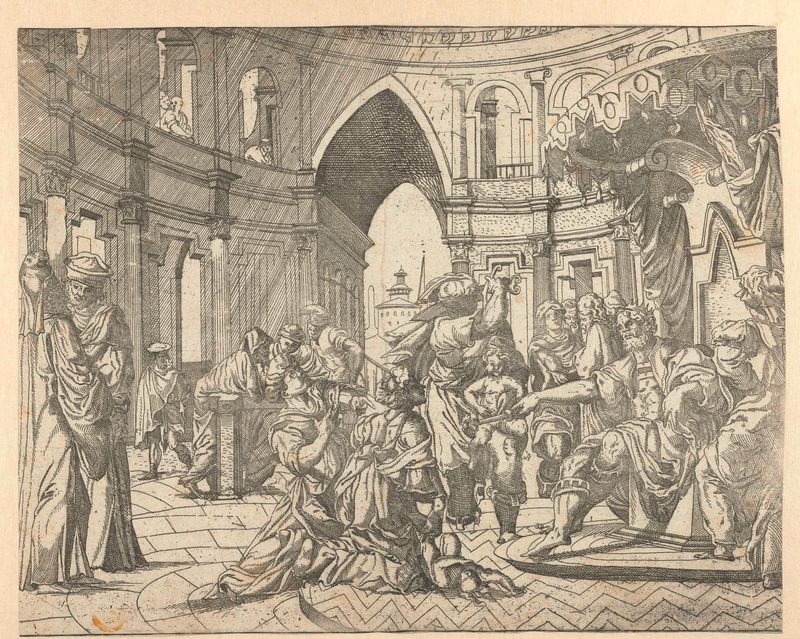
More Religious Art
Browse all →
The Return of the Prodigal Son
Rembrandt van Rijn

The Garden of Earthly Delights
El Bosco

Count Orgaz’ funeral
El Greco

The Hundred Guilder Print: the central piece with Christ preaching, the plate arched
Rembrandt van Rijn

The Descent from the Cross
Rogier van der Weyden

The return of the prodigal son
Rembrandt van Rijn