
Poet Ariwara no Motokata (d. 953), from an illustrated Competition of Poems from Different Periods (Jidai fudō uta-awase) — History & Facts
What if silence could speak through light? In the delicate strokes of this painting, an ethereal whisper of melancholy resonates, as if the passage of time itself has paused to reflect. Look to the left at the figure of the poet, clad in elegant robes that flutter like the leaves of an unseen breeze. Notice how the cool color palette, dominated by soft blues and muted grays, envelops the scene in an atmosphere of introspection. The subtle play of light highlights the contours of the poet's face, drawing attention to his contemplative expression, while the background elements blend harmoniously, creating a serene yet poignant backdrop against which his solitude is magnified. Hidden within the elegant simplicity are layers of emotional depth.
The slight tilt of the poet's head suggests a soft yearning for connection, while the faint hints of nature — the distant mountains and trees — speak to the isolation felt even in a landscape full of life. Here lies the tension between the inner world of thought and the external world of beauty, a poignant reminder of the bittersweet nature of existence. Each brushstroke captures the weight of unspoken words, imbuing the scene with an unshakeable sense of longing. Created during the early 14th century in the Kamakura period, the artist painted this piece amidst a cultural resurgence of classical poetry and refinement in Japan.
As the world of art evolved, so did Tameie’s approach, blending traditional influences with a unique sensitivity, mirroring the complexities of his own time and the collective consciousness of a society grappling with its past.
More Artworks by Fujiwara Tameie
Browse all →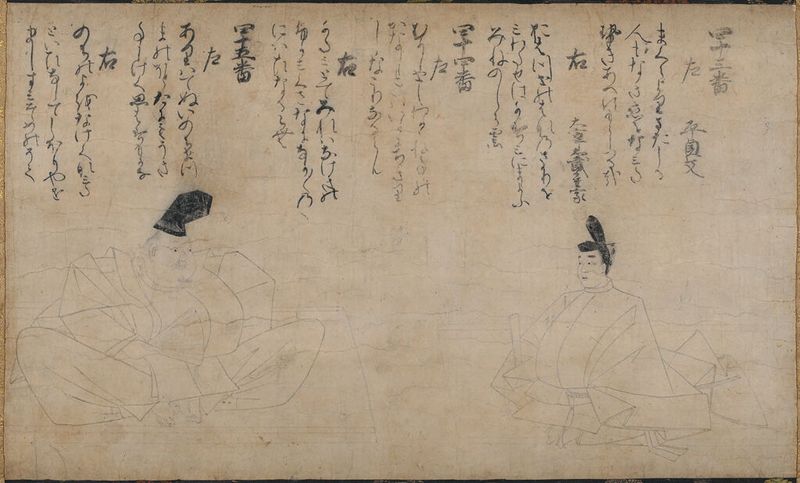
More Portrait Art
Browse all →
Las meninas
Diego Velázquez

Self-portrait with a Bandaged Ear and Pipe
Unidentified artist

Girl with a Pearl Earring
Johannes Vermeer

The Sampling Officials of the Amsterdam Drapers’ Guild, Known as ‘The Syndics’
Rembrandt van Rijn

The Hundred Guilder Print: the man seen on the back in the lower left corner
Rembrandt van Rijn

Portrait of Dr Gachet
Vincent van Gogh