
Saint Jerome in the Wilderness — History & Facts
When did color learn to lie? In a world where hues often veil harsh truths, the palette whispers of loss, beckoning us to confront the depths of solitude. Focus on the rich, somber tones that envelop the figure of Saint Jerome. The muted greens and browns dominate the landscape, framing him in a desolate wilderness. Look closely at the scroll in his hand — a lifeline to knowledge amidst the starkness — while the skull at his feet starkly contrasts the vibrancy of life he seeks.
The light falls softly on his contemplative face, illuminating the deep lines of sorrow etched into his expression, hinting at the weight of his thoughts. Yet, it is in the intricate details where the emotional tension resides. The desolate cliff's edge mirrors Jerome's isolation, while the tiny, distant figures in the background evoke a sense of the world moving on without him. This juxtaposition of a solitary man against a vast, indifferent landscape underscores his internal struggle with faith and mortality.
Each brushstroke captures the silent anguish of a heart burdened by the weight of spiritual pursuits, evoking a bittersweet longing for connection. Created during a time when the Northern Renaissance was flourishing, the artist painted this work amidst the shifts in religious sentiment and a growing fascination with humanism. The exact date remains elusive, yet it is clear that the atmosphere of introspection and existential inquiry informed his vision. In this moment, he sought to encapsulate the profound solitude of the mind grappling with the mysteries of existence, leaving us to ponder the depths of our own loneliness.
More Artworks by Herri met de Bles
Browse all →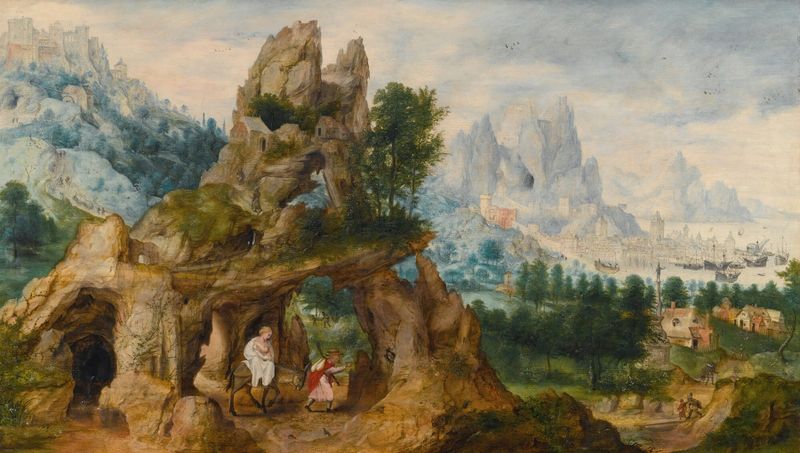

More Religious Art
Browse all →
The Return of the Prodigal Son
Rembrandt van Rijn

The Garden of Earthly Delights
El Bosco

Count Orgaz’ funeral
El Greco

The Hundred Guilder Print: the central piece with Christ preaching, the plate arched
Rembrandt van Rijn

The Descent from the Cross
Rogier van der Weyden

The return of the prodigal son
Rembrandt van Rijn