A Devon River at Low Tide, June 16, 1859 — History & Facts
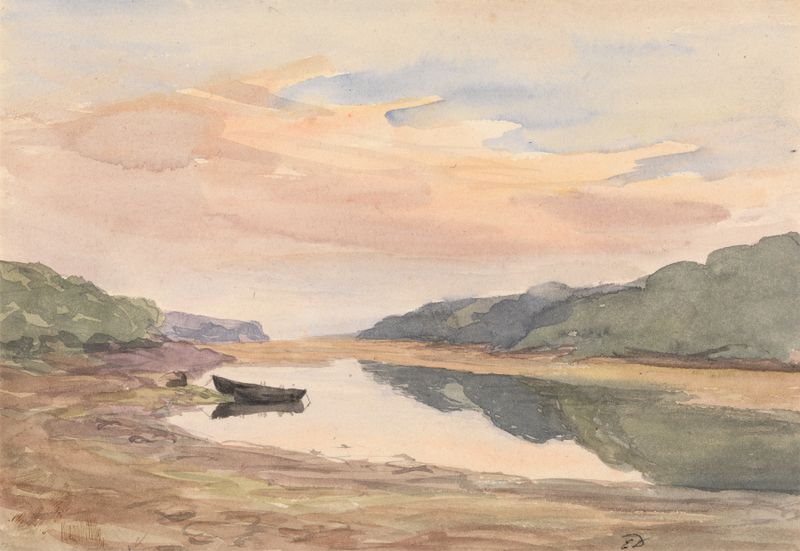
Can beauty exist without sorrow? In Edward Thompson Davis's A Devon River at Low Tide, June 16, 1859, the answer lingers in the stillness of a quiet river landscape, where emptiness holds its own haunting allure. Look closely at the foreground, where the riverbed emerges in muted browns and ochres, revealing a world receding, leaving behind traces of life. Notice how the pale sky, washed with soft blues and whites, reflects the serenity of the water, creating a canvas of tranquility. The artist's delicate brushwork captures the subtle play of light, emphasizing the glistening surfaces of the river, while the distant hills loom gently, providing a sense of both depth and distance. Yet, amidst this serene beauty lies an undercurrent of melancholy.
The low tide exposes the river's bed like an open wound, suggesting a narrative of absence and longing. The sparse vegetation lining the banks speaks to a desolate beauty, evoking the transient nature of life. Here, emptiness becomes a canvas upon which emotions are layered, inviting contemplation of what is left behind as the river withdraws, both physically and metaphorically. Davis painted this work during a time of personal and artistic exploration, capturing the English landscape at a moment when artists were shifting towards a more intimate connection with nature.
In 1859, as he navigated his own life challenges, the emerging Impressionist movement began to influence how landscapes were perceived — not merely as backdrops but as reflections of human experience. Through this lens, A Devon River at Low Tide becomes more than just a moment in time; it encapsulates a profound engagement with the beauty and solitude of the natural world.