
A Gentleman with His Pair of Bays Harnessed to a Curricle — History & Facts
Could beauty survive in a century of chaos? In a world where the hustle of modernity threatens the essence of life, the quiet grace of a gentleman and his horses stands as a powerful testament to stillness amidst turbulence. Look to the center of the composition, where the gentleman, poised and dignified, takes command of his pair of bays. His attire, meticulously detailed, reflects the artistry of fabric and tailoring, while the reflective sheen of the horses’ coats captures the light, enhancing their muscular forms. Notice how the gentle curve of the curricle frames this serene tableau, inviting the eye to wander along the smooth lines that lead further into the background, where hints of foliage suggest a world just beyond the canvas. Within this tranquil moment lies a contrast: the elegance of the gentleman’s calm demeanor juxtaposed against the unyielding energy of the horses, embodying both harmony and power.
The subtle interplay of shadows and light imbues the scene with a sense of depth, inviting the viewer to ponder the unity of man and nature. This delicate balance, captured through meticulous brushwork, conveys a fleeting tranquility that feels almost sacred. During the period when this painting was created, the artist worked amid a rapidly changing society marked by industrial growth and political unrest. Specific details of A Gentleman with His Pair of Bays Harnessed to a Curricle remain unclear, but it reflects a time when art often sought to distill beauty and elegance in stark contrast to the upheaval of the age.
Cordrey's work mirrors a longing for stability in an era that often felt chaotic and uncertain.
More Artworks by John Cordrey
Browse all →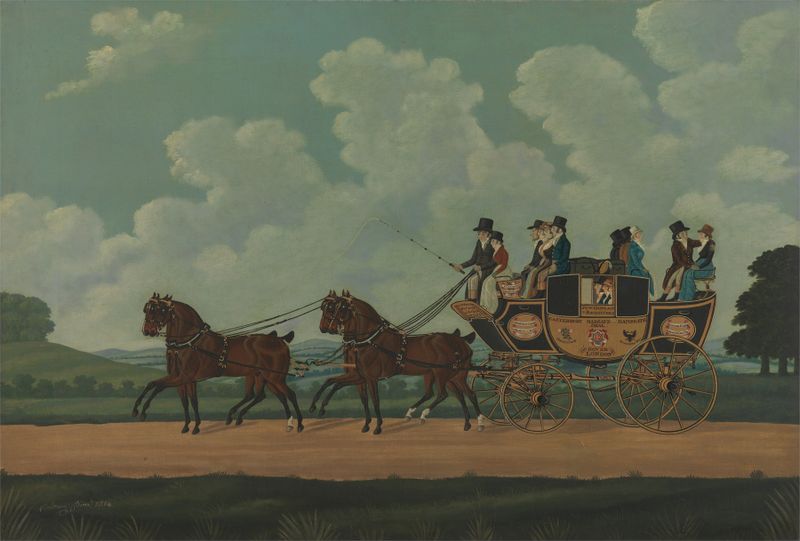
More Portrait Art
Browse all →
Las meninas
Diego Velázquez

Self-portrait with a Bandaged Ear and Pipe
Unidentified artist

Girl with a Pearl Earring
Johannes Vermeer

The Sampling Officials of the Amsterdam Drapers’ Guild, Known as ‘The Syndics’
Rembrandt van Rijn

The Hundred Guilder Print: the man seen on the back in the lower left corner
Rembrandt van Rijn

Portrait of Dr Gachet
Vincent van Gogh