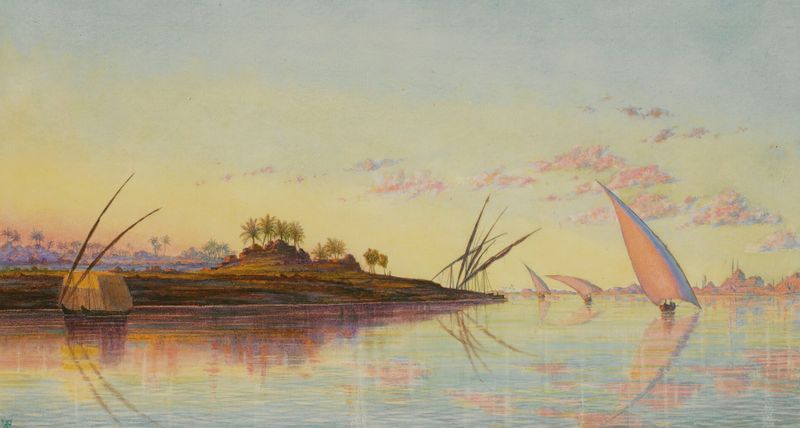
A Halted Caravan on the Borders of the Egyptian Desert — History & Facts
What if beauty was never meant to be finished? In the stillness of a moment caught between the earth and the vast sky, the illusion of time suspends itself, inviting contemplation. Focus your attention on the center of the canvas, where the caravan pauses, its figures draped in vibrant robes that contrast against the soft, sandy tones of the desert landscape. Notice how the sunlight bathes the scene, illuminating the intricate details of the carts and the textures of the men’s garments, which seem to ripple like the distant heat waves. The composition invites your eyes to wander, guided by the subtle curvature of the horizon and the gentle slope of the dunes, creating a sense of both movement and stasis. Hidden within the golden hues and delicate shadows lies a tension between anticipation and uncertainty.
The halted caravan suggests a journey interrupted, each figure lost in their thoughts, perhaps reflecting on the vastness of their surroundings. The blending of colors evokes the desert's ephemeral beauty, while the expansive sky hints at limitless possibilities, leaving viewers to question what lies beyond this moment in time. In 1856, Thomas Seddon painted this work during a period when he was deeply engaged with Orientalism, drawing inspiration from his travels in North Africa. This was a time of heightened fascination for Western artists with Eastern subjects, where Seddon's experiences informed his artistic vision, merging realism with the romantic allure of distant lands.