A View Of Venice With The Doge’s Palace, Saint Mark’s Campanile And Santa Maria Della Salute — History & Facts
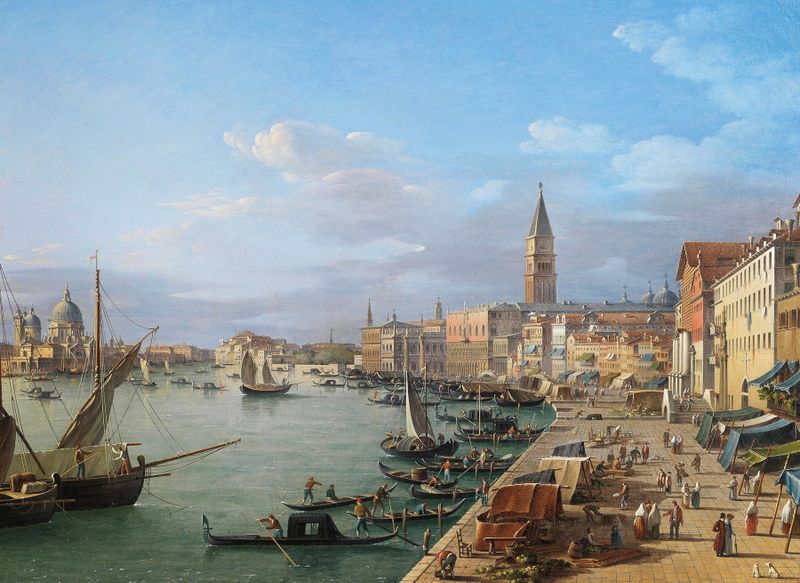
Can paint confess what words never could? In A View of Venice With The Doge’s Palace, Saint Mark’s Campanile And Santa Maria Della Salute, the artist captures both the beauty and the underlying tensions of a city steeped in history, revealing a narrative of violence beneath the surface of tranquil waters. Focus first on the intricate details of the Doge’s Palace, where the light bounces softly off the white stone façade, inviting your gaze. The symmetry of the architecture offers a sense of stability, yet the distant clouds hint at an approaching storm, creating an unsettling contrast. Move your eyes to the bustling activity along the canal, where gondolas drift lazily, yet there’s an underlying urgency in the figures that inhabit this scene — their gestures revealing more than mere leisure. As you delve deeper, notice how the vibrant blues of the water seem to clash with the darker undertones of the buildings, a reflection of Venice’s complex relationship with power and decay.
The juxtaposition of the serene facade of Santa Maria Della Salute and the looming shadows cast by the Campanile invites contemplation on the dual nature of beauty: it can inspire awe while masking the violence of its own history. Each stroke of the brush whispers secrets of a city that once thrived on trade and conflict. In 1821, Roberti painted this piece during a time of transformation in Venice, as the city was grappling with the repercussions of Napoleonic rule and the rise of nationalism. The art world was shifting, moving from the grand narratives of the past to a focus on personal expression and national identity.
Amidst this flux, Roberti sought to capture the essence of his beloved Venice — a city that was both a jewel of history and a battleground of political strife.