Bach im Herbstwald — History & Facts
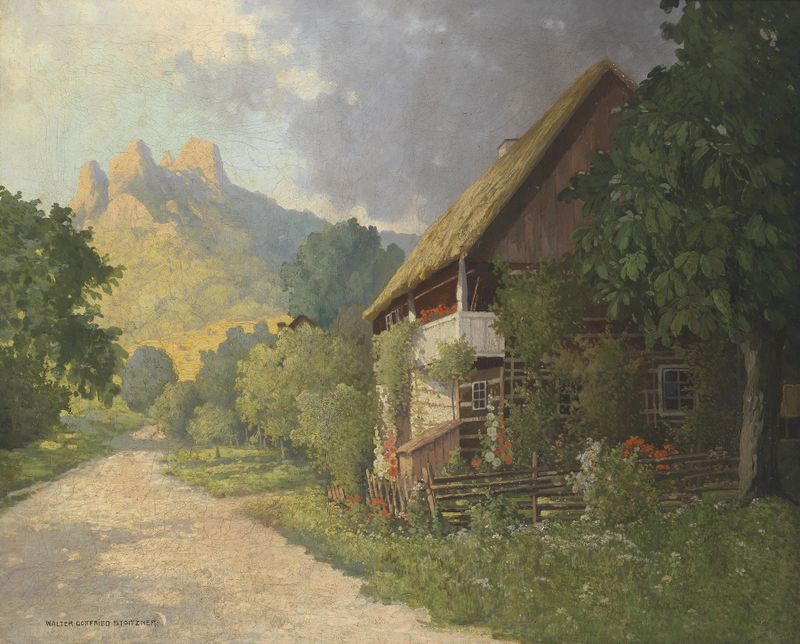
Did the painter know this moment would outlive them? In Bach im Herbstwald, a vivid interplay of colors invites viewers into a world suspended in time, encapsulating the fleeting beauty of nature's transition. Focus first on the center of the canvas, where a stream meanders through the dense autumn foliage. The colors burst forth in an explosion of amber, crimson, and gold, creating a warm embrace that contrasts with the cool blues and greens of the water. Notice how the artist employs delicate brushwork to capture the ripples in the stream, reflecting the surrounding hues while the sunlight filters through the branches overhead, creating tranquil dapples on the surface. The emotional tension lies in this juxtaposition of the serene landscape against the inevitable passage of time.
The luminous foliage hints at both vitality and decay, while the winding stream symbolizes the continuity of life, flowing steadily despite the changing seasons. Small details, such as a fallen leaf drifting on the water, remind us of nature's cycles—a poignant reflection on both beauty and impermanence. Walter Stoitzner painted this work during a period when autumn represented not just a season but a profound metaphor for transition. The exact date remains unknown, yet the context of the post-war era, with its quest for renewal and beauty in the aftermath of devastation, likely influenced his palette and theme.
In this painting, Stoitzner captures a moment that resonates beyond his lifetime, inviting us to appreciate the richness of color and the depth of meaning in even the simplest scenes.