Barn and Tree — History & Facts
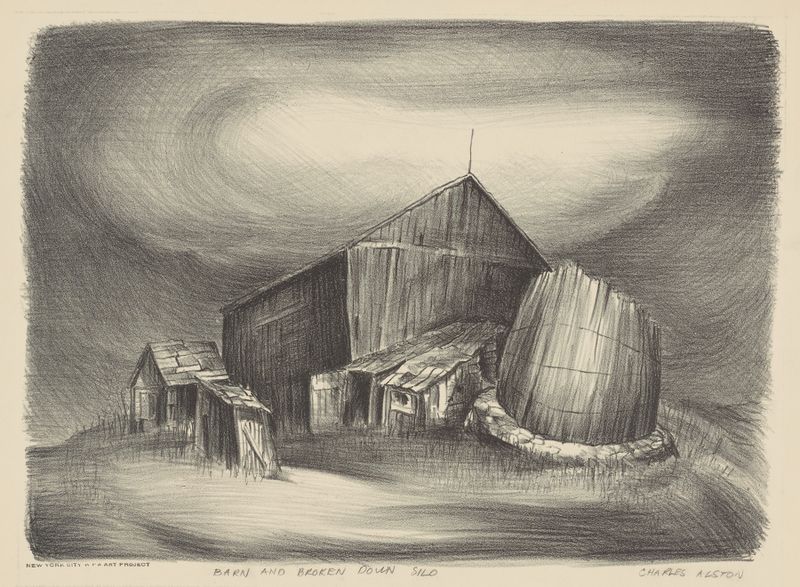
Can beauty exist without sorrow? In Charles Henry Alston's Barn and Tree, this question reverberates through the vibrant strokes of paint that seem alive with emotion and history. Look to the center of the canvas, where the barn stands stout against a backdrop of deep greens and earthy browns. The rich texture of the wood evokes a sense of labor and tradition, while the towering tree beside it wraps around the scene like an old friend—the gnarled branches reaching out in a protective embrace. Notice how the dappled light filters through the leaves, casting a mosaic of shadows that dance across the barn’s face, suggesting a moment frozen in time yet pulsating with life. Yet, beneath this serene exterior lies a tension that speaks to the era in which it was created.
The juxtaposition of the sturdy barn and the fragile tree hints at resilience amid change, a reflection on the ongoing struggles of communities during a time of social upheaval. The vibrant color palette, though warm, carries an undertone of unrest, suggesting that beauty often emerges from the shadows of hardship. Each brushstroke becomes a testament to both the hope and the sorrow that coexist in rural life. In 1940, Alston was deeply engaged with the Harlem Renaissance, capturing the pulse of Black American life through his art.
He painted Barn and Tree during a period of personal and societal upheaval, as the nation grappled with the looming specter of World War II and the ongoing fight for civil rights at home. His work, characterized by a blend of modernism and African American cultural influences, served as a silent yet powerful revolution—one that paved the way for future generations of artists.