Bergige Landschaft mit Reisenden — History & Facts
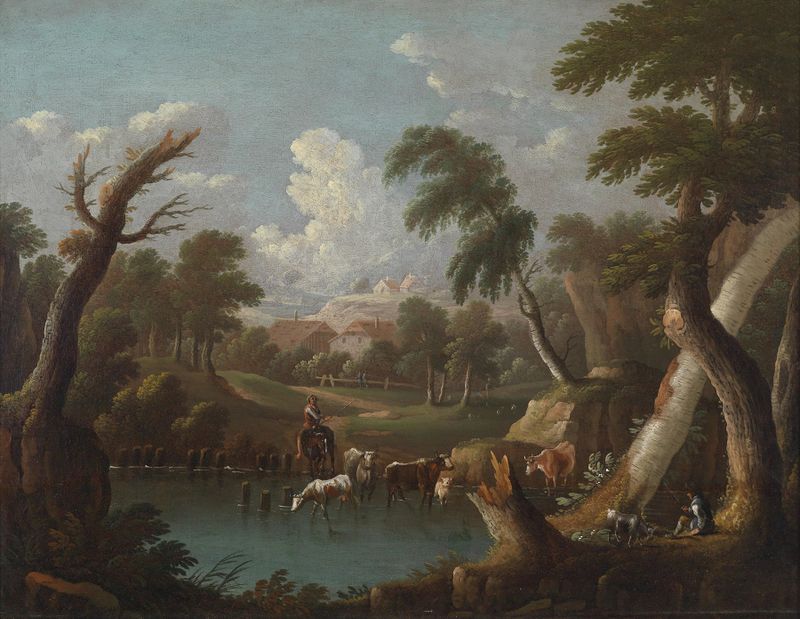
When did color learn to lie? The nuance of hues and shades can sometimes mask fragility, revealing the delicate balance between reality and illusion. Focus on the sweeping landscape that unfolds before us; notice how the vibrant greens of the hills roll gently into the distance, encased by a sky that dances between azure and soft gray. To the left, look closely at the figures traversing the path; their smallness in relation to the expansive backdrop emphasizes not just their journey, but also an emotional solitude. The brushwork evokes a sense of movement, while the interplay of light and shadow creates a pulsating rhythm that draws the viewer deeper into the scene. Yet, amidst this picturesque beauty lies a poignant tension.
The travelers, seemingly lost in their quest, embody a transient fragility against the grandeur of nature that looms above them. The contrasting light envelops them like a warm embrace, hinting at both safety and vulnerability, as if they are mere whispers in the vast landscape. Each brushstroke reveals a fleeting moment, urging us to contemplate the precariousness of their existence amid the unyielding forces of nature. In 1703, Johann Georg von Bemmel created this landscape during a time when Europe was entranced by the Baroque aesthetic, a period marked by dramatic expressions of light and color.
Living in the Netherlands, he was part of a vibrant artistic community that explored the intricacies of natural scenes. His work reflects a deep appreciation for the interplay of light and landscape, capturing a moment that speaks to the timeless human experience of seeking connection in a world that can often feel overwhelming.