
Blick auf das Grabmal des Grafen Ludwig von Löwenstein-Wertheim und seiner Frau Anna in der Stiftskirche St. Marien in Wertheim — History & Facts
In every brushstroke lies a testament to the eternal hope found within the confines of memory and legacy. Look to the center, where the intricately detailed tomb of Graf Ludwig von Löwenstein-Wertheim and his wife Anna dominates the composition. The marble gleams with a luminous quality, reflecting soft light that seems to cradle the figures resting above it. Surrounding this centerpiece, the muted earth tones of the church interior whisper of solemnity, enhancing the grandeur of the monument while inviting contemplation.
Notice how the artist skillfully balances light and shadow, drawing the eye to the entwined hands of the effigies, a poignant symbol of their enduring union. At first glance, the tomb conveys a sense of finality, yet deeper inspection reveals layers of emotional resonance. The intricate carvings tell stories of love, loss, and the aspiration for immortality. The juxtaposition of the serene expressions of the figures against the somber, cold stone evokes a delicate tension between life and death, suggesting that hope, like memory, persists beyond the grave.
Each detail serves to remind us that while the physical body may be laid to rest, the bonds of affection remain unbroken. In 1861, Alexander Gwinner captured this moment in the Stiftskirche St. Marien in Wertheim, a site thick with historical resonance. During this period, the artist was deeply engaged with the themes of Romanticism, reflecting society's yearning for connection to the past amidst the rapid advancements of the modern world.
This painting not only showcases his technical prowess but also serves as an artifact of a time grappling with its own legacy, intertwining art and history in a profound dialogue.
More Artworks by Alexander Gwinner
Browse all →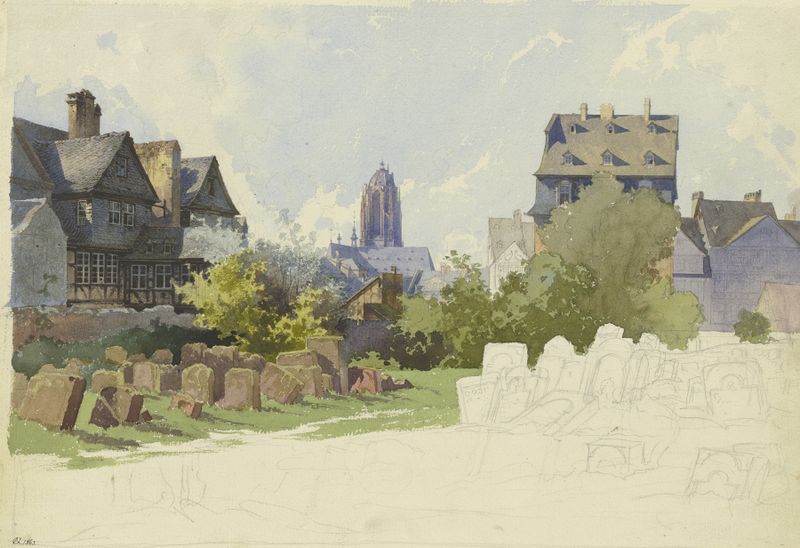
More Architecture Art
Browse all →
The statue of Liberty
Frédéric Auguste Bartholdi

View of Houses in Delft, Known as ‘The Little Street’
Johannes Vermeer

View of Houses in Delft, Known as ‘The Little Street’
Johannes Vermeer

The Cathedral in Rouen. The portal, Grey Weather
Claude Monet

The yellow house
Vincent van Gogh

The Church in Auvers-sur-Oise, View from the Chevet
Vincent van Gogh