Canandaigua, New York — History & Facts
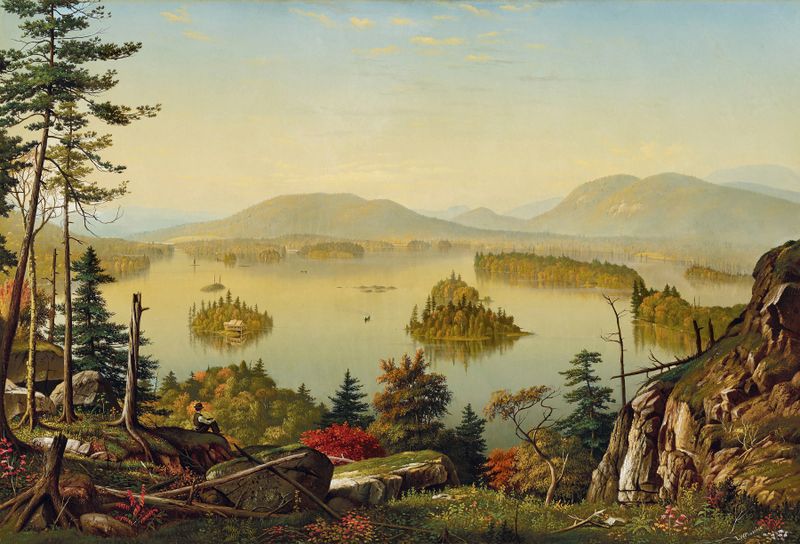
What secret hides in the quiet of the canvas? In Canandaigua, New York, the delicate interplay of light and landscape evokes a sense of fragility, inviting the viewer to explore the serene depths of the scene. Look to the foreground where soft greens and muted earth tones blend seamlessly, creating a tranquil meadow that stretches toward the horizon. Notice how the dappled sunlight filters through the leaves, casting gentle patterns on the ground, while the distant lake shimmers like an expanse of glass. The sky, painted in pastel blues and whites, frames the composition, drawing the eye upward and inviting an expansive sense of calm.
Prentice’s careful brushwork captures the subtle nuances of nature, revealing a moment poised between stillness and the ephemeral. The emotional tension in the work lies in its balance of serenity and fragility. The calm reflections on the water suggest a perfect harmony, yet the slight ripples hint at the possibility of disturbance. This juxtaposition may reflect the transient beauty of life itself, where stillness is often a prelude to change.
Small details, such as the wispy clouds and the gentle rippling of the lake, serve as reminders that nature is both a sanctuary and a playground of fleeting moments. In 1872, Levi Wells Prentice was immersed in the American landscape movement, seeking to capture the beauty of the natural world. Painting in upstate New York during this period, he was influenced by the growing appreciation for rural scenery and the advent of the Hudson River School's ideals. This piece emerges from a time when artists were eager to reflect on the pastoral beauty and fragility of America, capturing a moment that resonates with the spirit of the age.