Cattle Grazing, With Sefton Church Beyond — History & Facts
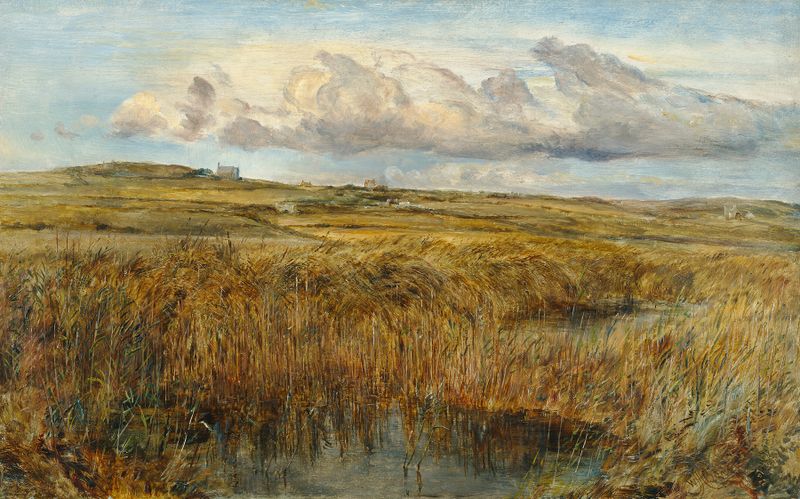
Where does light end, and longing begin? In the quiet expanse of a pastoral landscape, chaos finds its balance, revealing the delicate harmony of nature intertwined with human existence. Look to the left, where a gentle stream flows, its shimmer catching the warm sunlight that filters through the lush green foliage. The grazing cattle dot the foreground, their bodies painted with careful strokes, suggesting both serenity and the unyielding chaos of life—each beast a reminder of the heartbeat of the land. Notice the distant Sefton Church, its steeple reaching skyward, a solitary structure that anchors the scene, creating a stark contrast between the organic and the man-made, between tranquility and the inevitable march of time. The painting captures the tension between freedom and confinement.
The cattle roam, yet their grazing grounds are defined, a reflection of life's unpredictability amidst the constraints of order. The vibrant greens and browns pulsate with energy, while the soft blues of the distant sky evoke an emotional longing for something beyond reach—a yearning for simplicity, even as the complexities of life encroach. The interplay of light and shadow serves to heighten this tension, suggesting a world alive with both beauty and chaos. William Joseph Julius Caesar Bond painted this work in an uncertain time for British art, during the mid-19th century.
He often focused on rural scenes, capturing the essence of country life amidst the industrial changes sweeping across England. This piece reflects not only his personal observations but also a broader commentary on the coexistence of nature and civilization, showcasing a moment in art history where the pastoral ideal was increasingly challenged.