Christ Church Ferry — History & Facts
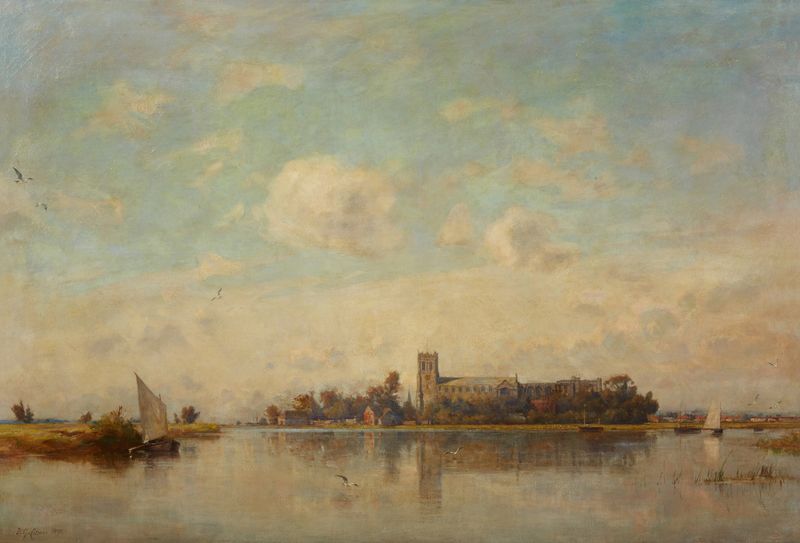
Is this a mirror — or a memory? The scene unfolds with a gentle reverence, as if Cotman’s brush has captured a fleeting moment in time, suspended between reality and reflection. Focus on the serene waters in the foreground where the ferry glides effortlessly, its presence both tranquil and commanding. Notice how the muted hues of blue and green blend harmoniously, creating a dreamlike quality that invites contemplation. The soft brushwork evokes the ripples on the surface, while the distant silhouette of Christ Church stands resolutely against the sky, bathed in a light that feels almost divine. Hidden within this landscape is a tension between movement and stillness; the ferry, a symbol of transition, contrasts dramatically with the steadfastness of the church.
The interplay of light and shadow adds depth, revealing the duality of human experience—between the fleeting nature of existence and the enduring strength of faith. Each stroke seems to echo the awe of the natural world, suggesting a moment of connection between the earthly and the divine that resonates deeply within the viewer. Created in 1859, this piece reflects Cotman’s commitment to capturing the essence of the English landscape amid a period marked by artistic exploration and innovation. Working primarily in Norwich, he drew inspiration from the surrounding beauty while responding to the evolving trends of Romanticism and the burgeoning landscape genre.
His work often sought to convey a sense of nostalgia, inviting viewers to lose themselves in the memory of a place just as much as its visual representation.