
Church Of Madeleine (Geneva) — History & Facts
In the hands of a skilled artist, decay transforms into a poignant reminder of beauty, whispering the stories of time. Look to the left, where soft hues of ochre and muted blues intertwine, guiding your gaze through crumbling columns and eroded facades. Notice how Vallet captures the play of light, filtering through the fragile remnants of this architectural marvel. The delicate brushstrokes evoke an air of reverence, while shadows dance across the textured surfaces, urging the viewer to contemplate the passage of time. Delve deeper into the subtle contrasts within the composition; the decayed grandeur of the church speaks to both loss and resilience.
Lush vegetation encroaches upon stone, symbolizing nature’s quiet reclaiming of what was once revered. This juxtaposition serves as a meditation on transience, evoking emotions that oscillate between nostalgia and acceptance, reminding us that beauty often resides in the aftermath of decay. In 1904, Vallet painted this scene amidst the quiet streets of Geneva, a city steeped in history and evolution. At this point in his career, he was exploring the interplay of light and structure, influenced by the burgeoning movements of Impressionism and Post-Impressionism.
The world was shifting, and so too was the artist’s vision, as he sought to encapsulate the ephemeral nature of existence through his brush, allowing the echoes of the past to resonate within the present.
More Artworks by Edouard Vallet
Browse all →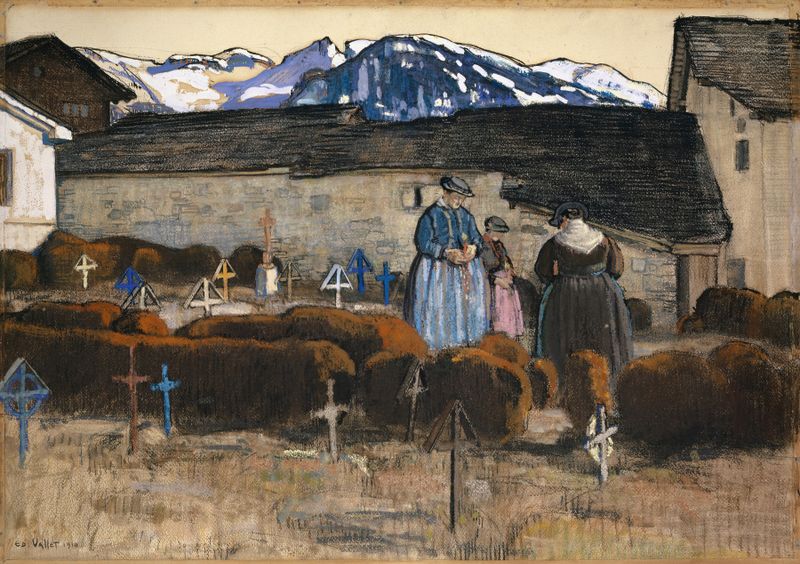
More Architecture Art
Browse all →
The statue of Liberty
Frédéric Auguste Bartholdi

View of Houses in Delft, Known as ‘The Little Street’
Johannes Vermeer

View of Houses in Delft, Known as ‘The Little Street’
Johannes Vermeer

The Cathedral in Rouen. The portal, Grey Weather
Claude Monet

The yellow house
Vincent van Gogh

The Church in Auvers-sur-Oise, View from the Chevet
Vincent van Gogh