
Das Wüstenschloss Qusair ‘Amra — History & Facts
In the quiet stillness of awakening, where the past lingers like a whisper, the essence of life and time converges within a frame. Focus your gaze on the majestic structure at the center, a fortress rising defiantly against a vast desert landscape. The warm hues of ochre and gold envelop the scene, capturing the sun's embrace as it dances across the ancient stones. Notice the intricate details of the architecture, the delicate arches and carved motifs that speak of a rich history, while the stark, endless horizon invites contemplation and vastness. Yet, beneath this serene exterior lies a tension between permanence and impermanence.
The fleeting shadows cast by the setting sun remind us of time’s relentless passage, while the solidity of the fortress evokes strength and resilience. This contrast evokes a sense of both safety and isolation, a reminder of the fragility of human existence amidst the unfathomable expanse of nature. In 1901, Alphons Leopold Mielich created this work during a period of exploration and interest in the Middle East among Western artists. Living in Germany, he was influenced by the Romantic fascination with exotic landscapes and ancient cultures.
This painting not only reflects his personal artistic journey but also resonates with a broader cultural shift as Europe began to engage more deeply with the world beyond its borders.
More Artworks by Alphons Leopold Mielich
Browse all →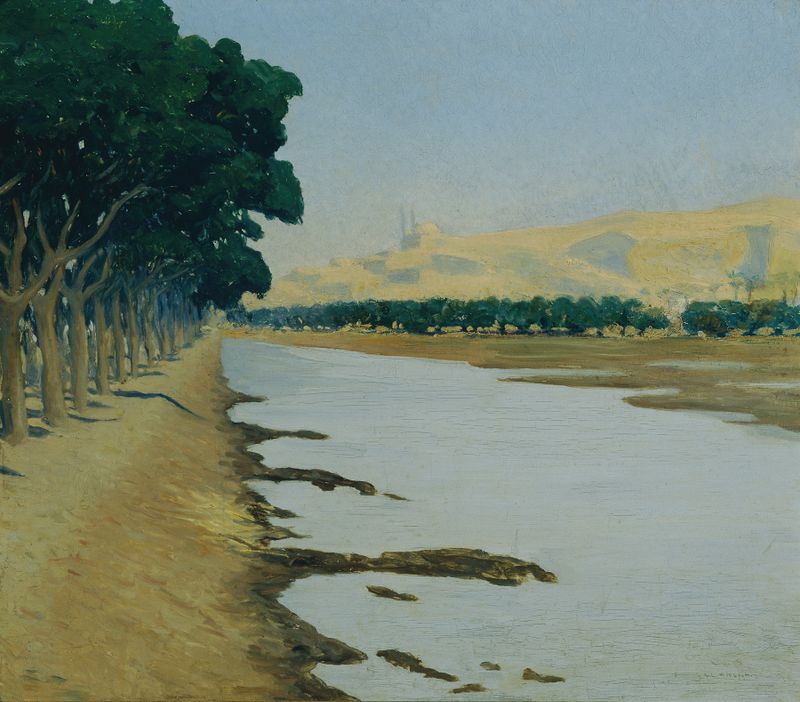
More Architecture Art
Browse all →
The statue of Liberty
Frédéric Auguste Bartholdi

View of Houses in Delft, Known as ‘The Little Street’
Johannes Vermeer

View of Houses in Delft, Known as ‘The Little Street’
Johannes Vermeer

The Cathedral in Rouen. The portal, Grey Weather
Claude Monet

The yellow house
Vincent van Gogh

The Church in Auvers-sur-Oise, View from the Chevet
Vincent van Gogh