Die Mündung des Bosporus (Yoros Kalesi) — History & Facts
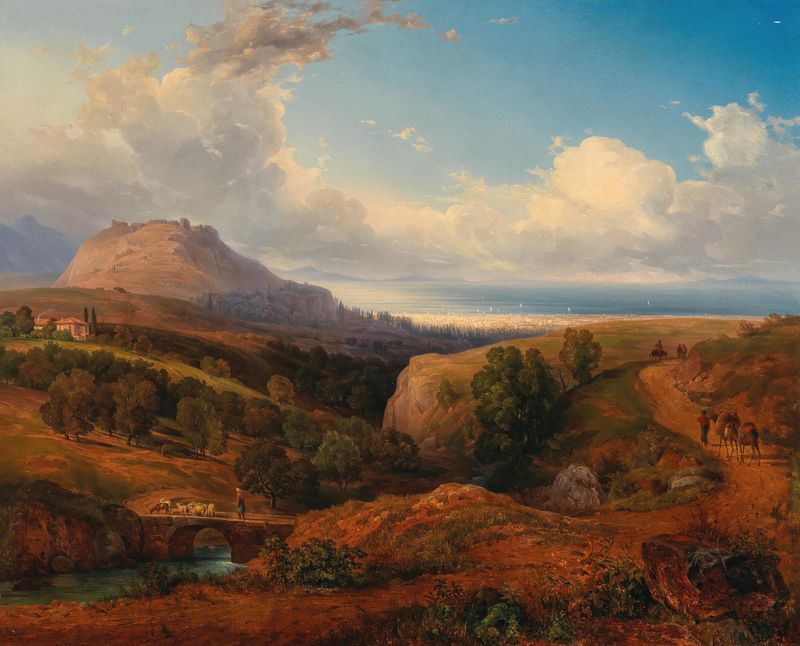
Did the painter know this moment would outlive them? As we gaze upon the vivid hues of this landscape, we are reminded that moments captured on canvas can transcend time, holding within them the essence of history and emotion. Look closely at the sweeping expanse of the Bosporus, where the deep blues and greens of the water dance with the warmth of the golden light. Focus on the horizon, where the soft gradient of the sky blends seamlessly into the landscape, inviting the viewer into a world where land and sea meet in harmonious tranquility. Notice the delicate brushwork that defines the rolling hills and the distant fortress, rendering them with both precision and a sense of ethereal beauty, evoking a dreamlike quality. Beneath the surface of this serene image lies a profound tension between nature and civilization.
The fortress, stoic and resilient, stands sentinel over the strait, a testament to human history amidst the ever-changing waters. The contrasting colors — vibrant greens of nature opposing the muted tones of stone — suggest a dialogue between the organic and the constructed, encapsulating the fragility of existence. Each stroke seems to whisper stories of time gone by, inviting us to reflect on what has been lost and what remains eternal. Emanuel Stöckler painted this work between 1849 and 1850, during a period of significant political and artistic evolution.
Working in the midst of the growing Romantic movement, he turned his gaze to the beautiful yet tumultuous landscapes of Eastern Europe, reflecting a world grappling with change. This piece came at a time when artists were beginning to explore the emotional resonance of color and nature, allowing them to capture not just a scene, but a feeling, a moment frozen in time.