Edlitz an der Aspangbahn — History & Facts
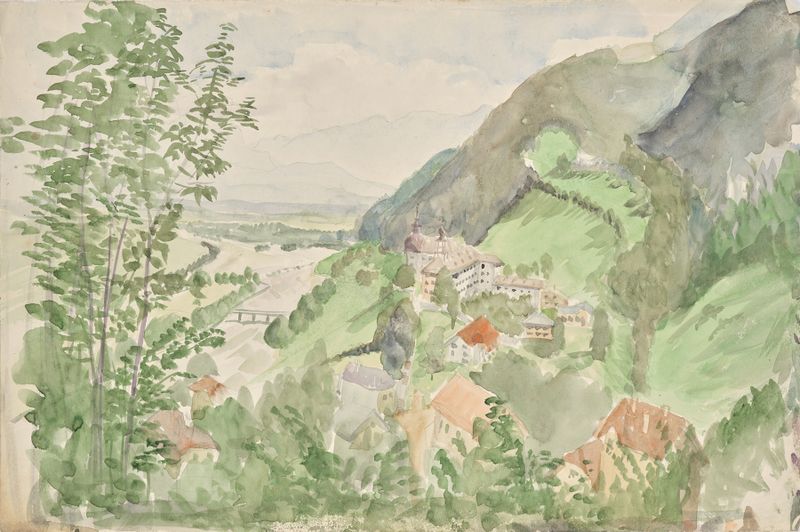
Can beauty exist without sorrow? In the haunting landscape Edlitz an der Aspangbahn, Franz Barwig the Elder invites us to reflect on the fragile interplay of faith and melancholy. Look to the center of the composition, where a solitary figure stands against a serene yet foreboding backdrop of rolling hills and a stark sky. The muted color palette—soft grays and deep greens—evokes a sense of stillness, while the brushwork captures the textured essence of the landscape. Notice how the light gently cascades across the scene, illuminating the figure’s contemplative stance, a poignant contrast to the heavy clouds looming above. In this artwork, the juxtaposition of the figure's quiet faith against the dramatic natural elements suggests a story of resilience amid uncertainty.
The surrounding landscape, both beautiful and ominous, embodies the duality of existence—where moments of peace are often shadowed by deeper sorrows. Each brushstroke serves as a reminder of the strength found in belief, even as nature’s moods shift around us. Barwig created this piece in 1916 during a tumultuous period marked by World War I. Living in Vienna, he encountered a world wrestling with despair and loss.
The art movement at the time leaned towards expressionism, embodying the emotional turmoil of society. In this context, Edlitz an der Aspangbahn stands as a testament to the artist's exploration of inner landscapes, where faith and beauty persist in the face of external chaos.