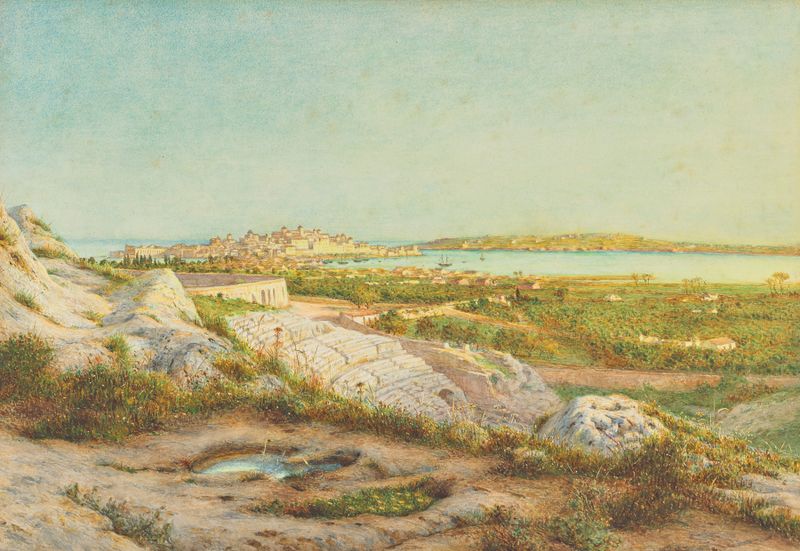
Etna, from the theatre at Taormino — History & Facts
Beneath the serene beauty of a landscape, what fears dwell in the heart of the beholder? Look to the foreground where the rocky cliffs rise dramatically, their jagged edges contrasting with the soft, golden glow of the setting sun. The vibrant hues of orange and violet blend seamlessly into the sky, while the distant silhouette of Mount Etna looms, a silent giant steeped in both majesty and threat. The artist’s brushwork captures the play of light with precision, inviting the viewer to linger on the delicate interplay between shadow and illumination, evoking an atmosphere of both awe and trepidation. In the background, the looming volcano stands as a symbol of nature’s duality: a source of life through its fertile soils, yet capable of violent destruction.
The calmness of the scene belies the latent fear of eruption, a reminder of the uncontrollable forces that shape our existence. The vibrant colors celebrate the landscape’s beauty while simultaneously hinting at an underlying tension, the viewer caught between admiration and apprehension. Henry Wallis painted this landscape during a transformative period in the late 19th century, reflecting both the Romantic fascination with nature and the emerging Symbolist movement. His time in Italy, surrounded by idyllic sceneries, coincided with a growing awareness of the environment’s unpredictable power, echoing the artists’ struggle to find harmony in a world fraught with chaos.
As he captured this moment, Wallis synthesized beauty and fear into a single frame, inviting contemplation on the fragility of existence.